
Frank Weston Benson
(1862–1951)
Artworks by Frank Weston Benson

About Frank Weston Benson
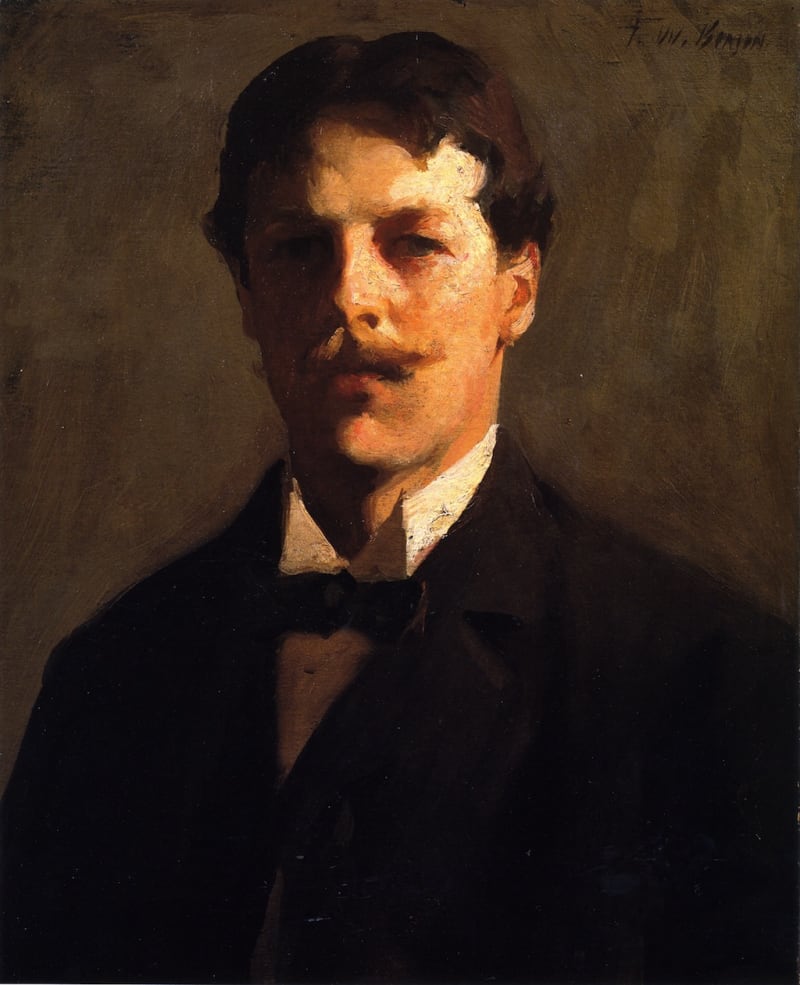
Frank Weston Benson (1862–1951) was a leading American Impressionist painter, printmaker, and teacher, best known for his luminous depictions of domestic life, elegant portraits, and later, dynamic scenes of wildlife. Born in Salem, Massachusetts, into a prosperous family, Benson showed early artistic promise and studied at the School of the Museum of Fine Arts, Boston, under Otto Grundman. In 1883, he traveled to Paris with fellow artist Edmund Tarbell to continue his training at the Académie Julian, where he absorbed the influence of European academic painting and the emerging currents of Impressionism.
Upon returning to Boston, Benson and Tarbell shared a studio and became central figures in the city’s artistic community. Both taught at the Museum School, mentoring a generation of artists associated with what became known as the “Boston School.” Their work reflected the refined social world of Boston’s elite, often portraying women in serene, light-filled interiors or outdoor settings. Benson’s paintings from roughly 1895 to 1910 represent his most impressionistic period, characterized by fluid brushwork and radiant natural light, particularly in his well-known images of his daughters posed in sunlit gardens and coastal landscapes.
In 1897, Benson joined Tarbell and others in founding The Ten American Painters, a group formed in response to the conservatism of established exhibition venues. The group sought greater artistic freedom and a more intimate setting for exhibiting work influenced by Impressionism.
After about 1915, Benson turned increasingly to printmaking, producing masterful etchings of birds and sporting scenes inspired by his lifelong passion for the outdoors. These works, often influenced by Japanese composition, reveal a shift toward bolder design and asymmetry.
Over a long and distinguished career, Benson balanced roles as artist and educator, leaving a lasting impact on American art through both his refined Impressionist vision and his later contributions to printmaking.