
John McCracken
(1934–2011)
Artworks by John McCracken

About John McCracken
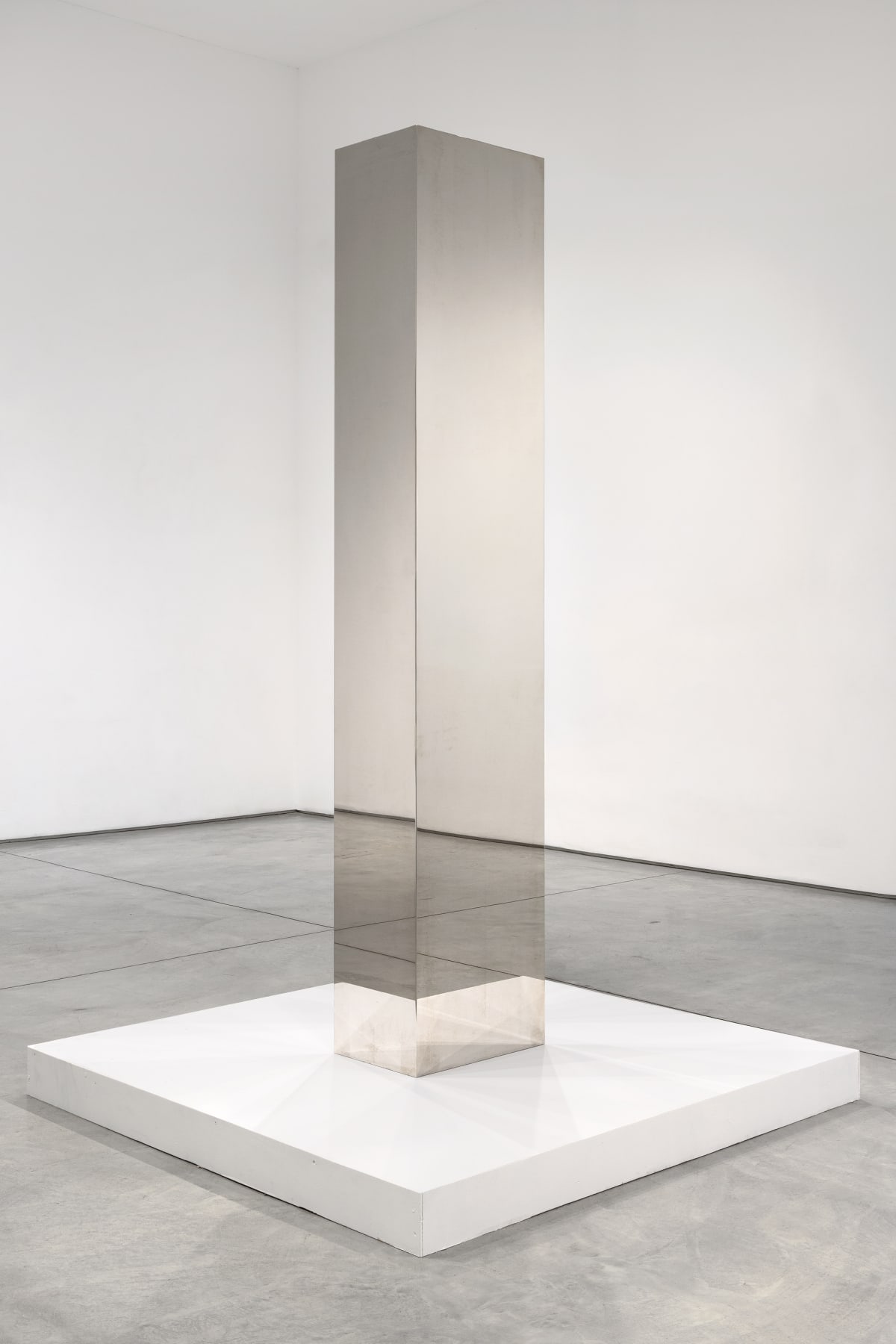
John McCracken (1934–2011) was born in Berkeley, California, and studied at the California College of Arts and Crafts, Oakland (1957–62). After early experiments in Abstract Expressionism and Pop-influenced painting, he developed his signature form by 1966: the plank, a tall, narrow, monochromatic rectangle that leaned against the wall and rested on the floor, simultaneously occupying the space of painting and sculpture. Rooted in the Minimalist tradition of Carl Andre and Donald Judd while reflecting the color field sensibility of Barnett Newman, his planks were finished with lacquer and resin — materials drawn from the surfboard industry of Southern California, where he relocated in 1965. Applied by hand and burnished to a high polish, this luminous surface became the hallmark of his practice. McCracken also produced freestanding sculptures in geometric forms, including pyramids, cubes, and polyhedrons, and late works so reflective they appeared to dissolve into the gallery space.
Underlying his formal concerns was a deeply personal metaphysics: an avid believer in extraterrestrials and time travel, McCracken conceived of his works as a bridge between worlds — the floor representing the physical realm, the wall the space of imagination. His work was the subject of a major retrospective at Castello di Rivoli, Italy (2011), and was featured in landmark Minimalist exhibitions including Primary Structures at the Jewish Museum, New York (1966). He lived in Santa Fe from 1994 until his death in New York on April 8, 2011.