


Artwork Details
The Collection of Edward Chodorov, Beverly Hills, California
The Collection of Miss Fanny Brice, Los Angeles, California
Mary-Anne Martin | Fine Art, New York
Private Collection
Private Collection, by descent

In the mid-1920s, Rufino Tamayo embarked on the crucial development phase as a sophisticated, contemporary colorist. In New York, he encountered the groundbreaking works of Picasso, Braque, and Giorgio de Chirico, along with the enduring impact of Cubism. Exploring painterly and plastic values through subjects sourced from street scenes, popular culture, and the fabric of daily life, his unique approach to color and form began to take shape. It was a pivotal shift toward cosmopolitan aesthetics, setting him apart from the nationalist fervor championed by the politically charged narratives of the Mexican Muralist movement. By focusing on the vitality of popular culture, he captured the essential Mexican identity that prioritized universal artistic values over explicit social and political commentary.
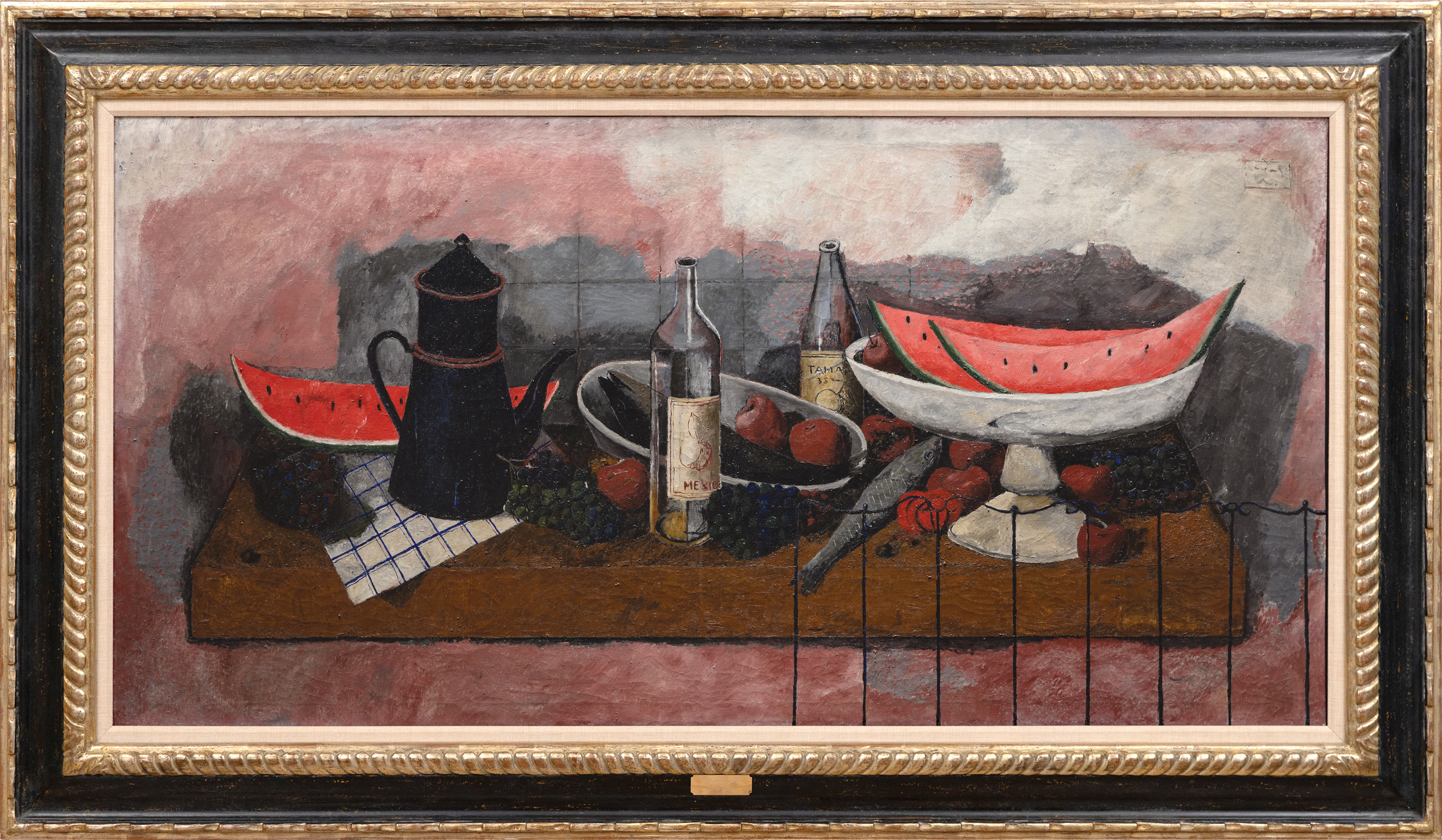
Like Cézanne, Tamayo elevated the still life genre to some of its most beautifully simple expressions. Yet high sophistication underlies the ease with which Tamayo melds vibrant Mexican motifs with the avant-garde influences of the School of Paris. As Naturaleza Muerta of 1935 reveals, Tamayo refused to lapse into the mere decoration that often characterizes the contemporary School of Paris art with which his work draws comparisons. Instead, his arrangement of watermelons, bottles, a coffee pot, and sundry items staged within a sobering, earthbound tonality and indeterminant, shallow space recalls Tamayo's early interest in Surrealism. An overlayed square matrix underscores the contrast between the organic subjects of the painting and the abstract, intellectualized structure imposed upon them, deepening the interpretation of the artist's exploration of visual perception and representation. In this way, the grid serves to navigate between the visible world and the underlying structures that inform our understanding of it, inviting viewers to consider the interplay between reality and abstraction, sensation and analysis.
“Every artist dips his brush in his own soul, and paints his own nature into his pictures.”— Henry Ward Beecher
Learn more about this artwork
Get in touch with us to learn more about Rufino Tamayo's Naturaleza Muerta and a specialist will get in touch with you:

Looking for someone else?
At Heather James we have access to thousands of works, but not all can be shown on our website. If there is a particular artist or artwork you are interested in, please contact us and we will work with you to make your collection complete.