

Alfred Sisley
Le Lavoir de Billancourt, 1879
Preis auf Anfrage

Details zum Werk
Henri Poidatz, Paris
Galerie Georges Petit, Paris, 27. April 1900, Los 79
Georges Petit, erworben bei obiger Auktion
Auktion: Galerie Georges Petit, Paris, 4.–5. März 1921, Los 113
Comte de Lanscay, Paris
Hôtel Drouot, Paris, 6. April 1922, Los 16
Eugène Blot, Paris, erworben bei obiger Auktion
Dr. Arthur Charpentier, Paris
Privatsammlung, Schweiz, erworben um 1950
Privatsammlung, durch Erbschaft von obigem
Privatsammlung, Europa
Sotheby's New York, 6. Mai 2015, Los 250
Privatsammlung, London, erworben bei obiger Auktion

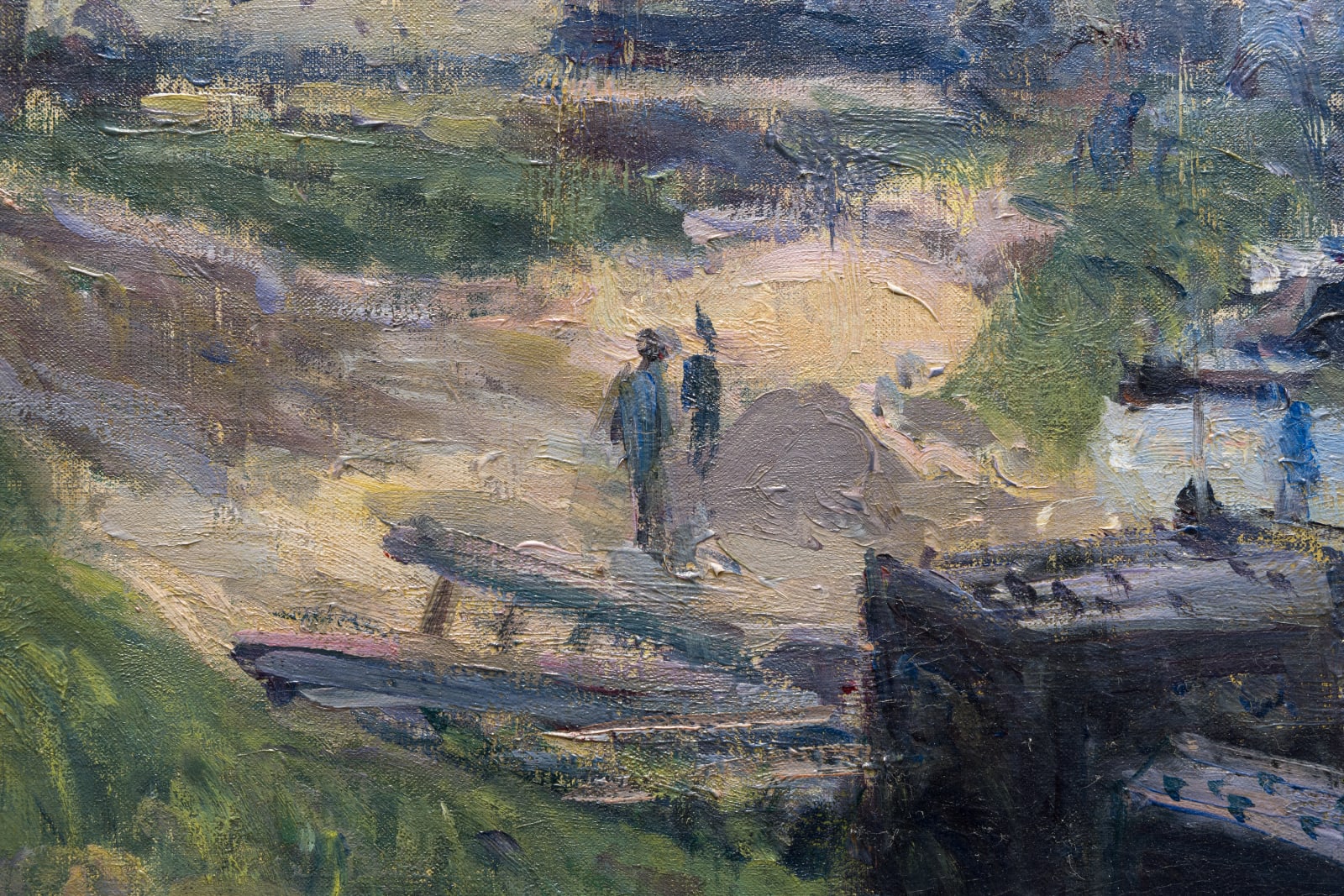
Alfred Sisley’s Le Lavoir de Billancourt (1879) is a superb example of the artist’s lifelong devotion to painting directly before nature, and to the quiet drama of landscape in flux. Often described as the “purest” plein air painter of the Impressionist circle, Sisley maintained an almost exclusive relationship with landscape, attending to the subtlest changes of season, weather, and time of day. His river scenes in particular have long been compared to Monet’s for their sensitivity to water—its shifting reflections, softened edges, and the way light dissolves form into atmosphere.
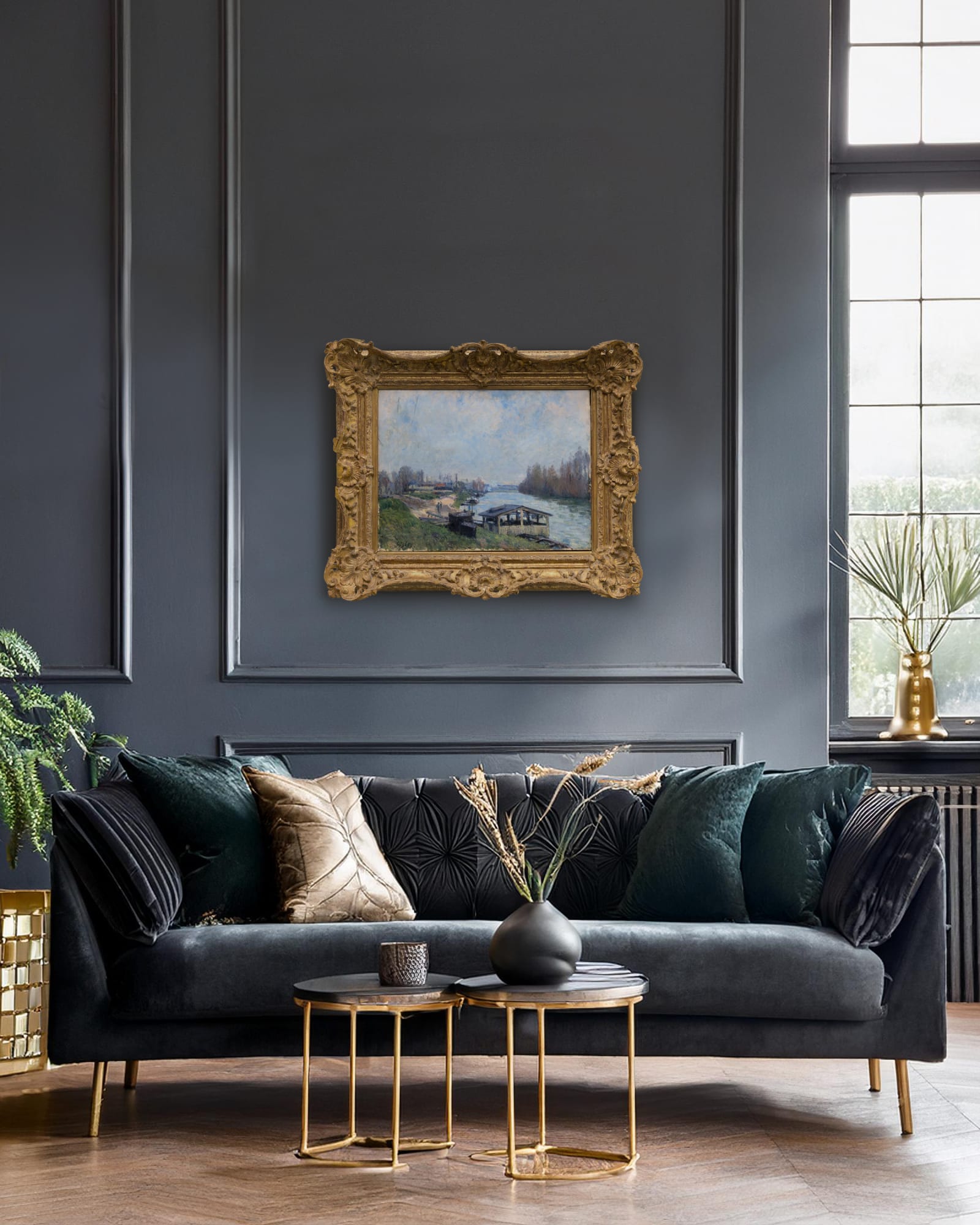
Painted along the Seine at Billancourt—an industrial town west of Paris—this work belongs to the sequence of views Sisley produced after the upheavals of 1871, when he moved his family first to Louveciennes and later to nearby Marly-le-Roi. The Seine valley offered him an ever-renewing motif: looping river bends, villages threaded along the banks, and a landscape marked by both history and modern life. Here, the floating washing house (a lavoir) sits low on the water, a practical structure where locals could wash clothes directly in the river for a small fee. Sisley transforms this everyday subject into an evocation of lived place, where human activity is integrated seamlessly into the broader rhythms of sky and current.
The 1870s are widely recognized as Sisley’s “golden period”—when his work speaks in a distinctly personal voice rather than under the overt influence of Corot, Courbet, or even early Monet. After ceasing to exhibit at the Salon after 1877, his compositions grew more complex and less dependent on traditional recession and linear perspective, shifting instead toward interlocking patterns and the expressive energy of his brushwork. In Le Lavoir de Billancourt, layers of pigment are built up in quick, multidirectional strokes, creating a richly textured surface saturated with color and air. This heightened spontaneity aligns with contemporary praise for Sisley’s ability to seize passing moments—clouds, breeze, and trembling foliage—so that space and light feel inseparable, and the scene remains vibrantly in motion. The painting is recorded in the François Dault Alfred Sisley: catalogue raisonné de l'oeuvre peint (1959) as no. 315.
“Jedes Bild zeigt einen Ort, in den sich der Künstler verliebt hat”— Alfred Sisley
Erfahren Sie mehr über dieses Kunstwerk
Nehmen Sie Kontakt mit uns auf, um mehr zu erfahren über Alfred Sisley's Le Lavoir de Billancourt und ein Spezialist wird sich mit Ihnen in Verbindung setzen:

Suchen Sie nach einem anderen Künstler?
Bei Heather James haben wir Zugang zu Tausenden von Werken, aber nicht alle können auf unserer Website gezeigt werden. Wenn Sie sich für einen bestimmten Künstler oder ein bestimmtes Werk interessieren, kontaktieren Sie uns bitte, und wir werden mit Ihnen zusammenarbeiten, um Ihre Sammlung zu vervollständigen.