
Meeting Life
N.C. Wyeth and the MetLife Murals

N.C. Wyeth painting the MetLife Murals
About

N.C. Wyeth painting
Emerging at the end of the Gilded Age, N.C. Wyeth was one of the most important American artists and illustrators. His paintings and illustrations brought life to classic literature from Treasure Island to The Boy's King Arthur and more. He is most remembered for his ability to capture crucial moments in narratives, fleshing out just a few words into a visual representation of deep drama and tension. Patriarch of the Wyeth artistic dynasty, which includes his son Andrew and grandson Jamie, his influence touched future illustrators and artists.
His legacy encompasses more than an astonishing ability to capture crucial moments in dynamic ways. Wyeth put that ability into paintings that shaped American imagination – of America itself and of wild possibilities. Because of his illustrating background, Wyeth was able to create narratives of America within his paintings. Wyeth’s powerful works gave life to many of the stories America told of itself. His early paintings captured life of the American West and some of his most beloved illustrations were for novels such as The Last of the Mohicans or short stories like Rip Van Winkle. Despite this success, Wyeth struggled with the commercialism of illustrations and advertisements, seeking his work to be accepted as fine art.
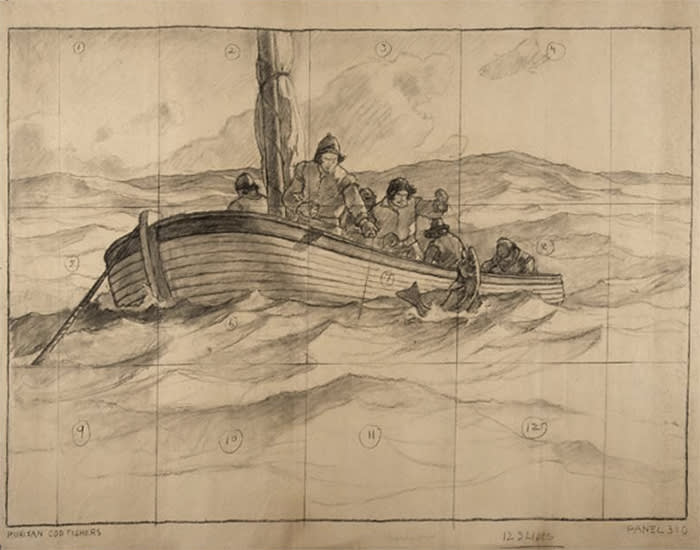
NC Wyeth, Puritan Cod Fishers, composition drawing for Metropolitan Lifemural, 1944-1945, charcoal and graphite on paper, 38 ¼ x 54 in. Brandywine River Museum of Art

The Metropolitan Life Lobby featuring the murals by Wyeth.

N.C. Wyeth, “The Coming of the Mayflower in 1620” (1941), oil on canvas, 104 1/2 x 158 3/4 in. On view in "N.C. Wyeth and the MetLife Murals", Heather James Palm Desert.
But, this story is not the United States’ only origin story, and even the story of the Pilgrims is complex and contentious. Like the founding of Rome (there is both Romulus and Aeneas of Virgil’s Aeneid), there are many complicated narratives that compete and complement each other, histories that were discussed and debated since the beginning. Whenever we talk about this history, we must ask ourselves why do we tell these stories, what do they say about us, where did they come from, who is and isn’t included, and how do we tell it?
Although these paintings were some of the last pieces worked on by Wyeth, they were not his only commissioned murals. While Wyeth may have been one of the towering figures of illustration, he was preoccupied with being seen as a fine art artist. In this way, murals provided him this possibility. Think of the many murals made by some of the greatest artists in history since the Renaissance – Leonardo da Vinci, Mary Cassatt, Diego Rivera, Keith Haring. Often murals depict events in history (also called “history paintings”) which were considered some of the highest forms of art. As they progressed, these works often performed other functions, particularly showcasing or celebrating values important to the commissioner. It is for these reasons that murals were considered so favorably and for which Wyeth was eager to paint them.

N.C. Wyeth, “The St. Andrews School Mural”, 1938, oil on canvas, 112 x 306 in. St. Andrews School.

N.C. Wyeth
These murals and the MetLife series were deeply personal to Wyeth for several reasons: from his desire to be taken seriously as an artist to an opportunity to investigate his own upbringing in New England. Wyeth was born in Needham, Massachusetts. One of his ancestors even came to Massachusetts from England in 1645, not far removed in time from the founding of Plymouth Colony in 1620. This deep appreciation can be seen in the two pieces in the exhibition. However, it is perhaps Puritan Cod Fishers that strikes us the most. Less historical than The Coming of the Mayflower in 1620, the piece presents an everyday moment, yet it is filled with every narrative convention he could deploy as if it were a great history painting. N.C. Wyeth, along with his grandson, died in a train collision. His son, Andrew Wyeth, completed this painting from his father’s sketch. It is the only painting from the MetLife project that Andrew completed.
“I hope the time will never come when I shall feel satisfied. To reach the goal of one’s ambitions must be tragic.”
N.C. Wyeth