
Picasso

Works on Paper
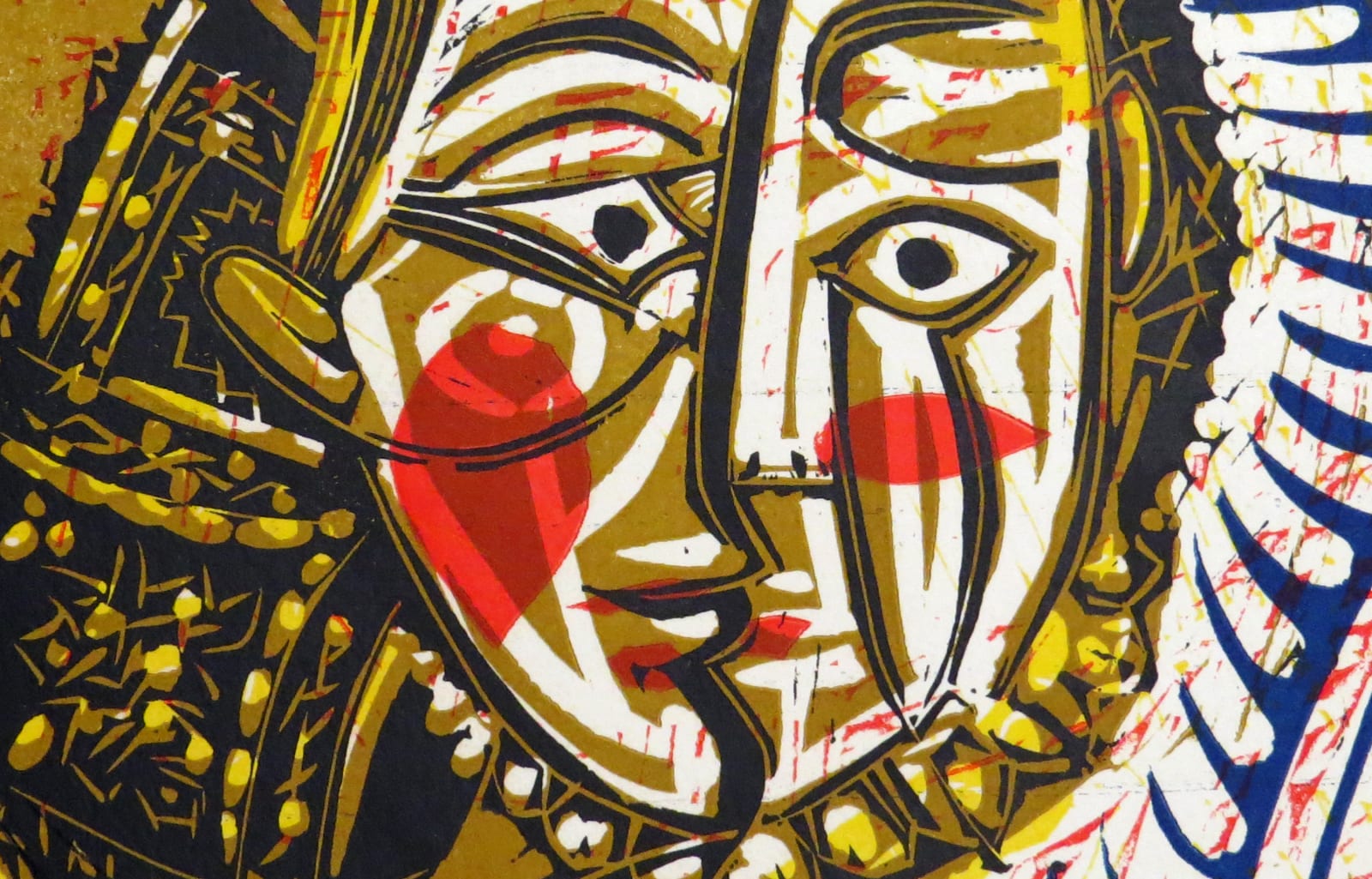
Detail of Picasso's color linocut "Buste de femme (d’après Cranach le Jeune)" (1958).
Among the many significant works in the exhibition is a color linocut from 1958 titled Buste de femme (d’après Cranach le Jeune), which translates to Bust of a Woman (after Cranach the Younger). Linocuts form a very small portion of Picasso’s printmaking output, as he generally favored etching and lithography. But between the years of 1958 and 1963, his residence in the south of France, away from the printmaking resources of Paris, led him to experiment with linoleum and produce a number of strong compositions. This print, an edition of 50, was inspired by a postcard image of Lucas Cranach the Younger’s Portrait of a Young Girl. A powerful image with rich colors, evoking a blend of Cubism and classical portraiture, this piece is considered the most important of Picasso’s linocuts.
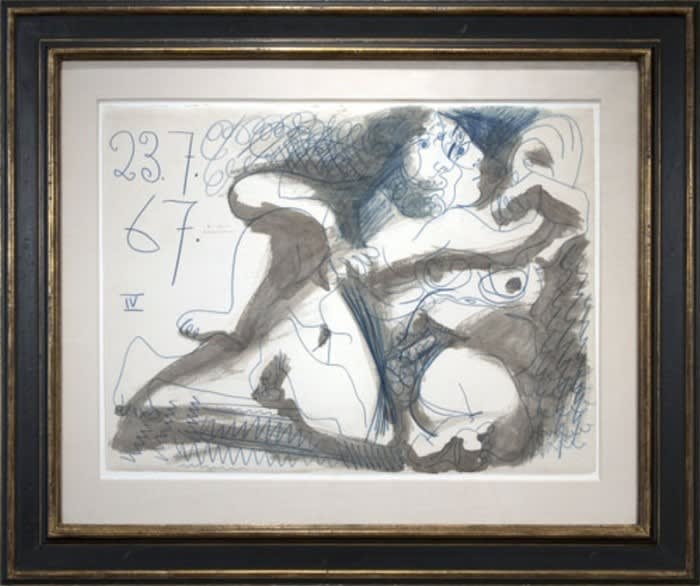
Picasso's drawing "L’Étreinte (The Embrace)" (1967).
Paintings

Picasso's painting "Paloma" (1951).
One of the real gems in this show is Paloma, an oil portrait of the artist’s youngest daughter. Made in 1951 when Paloma Picasso was only two years old, it is one of many paintings, drawings, and prints that Picasso made depicting his two youngest children, Claude and Paloma, while they were still toddlers. Picasso himself was already in his late sixties when these two were born, with his status as an art superstar cemented. He could afford to dote on them, spending more time interacting with them than he did with his two older children, born two decades earlier. The difference is evident in his art. Picasso’s portraits of his first son, Paulo, were formally posed and often referenced classical masterworks; his images of Claude and Paloma, however, find the artist completely immersed in a child’s wonderland of fantasy, play, and instinct. Instead of forcing them into adult contexts, he depicted Claude and Paloma surrounded by toys, crawling across the floor, making art, and spending time with their mother, Françoise Gilot. The flat, simple, cutout style employed in these works recalls a style that a toddler might use in his or her own compositions. Picasso famously said that while he could paint like Raphael at a very early age, it took him his whole life to learn to paint like a child.
Picasso’s imagery throughout his career contained a number of distinctive characters that served as stand-ins for the artist himself—the fisherman, the matador, the painter at work. In the mid-1960s, inspired by a re-reading of Alexandre Dumas’ classic novel, a new character emerged and came to dominate much of his final output: that of the musketeer. Mousquetaire I (Espagnol du XVIIème siècle) [Musketeer I (17th-century Spanish)] (1967) is a particularly emblematic painting from this period. With vigorous strokes, Picasso evokes the image of a rakish and handsomely clothed Spanish swordsman, ready to take on any challenges. For the aging artist, who was only six years away from his death the year this was painted, the musketeer was a fantasy figure who offered an escape into a golden era of youth, virility and adventure. Playing with the iconic image of the musketeer also allowed Picasso to examine and reconfirm his place in the pantheon of master artists that he admired. These included Rembrandt, whose classic The Night Watch painting was a constant source of inspiration, and Velázquez, the fellow Spaniard whom Picasso esteemed above all other artists.

