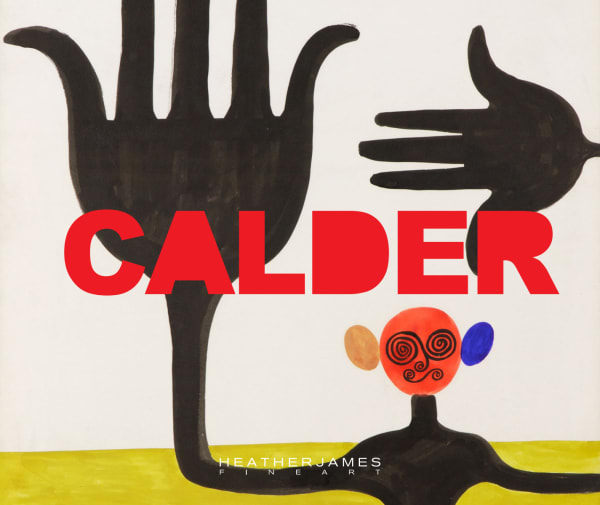
Calder

Sculpture

“Each element able to move, to stir, to oscillate, to come and go in its relationships with the other elementsin its universe.”
Alexander Calder worked in a variety of media throughout his life, however, his innovations in sculpture are considered his most enduring contribution to the history of art. His creation and elaboration of the mobile catapulted an entirely new art historical movement that imagined sculpture as performance art.
Lithographs

Calder utilized the techniques of each medium he mastered to create works in different media. This crosspollination is noticeable between his gouaches and his prints. Calder would paint a gouache as a maquettef or a print that would be redrawn on plates – one for each color. Furthermore, the paper that Calder used for prints, typically made by the French company Arches, was the same paper he used for his gouaches. During his career, Calder mastered the major forms of printmaking and worked with the master printmakers of his day. These prints have made Calder’s artwork available to a wider public, and contribute much to the impact and legacy of Calder’s work.
Gouaches

Calder began to paint gouaches in the 1930’s, but it was not until the mid-1940’s that he began to paint only with opaque watercolors. According to Calder, transparent watercolors were too pale and oil paint was too slow to dry. He enjoyed making gouaches, and preferred to work quickly to “surprise” himself with the results. During the 1950’s, Calder rented a small home near Aix-en-Provence and turned a small third floor room into a gouacherie. Here, he painted gouaches nearly everyday, and believed that he had “seemed to develop something new” with the medium.

"Calder" installed at Heather James Palm Desert.