


作品详情
Galerie Riva Yares, Santa Fe, New Mexico
Private Collection, acquired from the above, 1998

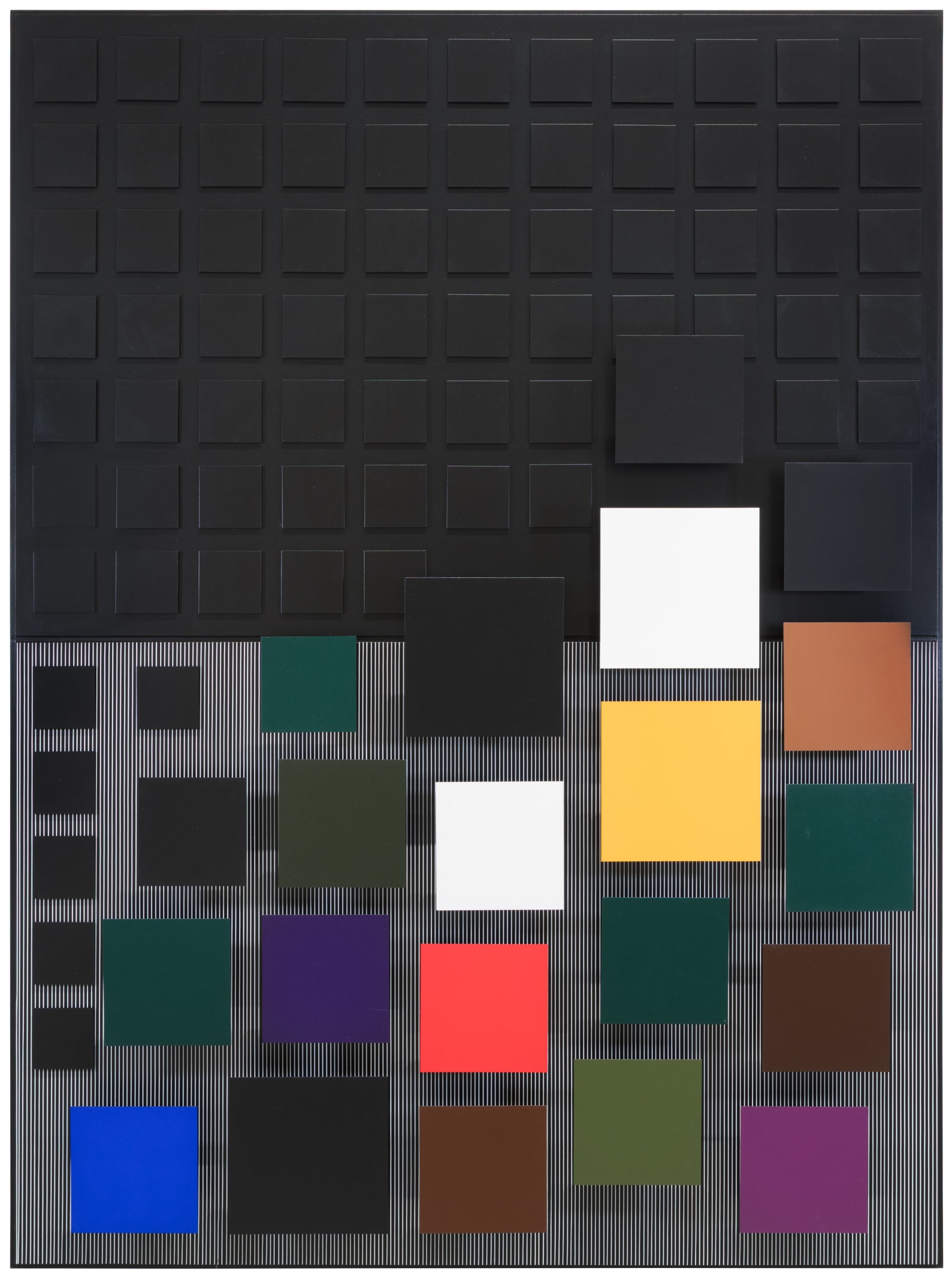
Jesús Rafael Soto's Negro y Color (Black and Color) (1995) extends the principles of his Ambivalencias series into the artist's mature late work. Begun in the late 1970s as an evolution of his earlier Vibraciones, the Ambivalencias introduced bold color into Soto's optical equation — recognized today as one of the defining phases of his career, alongside the Agujas, Vibraciones, and Penetrables.
The composition divides into two registers. Across the upper half, a grid of low-relief black squares projects subtly from a black ground, an architecture of light and shadow. The lower half erupts into a black-and-white striped backdrop overlaid with colored squares — red, yellow, ultramarine, emerald, violet, ochre, brown — floating forward on shallow supports. As the viewer moves before the piece, the stripes set the panels into apparent vibration, the eye unable to fix them in stable space.
Soto led the kinetic movement alongside Yaacov Agam, Jean Tinguely, and Victor Vasarely, drawing on physics, mathematics, music, and color theory. His commissions placed his work inside UNESCO's Paris headquarters (1969), the Grand Hall de la Régie Renault (1975), and the Volume Virtuel at the Centre Pompidou (1987). Works are held by the Tate, MoMA, Museum Ludwig, and Centre Georges Pompidou. Still undervalued relative to his European peers, Soto offers here a defining example of postwar optical art.

“I don't copy nature, I isolate fundamental properties of the reality.”— Jesús Rafael Soto
了解更多关于此作品的信息
与我们联系以了解更多关于 Jesús Rafael Soto's Negro y Color (Black and Color) 的信息,专业顾问将与您取得联系:
寻找其他艺术家?
Heather James拥有数以千计的艺术作品资源,但并非所有作品均可在网站上呈现。若您对特定艺术家或作品感兴趣,请与我们联系,我们将竭诚协助您完善您的收藏。