


作品详情
Stuart Pivar, New York
Doyle, New York, May 14, 2019, lot 1007
Private Collection, acquired from the above sale
Heather James, California
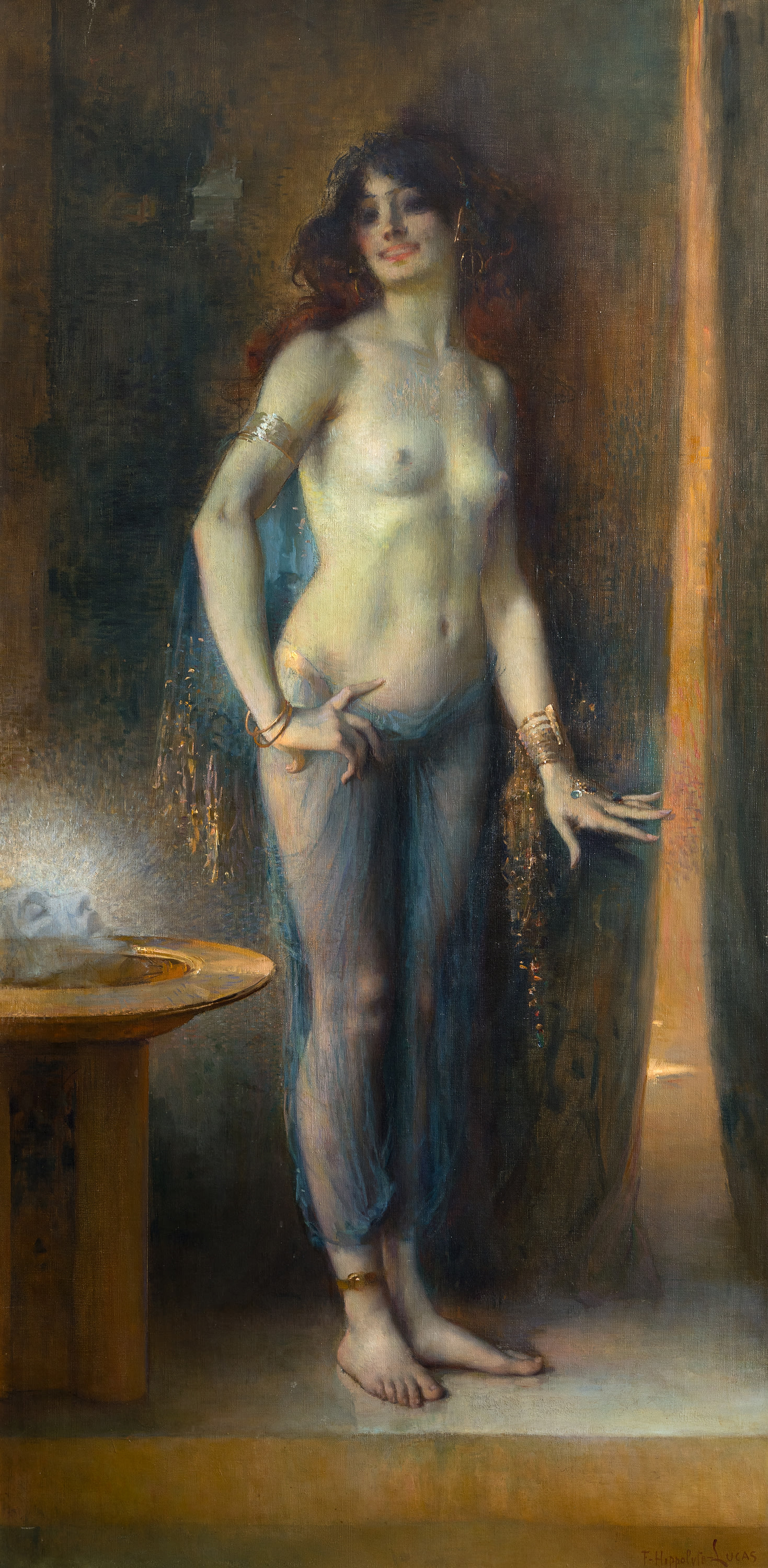
Marie-Félix Hippolyte-Lucas's Salome (The Mimic Dancer of Naxos) marks a striking departure for an artist celebrated for luminous portraits of aristocratic women. Submitted to the Paris Salon of 1912 — where Hippolyte-Lucas had exhibited regularly since 1877 — this canvas stands among the most theatrically ambitious works of his career.
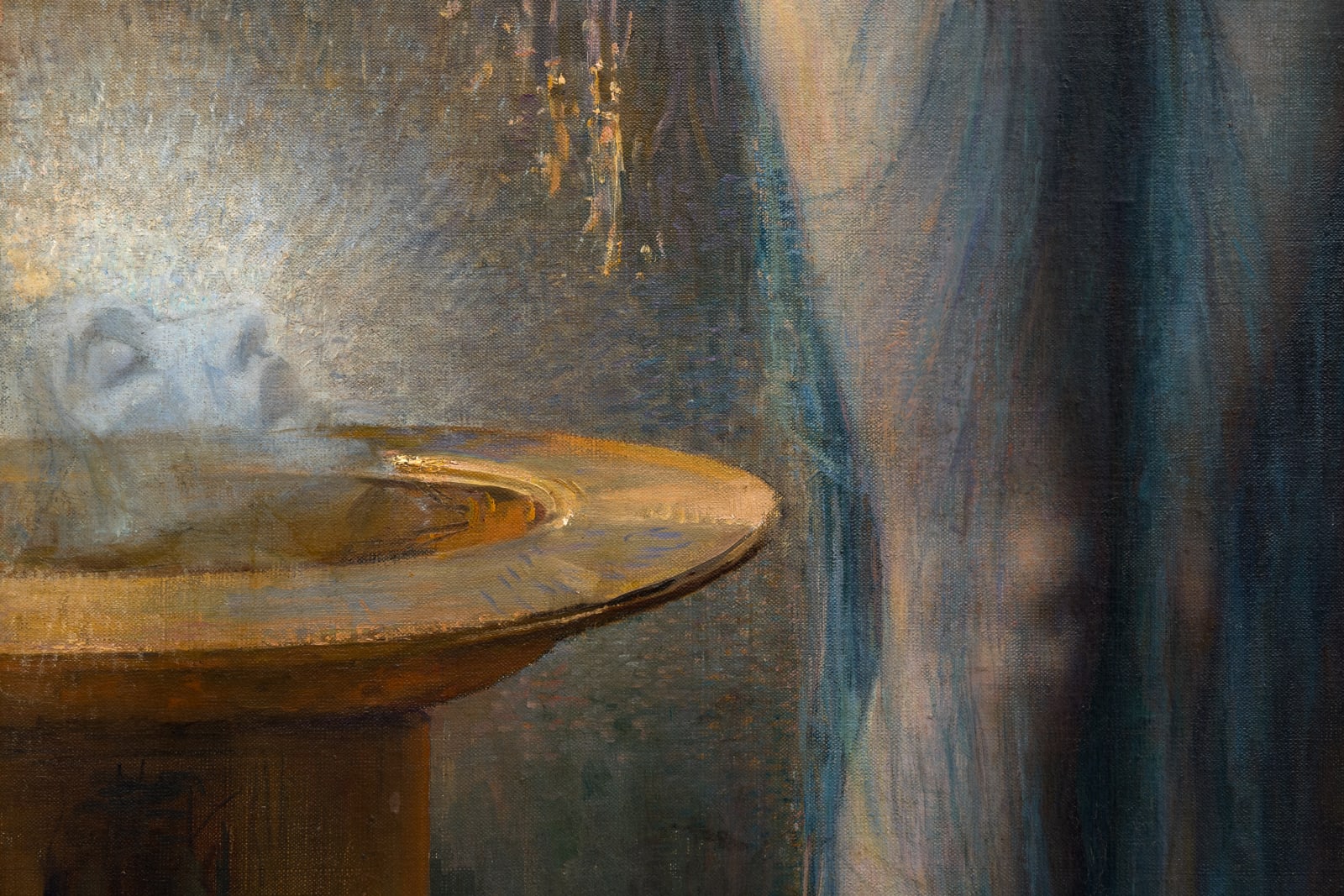
Painted in oil on a tall, narrow canvas — 77 by 38 inches — the composition presents Salome at full length: pale, self-possessed, draped in sheer blue-grey fabric. Gold armlets, bracelets, and an ankle cuff catch the ambient light; her hands rest loosely at her waist, a faint smile on her lips. To her left, the severed head of John the Baptist lies on a gold platter. The figure's cool luminosity against a smoky olive-grey background reflects Hippolyte-Lucas's rigorous Academic training under Pils, Lehmann, and Luminais.
By 1912, the Salome story — amplified by Oscar Wilde's 1893 tragedy and decades of Symbolist fascination — had become one of European art's defining subjects. Hippolyte-Lucas's version stands apart for its psychological stillness: rather than depicting the dance or the horror, he gives us the aftermath, Salome already composed and unbothered. A distinguished muralist whose commissions included the Monte Carlo Casino and the Paris Stock Exchange, he brought monumental confidence to this Salon centerpiece.
“Dance for me, Salomé, I beseech you. If you dance for me you may ask of me what you will, and I will give it you, even unto the half of my kingdom.”— Oscar Wilde, "Salomé" (1891)
了解更多关于此作品的信息
与我们联系以了解更多关于 Marie Felix Hippolyte-Lucas's Salome 的信息,专业顾问将与您取得联系:

寻找其他艺术家?
Heather James拥有数以千计的艺术作品资源,但并非所有作品均可在网站上呈现。若您对特定艺术家或作品感兴趣,请与我们联系,我们将竭诚协助您完善您的收藏。