
Hans Hofmann:抽象表现主义之父

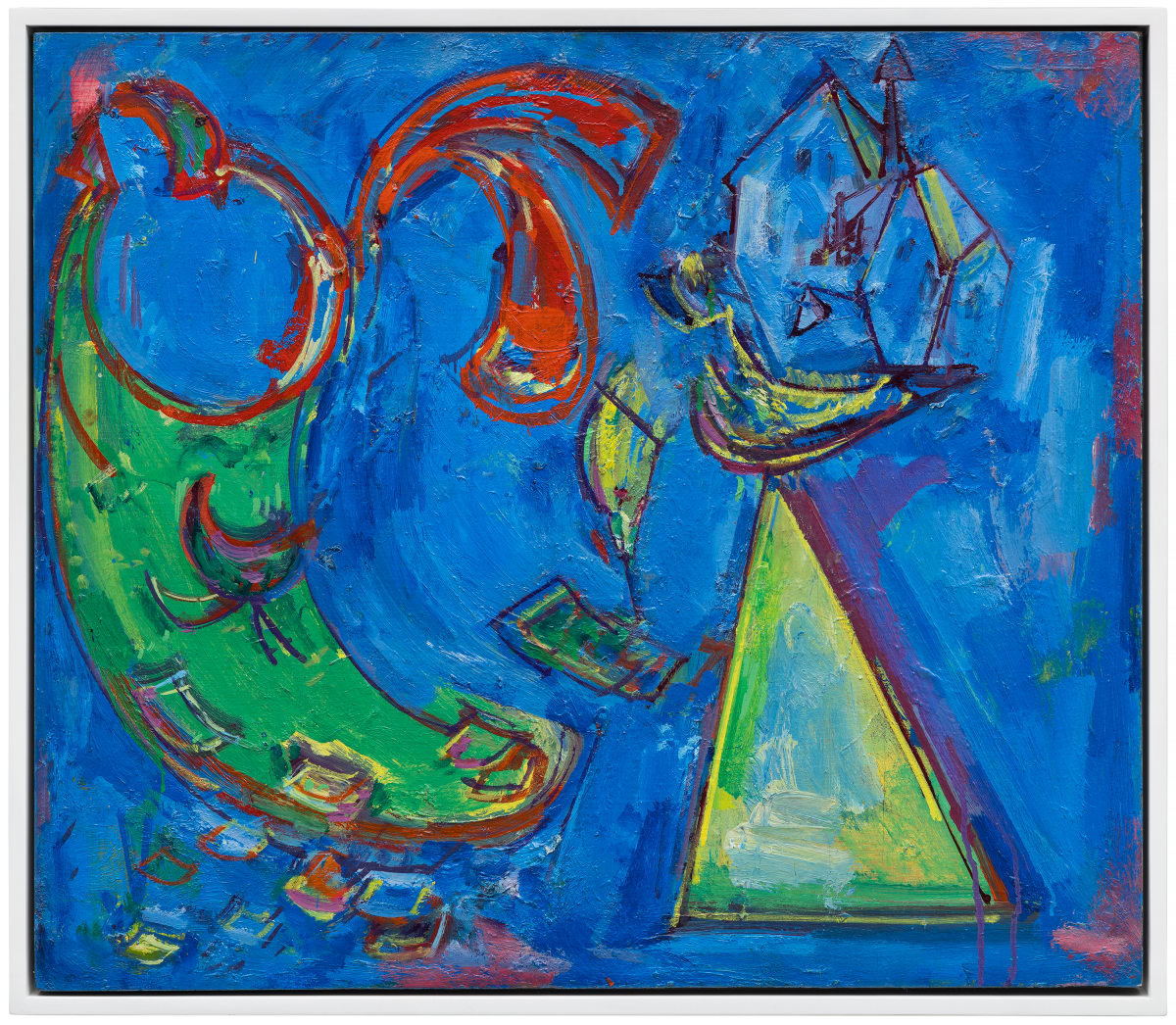
Landscape No. 108, 1941, oil on panel, 23 1/4 x 29 1/4 in.
Heather James荣幸地举办这场汉斯·霍夫曼展览,涵盖三十年的作品,其中大量绘画来自单一私人藏家。
拥有如此众多汉斯·霍夫曼绘画的收藏,这些作品诉说着一位珍视那些既打动内心又启迪心智之作的藏家。如同人一样,收藏往往永无完结,而是一个不断构建、有时亦需放手的持续过程。藏家是文化遗产的临时守护者,这一收藏的广度与品质,以及对1940年代的侧重,诉说着这位藏家对霍夫曼持久的热爱。将它们汇聚一堂,它们以自己的方式呈现出一篇关于霍夫曼的视觉论文,为我们提供了对这位20世纪巨匠的全新洞察。
穿越三十年的绘画,从1940年代到1950年代,展览深入每个时期,引导我们领略霍夫曼所发起的深刻变革,不仅在他自己的全部创作中,更在整个艺术史上。
谁是Hans Hofmann?

Bill Witt, “Hans Hofmann”, 1948, National Portrait Gallery, Smithsonian Institution, Washington, D.C. © Bill Witt
“Painters must speak through paint, not through words.” – Hans Hofmann
Born in 1880, a generation removed from the oldest Abstract Expressionists such as de Kooning or Rothko, Hofmann spent the crucial decade between 1904 and 1914 in Paris, knew Picasso and Matisse, and was on the scene when the great Cézanne retrospective opened in 1906. So, it is unsurprising that after arriving in New York in 1932, Hofmann took a somewhat circuitous path through a range of styles. Yet, he always held true to core ideas about painting.
Decades before he painted vibrant rectangles of pure, floating color, commonly known as ‘slabs,’ Hofmann brushed, stained, and dripped paint with a looser, chance-based hand. Whether he or Pollock pioneered the “drip” painting technique is still unsettled. Less controversy surrounds the impact of his teaching on Joan Mitchell and several of the younger painters who turned toward a more lyrical brand of Abstract Expressionism — one more closely aligned with nature.
1940年代

Bill Witt, “Hans Hofmann at Gallery 200”, 1949, Archives of American Art, Smithsonian Institution, Washington, D.C.
“Art leads to a more profound concept of life, because art itself is a profound expression of feeling.” – Hans Hofmann
Any analysis of Hans Hofmann’s oeuvre is incomplete without considering his small landscapes, which occupied him between 1940 and 1944. These works capture a pivotal moment in his artistic evolution, transitioning from Matisse-inspired figurative still lifes, portraits, and interiors to the pure abstraction that would later define his career. Rooted in Fauvism and resonant with Kandinsky’s early work, these works remain a robust testament to Hofmann’s evolving visual language during this transformative period.
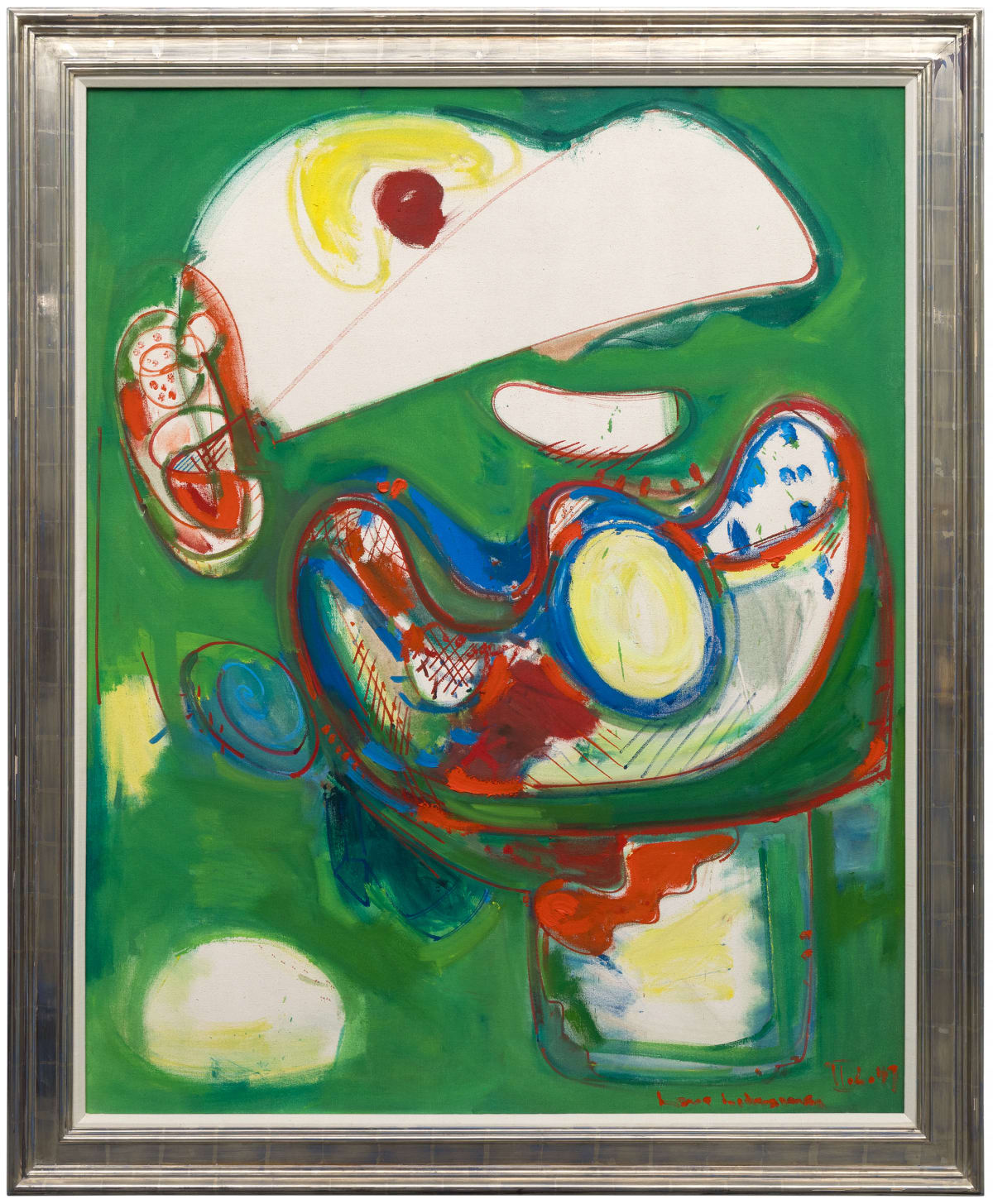
However, in the latter half of the decade, there is a clear shift in Hofmann’s practice. This shift should not be underappreciated as, by 1947, Hofmann was still painting at age 65, and rather than becoming entrenched to a single approach to the canvas, Hofmann pushed himself to discover new possibilities of painting. During this period, Hofmann’s reliance on linearity provided a departure from the more fluid, painterly dynamism of his earlier works. From 1944 to 1951, this linear impulse permeated his practice, signaling a prolonged exploration of modes of expression in which he grappled with reconciling abstraction and structure.
Hofmann was able to synthesize the earlier breakthroughs of European Modernism like Surrealism and Cubism with the gestural freedom of American Abstract Expressionism. Hofmann’s deliberate explorations during the late 1940s underscore his unique ability to create works that resist easy categorization, standing apart as deeply personal explorations of form and color.
1950年代
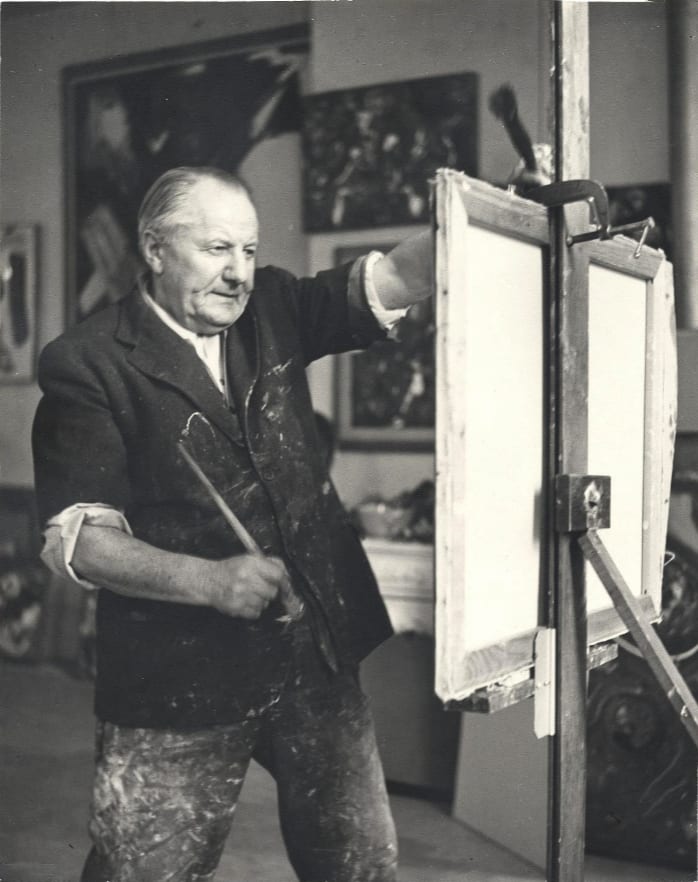
Kay Bell Reynal, “Hans Hofmann at work in his studio”, 1952, Archives of American Art, Smithsonian Institution, Washington, D.C.
“To sense the invisible and to be able to create it – that is art.” – Hans Hofmann
The 1950s saw Hofmann enter his 70s still as curious and groundbreaking as ever. A 72-year-old Hans Hofmann worked his canvases deliberately and thoughtfully to achieve impact through restraint. Hofmann’s work is never strongly associated with Surrealism and yet in this decade, he appeared to call back to that earlier avant-garde movement, synthesizing it with Abstract Expressionism, and underscoring the adaptibility of his famous “push-pull” theory, where the expanding and contracting forces of color and form create surface tension, depth and movement.
It was also during this decade that Hofmann began to explore and incorporate passages of color, allowing them to float in space where they produce a sense of tension against buoyant brushstrokes, harmonizing together through ebullience.
1960年代

“Hans Hofmann, Toshimitsu Imai, and others at the Venice Biennale”, 1960, photographic print, Archives of American Art, Smithsonian Institution
“I can’t understand how anyone is able to paint without optimism. Despite the general pessimistic attitude in the world today, I am nothing but an optimist.” – Hans Hofmann
In 1960, Hofmann was selected as one of the four artists to represent the United States at the Venice Biennale. The world obsesses over youth and young prodigies. From this perspective, Hans Hofmann was a late bloomer. However, look at the Abstract Expressionists who Hofmann guided – many didn’t hit their strides until their 40s. Or David Park who didn’t pioneer the Bay Area Figurative Movement until his 40s. Or more recently, Etel Adnan, who didn’t achieve acclaim for her paintings until the last decades of her long life. Age brings with it experience and perspective.
Maintaining his push-pull doctrine of applied oppositions onto the canvas, this decade continued to see Hofmann push the possibilities of paint. Some works show the graceful, lively brushstrokes of single colors flitting across the canvas. Some works show daubs of paint floating above a churning sea of color. Some paintings appear to be carefully planned while others seem to be the result of frenzied chance. But nothing seems extraneous or wasted. Everything counts on the canvas.
The 1960s saw Hofmann reach higher levels of renown and respect, even as he was reaching the last years of his life. Perhaps, it is the vitality and dynamism through color and brushstroke that grew Hofmann’s reputation. Perhaps, it was the growing acknowledgement of his influence on a generation of painters including Lee Krasner, Joan Mitchell, and Wolf Kahn. Perhaps, it is the idiosyncrasies of an artist that never settled into rote repetition, his paintings acting as visual research, bounding with optimism and joy.
艺术家论霍夫曼

Burt Glinn, “Hans Hoffman and Helen Frankenthaler exchange greetings at an opening for one of Frankenthaler’s shows. New York City”,1957 © Burt Glinn | Magnum Photos
“As a man and as an artist, positive, energetic, and elegant. A sport.” – Helen Frankenthaler in 2003
“Hofmann’s abstraction is hard won: it comes from depicting the world around him… Have I overpraised him? I think not: for me this still underrated artist stands out as one of the great painters of the century.” – Anthony Caro in 1990
“Hans Hofmann paints as if he could look into those infinitesimal particles of violence that could split the earth like an orange. He shows us the vitality of matter, its creation and its destruction, its angels of dark and light.” – Tennessee Williams in 1949
“I really didn’t get the first impact, the full impact of it [Cubism], until I worked with Hofmann.” – Lee Krasner in 1938
人类精神

“Vaclav Vytlacil and classmates being instructed by Hans Hofmann”, 1926 Archives of American Art, Smithsonian Institution, Washington, D.C.
“Art is to me the glorification of the human spirit, and as such it is the cultural documentation of the time in which it is produced.” – Hans Hofmann
Hans Hofmann was an authentic early modernist. Later, as a mature artist in full command of his abilities, his achievements were stimulated — made possible even — by the exhilarating New York milieu that gave rise to Abstract Expressionism. So perhaps it is not surprising that unlike most of the Abstract Expressionists who pursued a single iconographic look — Rothko’s soft-edged rectangles, Franz Kline’s enlarged calligraphic strokes, Clyfford Still’s dark, ragged shapes — Hofmann was constantly reaching for different and contradictory effects.
His paintings were wildly varied, and they carved a wide swath toward the most exciting avenues available to contemporary abstraction. Hofmann was a gallant experimenter who had refused to settle on a single style for long and stated those intentions clearly. “What I would hate most is to repeat myself over and over again – to develop a false style…I want to invent, to discover, to imagine, to speculate, to improvise — to seize the hazardous in order to be inspired.”

“艺术是艺术家灵魂充盈的表达。”
Hans Hofmann