ALSON CLARK (1876-1949)

$100,000

 
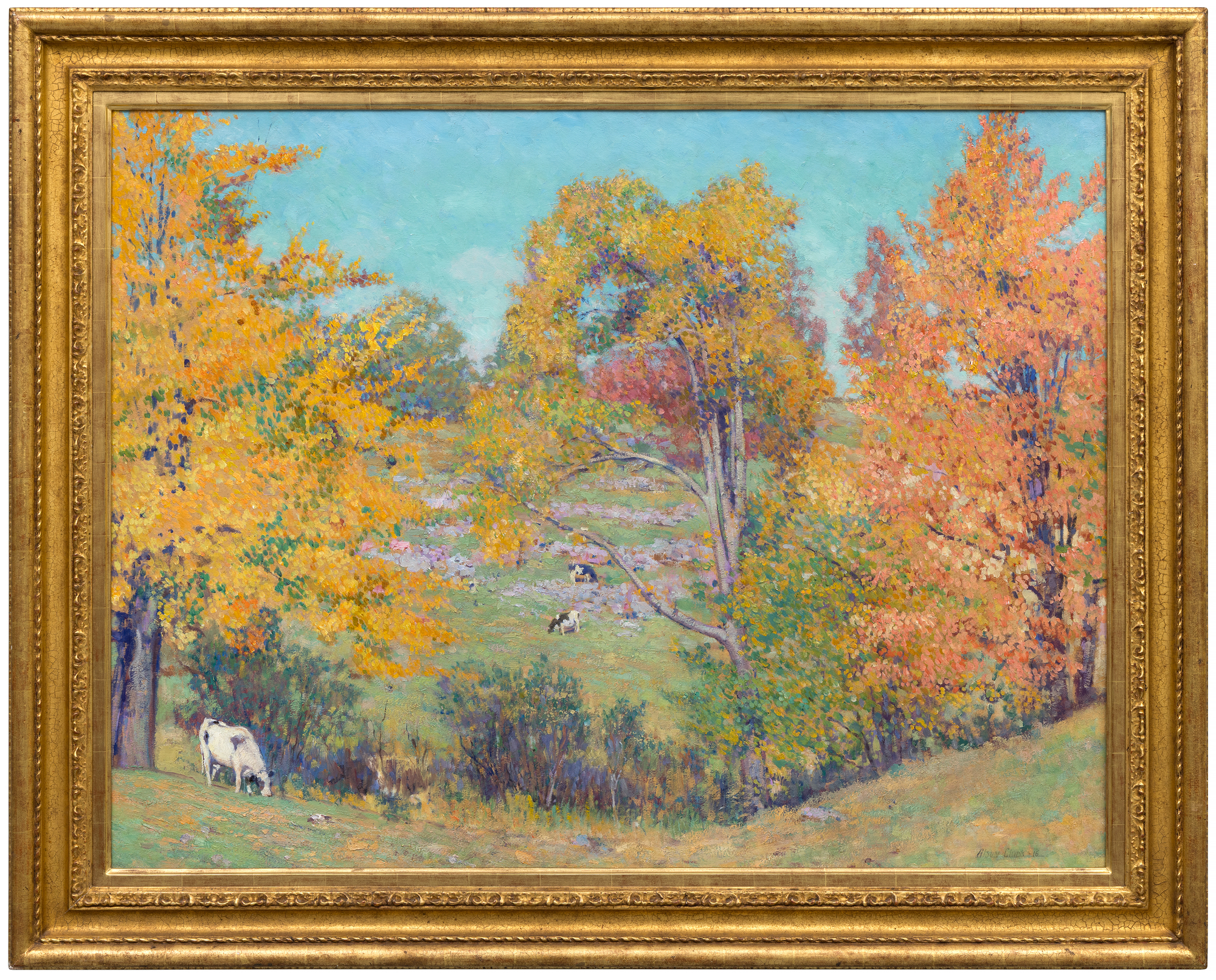
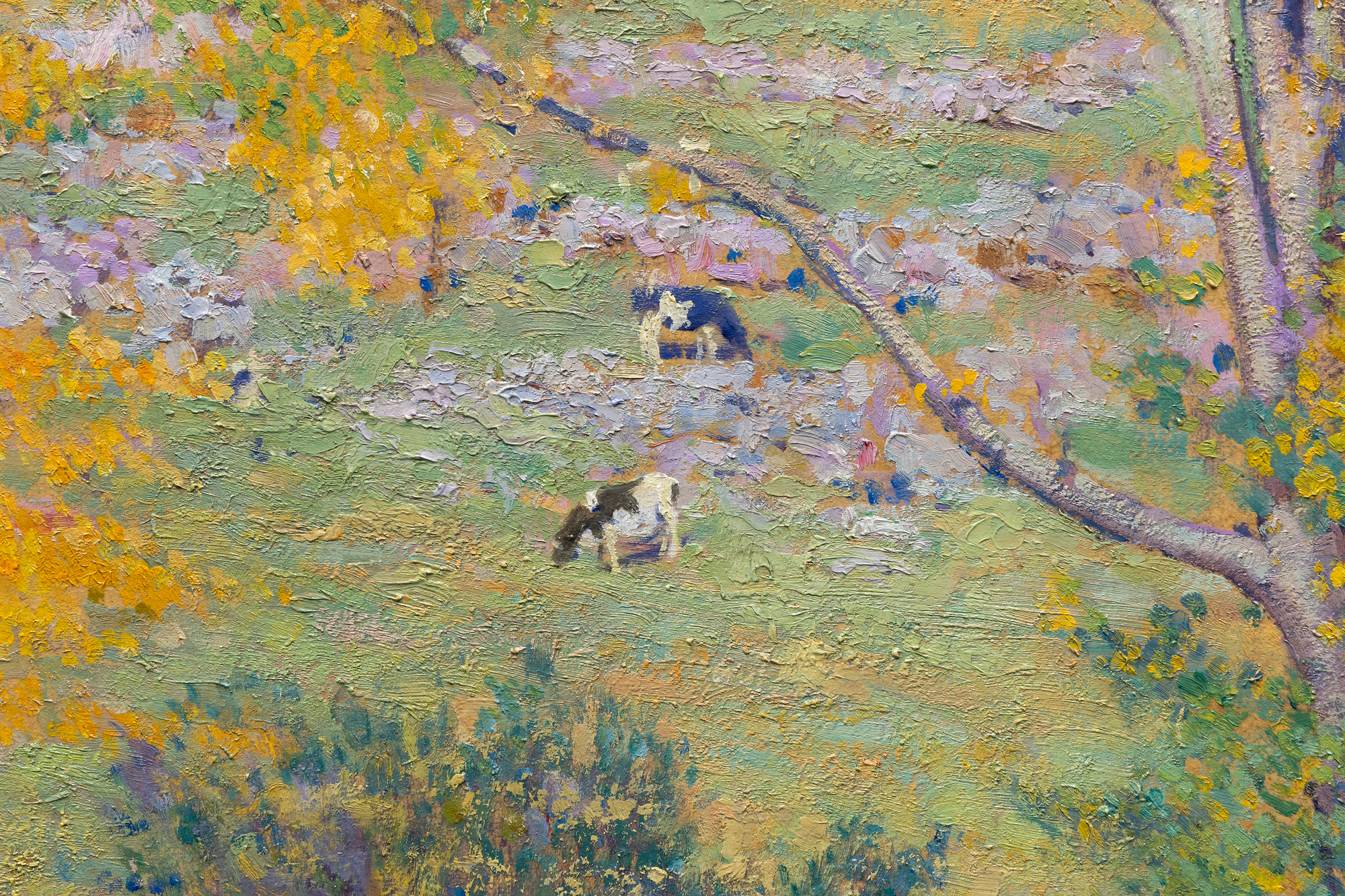
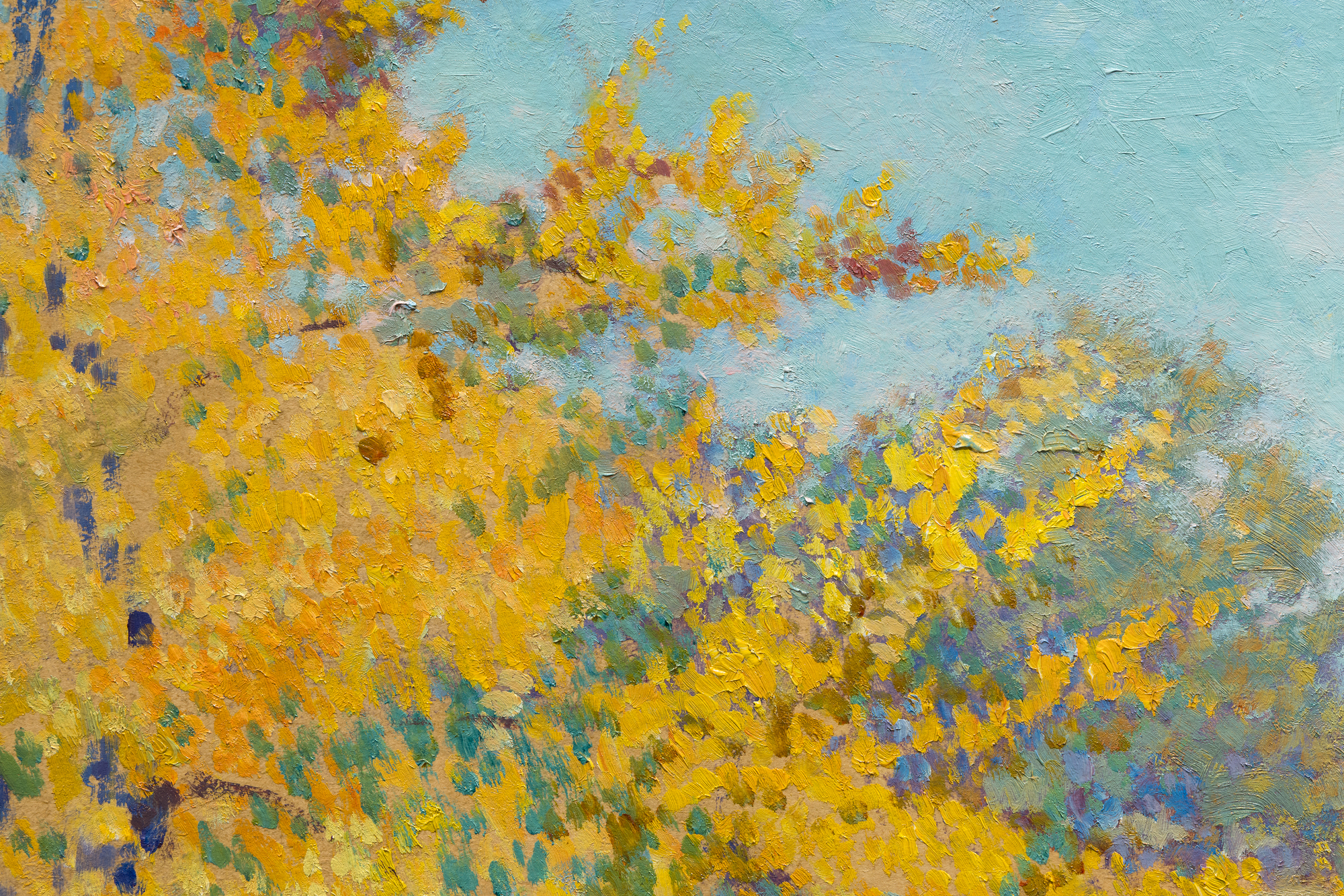
<div>Alson Clark’s <em>Autumn, St. Lawrence River</em> (1916) is a celebration of seasonal color and painterly assurance, created during a highly productive summer spent along the St. Lawrence River. Painted at a moment of peak confidence, the work follows closely on the artist’s major success at the Panama–Pacific International Exposition, where Clark filled an entire exhibition room with his paintings—an achievement that firmly established his reputation and momentum at this stage of his career. </div><br><br><div> </div><br><br><div>The composition unfolds across a gently rolling landscape animated by the brilliance of early autumn. Trees blaze with saturated yellows, oranges, and soft reds, their foliage rendered in broken, impressionistic strokes against a clear, luminous blue sky. Clark’s confident handling of paint allows color to carry form, creating a sense of depth through overlapping passages. Small grazing cattle dot the hillside, providing scale and a quiet note of pastoral life that anchors the composition without interrupting its chromatic rhythm. </div><br><br><div> </div><br><br><div>Clark was celebrated for his ability to fuse American landscape painting with lessons drawn from European Impressionism, and this work exemplifies that synthesis. The surface remains lively and tactile, with visible brushwork that conveys movement and atmosphere while maintaining compositional harmony. <em>Autumn, St. Lawrence River </em>reflects not only the artist’s mastery of color and light, but also the assured vision of a painter fully at ease with his subject, transforming a specific place and moment into a timeless expression of seasonal abundance. </div> <div>Alson Clark’s <em>Autumn, St. Lawrence River</em> (1916) is a celebration of seasonal color and painterly assurance, created during a highly productive summer spent along the St. Lawrence River. Painted at a moment of peak confidence, the work follows closely on the artist’s major success at the Panama–Pacific International Exposition, where Clark filled an entire exhibition room with his paintings—an achievement that firmly established his reputation and momentum at this stage of his career. </div><br><br><div> </div><br><br><div>The composition unfolds across a gently rolling landscape animated by the brilliance of early autumn. Trees blaze with saturated yellows, oranges, and soft reds, their foliage rendered in broken, impressionistic strokes against a clear, luminous blue sky. Clark’s confident handling of paint allows color to carry form, creating a sense of depth through overlapping passages. Small grazing cattle dot the hillside, providing scale and a quiet note of pastoral life that anchors the composition without interrupting its chromatic rhythm. </div><br><br><div> </div><br><br><div>Clark was celebrated for his ability to fuse American landscape painting with lessons drawn from European Impressionism, and this work exemplifies that synthesis. The surface remains lively and tactile, with visible brushwork that conveys movement and atmosphere while maintaining compositional harmony. <em>Autumn, St. Lawrence River </em>reflects not only the artist’s mastery of color and light, but also the assured vision of a painter fully at ease with his subject, transforming a specific place and moment into a timeless expression of seasonal abundance. </div> <div>Alson Clark’s <em>Autumn, St. Lawrence River</em> (1916) is a celebration of seasonal color and painterly assurance, created during a highly productive summer spent along the St. Lawrence River. Painted at a moment of peak confidence, the work follows closely on the artist’s major success at the Panama–Pacific International Exposition, where Clark filled an entire exhibition room with his paintings—an achievement that firmly established his reputation and momentum at this stage of his career. </div><br><br><div> </div><br><br><div>The composition unfolds across a gently rolling landscape animated by the brilliance of early autumn. Trees blaze with saturated yellows, oranges, and soft reds, their foliage rendered in broken, impressionistic strokes against a clear, luminous blue sky. Clark’s confident handling of paint allows color to carry form, creating a sense of depth through overlapping passages. Small grazing cattle dot the hillside, providing scale and a quiet note of pastoral life that anchors the composition without interrupting its chromatic rhythm. </div><br><br><div> </div><br><br><div>Clark was celebrated for his ability to fuse American landscape painting with lessons drawn from European Impressionism, and this work exemplifies that synthesis. The surface remains lively and tactile, with visible brushwork that conveys movement and atmosphere while maintaining compositional harmony. <em>Autumn, St. Lawrence River </em>reflects not only the artist’s mastery of color and light, but also the assured vision of a painter fully at ease with his subject, transforming a specific place and moment into a timeless expression of seasonal abundance. </div> <div>Alson Clark’s <em>Autumn, St. Lawrence River</em> (1916) is a celebration of seasonal color and painterly assurance, created during a highly productive summer spent along the St. Lawrence River. Painted at a moment of peak confidence, the work follows closely on the artist’s major success at the Panama–Pacific International Exposition, where Clark filled an entire exhibition room with his paintings—an achievement that firmly established his reputation and momentum at this stage of his career. </div><br><br><div> </div><br><br><div>The composition unfolds across a gently rolling landscape animated by the brilliance of early autumn. Trees blaze with saturated yellows, oranges, and soft reds, their foliage rendered in broken, impressionistic strokes against a clear, luminous blue sky. Clark’s confident handling of paint allows color to carry form, creating a sense of depth through overlapping passages. Small grazing cattle dot the hillside, providing scale and a quiet note of pastoral life that anchors the composition without interrupting its chromatic rhythm. </div><br><br><div> </div><br><br><div>Clark was celebrated for his ability to fuse American landscape painting with lessons drawn from European Impressionism, and this work exemplifies that synthesis. The surface remains lively and tactile, with visible brushwork that conveys movement and atmosphere while maintaining compositional harmony. <em>Autumn, St. Lawrence River </em>reflects not only the artist’s mastery of color and light, but also the assured vision of a painter fully at ease with his subject, transforming a specific place and moment into a timeless expression of seasonal abundance. </div> <div>Alson Clark’s <em>Autumn, St. Lawrence River</em> (1916) is a celebration of seasonal color and painterly assurance, created during a highly productive summer spent along the St. Lawrence River. Painted at a moment of peak confidence, the work follows closely on the artist’s major success at the Panama–Pacific International Exposition, where Clark filled an entire exhibition room with his paintings—an achievement that firmly established his reputation and momentum at this stage of his career. </div><br><br><div> </div><br><br><div>The composition unfolds across a gently rolling landscape animated by the brilliance of early autumn. Trees blaze with saturated yellows, oranges, and soft reds, their foliage rendered in broken, impressionistic strokes against a clear, luminous blue sky. Clark’s confident handling of paint allows color to carry form, creating a sense of depth through overlapping passages. Small grazing cattle dot the hillside, providing scale and a quiet note of pastoral life that anchors the composition without interrupting its chromatic rhythm. </div><br><br><div> </div><br><br><div>Clark was celebrated for his ability to fuse American landscape painting with lessons drawn from European Impressionism, and this work exemplifies that synthesis. The surface remains lively and tactile, with visible brushwork that conveys movement and atmosphere while maintaining compositional harmony. <em>Autumn, St. Lawrence River </em>reflects not only the artist’s mastery of color and light, but also the assured vision of a painter fully at ease with his subject, transforming a specific place and moment into a timeless expression of seasonal abundance. </div> <div>Alson Clark’s <em>Autumn, St. Lawrence River</em> (1916) is a celebration of seasonal color and painterly assurance, created during a highly productive summer spent along the St. Lawrence River. Painted at a moment of peak confidence, the work follows closely on the artist’s major success at the Panama–Pacific International Exposition, where Clark filled an entire exhibition room with his paintings—an achievement that firmly established his reputation and momentum at this stage of his career. </div><br><br><div> </div><br><br><div>The composition unfolds across a gently rolling landscape animated by the brilliance of early autumn. Trees blaze with saturated yellows, oranges, and soft reds, their foliage rendered in broken, impressionistic strokes against a clear, luminous blue sky. Clark’s confident handling of paint allows color to carry form, creating a sense of depth through overlapping passages. Small grazing cattle dot the hillside, providing scale and a quiet note of pastoral life that anchors the composition without interrupting its chromatic rhythm. </div><br><br><div> </div><br><br><div>Clark was celebrated for his ability to fuse American landscape painting with lessons drawn from European Impressionism, and this work exemplifies that synthesis. The surface remains lively and tactile, with visible brushwork that conveys movement and atmosphere while maintaining compositional harmony. <em>Autumn, St. Lawrence River </em>reflects not only the artist’s mastery of color and light, but also the assured vision of a painter fully at ease with his subject, transforming a specific place and moment into a timeless expression of seasonal abundance. </div> <div>Alson Clark’s <em>Autumn, St. Lawrence River</em> (1916) is a celebration of seasonal color and painterly assurance, created during a highly productive summer spent along the St. Lawrence River. Painted at a moment of peak confidence, the work follows closely on the artist’s major success at the Panama–Pacific International Exposition, where Clark filled an entire exhibition room with his paintings—an achievement that firmly established his reputation and momentum at this stage of his career. </div><br><br><div> </div><br><br><div>The composition unfolds across a gently rolling landscape animated by the brilliance of early autumn. Trees blaze with saturated yellows, oranges, and soft reds, their foliage rendered in broken, impressionistic strokes against a clear, luminous blue sky. Clark’s confident handling of paint allows color to carry form, creating a sense of depth through overlapping passages. Small grazing cattle dot the hillside, providing scale and a quiet note of pastoral life that anchors the composition without interrupting its chromatic rhythm. </div><br><br><div> </div><br><br><div>Clark was celebrated for his ability to fuse American landscape painting with lessons drawn from European Impressionism, and this work exemplifies that synthesis. The surface remains lively and tactile, with visible brushwork that conveys movement and atmosphere while maintaining compositional harmony. <em>Autumn, St. Lawrence River </em>reflects not only the artist’s mastery of color and light, but also the assured vision of a painter fully at ease with his subject, transforming a specific place and moment into a timeless expression of seasonal abundance. </div> <div>Alson Clark’s <em>Autumn, St. Lawrence River</em> (1916) is a celebration of seasonal color and painterly assurance, created during a highly productive summer spent along the St. Lawrence River. Painted at a moment of peak confidence, the work follows closely on the artist’s major success at the Panama–Pacific International Exposition, where Clark filled an entire exhibition room with his paintings—an achievement that firmly established his reputation and momentum at this stage of his career. </div><br><br><div> </div><br><br><div>The composition unfolds across a gently rolling landscape animated by the brilliance of early autumn. Trees blaze with saturated yellows, oranges, and soft reds, their foliage rendered in broken, impressionistic strokes against a clear, luminous blue sky. Clark’s confident handling of paint allows color to carry form, creating a sense of depth through overlapping passages. Small grazing cattle dot the hillside, providing scale and a quiet note of pastoral life that anchors the composition without interrupting its chromatic rhythm. </div><br><br><div> </div><br><br><div>Clark was celebrated for his ability to fuse American landscape painting with lessons drawn from European Impressionism, and this work exemplifies that synthesis. The surface remains lively and tactile, with visible brushwork that conveys movement and atmosphere while maintaining compositional harmony. <em>Autumn, St. Lawrence River </em>reflects not only the artist’s mastery of color and light, but also the assured vision of a painter fully at ease with his subject, transforming a specific place and moment into a timeless expression of seasonal abundance. </div> <div>Alson Clark’s <em>Autumn, St. Lawrence River</em> (1916) is a celebration of seasonal color and painterly assurance, created during a highly productive summer spent along the St. Lawrence River. Painted at a moment of peak confidence, the work follows closely on the artist’s major success at the Panama–Pacific International Exposition, where Clark filled an entire exhibition room with his paintings—an achievement that firmly established his reputation and momentum at this stage of his career. </div><br><br><div> </div><br><br><div>The composition unfolds across a gently rolling landscape animated by the brilliance of early autumn. Trees blaze with saturated yellows, oranges, and soft reds, their foliage rendered in broken, impressionistic strokes against a clear, luminous blue sky. Clark’s confident handling of paint allows color to carry form, creating a sense of depth through overlapping passages. Small grazing cattle dot the hillside, providing scale and a quiet note of pastoral life that anchors the composition without interrupting its chromatic rhythm. </div><br><br><div> </div><br><br><div>Clark was celebrated for his ability to fuse American landscape painting with lessons drawn from European Impressionism, and this work exemplifies that synthesis. The surface remains lively and tactile, with visible brushwork that conveys movement and atmosphere while maintaining compositional harmony. <em>Autumn, St. Lawrence River </em>reflects not only the artist’s mastery of color and light, but also the assured vision of a painter fully at ease with his subject, transforming a specific place and moment into a timeless expression of seasonal abundance. </div> <div>Alson Clark’s <em>Autumn, St. Lawrence River</em> (1916) is a celebration of seasonal color and painterly assurance, created during a highly productive summer spent along the St. Lawrence River. Painted at a moment of peak confidence, the work follows closely on the artist’s major success at the Panama–Pacific International Exposition, where Clark filled an entire exhibition room with his paintings—an achievement that firmly established his reputation and momentum at this stage of his career. </div><br><br><div> </div><br><br><div>The composition unfolds across a gently rolling landscape animated by the brilliance of early autumn. Trees blaze with saturated yellows, oranges, and soft reds, their foliage rendered in broken, impressionistic strokes against a clear, luminous blue sky. Clark’s confident handling of paint allows color to carry form, creating a sense of depth through overlapping passages. Small grazing cattle dot the hillside, providing scale and a quiet note of pastoral life that anchors the composition without interrupting its chromatic rhythm. </div><br><br><div> </div><br><br><div>Clark was celebrated for his ability to fuse American landscape painting with lessons drawn from European Impressionism, and this work exemplifies that synthesis. The surface remains lively and tactile, with visible brushwork that conveys movement and atmosphere while maintaining compositional harmony. <em>Autumn, St. Lawrence River </em>reflects not only the artist’s mastery of color and light, but also the assured vision of a painter fully at ease with his subject, transforming a specific place and moment into a timeless expression of seasonal abundance. </div>
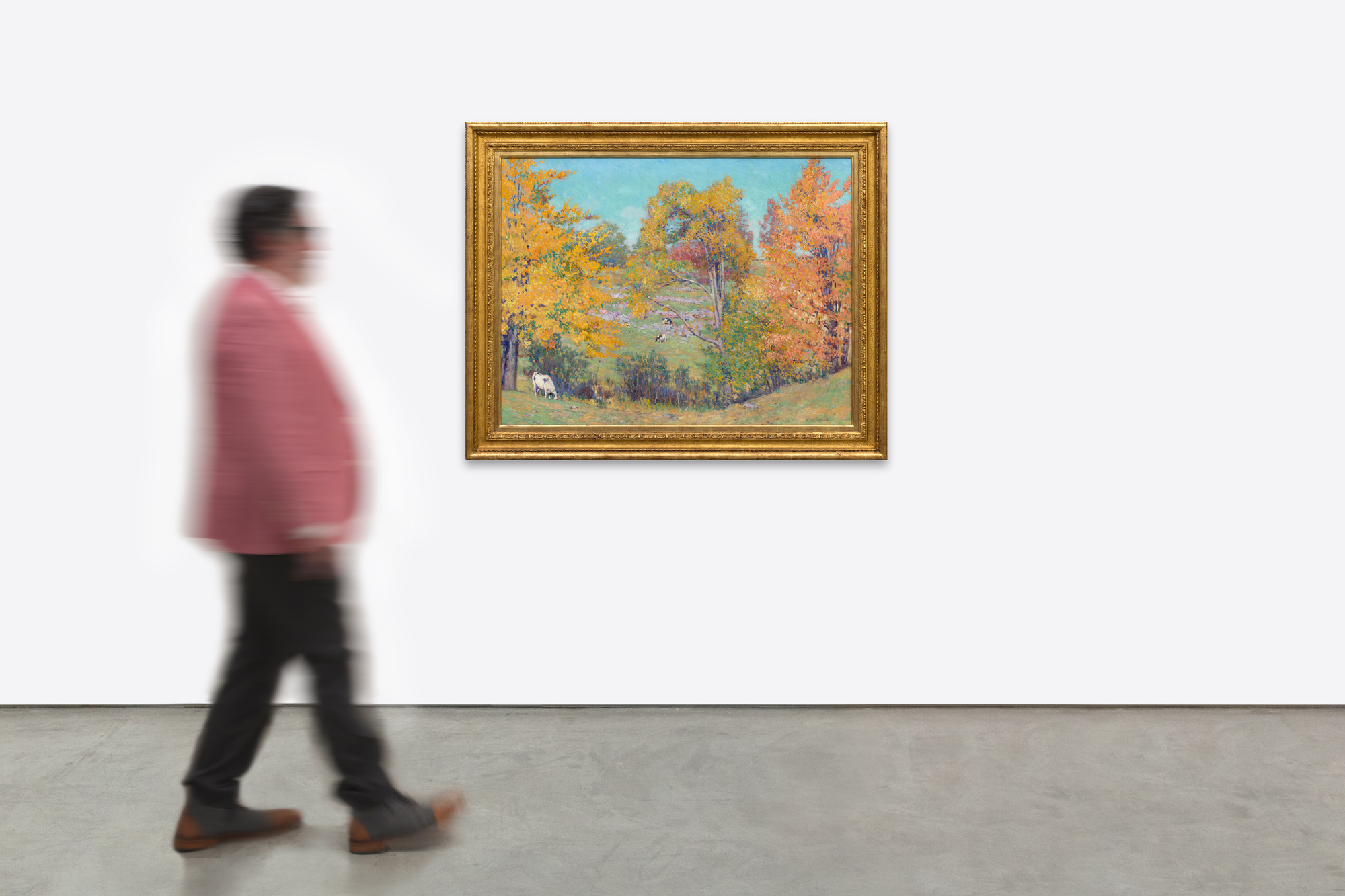
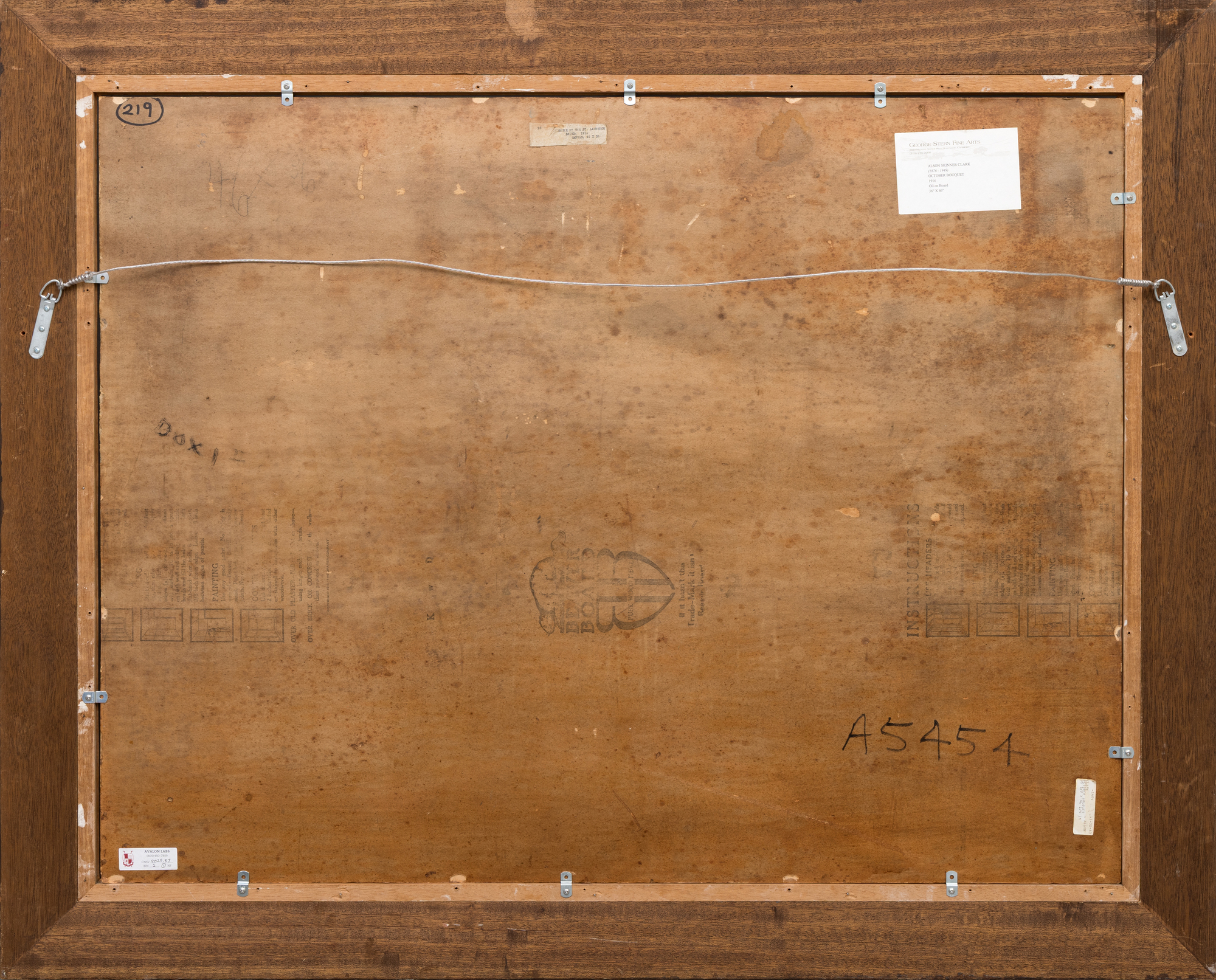
Otoño, río San Lorenzo191635 x 46 pulgadas(88,9 x 116,84 cm) Óleo sobre tabla
Procedencia
Patrimonio del artista
Petersen Galleries, Beverly Hills, California (como «October Bouquet»)
con George Stern Fine Art, West Hollywood, California (como «October Bouquet»)
Heritage Auctions, Beverly Hills, California, subasta Art Signature, 20 de marzo de 2012, lote 87023
Colección privada, California, adquirida de la anterior
Literatura
Jean Stern, Alson S. Clark, Beverly Hills, California, 1983, p. 79, n.º 33 (ilustrado).
Otoño, río San Lorenzo (1916), de Alson Clark, es una celebración del color estacional y la seguridad pictórica, creada durante un verano muy productivo que pasó a orillas del río San Lorenzo. Pintada en un momento de máxima confianza, la obra sigue de cerca el gran éxito del artista en la Exposición Internacional Panamá-Pacífico, donde Clark llenó toda una sala de exposiciones con sus pinturas, un logro que consolidó firmemente su reputación y su impulso en esta etapa de su carrera.


La composición se desarrolla a lo largo de un paisaje suavemente ondulado, animado por el esplendor del comienzo del otoño. Los árboles resplandecen con amarillos saturados, naranjas y rojos suaves, y su follaje se representa con pinceladas impresionistas entrecortadas contra un cielo azul claro y luminoso. El manejo seguro de la pintura por parte de Clark permite que el color transmita la forma, creando una sensación de profundidad a través de pasajes superpuestos. Pequeñas reses pastando salpican la ladera, aportando escala y una nota tranquila de vida pastoral que ancla la composición sin interrumpir su ritmo cromático.


Clark fue célebre por su capacidad para fusionar la pintura paisajística estadounidense con las lecciones extraídas del impresionismo europeo, y esta obra ejemplifica esa síntesis. La superficie sigue siendo viva y táctil, con pinceladas visibles que transmiten movimiento y atmósfera, al tiempo que mantienen la armonía compositiva. Otoño, río San Lorenzo refleja no solo el dominio del color y la luz por parte del artista, sino también la visión segura de un pintor totalmente cómodo con su tema, que transforma un lugar y un momento concretos en una expresión atemporal de la abundancia estacional.
Preguntar