JOSEPH KLEITSCH (1882-1931)

$275,000
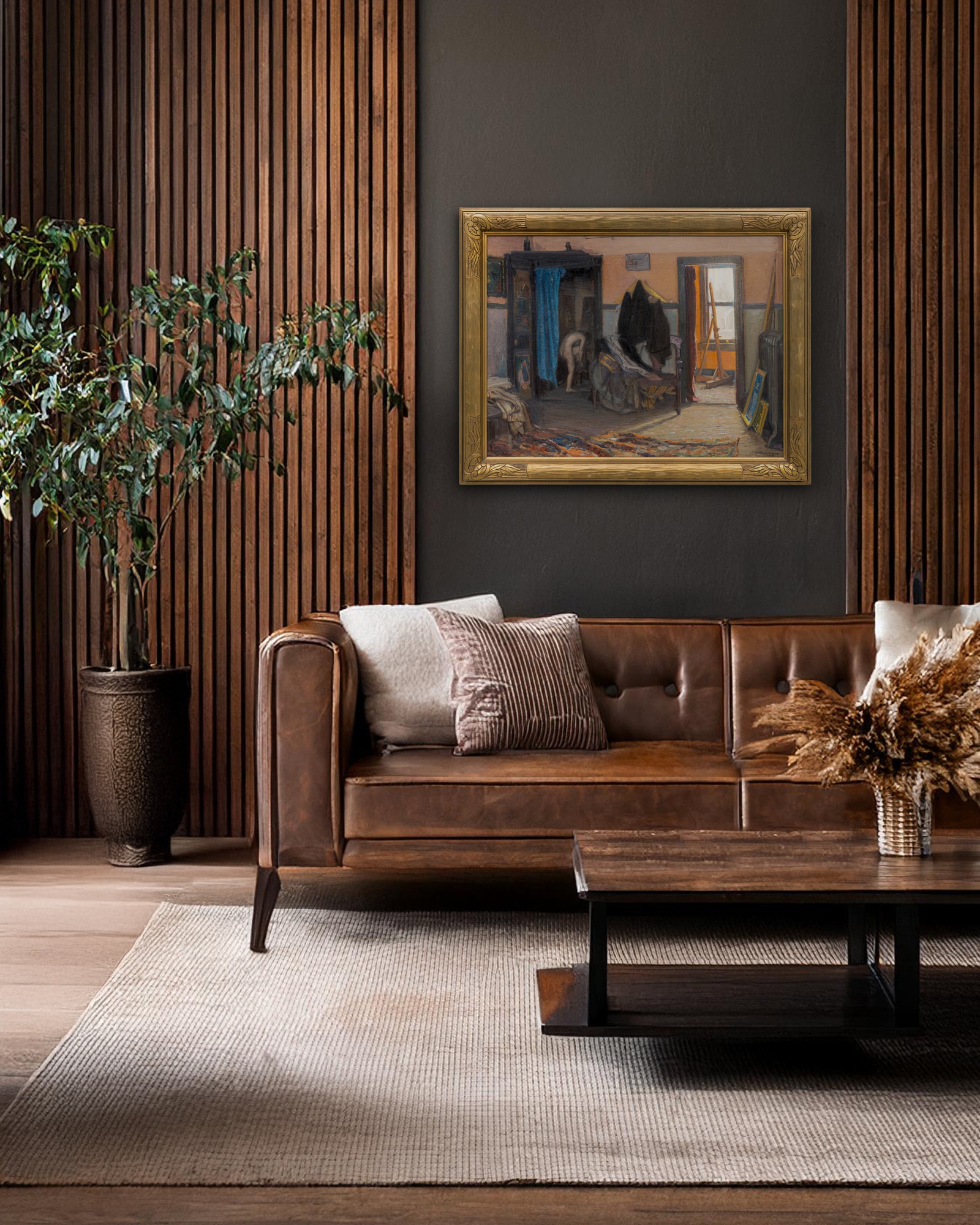
 
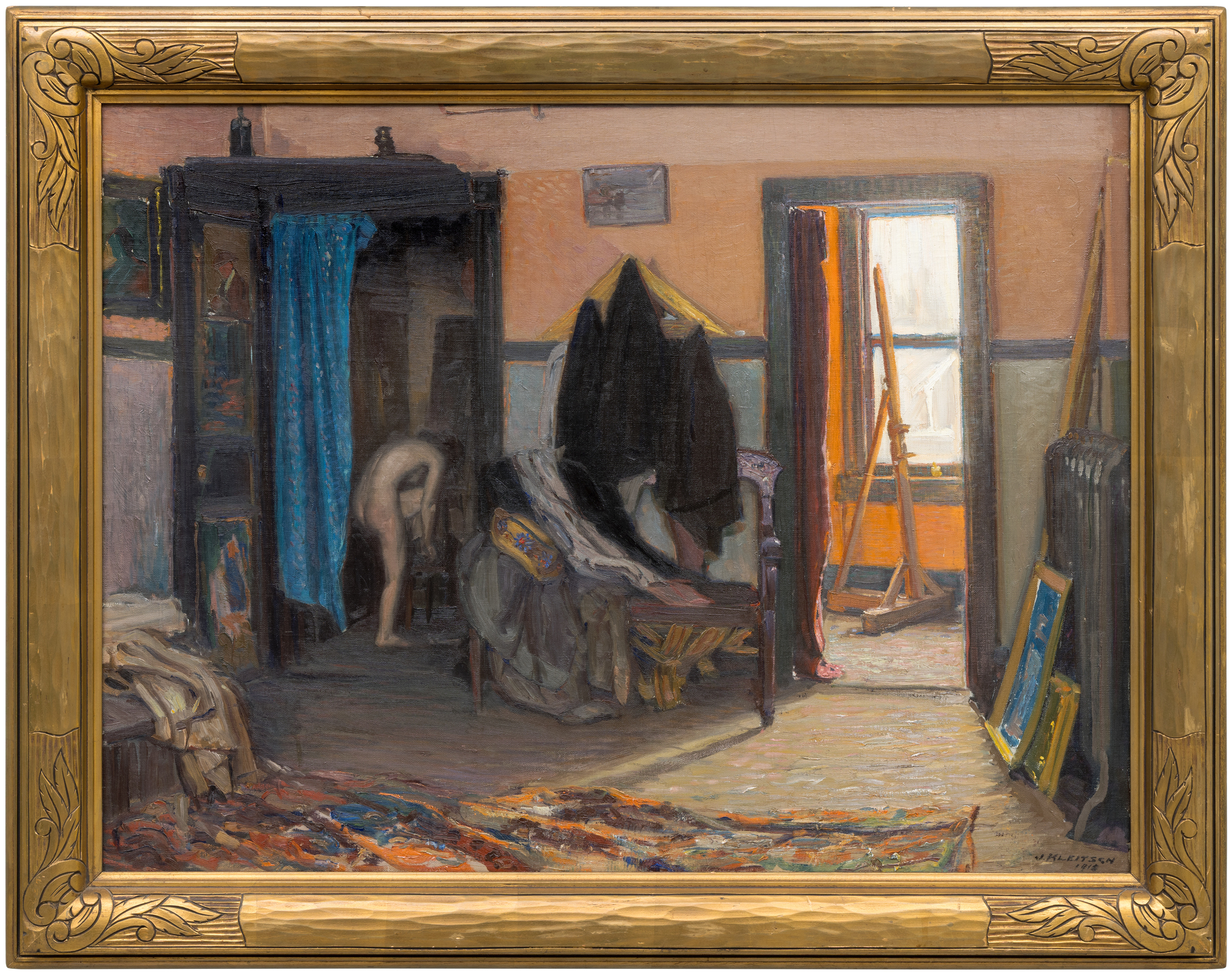
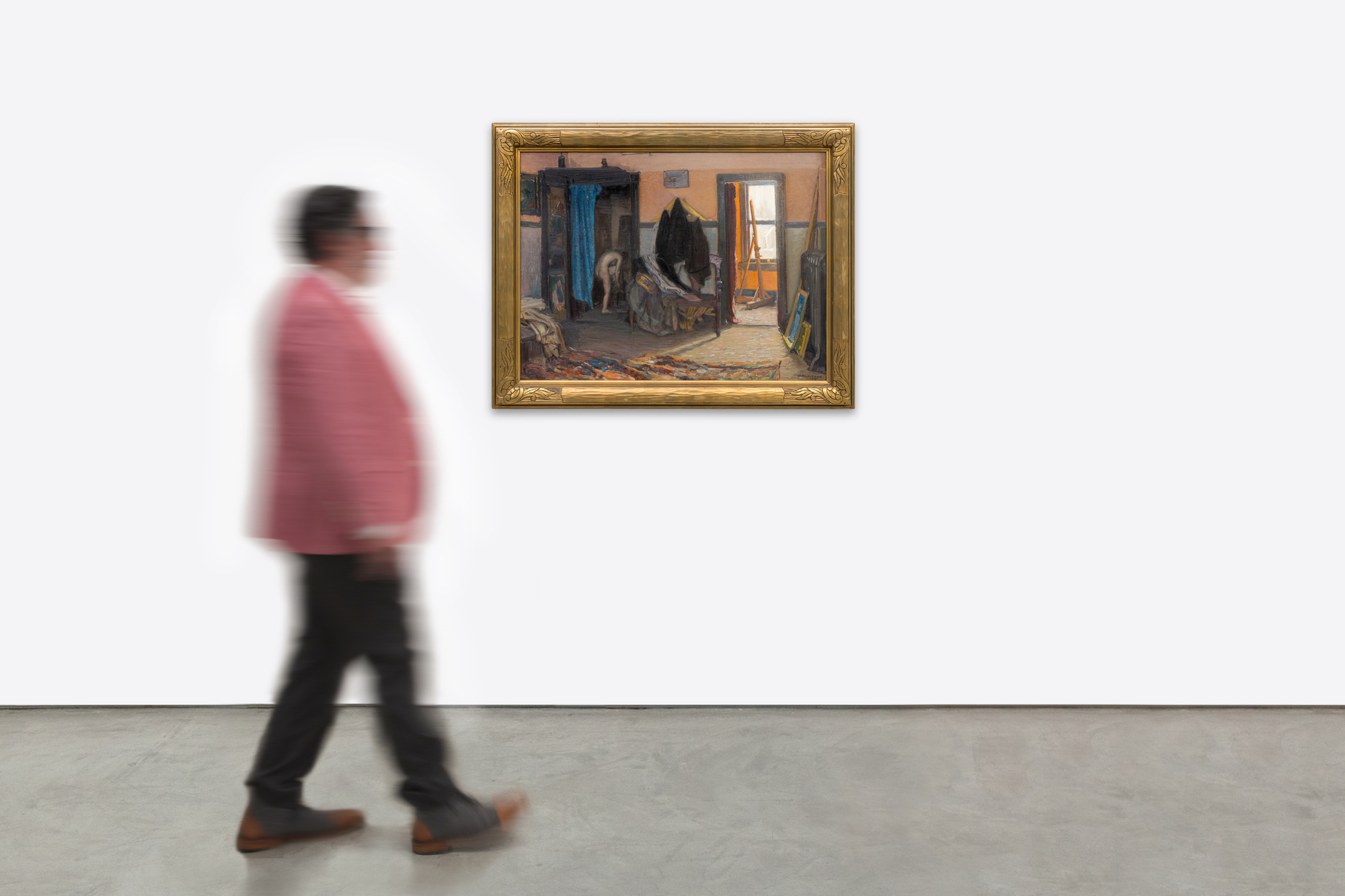
<div>Joseph Kleitsch’s <em>Studio Interior</em> (1918) is a compelling early work that reflects the artist’s academic-realist foundation and marks a pivotal moment just before his relocation from the Chicago to California. Painted shortly before this transition, the work reveals Kleitsch’s disciplined approach to composition and observation, shaped by his rigorous training in Budapest, Munich, and Paris. The scene depicts a quiet, lived-in studio space, where light enters through an open doorway to animate furniture, canvases, and everyday objects with a subdued yet attentive handling of color and tone. </div><br><br><div> </div><br><br><div>The interior is constructed with careful spatial logic and an emphasis on structure, underscoring Kleitsch’s preference for academic realism at this stage of his career. While in Chicago, his portrait and interior scenes were often distinguished by a “jeweled” palette—rich, saturated hues deployed with restraint—and that sensibility is evident here in the layered colors that enliven the otherwise low-keyed room. Subtle shifts in light guide the eye through the composition, balancing chromatic richness with solidity and calm. </div><br><br><div> </div><br><br><div>In the years leading up to his move west, Kleitsch was actively involved with Chicago’s artistic institutions, including the Palette and Chisel Club and the Art Institute of Chicago, situating him within a dynamic environment of evolving modern influences. During this time, Impressionist and Post-Impressionist works were increasingly visible in American exhibitions. While Kleitsch maintains a measured realism here, the Impressionist influence was incubating; he would later become renowned as a “master of gorgeous color” owing to the high-keyed vibrant palette of his California landscapes. </div><br><br><div> </div><br><br><div><em>Studio Interior</em> has been exhibited twice, both times in California, as part of exhibitions highlighting Kleitsch’s importance to the history of California art. Seen in retrospect, the painting offers a revealing glimpse of the artist’s roots before his later, more luminous California landscapes would come to define his legacy. </div><br><br><div> </div><br><br><div> </div> <div>Joseph Kleitsch’s <em>Studio Interior</em> (1918) is a compelling early work that reflects the artist’s academic-realist foundation and marks a pivotal moment just before his relocation from the Chicago to California. Painted shortly before this transition, the work reveals Kleitsch’s disciplined approach to composition and observation, shaped by his rigorous training in Budapest, Munich, and Paris. The scene depicts a quiet, lived-in studio space, where light enters through an open doorway to animate furniture, canvases, and everyday objects with a subdued yet attentive handling of color and tone. </div><br><br><div> </div><br><br><div>The interior is constructed with careful spatial logic and an emphasis on structure, underscoring Kleitsch’s preference for academic realism at this stage of his career. While in Chicago, his portrait and interior scenes were often distinguished by a “jeweled” palette—rich, saturated hues deployed with restraint—and that sensibility is evident here in the layered colors that enliven the otherwise low-keyed room. Subtle shifts in light guide the eye through the composition, balancing chromatic richness with solidity and calm. </div><br><br><div> </div><br><br><div>In the years leading up to his move west, Kleitsch was actively involved with Chicago’s artistic institutions, including the Palette and Chisel Club and the Art Institute of Chicago, situating him within a dynamic environment of evolving modern influences. During this time, Impressionist and Post-Impressionist works were increasingly visible in American exhibitions. While Kleitsch maintains a measured realism here, the Impressionist influence was incubating; he would later become renowned as a “master of gorgeous color” owing to the high-keyed vibrant palette of his California landscapes. </div><br><br><div> </div><br><br><div><em>Studio Interior</em> has been exhibited twice, both times in California, as part of exhibitions highlighting Kleitsch’s importance to the history of California art. Seen in retrospect, the painting offers a revealing glimpse of the artist’s roots before his later, more luminous California landscapes would come to define his legacy. </div><br><br><div> </div><br><br><div> </div> <div>Joseph Kleitsch’s <em>Studio Interior</em> (1918) is a compelling early work that reflects the artist’s academic-realist foundation and marks a pivotal moment just before his relocation from the Chicago to California. Painted shortly before this transition, the work reveals Kleitsch’s disciplined approach to composition and observation, shaped by his rigorous training in Budapest, Munich, and Paris. The scene depicts a quiet, lived-in studio space, where light enters through an open doorway to animate furniture, canvases, and everyday objects with a subdued yet attentive handling of color and tone. </div><br><br><div> </div><br><br><div>The interior is constructed with careful spatial logic and an emphasis on structure, underscoring Kleitsch’s preference for academic realism at this stage of his career. While in Chicago, his portrait and interior scenes were often distinguished by a “jeweled” palette—rich, saturated hues deployed with restraint—and that sensibility is evident here in the layered colors that enliven the otherwise low-keyed room. Subtle shifts in light guide the eye through the composition, balancing chromatic richness with solidity and calm. </div><br><br><div> </div><br><br><div>In the years leading up to his move west, Kleitsch was actively involved with Chicago’s artistic institutions, including the Palette and Chisel Club and the Art Institute of Chicago, situating him within a dynamic environment of evolving modern influences. During this time, Impressionist and Post-Impressionist works were increasingly visible in American exhibitions. While Kleitsch maintains a measured realism here, the Impressionist influence was incubating; he would later become renowned as a “master of gorgeous color” owing to the high-keyed vibrant palette of his California landscapes. </div><br><br><div> </div><br><br><div><em>Studio Interior</em> has been exhibited twice, both times in California, as part of exhibitions highlighting Kleitsch’s importance to the history of California art. Seen in retrospect, the painting offers a revealing glimpse of the artist’s roots before his later, more luminous California landscapes would come to define his legacy. </div><br><br><div> </div><br><br><div> </div> <div>Joseph Kleitsch’s <em>Studio Interior</em> (1918) is a compelling early work that reflects the artist’s academic-realist foundation and marks a pivotal moment just before his relocation from the Chicago to California. Painted shortly before this transition, the work reveals Kleitsch’s disciplined approach to composition and observation, shaped by his rigorous training in Budapest, Munich, and Paris. The scene depicts a quiet, lived-in studio space, where light enters through an open doorway to animate furniture, canvases, and everyday objects with a subdued yet attentive handling of color and tone. </div><br><br><div> </div><br><br><div>The interior is constructed with careful spatial logic and an emphasis on structure, underscoring Kleitsch’s preference for academic realism at this stage of his career. While in Chicago, his portrait and interior scenes were often distinguished by a “jeweled” palette—rich, saturated hues deployed with restraint—and that sensibility is evident here in the layered colors that enliven the otherwise low-keyed room. Subtle shifts in light guide the eye through the composition, balancing chromatic richness with solidity and calm. </div><br><br><div> </div><br><br><div>In the years leading up to his move west, Kleitsch was actively involved with Chicago’s artistic institutions, including the Palette and Chisel Club and the Art Institute of Chicago, situating him within a dynamic environment of evolving modern influences. During this time, Impressionist and Post-Impressionist works were increasingly visible in American exhibitions. While Kleitsch maintains a measured realism here, the Impressionist influence was incubating; he would later become renowned as a “master of gorgeous color” owing to the high-keyed vibrant palette of his California landscapes. </div><br><br><div> </div><br><br><div><em>Studio Interior</em> has been exhibited twice, both times in California, as part of exhibitions highlighting Kleitsch’s importance to the history of California art. Seen in retrospect, the painting offers a revealing glimpse of the artist’s roots before his later, more luminous California landscapes would come to define his legacy. </div><br><br><div> </div><br><br><div> </div> <div>Joseph Kleitsch’s <em>Studio Interior</em> (1918) is a compelling early work that reflects the artist’s academic-realist foundation and marks a pivotal moment just before his relocation from the Chicago to California. Painted shortly before this transition, the work reveals Kleitsch’s disciplined approach to composition and observation, shaped by his rigorous training in Budapest, Munich, and Paris. The scene depicts a quiet, lived-in studio space, where light enters through an open doorway to animate furniture, canvases, and everyday objects with a subdued yet attentive handling of color and tone. </div><br><br><div> </div><br><br><div>The interior is constructed with careful spatial logic and an emphasis on structure, underscoring Kleitsch’s preference for academic realism at this stage of his career. While in Chicago, his portrait and interior scenes were often distinguished by a “jeweled” palette—rich, saturated hues deployed with restraint—and that sensibility is evident here in the layered colors that enliven the otherwise low-keyed room. Subtle shifts in light guide the eye through the composition, balancing chromatic richness with solidity and calm. </div><br><br><div> </div><br><br><div>In the years leading up to his move west, Kleitsch was actively involved with Chicago’s artistic institutions, including the Palette and Chisel Club and the Art Institute of Chicago, situating him within a dynamic environment of evolving modern influences. During this time, Impressionist and Post-Impressionist works were increasingly visible in American exhibitions. While Kleitsch maintains a measured realism here, the Impressionist influence was incubating; he would later become renowned as a “master of gorgeous color” owing to the high-keyed vibrant palette of his California landscapes. </div><br><br><div> </div><br><br><div><em>Studio Interior</em> has been exhibited twice, both times in California, as part of exhibitions highlighting Kleitsch’s importance to the history of California art. Seen in retrospect, the painting offers a revealing glimpse of the artist’s roots before his later, more luminous California landscapes would come to define his legacy. </div><br><br><div> </div><br><br><div> </div> <div>Joseph Kleitsch’s <em>Studio Interior</em> (1918) is a compelling early work that reflects the artist’s academic-realist foundation and marks a pivotal moment just before his relocation from the Chicago to California. Painted shortly before this transition, the work reveals Kleitsch’s disciplined approach to composition and observation, shaped by his rigorous training in Budapest, Munich, and Paris. The scene depicts a quiet, lived-in studio space, where light enters through an open doorway to animate furniture, canvases, and everyday objects with a subdued yet attentive handling of color and tone. </div><br><br><div> </div><br><br><div>The interior is constructed with careful spatial logic and an emphasis on structure, underscoring Kleitsch’s preference for academic realism at this stage of his career. While in Chicago, his portrait and interior scenes were often distinguished by a “jeweled” palette—rich, saturated hues deployed with restraint—and that sensibility is evident here in the layered colors that enliven the otherwise low-keyed room. Subtle shifts in light guide the eye through the composition, balancing chromatic richness with solidity and calm. </div><br><br><div> </div><br><br><div>In the years leading up to his move west, Kleitsch was actively involved with Chicago’s artistic institutions, including the Palette and Chisel Club and the Art Institute of Chicago, situating him within a dynamic environment of evolving modern influences. During this time, Impressionist and Post-Impressionist works were increasingly visible in American exhibitions. While Kleitsch maintains a measured realism here, the Impressionist influence was incubating; he would later become renowned as a “master of gorgeous color” owing to the high-keyed vibrant palette of his California landscapes. </div><br><br><div> </div><br><br><div><em>Studio Interior</em> has been exhibited twice, both times in California, as part of exhibitions highlighting Kleitsch’s importance to the history of California art. Seen in retrospect, the painting offers a revealing glimpse of the artist’s roots before his later, more luminous California landscapes would come to define his legacy. </div><br><br><div> </div><br><br><div> </div> <div>Joseph Kleitsch’s <em>Studio Interior</em> (1918) is a compelling early work that reflects the artist’s academic-realist foundation and marks a pivotal moment just before his relocation from the Chicago to California. Painted shortly before this transition, the work reveals Kleitsch’s disciplined approach to composition and observation, shaped by his rigorous training in Budapest, Munich, and Paris. The scene depicts a quiet, lived-in studio space, where light enters through an open doorway to animate furniture, canvases, and everyday objects with a subdued yet attentive handling of color and tone. </div><br><br><div> </div><br><br><div>The interior is constructed with careful spatial logic and an emphasis on structure, underscoring Kleitsch’s preference for academic realism at this stage of his career. While in Chicago, his portrait and interior scenes were often distinguished by a “jeweled” palette—rich, saturated hues deployed with restraint—and that sensibility is evident here in the layered colors that enliven the otherwise low-keyed room. Subtle shifts in light guide the eye through the composition, balancing chromatic richness with solidity and calm. </div><br><br><div> </div><br><br><div>In the years leading up to his move west, Kleitsch was actively involved with Chicago’s artistic institutions, including the Palette and Chisel Club and the Art Institute of Chicago, situating him within a dynamic environment of evolving modern influences. During this time, Impressionist and Post-Impressionist works were increasingly visible in American exhibitions. While Kleitsch maintains a measured realism here, the Impressionist influence was incubating; he would later become renowned as a “master of gorgeous color” owing to the high-keyed vibrant palette of his California landscapes. </div><br><br><div> </div><br><br><div><em>Studio Interior</em> has been exhibited twice, both times in California, as part of exhibitions highlighting Kleitsch’s importance to the history of California art. Seen in retrospect, the painting offers a revealing glimpse of the artist’s roots before his later, more luminous California landscapes would come to define his legacy. </div><br><br><div> </div><br><br><div> </div> <div>Joseph Kleitsch’s <em>Studio Interior</em> (1918) is a compelling early work that reflects the artist’s academic-realist foundation and marks a pivotal moment just before his relocation from the Chicago to California. Painted shortly before this transition, the work reveals Kleitsch’s disciplined approach to composition and observation, shaped by his rigorous training in Budapest, Munich, and Paris. The scene depicts a quiet, lived-in studio space, where light enters through an open doorway to animate furniture, canvases, and everyday objects with a subdued yet attentive handling of color and tone. </div><br><br><div> </div><br><br><div>The interior is constructed with careful spatial logic and an emphasis on structure, underscoring Kleitsch’s preference for academic realism at this stage of his career. While in Chicago, his portrait and interior scenes were often distinguished by a “jeweled” palette—rich, saturated hues deployed with restraint—and that sensibility is evident here in the layered colors that enliven the otherwise low-keyed room. Subtle shifts in light guide the eye through the composition, balancing chromatic richness with solidity and calm. </div><br><br><div> </div><br><br><div>In the years leading up to his move west, Kleitsch was actively involved with Chicago’s artistic institutions, including the Palette and Chisel Club and the Art Institute of Chicago, situating him within a dynamic environment of evolving modern influences. During this time, Impressionist and Post-Impressionist works were increasingly visible in American exhibitions. While Kleitsch maintains a measured realism here, the Impressionist influence was incubating; he would later become renowned as a “master of gorgeous color” owing to the high-keyed vibrant palette of his California landscapes. </div><br><br><div> </div><br><br><div><em>Studio Interior</em> has been exhibited twice, both times in California, as part of exhibitions highlighting Kleitsch’s importance to the history of California art. Seen in retrospect, the painting offers a revealing glimpse of the artist’s roots before his later, more luminous California landscapes would come to define his legacy. </div><br><br><div> </div><br><br><div> </div> <div>Joseph Kleitsch’s <em>Studio Interior</em> (1918) is a compelling early work that reflects the artist’s academic-realist foundation and marks a pivotal moment just before his relocation from the Chicago to California. Painted shortly before this transition, the work reveals Kleitsch’s disciplined approach to composition and observation, shaped by his rigorous training in Budapest, Munich, and Paris. The scene depicts a quiet, lived-in studio space, where light enters through an open doorway to animate furniture, canvases, and everyday objects with a subdued yet attentive handling of color and tone. </div><br><br><div> </div><br><br><div>The interior is constructed with careful spatial logic and an emphasis on structure, underscoring Kleitsch’s preference for academic realism at this stage of his career. While in Chicago, his portrait and interior scenes were often distinguished by a “jeweled” palette—rich, saturated hues deployed with restraint—and that sensibility is evident here in the layered colors that enliven the otherwise low-keyed room. Subtle shifts in light guide the eye through the composition, balancing chromatic richness with solidity and calm. </div><br><br><div> </div><br><br><div>In the years leading up to his move west, Kleitsch was actively involved with Chicago’s artistic institutions, including the Palette and Chisel Club and the Art Institute of Chicago, situating him within a dynamic environment of evolving modern influences. During this time, Impressionist and Post-Impressionist works were increasingly visible in American exhibitions. While Kleitsch maintains a measured realism here, the Impressionist influence was incubating; he would later become renowned as a “master of gorgeous color” owing to the high-keyed vibrant palette of his California landscapes. </div><br><br><div> </div><br><br><div><em>Studio Interior</em> has been exhibited twice, both times in California, as part of exhibitions highlighting Kleitsch’s importance to the history of California art. Seen in retrospect, the painting offers a revealing glimpse of the artist’s roots before his later, more luminous California landscapes would come to define his legacy. </div><br><br><div> </div><br><br><div> </div> <div>Joseph Kleitsch’s <em>Studio Interior</em> (1918) is a compelling early work that reflects the artist’s academic-realist foundation and marks a pivotal moment just before his relocation from the Chicago to California. Painted shortly before this transition, the work reveals Kleitsch’s disciplined approach to composition and observation, shaped by his rigorous training in Budapest, Munich, and Paris. The scene depicts a quiet, lived-in studio space, where light enters through an open doorway to animate furniture, canvases, and everyday objects with a subdued yet attentive handling of color and tone. </div><br><br><div> </div><br><br><div>The interior is constructed with careful spatial logic and an emphasis on structure, underscoring Kleitsch’s preference for academic realism at this stage of his career. While in Chicago, his portrait and interior scenes were often distinguished by a “jeweled” palette—rich, saturated hues deployed with restraint—and that sensibility is evident here in the layered colors that enliven the otherwise low-keyed room. Subtle shifts in light guide the eye through the composition, balancing chromatic richness with solidity and calm. </div><br><br><div> </div><br><br><div>In the years leading up to his move west, Kleitsch was actively involved with Chicago’s artistic institutions, including the Palette and Chisel Club and the Art Institute of Chicago, situating him within a dynamic environment of evolving modern influences. During this time, Impressionist and Post-Impressionist works were increasingly visible in American exhibitions. While Kleitsch maintains a measured realism here, the Impressionist influence was incubating; he would later become renowned as a “master of gorgeous color” owing to the high-keyed vibrant palette of his California landscapes. </div><br><br><div> </div><br><br><div><em>Studio Interior</em> has been exhibited twice, both times in California, as part of exhibitions highlighting Kleitsch’s importance to the history of California art. Seen in retrospect, the painting offers a revealing glimpse of the artist’s roots before his later, more luminous California landscapes would come to define his legacy. </div><br><br><div> </div><br><br><div> </div>
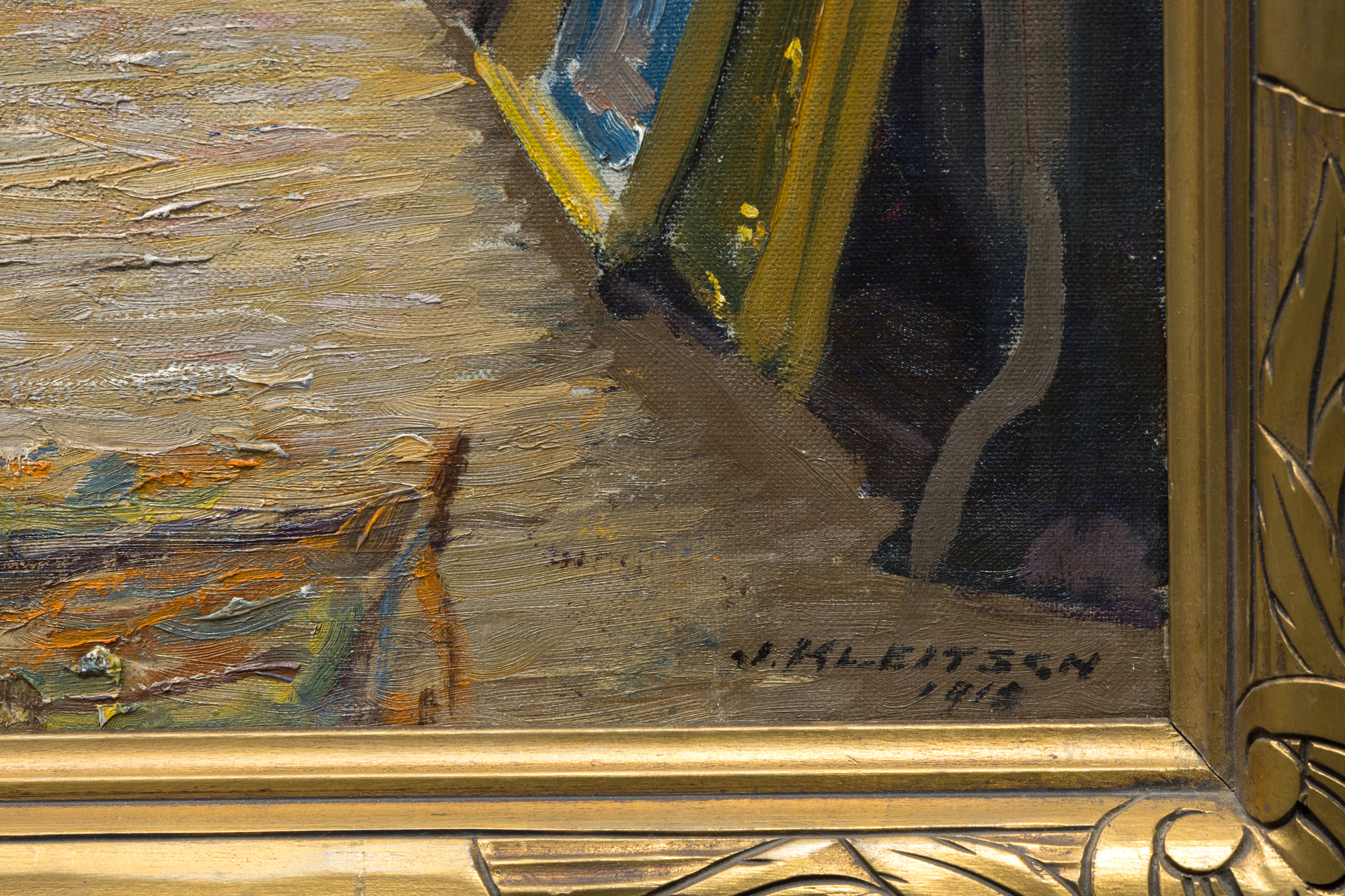
Interior del estudio191876,2 x 101,6 cm(76,2 x 101,6 cm) Óleo sobre lienzo
Procedencia
George Stern Fine Arts
Colección privada, adquirida al anterior, 2012
Exposición
Pasadena, California, Museo de Arte de California de Pasadena, Los dorados años veinte: Retratos y pinturas figurativas de Joseph Kleitsch, del 5 de marzo al 6 de agosto de 2017.
Laguna Beach, California, Museo de Arte de Laguna, Joseph Kleitsch: En el extranjero y en casa en Old Laguna, del 24 de junio al 24 de septiembre de 2023.
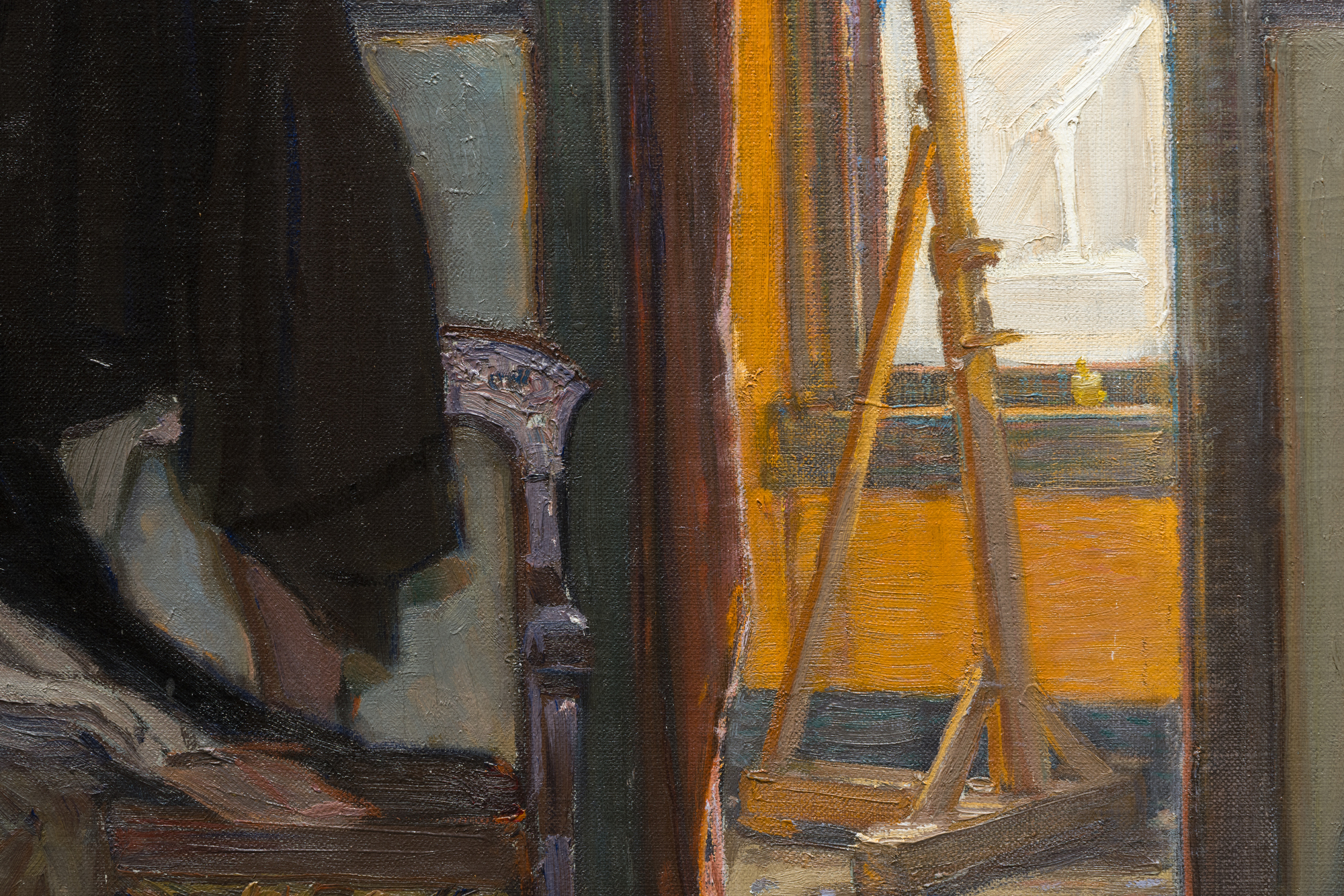
El interior del estudio de Joseph Kleitsch (1918) es una obra temprana fascinante que refleja la formación académica y realista del artista y marca un momento crucial justo antes de su traslado de Chicago a California. Pintada poco antes de esta transición, la obra revela el enfoque disciplinado de Kleitsch hacia la composición y la observación, moldeado por su rigurosa formación en Budapest, Múnich y París. La escena representa un estudio tranquilo y habitado, donde la luz entra por una puerta abierta para animar los muebles, los lienzos y los objetos cotidianos con un manejo sobrio pero atento del color y el tono.


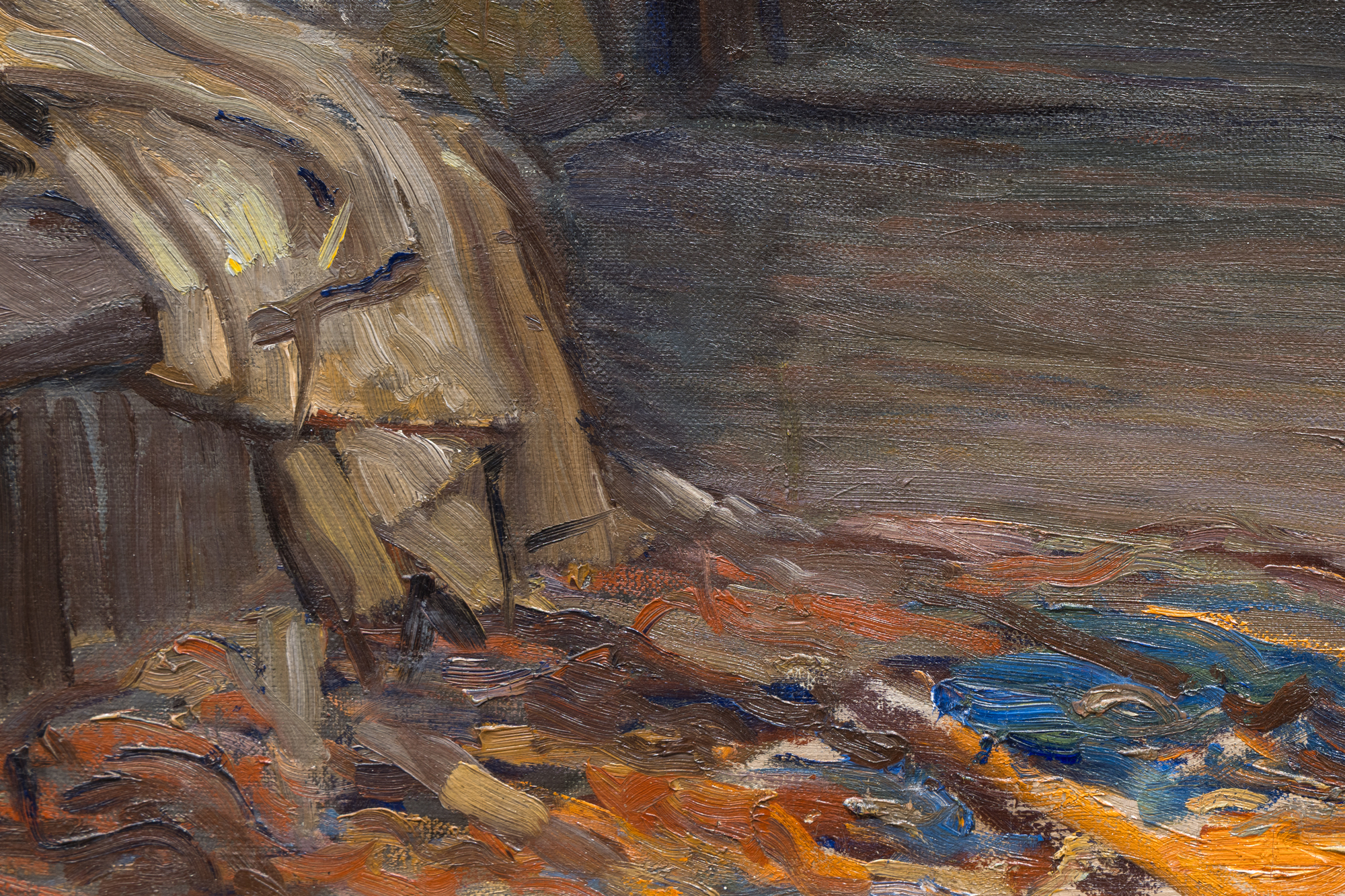
El interior está construido con una cuidadosa lógica espacial y un énfasis en la estructura, lo que subraya la preferencia de Kleitsch por el realismo académico en esta etapa de su carrera. Durante su estancia en Chicago, sus retratos y escenas de interiores se distinguían a menudo por una paleta «joyosa», con tonos ricos y saturados utilizados con moderación, y esa sensibilidad es evidente aquí en los colores superpuestos que animan la habitación, por lo demás discreta. Los sutiles cambios de luz guían la mirada a través de la composición, equilibrando la riqueza cromática con la solidez y la calma.


En los años previos a su traslado al oeste, Kleitsch participó activamente en las instituciones artísticas de Chicago, como el Palette and Chisel Club y el Art Institute of Chicago, lo que le situó en un entorno dinámico de influencias modernas en constante evolución. Durante este tiempo, las obras impresionistas y posimpresionistas eran cada vez más visibles en las exposiciones estadounidenses. Aunque Kleitsch mantiene aquí un realismo mesurado, la influencia impresionista estaba incubándose; más tarde se haría famoso como «maestro del color magnífico» gracias a la paleta vibrante y brillante de sus paisajes californianos.


Studio Interior se ha expuesto dos veces, ambas en California, como parte de exposiciones que destacan la importancia de Kleitsch en la historia del arte californiano. En retrospectiva, la pintura ofrece una reveladora visión de las raíces del artista antes de que sus paisajes californianos posteriores, más luminosos, llegaran a definir su legado.


Preguntar