



Atrás

LEON POLK SMITH(1906-1996)

 
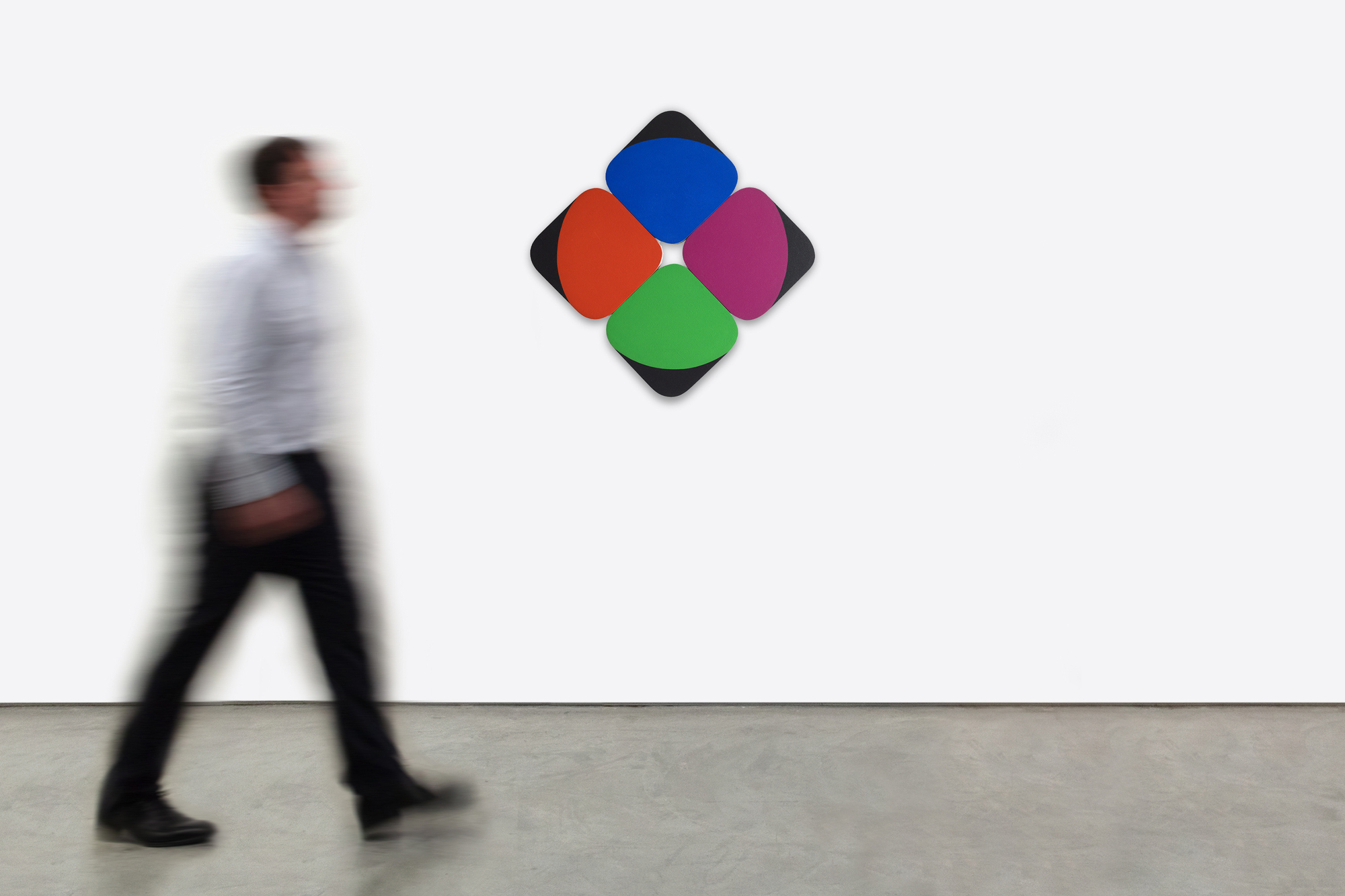
<div><font face=Lato size=3>Leon Polk Smith’s "Constellation Blue Violet Green Red" (1968) is a striking example of the artist’s radical exploration of form and color in postwar abstraction. Executed in acrylic on canvas, the work consists of four rounded-square panels arranged in a diamond formation. Each panel bears a crisp division of color: black at the outer edge, paired with one of four luminous hues—blue, violet, green, and red—creating a rhythmic interplay of symmetry and variation. </font></div><br><br><div><font face=Lato size=3> </font></div><br><br><div><font face=Lato size=3>Smith was a central figure in the development of hard-edge painting and geometric abstraction, aligned with contemporaries such as Ellsworth Kelly and Carmen Herrera. His "Constellation" series, begun in the 1960s, was groundbreaking for its use of multiple shaped canvases installed directly on the wall, eschewing traditional frames in favor of compositions that expand dynamically into surrounding space. </font></div><br><br><div><font face=Lato size=3> </font></div><br><br><div><font face=Lato size=3>While Smith was highly prolific in both works on paper and monumental single-panel paintings, multi-panel "Constellation" works remain less common within his oeuvre. Today, his paintings are represented in major institutions including The Museum of Modern Art, the Whitney Museum of American Art, and the Brooklyn Museum. In "Constellation Blue Violet Green Red", the clarity of Smith’s vision is on full display—color and geometry united in a constellation that feels both precise and expansive, disciplined yet alive with visual energy. </font></div> <div><font face=Lato size=3>Leon Polk Smith’s "Constellation Blue Violet Green Red" (1968) is a striking example of the artist’s radical exploration of form and color in postwar abstraction. Executed in acrylic on canvas, the work consists of four rounded-square panels arranged in a diamond formation. Each panel bears a crisp division of color: black at the outer edge, paired with one of four luminous hues—blue, violet, green, and red—creating a rhythmic interplay of symmetry and variation. </font></div><br><br><div><font face=Lato size=3> </font></div><br><br><div><font face=Lato size=3>Smith was a central figure in the development of hard-edge painting and geometric abstraction, aligned with contemporaries such as Ellsworth Kelly and Carmen Herrera. His "Constellation" series, begun in the 1960s, was groundbreaking for its use of multiple shaped canvases installed directly on the wall, eschewing traditional frames in favor of compositions that expand dynamically into surrounding space. </font></div><br><br><div><font face=Lato size=3> </font></div><br><br><div><font face=Lato size=3>While Smith was highly prolific in both works on paper and monumental single-panel paintings, multi-panel "Constellation" works remain less common within his oeuvre. Today, his paintings are represented in major institutions including The Museum of Modern Art, the Whitney Museum of American Art, and the Brooklyn Museum. In "Constellation Blue Violet Green Red", the clarity of Smith’s vision is on full display—color and geometry united in a constellation that feels both precise and expansive, disciplined yet alive with visual energy. </font></div> <div><font face=Lato size=3>Leon Polk Smith’s "Constellation Blue Violet Green Red" (1968) is a striking example of the artist’s radical exploration of form and color in postwar abstraction. Executed in acrylic on canvas, the work consists of four rounded-square panels arranged in a diamond formation. Each panel bears a crisp division of color: black at the outer edge, paired with one of four luminous hues—blue, violet, green, and red—creating a rhythmic interplay of symmetry and variation. </font></div><br><br><div><font face=Lato size=3> </font></div><br><br><div><font face=Lato size=3>Smith was a central figure in the development of hard-edge painting and geometric abstraction, aligned with contemporaries such as Ellsworth Kelly and Carmen Herrera. His "Constellation" series, begun in the 1960s, was groundbreaking for its use of multiple shaped canvases installed directly on the wall, eschewing traditional frames in favor of compositions that expand dynamically into surrounding space. </font></div><br><br><div><font face=Lato size=3> </font></div><br><br><div><font face=Lato size=3>While Smith was highly prolific in both works on paper and monumental single-panel paintings, multi-panel "Constellation" works remain less common within his oeuvre. Today, his paintings are represented in major institutions including The Museum of Modern Art, the Whitney Museum of American Art, and the Brooklyn Museum. In "Constellation Blue Violet Green Red", the clarity of Smith’s vision is on full display—color and geometry united in a constellation that feels both precise and expansive, disciplined yet alive with visual energy. </font></div> <div><font face=Lato size=3>Leon Polk Smith’s "Constellation Blue Violet Green Red" (1968) is a striking example of the artist’s radical exploration of form and color in postwar abstraction. Executed in acrylic on canvas, the work consists of four rounded-square panels arranged in a diamond formation. Each panel bears a crisp division of color: black at the outer edge, paired with one of four luminous hues—blue, violet, green, and red—creating a rhythmic interplay of symmetry and variation. </font></div><br><br><div><font face=Lato size=3> </font></div><br><br><div><font face=Lato size=3>Smith was a central figure in the development of hard-edge painting and geometric abstraction, aligned with contemporaries such as Ellsworth Kelly and Carmen Herrera. His "Constellation" series, begun in the 1960s, was groundbreaking for its use of multiple shaped canvases installed directly on the wall, eschewing traditional frames in favor of compositions that expand dynamically into surrounding space. </font></div><br><br><div><font face=Lato size=3> </font></div><br><br><div><font face=Lato size=3>While Smith was highly prolific in both works on paper and monumental single-panel paintings, multi-panel "Constellation" works remain less common within his oeuvre. Today, his paintings are represented in major institutions including The Museum of Modern Art, the Whitney Museum of American Art, and the Brooklyn Museum. In "Constellation Blue Violet Green Red", the clarity of Smith’s vision is on full display—color and geometry united in a constellation that feels both precise and expansive, disciplined yet alive with visual energy. </font></div> <div><font face=Lato size=3>Leon Polk Smith’s "Constellation Blue Violet Green Red" (1968) is a striking example of the artist’s radical exploration of form and color in postwar abstraction. Executed in acrylic on canvas, the work consists of four rounded-square panels arranged in a diamond formation. Each panel bears a crisp division of color: black at the outer edge, paired with one of four luminous hues—blue, violet, green, and red—creating a rhythmic interplay of symmetry and variation. </font></div><br><br><div><font face=Lato size=3> </font></div><br><br><div><font face=Lato size=3>Smith was a central figure in the development of hard-edge painting and geometric abstraction, aligned with contemporaries such as Ellsworth Kelly and Carmen Herrera. His "Constellation" series, begun in the 1960s, was groundbreaking for its use of multiple shaped canvases installed directly on the wall, eschewing traditional frames in favor of compositions that expand dynamically into surrounding space. </font></div><br><br><div><font face=Lato size=3> </font></div><br><br><div><font face=Lato size=3>While Smith was highly prolific in both works on paper and monumental single-panel paintings, multi-panel "Constellation" works remain less common within his oeuvre. Today, his paintings are represented in major institutions including The Museum of Modern Art, the Whitney Museum of American Art, and the Brooklyn Museum. In "Constellation Blue Violet Green Red", the clarity of Smith’s vision is on full display—color and geometry united in a constellation that feels both precise and expansive, disciplined yet alive with visual energy. </font></div> <div><font face=Lato size=3>Leon Polk Smith’s "Constellation Blue Violet Green Red" (1968) is a striking example of the artist’s radical exploration of form and color in postwar abstraction. Executed in acrylic on canvas, the work consists of four rounded-square panels arranged in a diamond formation. Each panel bears a crisp division of color: black at the outer edge, paired with one of four luminous hues—blue, violet, green, and red—creating a rhythmic interplay of symmetry and variation. </font></div><br><br><div><font face=Lato size=3> </font></div><br><br><div><font face=Lato size=3>Smith was a central figure in the development of hard-edge painting and geometric abstraction, aligned with contemporaries such as Ellsworth Kelly and Carmen Herrera. His "Constellation" series, begun in the 1960s, was groundbreaking for its use of multiple shaped canvases installed directly on the wall, eschewing traditional frames in favor of compositions that expand dynamically into surrounding space. </font></div><br><br><div><font face=Lato size=3> </font></div><br><br><div><font face=Lato size=3>While Smith was highly prolific in both works on paper and monumental single-panel paintings, multi-panel "Constellation" works remain less common within his oeuvre. Today, his paintings are represented in major institutions including The Museum of Modern Art, the Whitney Museum of American Art, and the Brooklyn Museum. In "Constellation Blue Violet Green Red", the clarity of Smith’s vision is on full display—color and geometry united in a constellation that feels both precise and expansive, disciplined yet alive with visual energy. </font></div> <div><font face=Lato size=3>Leon Polk Smith’s "Constellation Blue Violet Green Red" (1968) is a striking example of the artist’s radical exploration of form and color in postwar abstraction. Executed in acrylic on canvas, the work consists of four rounded-square panels arranged in a diamond formation. Each panel bears a crisp division of color: black at the outer edge, paired with one of four luminous hues—blue, violet, green, and red—creating a rhythmic interplay of symmetry and variation. </font></div><br><br><div><font face=Lato size=3> </font></div><br><br><div><font face=Lato size=3>Smith was a central figure in the development of hard-edge painting and geometric abstraction, aligned with contemporaries such as Ellsworth Kelly and Carmen Herrera. His "Constellation" series, begun in the 1960s, was groundbreaking for its use of multiple shaped canvases installed directly on the wall, eschewing traditional frames in favor of compositions that expand dynamically into surrounding space. </font></div><br><br><div><font face=Lato size=3> </font></div><br><br><div><font face=Lato size=3>While Smith was highly prolific in both works on paper and monumental single-panel paintings, multi-panel "Constellation" works remain less common within his oeuvre. Today, his paintings are represented in major institutions including The Museum of Modern Art, the Whitney Museum of American Art, and the Brooklyn Museum. In "Constellation Blue Violet Green Red", the clarity of Smith’s vision is on full display—color and geometry united in a constellation that feels both precise and expansive, disciplined yet alive with visual energy. </font></div> <div><font face=Lato size=3>Leon Polk Smith’s "Constellation Blue Violet Green Red" (1968) is a striking example of the artist’s radical exploration of form and color in postwar abstraction. Executed in acrylic on canvas, the work consists of four rounded-square panels arranged in a diamond formation. Each panel bears a crisp division of color: black at the outer edge, paired with one of four luminous hues—blue, violet, green, and red—creating a rhythmic interplay of symmetry and variation. </font></div><br><br><div><font face=Lato size=3> </font></div><br><br><div><font face=Lato size=3>Smith was a central figure in the development of hard-edge painting and geometric abstraction, aligned with contemporaries such as Ellsworth Kelly and Carmen Herrera. His "Constellation" series, begun in the 1960s, was groundbreaking for its use of multiple shaped canvases installed directly on the wall, eschewing traditional frames in favor of compositions that expand dynamically into surrounding space. </font></div><br><br><div><font face=Lato size=3> </font></div><br><br><div><font face=Lato size=3>While Smith was highly prolific in both works on paper and monumental single-panel paintings, multi-panel "Constellation" works remain less common within his oeuvre. Today, his paintings are represented in major institutions including The Museum of Modern Art, the Whitney Museum of American Art, and the Brooklyn Museum. In "Constellation Blue Violet Green Red", the clarity of Smith’s vision is on full display—color and geometry united in a constellation that feels both precise and expansive, disciplined yet alive with visual energy. </font></div> <div><font face=Lato size=3>Leon Polk Smith’s "Constellation Blue Violet Green Red" (1968) is a striking example of the artist’s radical exploration of form and color in postwar abstraction. Executed in acrylic on canvas, the work consists of four rounded-square panels arranged in a diamond formation. Each panel bears a crisp division of color: black at the outer edge, paired with one of four luminous hues—blue, violet, green, and red—creating a rhythmic interplay of symmetry and variation. </font></div><br><br><div><font face=Lato size=3> </font></div><br><br><div><font face=Lato size=3>Smith was a central figure in the development of hard-edge painting and geometric abstraction, aligned with contemporaries such as Ellsworth Kelly and Carmen Herrera. His "Constellation" series, begun in the 1960s, was groundbreaking for its use of multiple shaped canvases installed directly on the wall, eschewing traditional frames in favor of compositions that expand dynamically into surrounding space. </font></div><br><br><div><font face=Lato size=3> </font></div><br><br><div><font face=Lato size=3>While Smith was highly prolific in both works on paper and monumental single-panel paintings, multi-panel "Constellation" works remain less common within his oeuvre. Today, his paintings are represented in major institutions including The Museum of Modern Art, the Whitney Museum of American Art, and the Brooklyn Museum. In "Constellation Blue Violet Green Red", the clarity of Smith’s vision is on full display—color and geometry united in a constellation that feels both precise and expansive, disciplined yet alive with visual energy. </font></div> <div><font face=Lato size=3>Leon Polk Smith’s "Constellation Blue Violet Green Red" (1968) is a striking example of the artist’s radical exploration of form and color in postwar abstraction. Executed in acrylic on canvas, the work consists of four rounded-square panels arranged in a diamond formation. Each panel bears a crisp division of color: black at the outer edge, paired with one of four luminous hues—blue, violet, green, and red—creating a rhythmic interplay of symmetry and variation. </font></div><br><br><div><font face=Lato size=3> </font></div><br><br><div><font face=Lato size=3>Smith was a central figure in the development of hard-edge painting and geometric abstraction, aligned with contemporaries such as Ellsworth Kelly and Carmen Herrera. His "Constellation" series, begun in the 1960s, was groundbreaking for its use of multiple shaped canvases installed directly on the wall, eschewing traditional frames in favor of compositions that expand dynamically into surrounding space. </font></div><br><br><div><font face=Lato size=3> </font></div><br><br><div><font face=Lato size=3>While Smith was highly prolific in both works on paper and monumental single-panel paintings, multi-panel "Constellation" works remain less common within his oeuvre. Today, his paintings are represented in major institutions including The Museum of Modern Art, the Whitney Museum of American Art, and the Brooklyn Museum. In "Constellation Blue Violet Green Red", the clarity of Smith’s vision is on full display—color and geometry united in a constellation that feels both precise and expansive, disciplined yet alive with visual energy. </font></div>
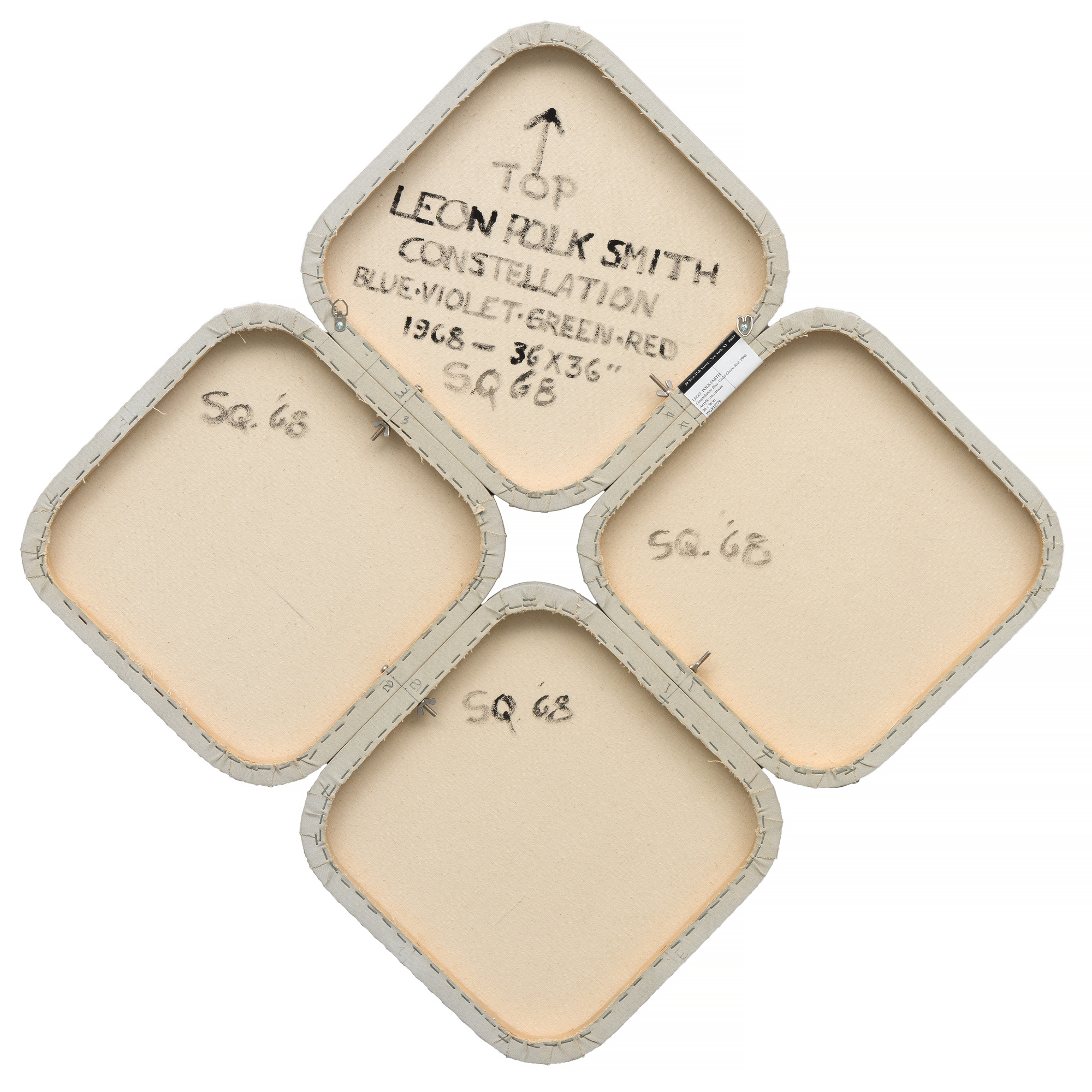
Constelación Azul Violeta Verde Rojo196836 x 36 1/4 pulgadas(91,44 x 92,08 cm) acrílico sobre lienzo
Procedencia
Lisson Gallery, Nueva York
Colección privada, adquirida de la anterior.
La obra «Constellation Blue Violet Green Red» (1968) de Leon Polk Smith es un ejemplo llamativo de la exploración radical del artista de la forma y el color en la abstracción de la posguerra. Realizada en acrílico sobre lienzo, la obra consta de cuatro paneles cuadrados redondeados dispuestos en forma de rombo. Cada panel presenta una nítida división de color: negro en el borde exterior, combinado con uno de los cuatro tonos luminosos —azul, violeta, verde y rojo— creando una interacción rítmica de simetría y variación.


Smith fue una figura central en el desarrollo de la pintura de bordes definidos y la abstracción geométrica, en línea con contemporáneos como Ellsworth Kelly y Carmen Herrera. Su serie «Constellation», iniciada en la década de 1960, fue innovadora por el uso de múltiples lienzos de diferentes formas instalados directamente en la pared, evitando los marcos tradicionales en favor de composiciones que se expanden dinámicamente en el espacio circundante.


Aunque Smith fue muy prolífico tanto en obras sobre papel como en pinturas monumentales de un solo panel, las obras de «Constellation» de varios paneles siguen siendo menos comunes dentro de su obra. Hoy en día, sus pinturas están representadas en importantes instituciones como el Museo de Arte Moderno, el Museo Whitney de Arte Americano y el Museo de Brooklyn. En «Constellation Blue Violet Green Red», la claridad de la visión de Smith se muestra en todo su esplendor: el color y la geometría se unen en una constelación que se percibe como precisa y expansiva, disciplinada pero llena de energía visual.
Preguntar