
Atrás

PIERRE BONNARD (1867-1947)

 
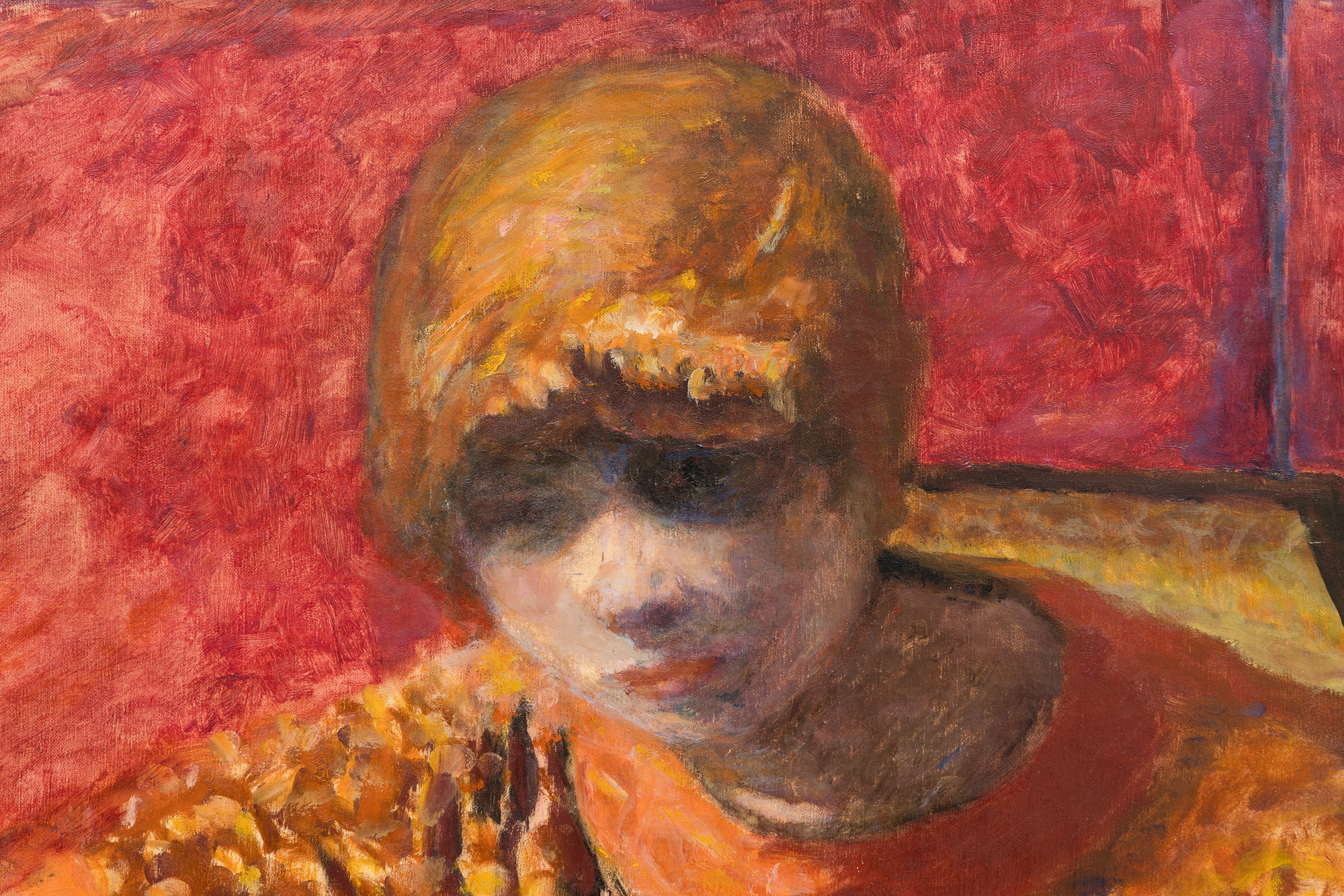
<div>Pierre Bonnard’s <em>La robe de chambre rouge (Marthe Bonnard)</em> (1912) is a richly intimate portrait of the artist’s lifelong muse and wife, Marthe de Meligny, painted at a moment when Bonnard was redefining modern interior painting through color, memory, and psychological nuance. Seated and absorbed in a private moment, Marthe is enveloped by a saturated red ground that presses close to the picture plane, dissolving traditional depth in favor of chromatic intensity. Her patterned robe and softly modeled face emerge through Bonnard’s layered brushwork, where color functions less as description than as emotional atmosphere. </div><br><br><div> </div><br><br><div>Painted in 1912, the work was exhibited extensively from the year of its creation, appearing in seven exhibitions across Paris, Rotterdam, and Munich, signaling its immediate recognition within Bonnard’s circle and the broader European avant-garde. The painting also boasts a distinguished provenance, having passed through the collections of notable French Jewish collector Alphonse Kahn; Eugène Blot, the influential gallerist, collector, and sculpture castor; and Jacques Dupont, the celebrated Olympic cyclist. </div><br><br><div> </div><br><br><div><em>La robe de chambre rouge</em> is published seven times, including Bonnard’s 1968 catalogue raisonné, where it is listed as no. 674. The artist’s portraits of Marthe occupy a central place in his oeuvre. Closely related examples are held in the permanent collections of major institutions such as the Tate, the Museum of Modern Art, the Guggenheim, and The Metropolitan Museum of Art, underscoring the enduring significance of these deeply personal yet formally radical compositions. </div> <div>Pierre Bonnard’s <em>La robe de chambre rouge (Marthe Bonnard)</em> (1912) is a richly intimate portrait of the artist’s lifelong muse and wife, Marthe de Meligny, painted at a moment when Bonnard was redefining modern interior painting through color, memory, and psychological nuance. Seated and absorbed in a private moment, Marthe is enveloped by a saturated red ground that presses close to the picture plane, dissolving traditional depth in favor of chromatic intensity. Her patterned robe and softly modeled face emerge through Bonnard’s layered brushwork, where color functions less as description than as emotional atmosphere. </div><br><br><div> </div><br><br><div>Painted in 1912, the work was exhibited extensively from the year of its creation, appearing in seven exhibitions across Paris, Rotterdam, and Munich, signaling its immediate recognition within Bonnard’s circle and the broader European avant-garde. The painting also boasts a distinguished provenance, having passed through the collections of notable French Jewish collector Alphonse Kahn; Eugène Blot, the influential gallerist, collector, and sculpture castor; and Jacques Dupont, the celebrated Olympic cyclist. </div><br><br><div> </div><br><br><div><em>La robe de chambre rouge</em> is published seven times, including Bonnard’s 1968 catalogue raisonné, where it is listed as no. 674. The artist’s portraits of Marthe occupy a central place in his oeuvre. Closely related examples are held in the permanent collections of major institutions such as the Tate, the Museum of Modern Art, the Guggenheim, and The Metropolitan Museum of Art, underscoring the enduring significance of these deeply personal yet formally radical compositions. </div> <div>Pierre Bonnard’s <em>La robe de chambre rouge (Marthe Bonnard)</em> (1912) is a richly intimate portrait of the artist’s lifelong muse and wife, Marthe de Meligny, painted at a moment when Bonnard was redefining modern interior painting through color, memory, and psychological nuance. Seated and absorbed in a private moment, Marthe is enveloped by a saturated red ground that presses close to the picture plane, dissolving traditional depth in favor of chromatic intensity. Her patterned robe and softly modeled face emerge through Bonnard’s layered brushwork, where color functions less as description than as emotional atmosphere. </div><br><br><div> </div><br><br><div>Painted in 1912, the work was exhibited extensively from the year of its creation, appearing in seven exhibitions across Paris, Rotterdam, and Munich, signaling its immediate recognition within Bonnard’s circle and the broader European avant-garde. The painting also boasts a distinguished provenance, having passed through the collections of notable French Jewish collector Alphonse Kahn; Eugène Blot, the influential gallerist, collector, and sculpture castor; and Jacques Dupont, the celebrated Olympic cyclist. </div><br><br><div> </div><br><br><div><em>La robe de chambre rouge</em> is published seven times, including Bonnard’s 1968 catalogue raisonné, where it is listed as no. 674. The artist’s portraits of Marthe occupy a central place in his oeuvre. Closely related examples are held in the permanent collections of major institutions such as the Tate, the Museum of Modern Art, the Guggenheim, and The Metropolitan Museum of Art, underscoring the enduring significance of these deeply personal yet formally radical compositions. </div> <div>Pierre Bonnard’s <em>La robe de chambre rouge (Marthe Bonnard)</em> (1912) is a richly intimate portrait of the artist’s lifelong muse and wife, Marthe de Meligny, painted at a moment when Bonnard was redefining modern interior painting through color, memory, and psychological nuance. Seated and absorbed in a private moment, Marthe is enveloped by a saturated red ground that presses close to the picture plane, dissolving traditional depth in favor of chromatic intensity. Her patterned robe and softly modeled face emerge through Bonnard’s layered brushwork, where color functions less as description than as emotional atmosphere. </div><br><br><div> </div><br><br><div>Painted in 1912, the work was exhibited extensively from the year of its creation, appearing in seven exhibitions across Paris, Rotterdam, and Munich, signaling its immediate recognition within Bonnard’s circle and the broader European avant-garde. The painting also boasts a distinguished provenance, having passed through the collections of notable French Jewish collector Alphonse Kahn; Eugène Blot, the influential gallerist, collector, and sculpture castor; and Jacques Dupont, the celebrated Olympic cyclist. </div><br><br><div> </div><br><br><div><em>La robe de chambre rouge</em> is published seven times, including Bonnard’s 1968 catalogue raisonné, where it is listed as no. 674. The artist’s portraits of Marthe occupy a central place in his oeuvre. Closely related examples are held in the permanent collections of major institutions such as the Tate, the Museum of Modern Art, the Guggenheim, and The Metropolitan Museum of Art, underscoring the enduring significance of these deeply personal yet formally radical compositions. </div> <div>Pierre Bonnard’s <em>La robe de chambre rouge (Marthe Bonnard)</em> (1912) is a richly intimate portrait of the artist’s lifelong muse and wife, Marthe de Meligny, painted at a moment when Bonnard was redefining modern interior painting through color, memory, and psychological nuance. Seated and absorbed in a private moment, Marthe is enveloped by a saturated red ground that presses close to the picture plane, dissolving traditional depth in favor of chromatic intensity. Her patterned robe and softly modeled face emerge through Bonnard’s layered brushwork, where color functions less as description than as emotional atmosphere. </div><br><br><div> </div><br><br><div>Painted in 1912, the work was exhibited extensively from the year of its creation, appearing in seven exhibitions across Paris, Rotterdam, and Munich, signaling its immediate recognition within Bonnard’s circle and the broader European avant-garde. The painting also boasts a distinguished provenance, having passed through the collections of notable French Jewish collector Alphonse Kahn; Eugène Blot, the influential gallerist, collector, and sculpture castor; and Jacques Dupont, the celebrated Olympic cyclist. </div><br><br><div> </div><br><br><div><em>La robe de chambre rouge</em> is published seven times, including Bonnard’s 1968 catalogue raisonné, where it is listed as no. 674. The artist’s portraits of Marthe occupy a central place in his oeuvre. Closely related examples are held in the permanent collections of major institutions such as the Tate, the Museum of Modern Art, the Guggenheim, and The Metropolitan Museum of Art, underscoring the enduring significance of these deeply personal yet formally radical compositions. </div> <div>Pierre Bonnard’s <em>La robe de chambre rouge (Marthe Bonnard)</em> (1912) is a richly intimate portrait of the artist’s lifelong muse and wife, Marthe de Meligny, painted at a moment when Bonnard was redefining modern interior painting through color, memory, and psychological nuance. Seated and absorbed in a private moment, Marthe is enveloped by a saturated red ground that presses close to the picture plane, dissolving traditional depth in favor of chromatic intensity. Her patterned robe and softly modeled face emerge through Bonnard’s layered brushwork, where color functions less as description than as emotional atmosphere. </div><br><br><div> </div><br><br><div>Painted in 1912, the work was exhibited extensively from the year of its creation, appearing in seven exhibitions across Paris, Rotterdam, and Munich, signaling its immediate recognition within Bonnard’s circle and the broader European avant-garde. The painting also boasts a distinguished provenance, having passed through the collections of notable French Jewish collector Alphonse Kahn; Eugène Blot, the influential gallerist, collector, and sculpture castor; and Jacques Dupont, the celebrated Olympic cyclist. </div><br><br><div> </div><br><br><div><em>La robe de chambre rouge</em> is published seven times, including Bonnard’s 1968 catalogue raisonné, where it is listed as no. 674. The artist’s portraits of Marthe occupy a central place in his oeuvre. Closely related examples are held in the permanent collections of major institutions such as the Tate, the Museum of Modern Art, the Guggenheim, and The Metropolitan Museum of Art, underscoring the enduring significance of these deeply personal yet formally radical compositions. </div> <div>Pierre Bonnard’s <em>La robe de chambre rouge (Marthe Bonnard)</em> (1912) is a richly intimate portrait of the artist’s lifelong muse and wife, Marthe de Meligny, painted at a moment when Bonnard was redefining modern interior painting through color, memory, and psychological nuance. Seated and absorbed in a private moment, Marthe is enveloped by a saturated red ground that presses close to the picture plane, dissolving traditional depth in favor of chromatic intensity. Her patterned robe and softly modeled face emerge through Bonnard’s layered brushwork, where color functions less as description than as emotional atmosphere. </div><br><br><div> </div><br><br><div>Painted in 1912, the work was exhibited extensively from the year of its creation, appearing in seven exhibitions across Paris, Rotterdam, and Munich, signaling its immediate recognition within Bonnard’s circle and the broader European avant-garde. The painting also boasts a distinguished provenance, having passed through the collections of notable French Jewish collector Alphonse Kahn; Eugène Blot, the influential gallerist, collector, and sculpture castor; and Jacques Dupont, the celebrated Olympic cyclist. </div><br><br><div> </div><br><br><div><em>La robe de chambre rouge</em> is published seven times, including Bonnard’s 1968 catalogue raisonné, where it is listed as no. 674. The artist’s portraits of Marthe occupy a central place in his oeuvre. Closely related examples are held in the permanent collections of major institutions such as the Tate, the Museum of Modern Art, the Guggenheim, and The Metropolitan Museum of Art, underscoring the enduring significance of these deeply personal yet formally radical compositions. </div>
La bata roja (Marthe Bonnard)191221 x 27 1/4 pulgadas(53,34 x 69,22 cm) Óleo sobre lienzo
Procedencia
Galerie Bernheim-Jeune, París, adquirido al artista
Alphonse Kahn, Saint-Germain-en-Laye, adquirido al anterior
Me Lair-Dubreuil, Hôtel Drouot, París, 20 de noviembre de 1922, lote 40 (titulado «La robe de chambre orange»)
Eugène Blot, París, adquirido en la venta anterior
Me Baudoin, París, 2 de junio de 1933, lote 33 (titulado «Femme assise dans un intérieur»)
Colección Huet, París, adquirido en la venta anterior
Jacques Dupont, París, diciembre de 1940
Colección privada, por descendencia de la anterior
Christie’s, París, O
...Más....17 de octubre de 2018, lote 37
Colección privada, adquirida en la subasta mencionada anteriormente.
Exposición
París, Galerie Bernheim-Jeune, Bonnard, Œuvres récentes, 17 de junio – 6 de julio de 1912, n.º 15.
París, Galerie Bernheim-Jeune, Pierre Bonnard, Œuvres récentes, 19 de mayo – 7 de junio de 1913
París, Galerie d'art Braun & Cie, Portraits de Pierre Bonnard, junio de 1933, n.º 21, p. 4 (titulado «Portrait de femme au turban»).
París, Galerie Frommont, La compagne du peintre, 1953
Rotterdam, Museo Boymans-van Beuningen, Bonnard, 1953, n.º 45 (fechado «vers 1910-11»).
París, Maison de la Pensée française, Pierre Bonnard, verano de 1955, n.º 20.
Múnich, Haus der Kunst; París, Orangerie des Tuileries, Pierre Bonnard, Centenaire de sa naissance, 8 de octubre de 1966 – 15 de abril de 1967, n.º 75.
Literatura
Le courrier européen, 23 de mayo de 1913 (ilustrado, titulado Étude de femme)
Gustave Coquiot, Les indépendants, 1884-1920, París, 1921, págs. 78-79 (ilustrado).
Gustave Coquiot, Bonnard, París, 1922, p. 54 (titulado «La robe de chambre orangée»).
Léon Werth, Bonnard, París, 1923 (ilustrado, lámina 25).
André Fage, Le collectionneur des peintures modernes, París, 1930, p. 252.
Galería de arte Braun & Cie, Retratos de Pierre Bonnard, París, 1933, n.º 21, p. 4 (titulado «Retrato de mujer con turbante»).
M.-T. Mauguis, Artes, 25 de junio de 1955
Haus der Kunst & Orangerie des Tuileries, Pierre Bonnard, Centenaire de sa naissance, Múnich y París, 1967, n.º 75 (ilustrado).
Raymond Cogniat, Bonnard, París, 1968 (ilustrado en la portada)
Jean y Henry Dauberville, Bonnard, Catálogo razonado de la obra pictórica, 1906-1919, París, 1968, vol. II, n.º 674, p. 247 (ilustrado).
...MENOS....
La robe de chambre rouge (Marthe Bonnard) (1912), de Pierre Bonnard, es un retrato profundamente íntimo de la musa y esposa del artista, Marthe de Meligny, pintado en un momento en el que Bonnard estaba redefiniendo la pintura de interiores moderna a través del color, la memoria y los matices psicológicos. Sentada y absorta en un momento privado, Marthe está envuelta por un fondo rojo saturado que se acerca al plano pictórico, disolviendo la profundidad tradicional en favor de la intensidad cromática. Su bata estampada y su rostro suavemente modelado emergen a través de la pincelada en capas de Bonnard, donde el color funciona menos como descripción que como atmósfera emocional.


Pintada en 1912, la obra se expuso ampliamente desde el año de su creación, apareciendo en siete exposiciones en París, Rotterdam y Múnich, lo que supuso su reconocimiento inmediato dentro del círculo de Bonnard y de la vanguardia europea en general. La pintura también cuenta con una procedencia distinguida, ya que ha pasado por las colecciones del notable coleccionista judío francés Alphonse Kahn; Eugène Blot, influyente galerista, coleccionista y fundidor de esculturas; y Jacques Dupont, el célebre ciclista olímpico.


La robe de chambre rouge se ha publicado siete veces, incluido el catálogo razonado de Bonnard de 1968, donde figura como n.º 674. Los retratos de Marthe realizados por el artista ocupan un lugar central en su obra. Ejemplos muy similares se conservan en las colecciones permanentes de importantes instituciones como la Tate, el Museo de Arte Moderno, el Guggenheim y el Museo Metropolitano de Arte, lo que subraya la importancia perdurable de estas composiciones profundamente personales y, al mismo tiempo, formalmente radicales.
Preguntar