Atrás

MAX PECHSTEIN (1881-1955)

 
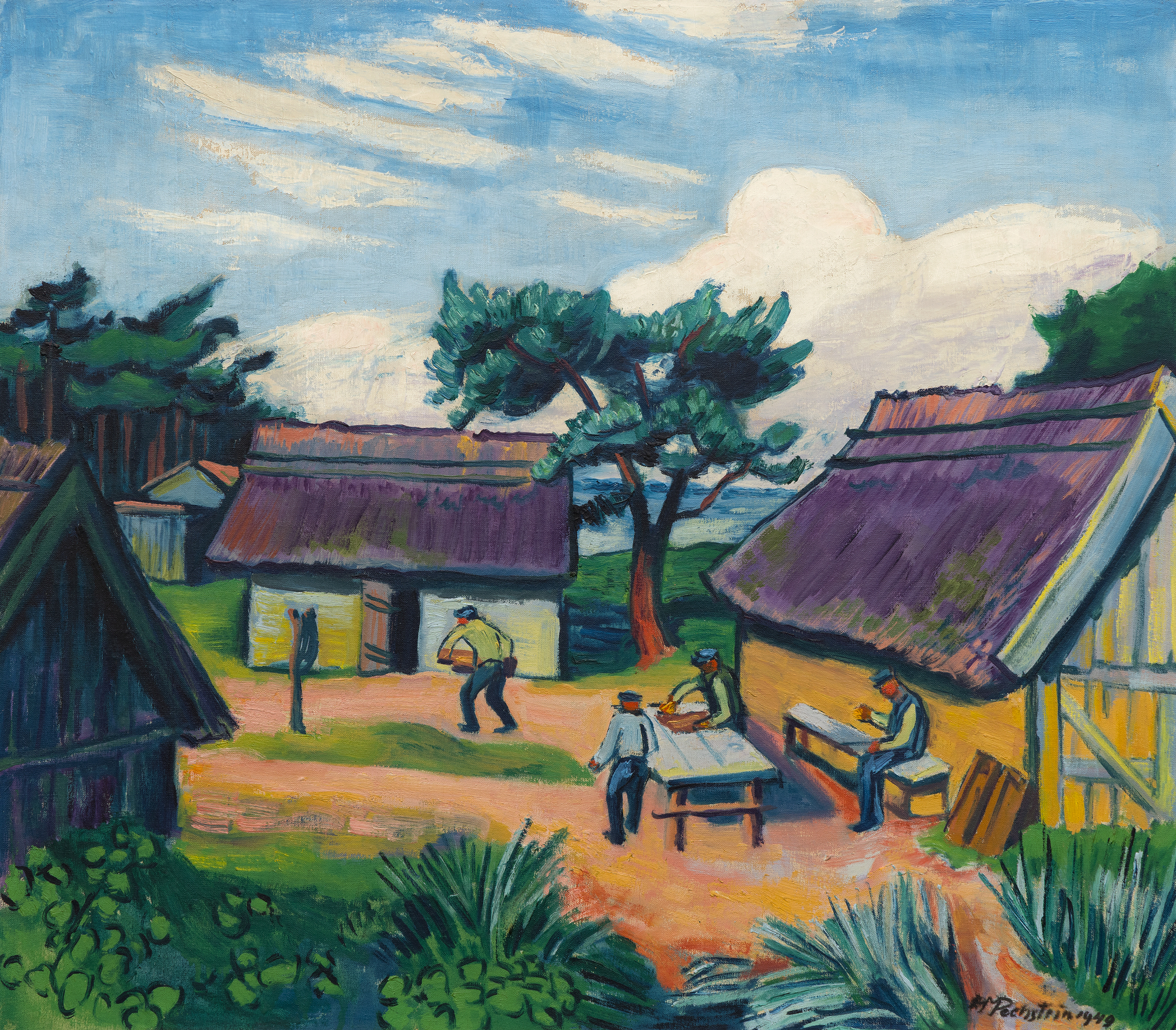
<div><font face=Lato size=3 color=black><em>Alte Fischerhütten</em> (1949) by Max Pechstein is an oil on canvas in which the artist transforms a humble cluster of weathered fishing huts into a study of light, form, and atmosphere. Broad, rhythmic brushstrokes delineate the worn timbers and thatched roofs, while a sky streaked with lavender and rose imbues the scene with a quiet, almost meditative luminosity. Pechstein’s bold outlines and flattened perspective are tempered by a late-career restraint, allowing the simple geometry of dunes, huts, and sea to resonate with an almost timeless calm.<br><br></font></div><br><br><div><font face=Lato size=3 color=black>Though painted in 1949, this work reaches back to a motif Pechstein first explored between 1927 and 1930 during summers on the Baltic coast and in the village of Rowe with <em>Herbstabend </em>(1927) and <em>Getreideernte</em> (1930). In a letter from that earlier period he wrote of his inspiration:<br><br></font></div><br><br><div><font face=Lato size=3 color=black>“A small, empty fishing hut on the lagoon, which Martin Sakuth had set aside for me… it was there that I first felt the heady, eternal rhythm of the sea.” (translated)<br><br></font></div><br><br><div><font face=Lato size=3 color=black>By revisiting these modest structures in his final decade, Pechstein fuses the elemental power of wind, sand, and sea with a masterful control of color and form. <em>Alte Fischerhütten</em> thus stands as a poignant culmination of his lifelong dialogue with vernacular architecture and elemental landscapes, an enduring testament to his vision of nature’s quiet grandeur.</font></div> <div><font face=Lato size=3 color=black><em>Alte Fischerhütten</em> (1949) by Max Pechstein is an oil on canvas in which the artist transforms a humble cluster of weathered fishing huts into a study of light, form, and atmosphere. Broad, rhythmic brushstrokes delineate the worn timbers and thatched roofs, while a sky streaked with lavender and rose imbues the scene with a quiet, almost meditative luminosity. Pechstein’s bold outlines and flattened perspective are tempered by a late-career restraint, allowing the simple geometry of dunes, huts, and sea to resonate with an almost timeless calm.<br><br></font></div><br><br><div><font face=Lato size=3 color=black>Though painted in 1949, this work reaches back to a motif Pechstein first explored between 1927 and 1930 during summers on the Baltic coast and in the village of Rowe with <em>Herbstabend </em>(1927) and <em>Getreideernte</em> (1930). In a letter from that earlier period he wrote of his inspiration:<br><br></font></div><br><br><div><font face=Lato size=3 color=black>“A small, empty fishing hut on the lagoon, which Martin Sakuth had set aside for me… it was there that I first felt the heady, eternal rhythm of the sea.” (translated)<br><br></font></div><br><br><div><font face=Lato size=3 color=black>By revisiting these modest structures in his final decade, Pechstein fuses the elemental power of wind, sand, and sea with a masterful control of color and form. <em>Alte Fischerhütten</em> thus stands as a poignant culmination of his lifelong dialogue with vernacular architecture and elemental landscapes, an enduring testament to his vision of nature’s quiet grandeur.</font></div> <div><font face=Lato size=3 color=black><em>Alte Fischerhütten</em> (1949) by Max Pechstein is an oil on canvas in which the artist transforms a humble cluster of weathered fishing huts into a study of light, form, and atmosphere. Broad, rhythmic brushstrokes delineate the worn timbers and thatched roofs, while a sky streaked with lavender and rose imbues the scene with a quiet, almost meditative luminosity. Pechstein’s bold outlines and flattened perspective are tempered by a late-career restraint, allowing the simple geometry of dunes, huts, and sea to resonate with an almost timeless calm.<br><br></font></div><br><br><div><font face=Lato size=3 color=black>Though painted in 1949, this work reaches back to a motif Pechstein first explored between 1927 and 1930 during summers on the Baltic coast and in the village of Rowe with <em>Herbstabend </em>(1927) and <em>Getreideernte</em> (1930). In a letter from that earlier period he wrote of his inspiration:<br><br></font></div><br><br><div><font face=Lato size=3 color=black>“A small, empty fishing hut on the lagoon, which Martin Sakuth had set aside for me… it was there that I first felt the heady, eternal rhythm of the sea.” (translated)<br><br></font></div><br><br><div><font face=Lato size=3 color=black>By revisiting these modest structures in his final decade, Pechstein fuses the elemental power of wind, sand, and sea with a masterful control of color and form. <em>Alte Fischerhütten</em> thus stands as a poignant culmination of his lifelong dialogue with vernacular architecture and elemental landscapes, an enduring testament to his vision of nature’s quiet grandeur.</font></div> <div><font face=Lato size=3 color=black><em>Alte Fischerhütten</em> (1949) by Max Pechstein is an oil on canvas in which the artist transforms a humble cluster of weathered fishing huts into a study of light, form, and atmosphere. Broad, rhythmic brushstrokes delineate the worn timbers and thatched roofs, while a sky streaked with lavender and rose imbues the scene with a quiet, almost meditative luminosity. Pechstein’s bold outlines and flattened perspective are tempered by a late-career restraint, allowing the simple geometry of dunes, huts, and sea to resonate with an almost timeless calm.<br><br></font></div><br><br><div><font face=Lato size=3 color=black>Though painted in 1949, this work reaches back to a motif Pechstein first explored between 1927 and 1930 during summers on the Baltic coast and in the village of Rowe with <em>Herbstabend </em>(1927) and <em>Getreideernte</em> (1930). In a letter from that earlier period he wrote of his inspiration:<br><br></font></div><br><br><div><font face=Lato size=3 color=black>“A small, empty fishing hut on the lagoon, which Martin Sakuth had set aside for me… it was there that I first felt the heady, eternal rhythm of the sea.” (translated)<br><br></font></div><br><br><div><font face=Lato size=3 color=black>By revisiting these modest structures in his final decade, Pechstein fuses the elemental power of wind, sand, and sea with a masterful control of color and form. <em>Alte Fischerhütten</em> thus stands as a poignant culmination of his lifelong dialogue with vernacular architecture and elemental landscapes, an enduring testament to his vision of nature’s quiet grandeur.</font></div> <div><font face=Lato size=3 color=black><em>Alte Fischerhütten</em> (1949) by Max Pechstein is an oil on canvas in which the artist transforms a humble cluster of weathered fishing huts into a study of light, form, and atmosphere. Broad, rhythmic brushstrokes delineate the worn timbers and thatched roofs, while a sky streaked with lavender and rose imbues the scene with a quiet, almost meditative luminosity. Pechstein’s bold outlines and flattened perspective are tempered by a late-career restraint, allowing the simple geometry of dunes, huts, and sea to resonate with an almost timeless calm.<br><br></font></div><br><br><div><font face=Lato size=3 color=black>Though painted in 1949, this work reaches back to a motif Pechstein first explored between 1927 and 1930 during summers on the Baltic coast and in the village of Rowe with <em>Herbstabend </em>(1927) and <em>Getreideernte</em> (1930). In a letter from that earlier period he wrote of his inspiration:<br><br></font></div><br><br><div><font face=Lato size=3 color=black>“A small, empty fishing hut on the lagoon, which Martin Sakuth had set aside for me… it was there that I first felt the heady, eternal rhythm of the sea.” (translated)<br><br></font></div><br><br><div><font face=Lato size=3 color=black>By revisiting these modest structures in his final decade, Pechstein fuses the elemental power of wind, sand, and sea with a masterful control of color and form. <em>Alte Fischerhütten</em> thus stands as a poignant culmination of his lifelong dialogue with vernacular architecture and elemental landscapes, an enduring testament to his vision of nature’s quiet grandeur.</font></div> <div><font face=Lato size=3 color=black><em>Alte Fischerhütten</em> (1949) by Max Pechstein is an oil on canvas in which the artist transforms a humble cluster of weathered fishing huts into a study of light, form, and atmosphere. Broad, rhythmic brushstrokes delineate the worn timbers and thatched roofs, while a sky streaked with lavender and rose imbues the scene with a quiet, almost meditative luminosity. Pechstein’s bold outlines and flattened perspective are tempered by a late-career restraint, allowing the simple geometry of dunes, huts, and sea to resonate with an almost timeless calm.<br><br></font></div><br><br><div><font face=Lato size=3 color=black>Though painted in 1949, this work reaches back to a motif Pechstein first explored between 1927 and 1930 during summers on the Baltic coast and in the village of Rowe with <em>Herbstabend </em>(1927) and <em>Getreideernte</em> (1930). In a letter from that earlier period he wrote of his inspiration:<br><br></font></div><br><br><div><font face=Lato size=3 color=black>“A small, empty fishing hut on the lagoon, which Martin Sakuth had set aside for me… it was there that I first felt the heady, eternal rhythm of the sea.” (translated)<br><br></font></div><br><br><div><font face=Lato size=3 color=black>By revisiting these modest structures in his final decade, Pechstein fuses the elemental power of wind, sand, and sea with a masterful control of color and form. <em>Alte Fischerhütten</em> thus stands as a poignant culmination of his lifelong dialogue with vernacular architecture and elemental landscapes, an enduring testament to his vision of nature’s quiet grandeur.</font></div> <div><font face=Lato size=3 color=black><em>Alte Fischerhütten</em> (1949) by Max Pechstein is an oil on canvas in which the artist transforms a humble cluster of weathered fishing huts into a study of light, form, and atmosphere. Broad, rhythmic brushstrokes delineate the worn timbers and thatched roofs, while a sky streaked with lavender and rose imbues the scene with a quiet, almost meditative luminosity. Pechstein’s bold outlines and flattened perspective are tempered by a late-career restraint, allowing the simple geometry of dunes, huts, and sea to resonate with an almost timeless calm.<br><br></font></div><br><br><div><font face=Lato size=3 color=black>Though painted in 1949, this work reaches back to a motif Pechstein first explored between 1927 and 1930 during summers on the Baltic coast and in the village of Rowe with <em>Herbstabend </em>(1927) and <em>Getreideernte</em> (1930). In a letter from that earlier period he wrote of his inspiration:<br><br></font></div><br><br><div><font face=Lato size=3 color=black>“A small, empty fishing hut on the lagoon, which Martin Sakuth had set aside for me… it was there that I first felt the heady, eternal rhythm of the sea.” (translated)<br><br></font></div><br><br><div><font face=Lato size=3 color=black>By revisiting these modest structures in his final decade, Pechstein fuses the elemental power of wind, sand, and sea with a masterful control of color and form. <em>Alte Fischerhütten</em> thus stands as a poignant culmination of his lifelong dialogue with vernacular architecture and elemental landscapes, an enduring testament to his vision of nature’s quiet grandeur.</font></div> <div><font face=Lato size=3 color=black><em>Alte Fischerhütten</em> (1949) by Max Pechstein is an oil on canvas in which the artist transforms a humble cluster of weathered fishing huts into a study of light, form, and atmosphere. Broad, rhythmic brushstrokes delineate the worn timbers and thatched roofs, while a sky streaked with lavender and rose imbues the scene with a quiet, almost meditative luminosity. Pechstein’s bold outlines and flattened perspective are tempered by a late-career restraint, allowing the simple geometry of dunes, huts, and sea to resonate with an almost timeless calm.<br><br></font></div><br><br><div><font face=Lato size=3 color=black>Though painted in 1949, this work reaches back to a motif Pechstein first explored between 1927 and 1930 during summers on the Baltic coast and in the village of Rowe with <em>Herbstabend </em>(1927) and <em>Getreideernte</em> (1930). In a letter from that earlier period he wrote of his inspiration:<br><br></font></div><br><br><div><font face=Lato size=3 color=black>“A small, empty fishing hut on the lagoon, which Martin Sakuth had set aside for me… it was there that I first felt the heady, eternal rhythm of the sea.” (translated)<br><br></font></div><br><br><div><font face=Lato size=3 color=black>By revisiting these modest structures in his final decade, Pechstein fuses the elemental power of wind, sand, and sea with a masterful control of color and form. <em>Alte Fischerhütten</em> thus stands as a poignant culmination of his lifelong dialogue with vernacular architecture and elemental landscapes, an enduring testament to his vision of nature’s quiet grandeur.</font></div> <div><font face=Lato size=3 color=black><em>Alte Fischerhütten</em> (1949) by Max Pechstein is an oil on canvas in which the artist transforms a humble cluster of weathered fishing huts into a study of light, form, and atmosphere. Broad, rhythmic brushstrokes delineate the worn timbers and thatched roofs, while a sky streaked with lavender and rose imbues the scene with a quiet, almost meditative luminosity. Pechstein’s bold outlines and flattened perspective are tempered by a late-career restraint, allowing the simple geometry of dunes, huts, and sea to resonate with an almost timeless calm.<br><br></font></div><br><br><div><font face=Lato size=3 color=black>Though painted in 1949, this work reaches back to a motif Pechstein first explored between 1927 and 1930 during summers on the Baltic coast and in the village of Rowe with <em>Herbstabend </em>(1927) and <em>Getreideernte</em> (1930). In a letter from that earlier period he wrote of his inspiration:<br><br></font></div><br><br><div><font face=Lato size=3 color=black>“A small, empty fishing hut on the lagoon, which Martin Sakuth had set aside for me… it was there that I first felt the heady, eternal rhythm of the sea.” (translated)<br><br></font></div><br><br><div><font face=Lato size=3 color=black>By revisiting these modest structures in his final decade, Pechstein fuses the elemental power of wind, sand, and sea with a masterful control of color and form. <em>Alte Fischerhütten</em> thus stands as a poignant culmination of his lifelong dialogue with vernacular architecture and elemental landscapes, an enduring testament to his vision of nature’s quiet grandeur.</font></div> <div><font face=Lato size=3 color=black><em>Alte Fischerhütten</em> (1949) by Max Pechstein is an oil on canvas in which the artist transforms a humble cluster of weathered fishing huts into a study of light, form, and atmosphere. Broad, rhythmic brushstrokes delineate the worn timbers and thatched roofs, while a sky streaked with lavender and rose imbues the scene with a quiet, almost meditative luminosity. Pechstein’s bold outlines and flattened perspective are tempered by a late-career restraint, allowing the simple geometry of dunes, huts, and sea to resonate with an almost timeless calm.<br><br></font></div><br><br><div><font face=Lato size=3 color=black>Though painted in 1949, this work reaches back to a motif Pechstein first explored between 1927 and 1930 during summers on the Baltic coast and in the village of Rowe with <em>Herbstabend </em>(1927) and <em>Getreideernte</em> (1930). In a letter from that earlier period he wrote of his inspiration:<br><br></font></div><br><br><div><font face=Lato size=3 color=black>“A small, empty fishing hut on the lagoon, which Martin Sakuth had set aside for me… it was there that I first felt the heady, eternal rhythm of the sea.” (translated)<br><br></font></div><br><br><div><font face=Lato size=3 color=black>By revisiting these modest structures in his final decade, Pechstein fuses the elemental power of wind, sand, and sea with a masterful control of color and form. <em>Alte Fischerhütten</em> thus stands as a poignant culmination of his lifelong dialogue with vernacular architecture and elemental landscapes, an enduring testament to his vision of nature’s quiet grandeur.</font></div>
Alte Fischerhutten194928 x 31 5/8 pulg.(71,12 x 80,33 cm) óleo sobre lienzo
Procedencia
Colección privada, Europa
Lempertz, Colonia, 15 de junio de 1966, lote 531
Selected Artists Galleries, Nueva York, adquirido en 1970
Colección privada, Nueva York, adquirida a la anterior
Colección privada, descendiente de la anterior
Phillips, Nueva York, miércoles 15 de noviembre de 2023, lote 123
Colección privada, adquirida a la anterior
Literatura
Aya Soika, Max Pechstein The Catalgoue raisonne of oil paintings, Volume II 1919-1954, Múnich, 2011, nº 1949/12, p. 490, ilustrado.
Alte Fischerhütten (1949) de Max Pechstein es un óleo sobre lienzo en el que el artista transforma un humilde grupo de cabañas de pescadores desgastadas en un estudio de la luz, la forma y la atmósfera. Amplias y rítmicas pinceladas delinean las desgastadas maderas y los tejados de paja, mientras que un cielo salpicado de lavanda y rosa impregna la escena de una luminosidad tranquila, casi meditativa. Los atrevidos contornos y la perspectiva aplanada de Pechstein se ven atenuados por una moderación propia de los últimos años de su carrera, lo que permite que la sencilla geometría de las dunas, las cabañas y el mar resuene con una calma casi intemporal.


Aunque pintada en 1949, esta obra se remonta a un motivo que Pechstein exploró por primera vez entre 1927 y 1930 durante los veranos en la costa báltica y en el pueblo de Rowe con Herbstabend (1927) y Getreideernte (1930). En una carta de esa época escribió sobre su inspiración:


"Una pequeña cabaña de pescadores vacía en la laguna, que Martin Sakuth había reservado para mí... fue allí donde sentí por primera vez el ritmo embriagador y eterno del mar". (traducido)


Al volver a visitar estas modestas estructuras en su última década, Pechstein fusiona el poder elemental del viento, la arena y el mar con un control magistral del color y la forma. Alte Fischerhütten se erige así en conmovedora culminación de su diálogo de toda la vida con la arquitectura vernácula y los paisajes elementales, testimonio perdurable de su visión de la tranquila grandeza de la naturaleza.
Preguntar