العودة

موريس دي فيلمينك(1876-1958)

 
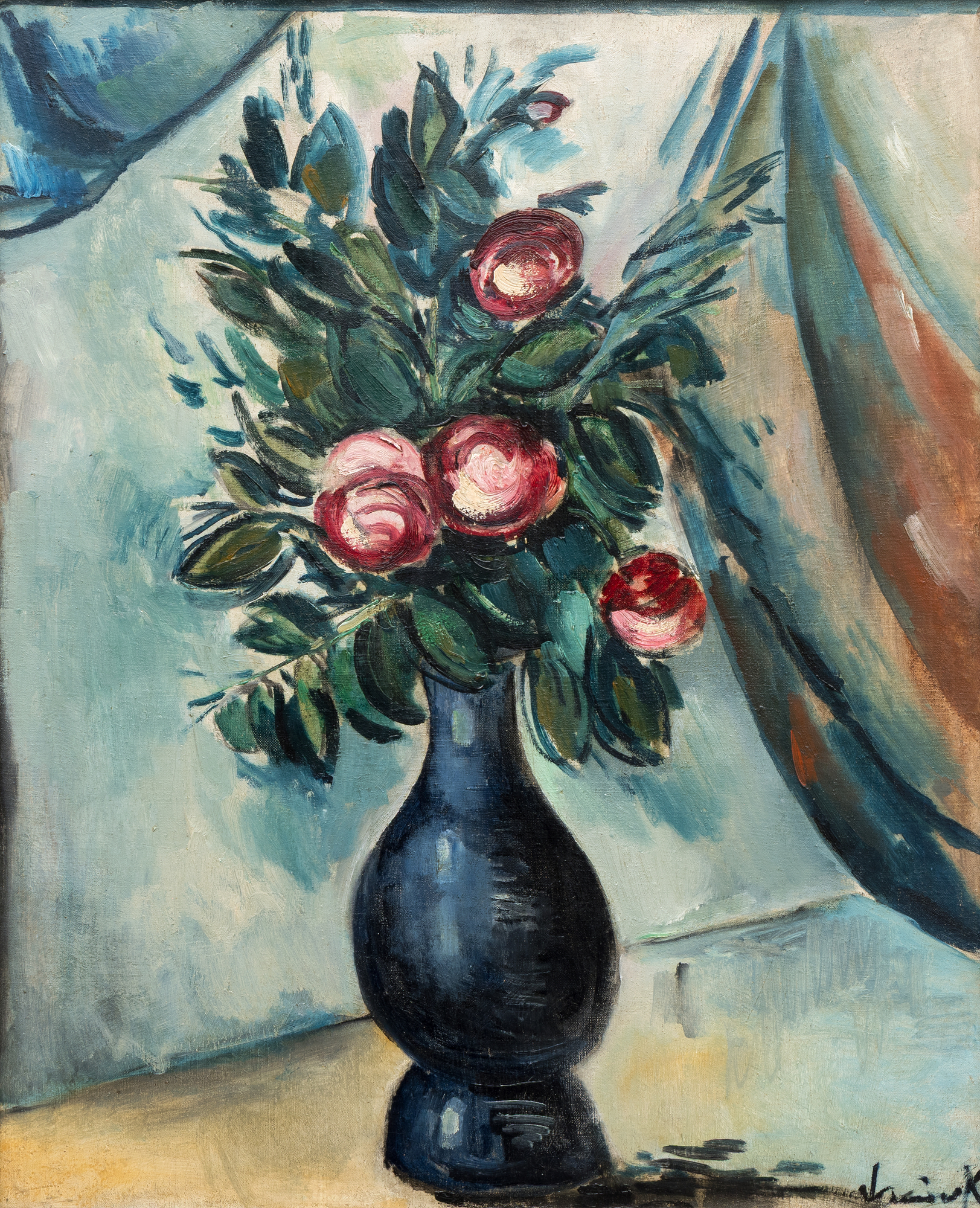
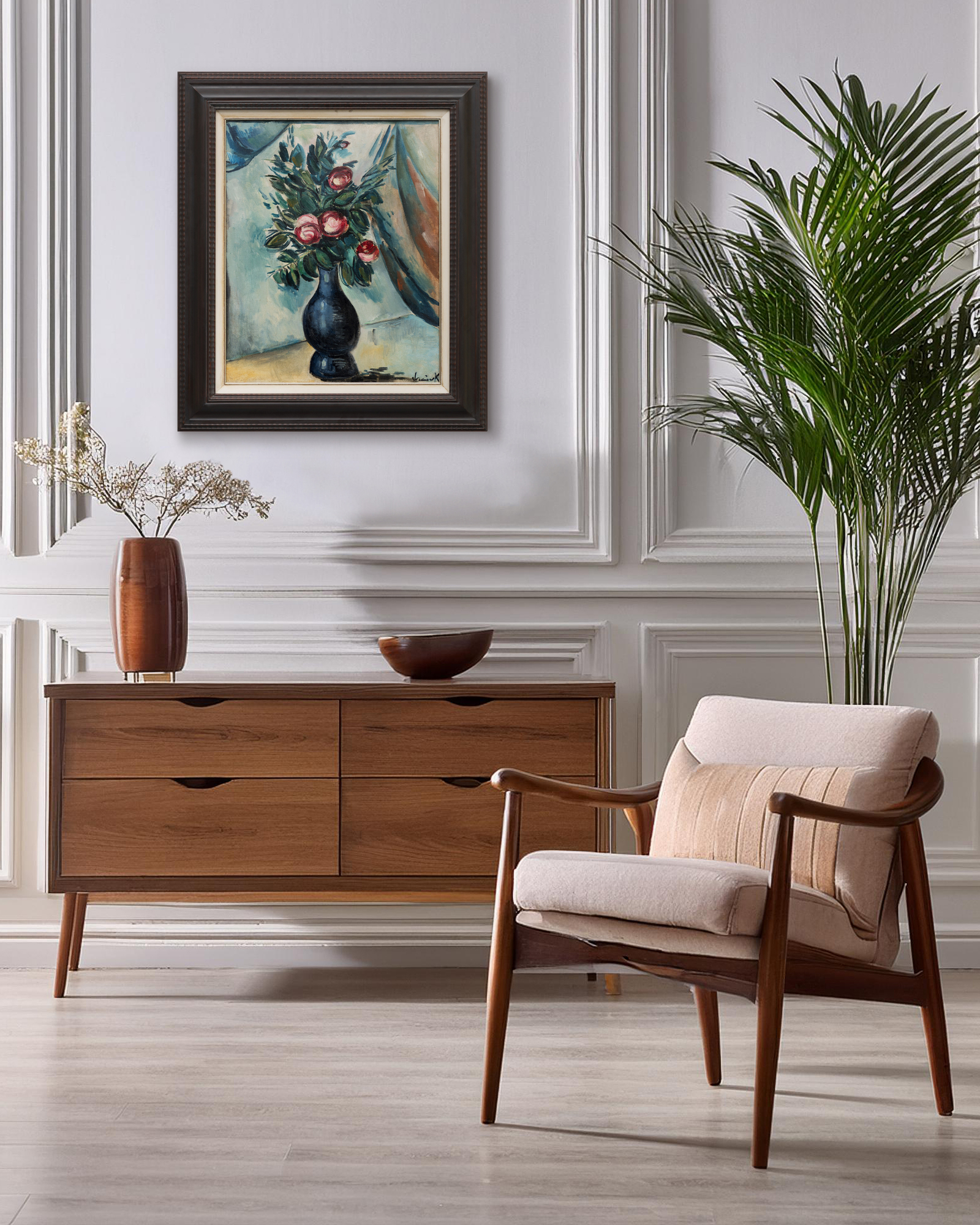
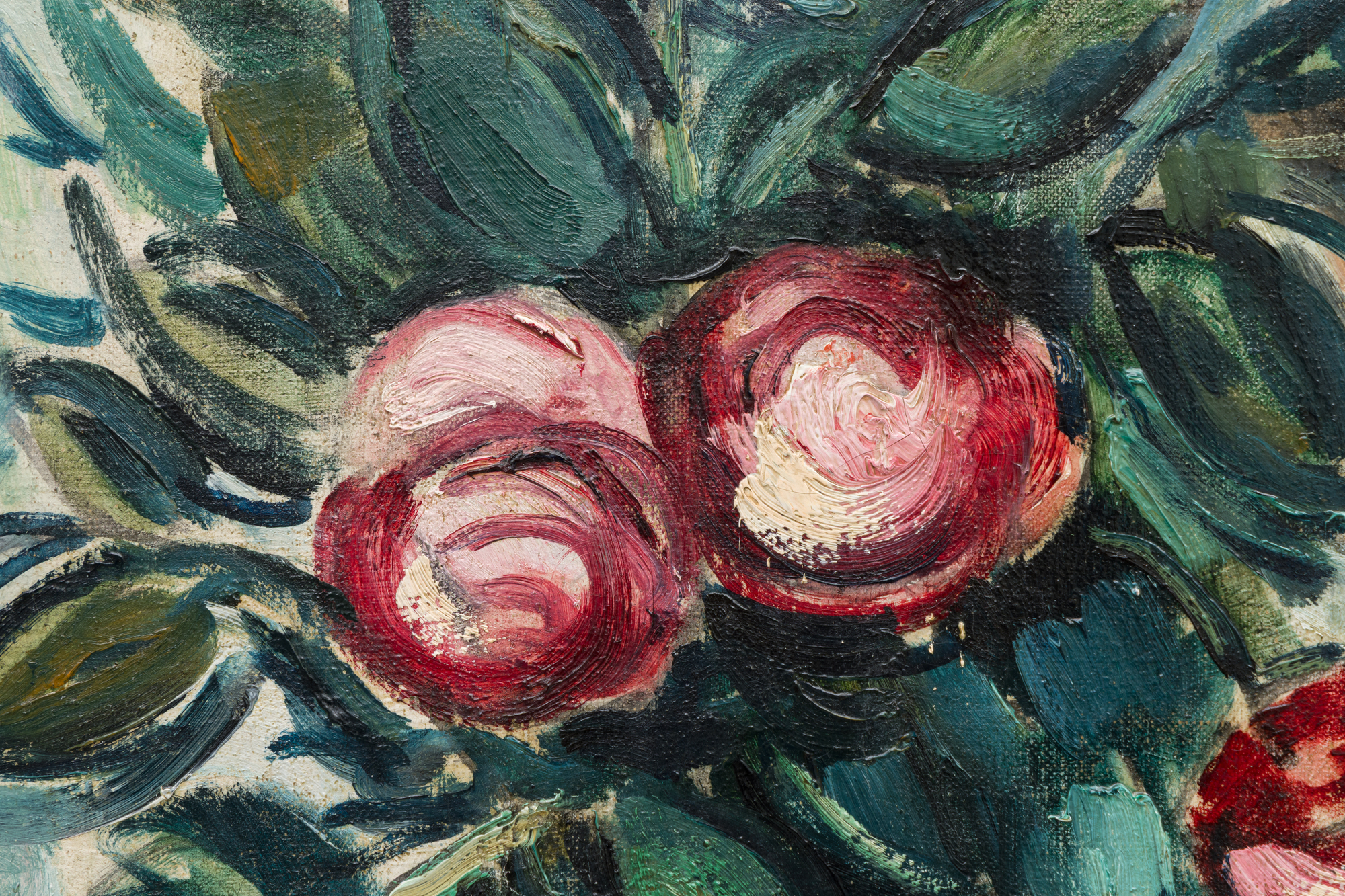
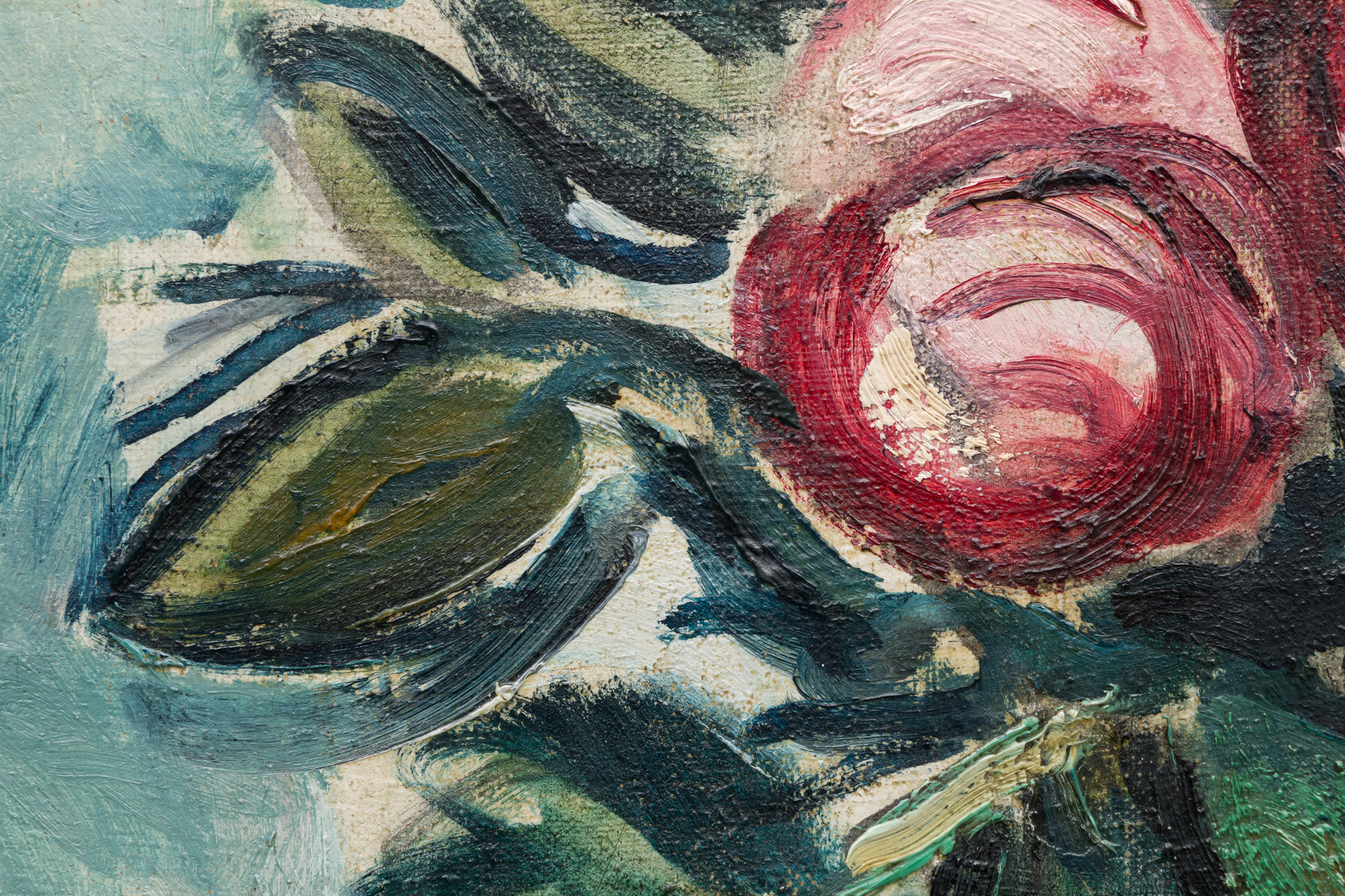
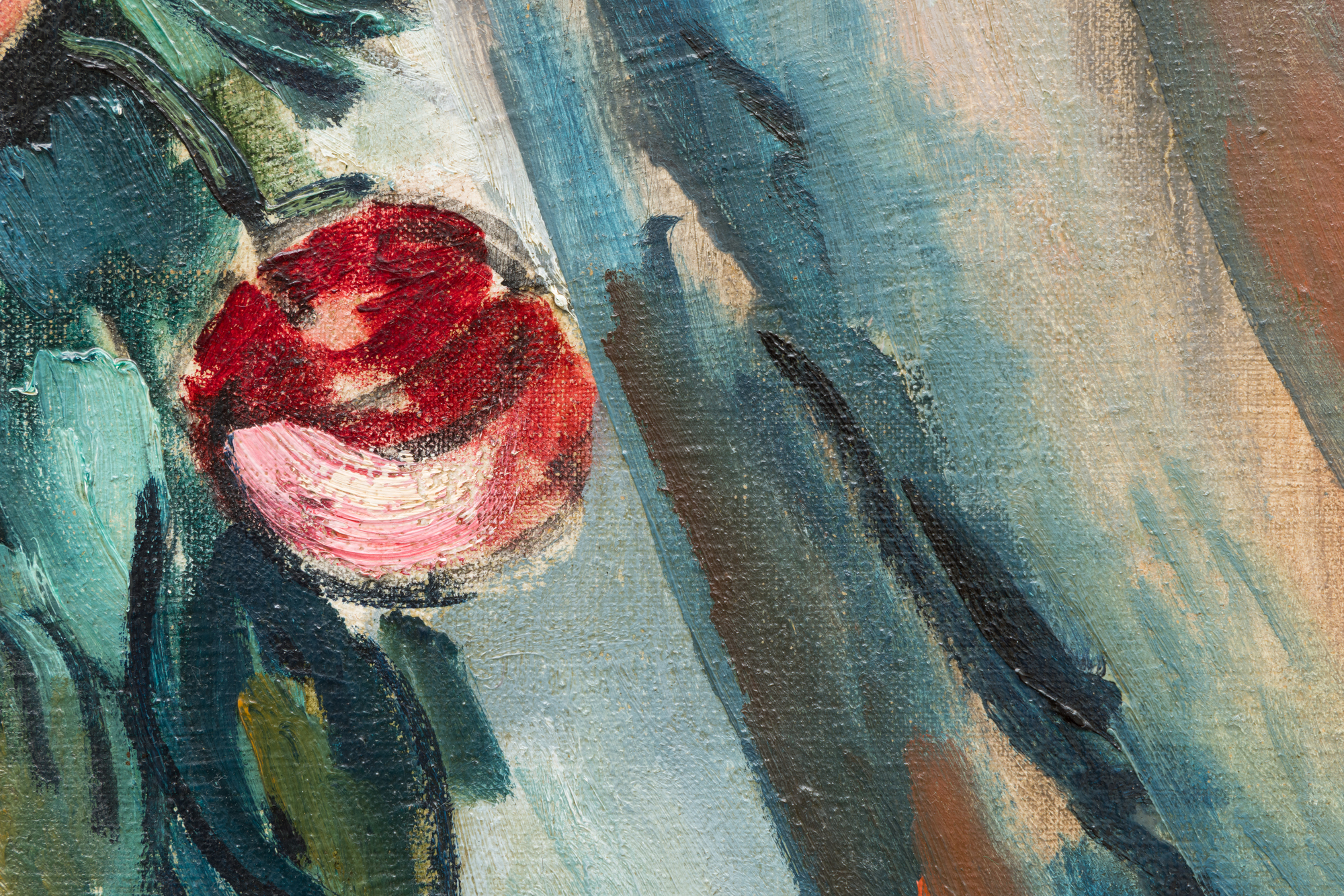
<div>Maurice de Vlaminck’s <em>Bouquet de Pivoines dans un Vase Bleu</em> (1913–14) is a prime-period still life that channels the artist’s Fauvist audacity into an image of exuberant, painterly force. A dense spray of peonies—painted as spiraling bursts of pinks, reds, and creamy whites—pushes outward from a deep blue vase, its rounded form anchoring the composition. With vigorous, directional brushstrokes, Vlaminck animates petals and foliage into a rhythmic surge, turning a traditional tabletop motif into a study of movement, texture, and chromatic intensity. </div><br><br><div> </div><br><br><div>As one of the core founders of Fauvism, Vlaminck was celebrated for his radical, non-naturalistic use of color, and this work retains that avant-garde approach. Cool blues and sea-greens collide with hot, saturated reds, while the background drapery and angled planes are simplified into sweeping passages that heighten contrast and speed. The paint surface remains boldly worked, emphasizing the physicality of oil on canvas and the immediacy of the artist’s hand. A prominent signature reinforces the picture’s assertive presence and its sense of completed statement. </div><br><br><div> </div><br><br><div>The painting will be included in the forthcoming critical catalogue of Maurice de Vlaminck’s works, currently being prepared by Maïté Vallès-Bled and Godeliève de Vlaminck under the auspices of the Wildenstein Institute. Renewed international attention to Vlaminck’s achievements—including a recent retrospective at Museum Barberini in Potsdam, the first in nearly a century—has reaffirmed his vital role in the development of modern painting. <em>Bouquet de Pivoines dans un Vase Bleu </em>captures that legacy: unapologetically modern and powered by color as expression. </div> <div>Maurice de Vlaminck’s <em>Bouquet de Pivoines dans un Vase Bleu</em> (1913–14) is a prime-period still life that channels the artist’s Fauvist audacity into an image of exuberant, painterly force. A dense spray of peonies—painted as spiraling bursts of pinks, reds, and creamy whites—pushes outward from a deep blue vase, its rounded form anchoring the composition. With vigorous, directional brushstrokes, Vlaminck animates petals and foliage into a rhythmic surge, turning a traditional tabletop motif into a study of movement, texture, and chromatic intensity. </div><br><br><div> </div><br><br><div>As one of the core founders of Fauvism, Vlaminck was celebrated for his radical, non-naturalistic use of color, and this work retains that avant-garde approach. Cool blues and sea-greens collide with hot, saturated reds, while the background drapery and angled planes are simplified into sweeping passages that heighten contrast and speed. The paint surface remains boldly worked, emphasizing the physicality of oil on canvas and the immediacy of the artist’s hand. A prominent signature reinforces the picture’s assertive presence and its sense of completed statement. </div><br><br><div> </div><br><br><div>The painting will be included in the forthcoming critical catalogue of Maurice de Vlaminck’s works, currently being prepared by Maïté Vallès-Bled and Godeliève de Vlaminck under the auspices of the Wildenstein Institute. Renewed international attention to Vlaminck’s achievements—including a recent retrospective at Museum Barberini in Potsdam, the first in nearly a century—has reaffirmed his vital role in the development of modern painting. <em>Bouquet de Pivoines dans un Vase Bleu </em>captures that legacy: unapologetically modern and powered by color as expression. </div> <div>Maurice de Vlaminck’s <em>Bouquet de Pivoines dans un Vase Bleu</em> (1913–14) is a prime-period still life that channels the artist’s Fauvist audacity into an image of exuberant, painterly force. A dense spray of peonies—painted as spiraling bursts of pinks, reds, and creamy whites—pushes outward from a deep blue vase, its rounded form anchoring the composition. With vigorous, directional brushstrokes, Vlaminck animates petals and foliage into a rhythmic surge, turning a traditional tabletop motif into a study of movement, texture, and chromatic intensity. </div><br><br><div> </div><br><br><div>As one of the core founders of Fauvism, Vlaminck was celebrated for his radical, non-naturalistic use of color, and this work retains that avant-garde approach. Cool blues and sea-greens collide with hot, saturated reds, while the background drapery and angled planes are simplified into sweeping passages that heighten contrast and speed. The paint surface remains boldly worked, emphasizing the physicality of oil on canvas and the immediacy of the artist’s hand. A prominent signature reinforces the picture’s assertive presence and its sense of completed statement. </div><br><br><div> </div><br><br><div>The painting will be included in the forthcoming critical catalogue of Maurice de Vlaminck’s works, currently being prepared by Maïté Vallès-Bled and Godeliève de Vlaminck under the auspices of the Wildenstein Institute. Renewed international attention to Vlaminck’s achievements—including a recent retrospective at Museum Barberini in Potsdam, the first in nearly a century—has reaffirmed his vital role in the development of modern painting. <em>Bouquet de Pivoines dans un Vase Bleu </em>captures that legacy: unapologetically modern and powered by color as expression. </div> <div>Maurice de Vlaminck’s <em>Bouquet de Pivoines dans un Vase Bleu</em> (1913–14) is a prime-period still life that channels the artist’s Fauvist audacity into an image of exuberant, painterly force. A dense spray of peonies—painted as spiraling bursts of pinks, reds, and creamy whites—pushes outward from a deep blue vase, its rounded form anchoring the composition. With vigorous, directional brushstrokes, Vlaminck animates petals and foliage into a rhythmic surge, turning a traditional tabletop motif into a study of movement, texture, and chromatic intensity. </div><br><br><div> </div><br><br><div>As one of the core founders of Fauvism, Vlaminck was celebrated for his radical, non-naturalistic use of color, and this work retains that avant-garde approach. Cool blues and sea-greens collide with hot, saturated reds, while the background drapery and angled planes are simplified into sweeping passages that heighten contrast and speed. The paint surface remains boldly worked, emphasizing the physicality of oil on canvas and the immediacy of the artist’s hand. A prominent signature reinforces the picture’s assertive presence and its sense of completed statement. </div><br><br><div> </div><br><br><div>The painting will be included in the forthcoming critical catalogue of Maurice de Vlaminck’s works, currently being prepared by Maïté Vallès-Bled and Godeliève de Vlaminck under the auspices of the Wildenstein Institute. Renewed international attention to Vlaminck’s achievements—including a recent retrospective at Museum Barberini in Potsdam, the first in nearly a century—has reaffirmed his vital role in the development of modern painting. <em>Bouquet de Pivoines dans un Vase Bleu </em>captures that legacy: unapologetically modern and powered by color as expression. </div> <div>Maurice de Vlaminck’s <em>Bouquet de Pivoines dans un Vase Bleu</em> (1913–14) is a prime-period still life that channels the artist’s Fauvist audacity into an image of exuberant, painterly force. A dense spray of peonies—painted as spiraling bursts of pinks, reds, and creamy whites—pushes outward from a deep blue vase, its rounded form anchoring the composition. With vigorous, directional brushstrokes, Vlaminck animates petals and foliage into a rhythmic surge, turning a traditional tabletop motif into a study of movement, texture, and chromatic intensity. </div><br><br><div> </div><br><br><div>As one of the core founders of Fauvism, Vlaminck was celebrated for his radical, non-naturalistic use of color, and this work retains that avant-garde approach. Cool blues and sea-greens collide with hot, saturated reds, while the background drapery and angled planes are simplified into sweeping passages that heighten contrast and speed. The paint surface remains boldly worked, emphasizing the physicality of oil on canvas and the immediacy of the artist’s hand. A prominent signature reinforces the picture’s assertive presence and its sense of completed statement. </div><br><br><div> </div><br><br><div>The painting will be included in the forthcoming critical catalogue of Maurice de Vlaminck’s works, currently being prepared by Maïté Vallès-Bled and Godeliève de Vlaminck under the auspices of the Wildenstein Institute. Renewed international attention to Vlaminck’s achievements—including a recent retrospective at Museum Barberini in Potsdam, the first in nearly a century—has reaffirmed his vital role in the development of modern painting. <em>Bouquet de Pivoines dans un Vase Bleu </em>captures that legacy: unapologetically modern and powered by color as expression. </div> <div>Maurice de Vlaminck’s <em>Bouquet de Pivoines dans un Vase Bleu</em> (1913–14) is a prime-period still life that channels the artist’s Fauvist audacity into an image of exuberant, painterly force. A dense spray of peonies—painted as spiraling bursts of pinks, reds, and creamy whites—pushes outward from a deep blue vase, its rounded form anchoring the composition. With vigorous, directional brushstrokes, Vlaminck animates petals and foliage into a rhythmic surge, turning a traditional tabletop motif into a study of movement, texture, and chromatic intensity. </div><br><br><div> </div><br><br><div>As one of the core founders of Fauvism, Vlaminck was celebrated for his radical, non-naturalistic use of color, and this work retains that avant-garde approach. Cool blues and sea-greens collide with hot, saturated reds, while the background drapery and angled planes are simplified into sweeping passages that heighten contrast and speed. The paint surface remains boldly worked, emphasizing the physicality of oil on canvas and the immediacy of the artist’s hand. A prominent signature reinforces the picture’s assertive presence and its sense of completed statement. </div><br><br><div> </div><br><br><div>The painting will be included in the forthcoming critical catalogue of Maurice de Vlaminck’s works, currently being prepared by Maïté Vallès-Bled and Godeliève de Vlaminck under the auspices of the Wildenstein Institute. Renewed international attention to Vlaminck’s achievements—including a recent retrospective at Museum Barberini in Potsdam, the first in nearly a century—has reaffirmed his vital role in the development of modern painting. <em>Bouquet de Pivoines dans un Vase Bleu </em>captures that legacy: unapologetically modern and powered by color as expression. </div> <div>Maurice de Vlaminck’s <em>Bouquet de Pivoines dans un Vase Bleu</em> (1913–14) is a prime-period still life that channels the artist’s Fauvist audacity into an image of exuberant, painterly force. A dense spray of peonies—painted as spiraling bursts of pinks, reds, and creamy whites—pushes outward from a deep blue vase, its rounded form anchoring the composition. With vigorous, directional brushstrokes, Vlaminck animates petals and foliage into a rhythmic surge, turning a traditional tabletop motif into a study of movement, texture, and chromatic intensity. </div><br><br><div> </div><br><br><div>As one of the core founders of Fauvism, Vlaminck was celebrated for his radical, non-naturalistic use of color, and this work retains that avant-garde approach. Cool blues and sea-greens collide with hot, saturated reds, while the background drapery and angled planes are simplified into sweeping passages that heighten contrast and speed. The paint surface remains boldly worked, emphasizing the physicality of oil on canvas and the immediacy of the artist’s hand. A prominent signature reinforces the picture’s assertive presence and its sense of completed statement. </div><br><br><div> </div><br><br><div>The painting will be included in the forthcoming critical catalogue of Maurice de Vlaminck’s works, currently being prepared by Maïté Vallès-Bled and Godeliève de Vlaminck under the auspices of the Wildenstein Institute. Renewed international attention to Vlaminck’s achievements—including a recent retrospective at Museum Barberini in Potsdam, the first in nearly a century—has reaffirmed his vital role in the development of modern painting. <em>Bouquet de Pivoines dans un Vase Bleu </em>captures that legacy: unapologetically modern and powered by color as expression. </div> <div>Maurice de Vlaminck’s <em>Bouquet de Pivoines dans un Vase Bleu</em> (1913–14) is a prime-period still life that channels the artist’s Fauvist audacity into an image of exuberant, painterly force. A dense spray of peonies—painted as spiraling bursts of pinks, reds, and creamy whites—pushes outward from a deep blue vase, its rounded form anchoring the composition. With vigorous, directional brushstrokes, Vlaminck animates petals and foliage into a rhythmic surge, turning a traditional tabletop motif into a study of movement, texture, and chromatic intensity. </div><br><br><div> </div><br><br><div>As one of the core founders of Fauvism, Vlaminck was celebrated for his radical, non-naturalistic use of color, and this work retains that avant-garde approach. Cool blues and sea-greens collide with hot, saturated reds, while the background drapery and angled planes are simplified into sweeping passages that heighten contrast and speed. The paint surface remains boldly worked, emphasizing the physicality of oil on canvas and the immediacy of the artist’s hand. A prominent signature reinforces the picture’s assertive presence and its sense of completed statement. </div><br><br><div> </div><br><br><div>The painting will be included in the forthcoming critical catalogue of Maurice de Vlaminck’s works, currently being prepared by Maïté Vallès-Bled and Godeliève de Vlaminck under the auspices of the Wildenstein Institute. Renewed international attention to Vlaminck’s achievements—including a recent retrospective at Museum Barberini in Potsdam, the first in nearly a century—has reaffirmed his vital role in the development of modern painting. <em>Bouquet de Pivoines dans un Vase Bleu </em>captures that legacy: unapologetically modern and powered by color as expression. </div> <div>Maurice de Vlaminck’s <em>Bouquet de Pivoines dans un Vase Bleu</em> (1913–14) is a prime-period still life that channels the artist’s Fauvist audacity into an image of exuberant, painterly force. A dense spray of peonies—painted as spiraling bursts of pinks, reds, and creamy whites—pushes outward from a deep blue vase, its rounded form anchoring the composition. With vigorous, directional brushstrokes, Vlaminck animates petals and foliage into a rhythmic surge, turning a traditional tabletop motif into a study of movement, texture, and chromatic intensity. </div><br><br><div> </div><br><br><div>As one of the core founders of Fauvism, Vlaminck was celebrated for his radical, non-naturalistic use of color, and this work retains that avant-garde approach. Cool blues and sea-greens collide with hot, saturated reds, while the background drapery and angled planes are simplified into sweeping passages that heighten contrast and speed. The paint surface remains boldly worked, emphasizing the physicality of oil on canvas and the immediacy of the artist’s hand. A prominent signature reinforces the picture’s assertive presence and its sense of completed statement. </div><br><br><div> </div><br><br><div>The painting will be included in the forthcoming critical catalogue of Maurice de Vlaminck’s works, currently being prepared by Maïté Vallès-Bled and Godeliève de Vlaminck under the auspices of the Wildenstein Institute. Renewed international attention to Vlaminck’s achievements—including a recent retrospective at Museum Barberini in Potsdam, the first in nearly a century—has reaffirmed his vital role in the development of modern painting. <em>Bouquet de Pivoines dans un Vase Bleu </em>captures that legacy: unapologetically modern and powered by color as expression. </div> <div>Maurice de Vlaminck’s <em>Bouquet de Pivoines dans un Vase Bleu</em> (1913–14) is a prime-period still life that channels the artist’s Fauvist audacity into an image of exuberant, painterly force. A dense spray of peonies—painted as spiraling bursts of pinks, reds, and creamy whites—pushes outward from a deep blue vase, its rounded form anchoring the composition. With vigorous, directional brushstrokes, Vlaminck animates petals and foliage into a rhythmic surge, turning a traditional tabletop motif into a study of movement, texture, and chromatic intensity. </div><br><br><div> </div><br><br><div>As one of the core founders of Fauvism, Vlaminck was celebrated for his radical, non-naturalistic use of color, and this work retains that avant-garde approach. Cool blues and sea-greens collide with hot, saturated reds, while the background drapery and angled planes are simplified into sweeping passages that heighten contrast and speed. The paint surface remains boldly worked, emphasizing the physicality of oil on canvas and the immediacy of the artist’s hand. A prominent signature reinforces the picture’s assertive presence and its sense of completed statement. </div><br><br><div> </div><br><br><div>The painting will be included in the forthcoming critical catalogue of Maurice de Vlaminck’s works, currently being prepared by Maïté Vallès-Bled and Godeliève de Vlaminck under the auspices of the Wildenstein Institute. Renewed international attention to Vlaminck’s achievements—including a recent retrospective at Museum Barberini in Potsdam, the first in nearly a century—has reaffirmed his vital role in the development of modern painting. <em>Bouquet de Pivoines dans un Vase Bleu </em>captures that legacy: unapologetically modern and powered by color as expression. </div>
باقة من الفاوانيا في مزهرية زرقاء1913-191425 3/4 × 21 1/2 بوصة(65.41 × 54.61 سم) زيت على قماش
الاصل
غاليري شويسول، باريس
مجموعة خاصة، فرنسا
مجموعة خاصة، أوروبا، تم الحصول عليها من المجموعة المذكورة أعلاه
معرض
كوريا الجنوبية، مركز سيول للفنون، فلامينك، 4 يونيو – 21 أغسطس 2017؛ انتقلت إلى
متحف محافظة ياماناشي للفنون، متحف هيروشيما للفنون، متحف كيتاكيوشو البلدي للفنون، متحف محافظة كوماموتو للفنون، متحف مدينة شيزوكا للفنون
الادب
Maithe Valles-Bled، Maurice de Vlaminck: Regards sur L'oeuvre et sur l'artiste.1907-1958، سيول، 2017، ص. 35-36، اللوحة 14 (مصورة)
Maithe Valles-Blend، Vlaminck: Regards s
... اكثر...عن العمل والفنان، 1907-1958، هيروشيما، 2017، ص. 28 (مصورة)
... اقل...
لوحة "باقة من زهور الفاوانيا في مزهرية زرقاء" (1913-1914) لموريس دي فلامينك هي لوحة من فترة الذروة الفنية للفنان، تعكس جرأة الفن الفوفي في صورة غنية بالقوة التصويرية. تنبثق باقة كثيفة من زهور الفاوانيا — مرسومة على شكل دوامات من اللون الوردي والأحمر والأبيض الكريمي — من مزهرية زرقاء داكنة، وتثبت شكلها الدائري التكوين. بضربات فرشاة قوية وموجهة، ينعش فلامينك البتلات والأوراق في موجة إيقاعية، ويحول موضوع الطاولة التقليدي إلى دراسة للحركة والملمس والكثافة اللونية.


باعتباره أحد مؤسسي الفوفية، اشتهر فلامينك باستخدامه الجذري وغير الطبيعي للألوان، وتحتفظ هذه العمل بهذه المقاربة الطليعية. يتصادم اللون الأزرق البارد والأخضر البحري مع اللون الأحمر الساخن المشبع، بينما يتم تبسيط الستائر الخلفية والأسطح المائلة إلى ممرات واسعة تزيد من التباين والسرعة. تظل سطح اللوحة جريئة، مما يؤكد على الطبيعة المادية للزيت على القماش وفورية يد الفنان. تعزز التوقيع البارز حضور الصورة القوي وإحساسها بالكمال.


ستُدرج اللوحة في الكتالوج النقدي القادم لأعمال موريس دي فلامينك، الذي يتم إعداده حاليًا من قبل مايتي فاليس-بليد وغوديليف دي فلامينك تحت رعاية معهد ويلدنشتاين. أعاد الاهتمام الدولي المتجدد بإنجازات فلامينك - بما في ذلك معرض استعادي أقيم مؤخرًا في متحف باربيريني في بوتسدام، وهو الأول منذ ما يقرب من قرن - تأكيد دوره الحيوي في تطور الرسم الحديث. تلتقط لوحة Bouquet de Pivoines dans un Vase Bleu هذا الإرث: حديثة بلا اعتذار ومدعومة بالألوان كوسيلة للتعبير.
الاستفسار