JOSEPH KLEITSCH (1882-1931)

$275,000
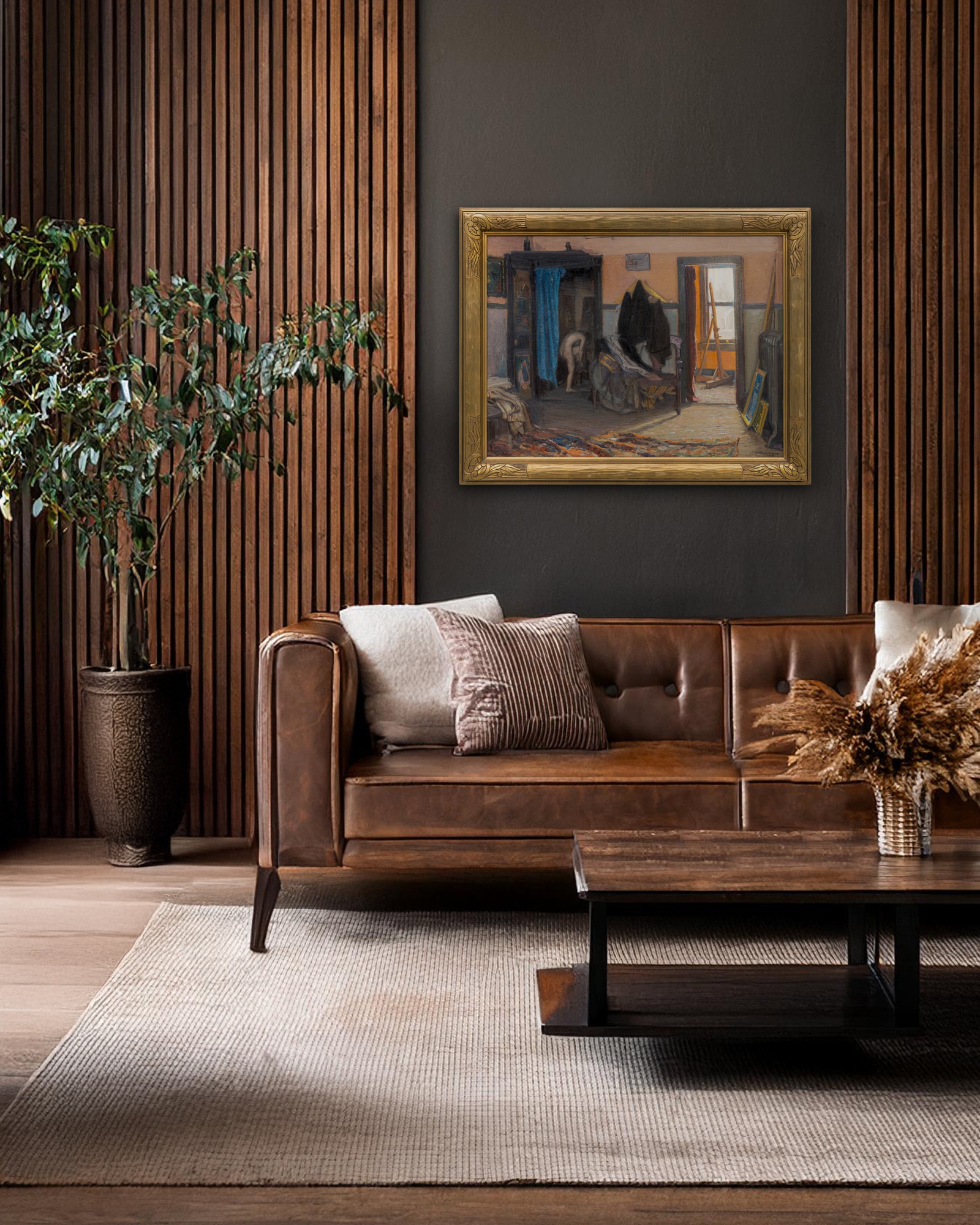
 
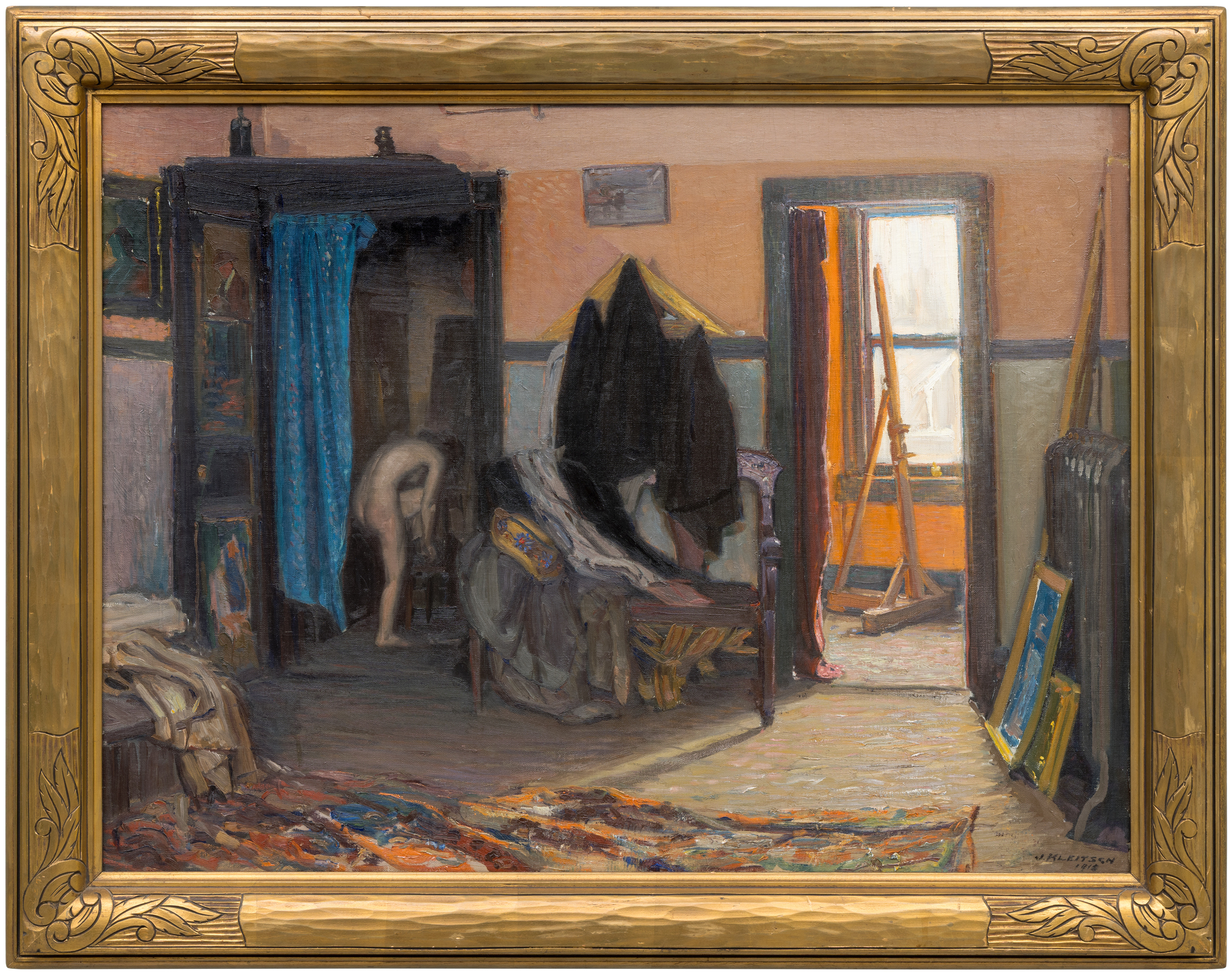
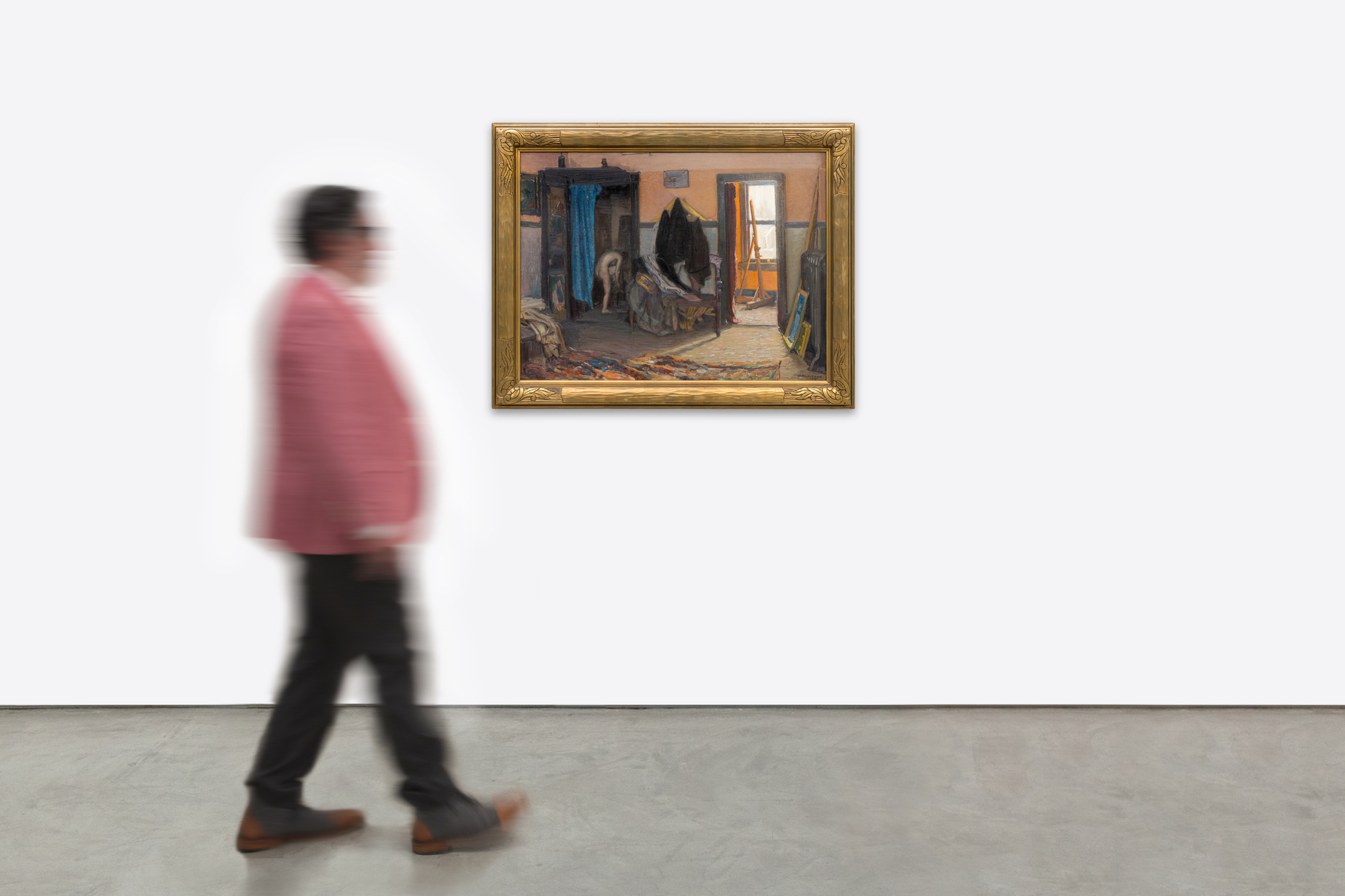
<div>Joseph Kleitsch’s <em>Studio Interior</em> (1918) is a compelling early work that reflects the artist’s academic-realist foundation and marks a pivotal moment just before his relocation from the Chicago to California. Painted shortly before this transition, the work reveals Kleitsch’s disciplined approach to composition and observation, shaped by his rigorous training in Budapest, Munich, and Paris. The scene depicts a quiet, lived-in studio space, where light enters through an open doorway to animate furniture, canvases, and everyday objects with a subdued yet attentive handling of color and tone. </div><br><br><div> </div><br><br><div>The interior is constructed with careful spatial logic and an emphasis on structure, underscoring Kleitsch’s preference for academic realism at this stage of his career. While in Chicago, his portrait and interior scenes were often distinguished by a “jeweled” palette—rich, saturated hues deployed with restraint—and that sensibility is evident here in the layered colors that enliven the otherwise low-keyed room. Subtle shifts in light guide the eye through the composition, balancing chromatic richness with solidity and calm. </div><br><br><div> </div><br><br><div>In the years leading up to his move west, Kleitsch was actively involved with Chicago’s artistic institutions, including the Palette and Chisel Club and the Art Institute of Chicago, situating him within a dynamic environment of evolving modern influences. During this time, Impressionist and Post-Impressionist works were increasingly visible in American exhibitions. While Kleitsch maintains a measured realism here, the Impressionist influence was incubating; he would later become renowned as a “master of gorgeous color” owing to the high-keyed vibrant palette of his California landscapes. </div><br><br><div> </div><br><br><div><em>Studio Interior</em> has been exhibited twice, both times in California, as part of exhibitions highlighting Kleitsch’s importance to the history of California art. Seen in retrospect, the painting offers a revealing glimpse of the artist’s roots before his later, more luminous California landscapes would come to define his legacy. </div><br><br><div> </div><br><br><div> </div> <div>Joseph Kleitsch’s <em>Studio Interior</em> (1918) is a compelling early work that reflects the artist’s academic-realist foundation and marks a pivotal moment just before his relocation from the Chicago to California. Painted shortly before this transition, the work reveals Kleitsch’s disciplined approach to composition and observation, shaped by his rigorous training in Budapest, Munich, and Paris. The scene depicts a quiet, lived-in studio space, where light enters through an open doorway to animate furniture, canvases, and everyday objects with a subdued yet attentive handling of color and tone. </div><br><br><div> </div><br><br><div>The interior is constructed with careful spatial logic and an emphasis on structure, underscoring Kleitsch’s preference for academic realism at this stage of his career. While in Chicago, his portrait and interior scenes were often distinguished by a “jeweled” palette—rich, saturated hues deployed with restraint—and that sensibility is evident here in the layered colors that enliven the otherwise low-keyed room. Subtle shifts in light guide the eye through the composition, balancing chromatic richness with solidity and calm. </div><br><br><div> </div><br><br><div>In the years leading up to his move west, Kleitsch was actively involved with Chicago’s artistic institutions, including the Palette and Chisel Club and the Art Institute of Chicago, situating him within a dynamic environment of evolving modern influences. During this time, Impressionist and Post-Impressionist works were increasingly visible in American exhibitions. While Kleitsch maintains a measured realism here, the Impressionist influence was incubating; he would later become renowned as a “master of gorgeous color” owing to the high-keyed vibrant palette of his California landscapes. </div><br><br><div> </div><br><br><div><em>Studio Interior</em> has been exhibited twice, both times in California, as part of exhibitions highlighting Kleitsch’s importance to the history of California art. Seen in retrospect, the painting offers a revealing glimpse of the artist’s roots before his later, more luminous California landscapes would come to define his legacy. </div><br><br><div> </div><br><br><div> </div> <div>Joseph Kleitsch’s <em>Studio Interior</em> (1918) is a compelling early work that reflects the artist’s academic-realist foundation and marks a pivotal moment just before his relocation from the Chicago to California. Painted shortly before this transition, the work reveals Kleitsch’s disciplined approach to composition and observation, shaped by his rigorous training in Budapest, Munich, and Paris. The scene depicts a quiet, lived-in studio space, where light enters through an open doorway to animate furniture, canvases, and everyday objects with a subdued yet attentive handling of color and tone. </div><br><br><div> </div><br><br><div>The interior is constructed with careful spatial logic and an emphasis on structure, underscoring Kleitsch’s preference for academic realism at this stage of his career. While in Chicago, his portrait and interior scenes were often distinguished by a “jeweled” palette—rich, saturated hues deployed with restraint—and that sensibility is evident here in the layered colors that enliven the otherwise low-keyed room. Subtle shifts in light guide the eye through the composition, balancing chromatic richness with solidity and calm. </div><br><br><div> </div><br><br><div>In the years leading up to his move west, Kleitsch was actively involved with Chicago’s artistic institutions, including the Palette and Chisel Club and the Art Institute of Chicago, situating him within a dynamic environment of evolving modern influences. During this time, Impressionist and Post-Impressionist works were increasingly visible in American exhibitions. While Kleitsch maintains a measured realism here, the Impressionist influence was incubating; he would later become renowned as a “master of gorgeous color” owing to the high-keyed vibrant palette of his California landscapes. </div><br><br><div> </div><br><br><div><em>Studio Interior</em> has been exhibited twice, both times in California, as part of exhibitions highlighting Kleitsch’s importance to the history of California art. Seen in retrospect, the painting offers a revealing glimpse of the artist’s roots before his later, more luminous California landscapes would come to define his legacy. </div><br><br><div> </div><br><br><div> </div> <div>Joseph Kleitsch’s <em>Studio Interior</em> (1918) is a compelling early work that reflects the artist’s academic-realist foundation and marks a pivotal moment just before his relocation from the Chicago to California. Painted shortly before this transition, the work reveals Kleitsch’s disciplined approach to composition and observation, shaped by his rigorous training in Budapest, Munich, and Paris. The scene depicts a quiet, lived-in studio space, where light enters through an open doorway to animate furniture, canvases, and everyday objects with a subdued yet attentive handling of color and tone. </div><br><br><div> </div><br><br><div>The interior is constructed with careful spatial logic and an emphasis on structure, underscoring Kleitsch’s preference for academic realism at this stage of his career. While in Chicago, his portrait and interior scenes were often distinguished by a “jeweled” palette—rich, saturated hues deployed with restraint—and that sensibility is evident here in the layered colors that enliven the otherwise low-keyed room. Subtle shifts in light guide the eye through the composition, balancing chromatic richness with solidity and calm. </div><br><br><div> </div><br><br><div>In the years leading up to his move west, Kleitsch was actively involved with Chicago’s artistic institutions, including the Palette and Chisel Club and the Art Institute of Chicago, situating him within a dynamic environment of evolving modern influences. During this time, Impressionist and Post-Impressionist works were increasingly visible in American exhibitions. While Kleitsch maintains a measured realism here, the Impressionist influence was incubating; he would later become renowned as a “master of gorgeous color” owing to the high-keyed vibrant palette of his California landscapes. </div><br><br><div> </div><br><br><div><em>Studio Interior</em> has been exhibited twice, both times in California, as part of exhibitions highlighting Kleitsch’s importance to the history of California art. Seen in retrospect, the painting offers a revealing glimpse of the artist’s roots before his later, more luminous California landscapes would come to define his legacy. </div><br><br><div> </div><br><br><div> </div> <div>Joseph Kleitsch’s <em>Studio Interior</em> (1918) is a compelling early work that reflects the artist’s academic-realist foundation and marks a pivotal moment just before his relocation from the Chicago to California. Painted shortly before this transition, the work reveals Kleitsch’s disciplined approach to composition and observation, shaped by his rigorous training in Budapest, Munich, and Paris. The scene depicts a quiet, lived-in studio space, where light enters through an open doorway to animate furniture, canvases, and everyday objects with a subdued yet attentive handling of color and tone. </div><br><br><div> </div><br><br><div>The interior is constructed with careful spatial logic and an emphasis on structure, underscoring Kleitsch’s preference for academic realism at this stage of his career. While in Chicago, his portrait and interior scenes were often distinguished by a “jeweled” palette—rich, saturated hues deployed with restraint—and that sensibility is evident here in the layered colors that enliven the otherwise low-keyed room. Subtle shifts in light guide the eye through the composition, balancing chromatic richness with solidity and calm. </div><br><br><div> </div><br><br><div>In the years leading up to his move west, Kleitsch was actively involved with Chicago’s artistic institutions, including the Palette and Chisel Club and the Art Institute of Chicago, situating him within a dynamic environment of evolving modern influences. During this time, Impressionist and Post-Impressionist works were increasingly visible in American exhibitions. While Kleitsch maintains a measured realism here, the Impressionist influence was incubating; he would later become renowned as a “master of gorgeous color” owing to the high-keyed vibrant palette of his California landscapes. </div><br><br><div> </div><br><br><div><em>Studio Interior</em> has been exhibited twice, both times in California, as part of exhibitions highlighting Kleitsch’s importance to the history of California art. Seen in retrospect, the painting offers a revealing glimpse of the artist’s roots before his later, more luminous California landscapes would come to define his legacy. </div><br><br><div> </div><br><br><div> </div> <div>Joseph Kleitsch’s <em>Studio Interior</em> (1918) is a compelling early work that reflects the artist’s academic-realist foundation and marks a pivotal moment just before his relocation from the Chicago to California. Painted shortly before this transition, the work reveals Kleitsch’s disciplined approach to composition and observation, shaped by his rigorous training in Budapest, Munich, and Paris. The scene depicts a quiet, lived-in studio space, where light enters through an open doorway to animate furniture, canvases, and everyday objects with a subdued yet attentive handling of color and tone. </div><br><br><div> </div><br><br><div>The interior is constructed with careful spatial logic and an emphasis on structure, underscoring Kleitsch’s preference for academic realism at this stage of his career. While in Chicago, his portrait and interior scenes were often distinguished by a “jeweled” palette—rich, saturated hues deployed with restraint—and that sensibility is evident here in the layered colors that enliven the otherwise low-keyed room. Subtle shifts in light guide the eye through the composition, balancing chromatic richness with solidity and calm. </div><br><br><div> </div><br><br><div>In the years leading up to his move west, Kleitsch was actively involved with Chicago’s artistic institutions, including the Palette and Chisel Club and the Art Institute of Chicago, situating him within a dynamic environment of evolving modern influences. During this time, Impressionist and Post-Impressionist works were increasingly visible in American exhibitions. While Kleitsch maintains a measured realism here, the Impressionist influence was incubating; he would later become renowned as a “master of gorgeous color” owing to the high-keyed vibrant palette of his California landscapes. </div><br><br><div> </div><br><br><div><em>Studio Interior</em> has been exhibited twice, both times in California, as part of exhibitions highlighting Kleitsch’s importance to the history of California art. Seen in retrospect, the painting offers a revealing glimpse of the artist’s roots before his later, more luminous California landscapes would come to define his legacy. </div><br><br><div> </div><br><br><div> </div> <div>Joseph Kleitsch’s <em>Studio Interior</em> (1918) is a compelling early work that reflects the artist’s academic-realist foundation and marks a pivotal moment just before his relocation from the Chicago to California. Painted shortly before this transition, the work reveals Kleitsch’s disciplined approach to composition and observation, shaped by his rigorous training in Budapest, Munich, and Paris. The scene depicts a quiet, lived-in studio space, where light enters through an open doorway to animate furniture, canvases, and everyday objects with a subdued yet attentive handling of color and tone. </div><br><br><div> </div><br><br><div>The interior is constructed with careful spatial logic and an emphasis on structure, underscoring Kleitsch’s preference for academic realism at this stage of his career. While in Chicago, his portrait and interior scenes were often distinguished by a “jeweled” palette—rich, saturated hues deployed with restraint—and that sensibility is evident here in the layered colors that enliven the otherwise low-keyed room. Subtle shifts in light guide the eye through the composition, balancing chromatic richness with solidity and calm. </div><br><br><div> </div><br><br><div>In the years leading up to his move west, Kleitsch was actively involved with Chicago’s artistic institutions, including the Palette and Chisel Club and the Art Institute of Chicago, situating him within a dynamic environment of evolving modern influences. During this time, Impressionist and Post-Impressionist works were increasingly visible in American exhibitions. While Kleitsch maintains a measured realism here, the Impressionist influence was incubating; he would later become renowned as a “master of gorgeous color” owing to the high-keyed vibrant palette of his California landscapes. </div><br><br><div> </div><br><br><div><em>Studio Interior</em> has been exhibited twice, both times in California, as part of exhibitions highlighting Kleitsch’s importance to the history of California art. Seen in retrospect, the painting offers a revealing glimpse of the artist’s roots before his later, more luminous California landscapes would come to define his legacy. </div><br><br><div> </div><br><br><div> </div> <div>Joseph Kleitsch’s <em>Studio Interior</em> (1918) is a compelling early work that reflects the artist’s academic-realist foundation and marks a pivotal moment just before his relocation from the Chicago to California. Painted shortly before this transition, the work reveals Kleitsch’s disciplined approach to composition and observation, shaped by his rigorous training in Budapest, Munich, and Paris. The scene depicts a quiet, lived-in studio space, where light enters through an open doorway to animate furniture, canvases, and everyday objects with a subdued yet attentive handling of color and tone. </div><br><br><div> </div><br><br><div>The interior is constructed with careful spatial logic and an emphasis on structure, underscoring Kleitsch’s preference for academic realism at this stage of his career. While in Chicago, his portrait and interior scenes were often distinguished by a “jeweled” palette—rich, saturated hues deployed with restraint—and that sensibility is evident here in the layered colors that enliven the otherwise low-keyed room. Subtle shifts in light guide the eye through the composition, balancing chromatic richness with solidity and calm. </div><br><br><div> </div><br><br><div>In the years leading up to his move west, Kleitsch was actively involved with Chicago’s artistic institutions, including the Palette and Chisel Club and the Art Institute of Chicago, situating him within a dynamic environment of evolving modern influences. During this time, Impressionist and Post-Impressionist works were increasingly visible in American exhibitions. While Kleitsch maintains a measured realism here, the Impressionist influence was incubating; he would later become renowned as a “master of gorgeous color” owing to the high-keyed vibrant palette of his California landscapes. </div><br><br><div> </div><br><br><div><em>Studio Interior</em> has been exhibited twice, both times in California, as part of exhibitions highlighting Kleitsch’s importance to the history of California art. Seen in retrospect, the painting offers a revealing glimpse of the artist’s roots before his later, more luminous California landscapes would come to define his legacy. </div><br><br><div> </div><br><br><div> </div> <div>Joseph Kleitsch’s <em>Studio Interior</em> (1918) is a compelling early work that reflects the artist’s academic-realist foundation and marks a pivotal moment just before his relocation from the Chicago to California. Painted shortly before this transition, the work reveals Kleitsch’s disciplined approach to composition and observation, shaped by his rigorous training in Budapest, Munich, and Paris. The scene depicts a quiet, lived-in studio space, where light enters through an open doorway to animate furniture, canvases, and everyday objects with a subdued yet attentive handling of color and tone. </div><br><br><div> </div><br><br><div>The interior is constructed with careful spatial logic and an emphasis on structure, underscoring Kleitsch’s preference for academic realism at this stage of his career. While in Chicago, his portrait and interior scenes were often distinguished by a “jeweled” palette—rich, saturated hues deployed with restraint—and that sensibility is evident here in the layered colors that enliven the otherwise low-keyed room. Subtle shifts in light guide the eye through the composition, balancing chromatic richness with solidity and calm. </div><br><br><div> </div><br><br><div>In the years leading up to his move west, Kleitsch was actively involved with Chicago’s artistic institutions, including the Palette and Chisel Club and the Art Institute of Chicago, situating him within a dynamic environment of evolving modern influences. During this time, Impressionist and Post-Impressionist works were increasingly visible in American exhibitions. While Kleitsch maintains a measured realism here, the Impressionist influence was incubating; he would later become renowned as a “master of gorgeous color” owing to the high-keyed vibrant palette of his California landscapes. </div><br><br><div> </div><br><br><div><em>Studio Interior</em> has been exhibited twice, both times in California, as part of exhibitions highlighting Kleitsch’s importance to the history of California art. Seen in retrospect, the painting offers a revealing glimpse of the artist’s roots before his later, more luminous California landscapes would come to define his legacy. </div><br><br><div> </div><br><br><div> </div> <div>Joseph Kleitsch’s <em>Studio Interior</em> (1918) is a compelling early work that reflects the artist’s academic-realist foundation and marks a pivotal moment just before his relocation from the Chicago to California. Painted shortly before this transition, the work reveals Kleitsch’s disciplined approach to composition and observation, shaped by his rigorous training in Budapest, Munich, and Paris. The scene depicts a quiet, lived-in studio space, where light enters through an open doorway to animate furniture, canvases, and everyday objects with a subdued yet attentive handling of color and tone. </div><br><br><div> </div><br><br><div>The interior is constructed with careful spatial logic and an emphasis on structure, underscoring Kleitsch’s preference for academic realism at this stage of his career. While in Chicago, his portrait and interior scenes were often distinguished by a “jeweled” palette—rich, saturated hues deployed with restraint—and that sensibility is evident here in the layered colors that enliven the otherwise low-keyed room. Subtle shifts in light guide the eye through the composition, balancing chromatic richness with solidity and calm. </div><br><br><div> </div><br><br><div>In the years leading up to his move west, Kleitsch was actively involved with Chicago’s artistic institutions, including the Palette and Chisel Club and the Art Institute of Chicago, situating him within a dynamic environment of evolving modern influences. During this time, Impressionist and Post-Impressionist works were increasingly visible in American exhibitions. While Kleitsch maintains a measured realism here, the Impressionist influence was incubating; he would later become renowned as a “master of gorgeous color” owing to the high-keyed vibrant palette of his California landscapes. </div><br><br><div> </div><br><br><div><em>Studio Interior</em> has been exhibited twice, both times in California, as part of exhibitions highlighting Kleitsch’s importance to the history of California art. Seen in retrospect, the painting offers a revealing glimpse of the artist’s roots before his later, more luminous California landscapes would come to define his legacy. </div><br><br><div> </div><br><br><div> </div>
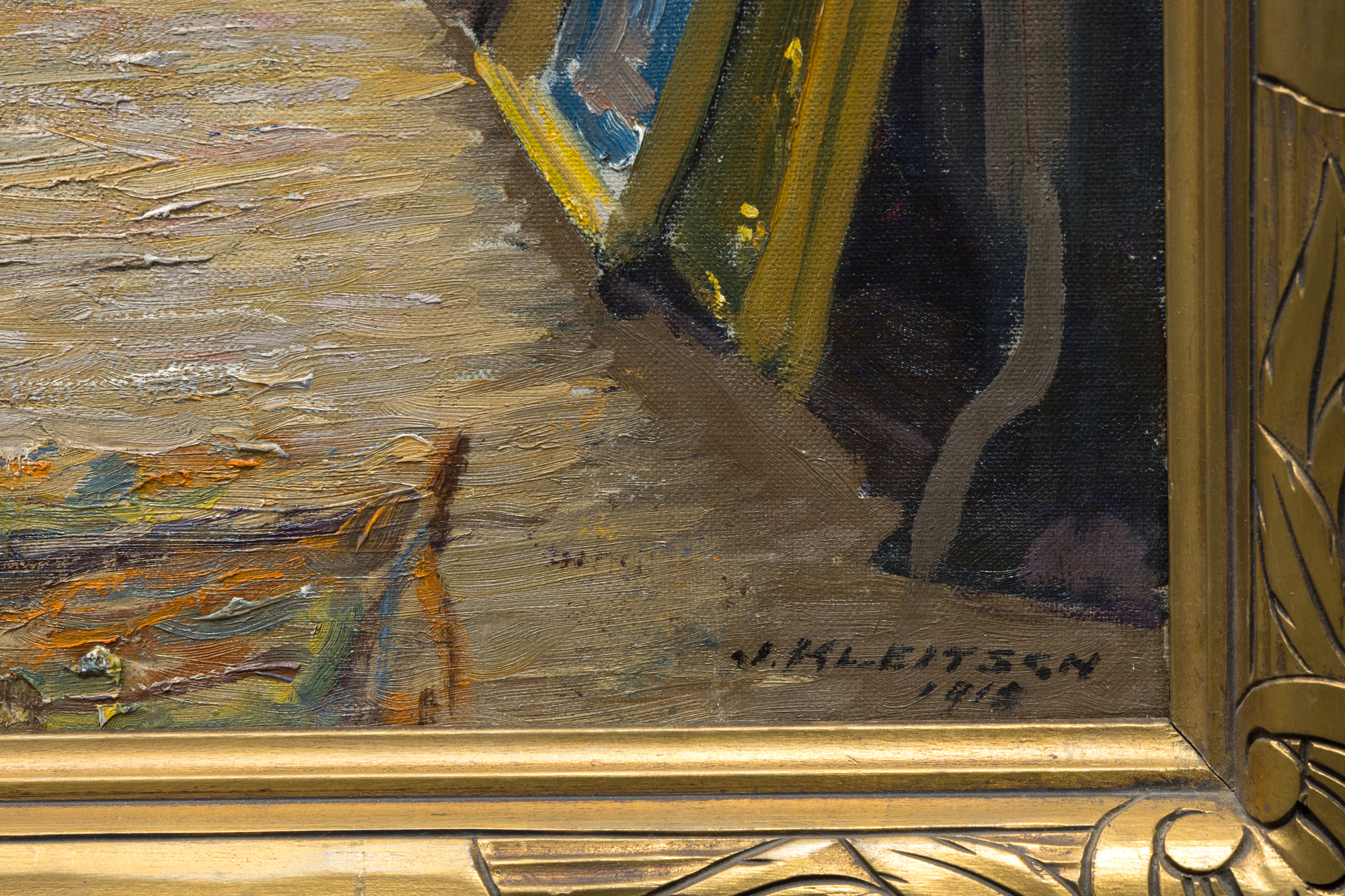
Studio-Innenraum191830 x 40 Zoll(76,2 x 101,6 cm) Öl auf Leinwand
Provenienz
George Stern Fine Arts
Privatsammlung, erworben von oben genanntem, 2012
Ausstellung
Pasadena, Kalifornien, Pasadena Museum of California Art, Die goldenen Zwanziger: Porträts und Figurenbilder von Joseph Kleitsch, 5. März bis 6. August 2017
Laguna Beach, Kalifornien, Laguna Art Museum, Joseph Kleitsch: Im Ausland und zu Hause im alten Laguna, 24. Juni bis 24. September 2023
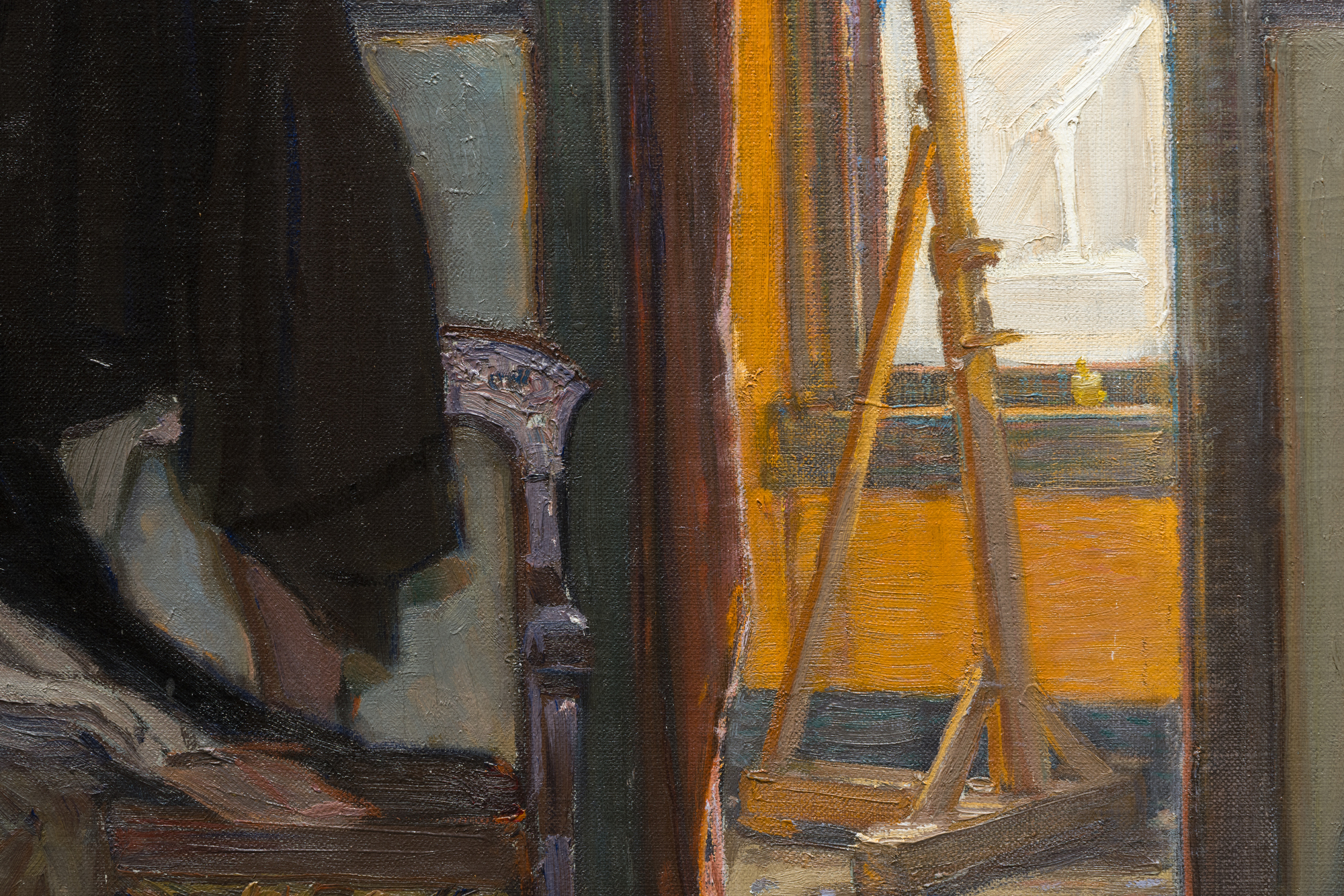
Joseph Kleitschs „Studio Interior“ (1918) ist ein faszinierendes Frühwerk, das die akademisch-realistische Grundlage des Künstlers widerspiegelt und einen entscheidenden Moment kurz vor seinem Umzug von Chicago nach Kalifornien markiert. Das kurz vor diesem Umzug entstandene Werk offenbart Kleitschs disziplinierten Ansatz in Bezug auf Komposition und Beobachtung, der durch seine strenge Ausbildung in Budapest, München und Paris geprägt wurde. Die Szene zeigt einen ruhigen, bewohnten Atelierraum, in den durch eine offene Tür Licht fällt und Möbel, Leinwände und Alltagsgegenstände mit einer zurückhaltenden, aber aufmerksamen Verwendung von Farben und Tönen zum Leben erweckt.


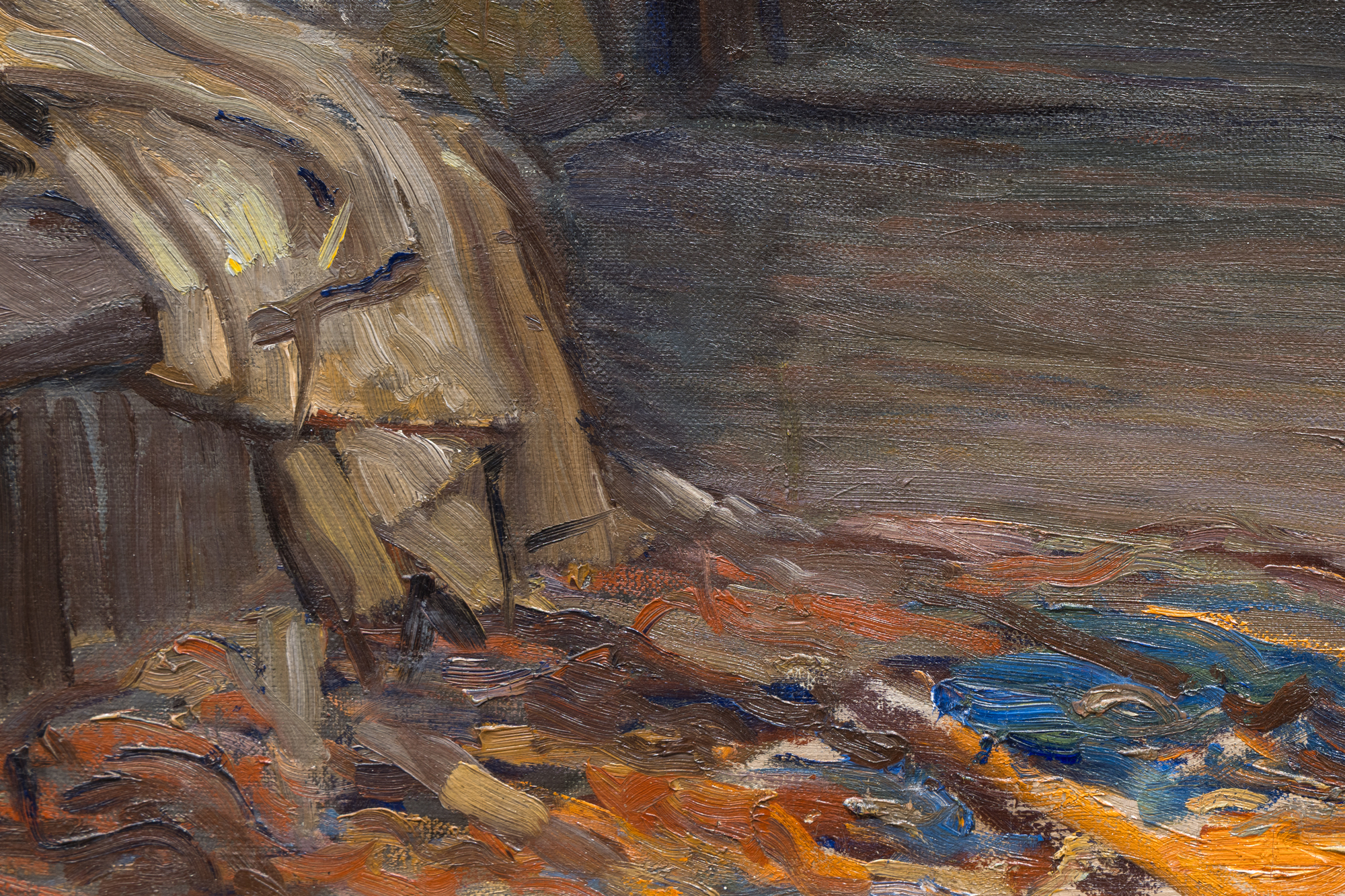
Der Innenraum ist mit sorgfältiger räumlicher Logik und einer Betonung der Struktur konstruiert, was Kleitschs Vorliebe für akademischen Realismus in dieser Phase seiner Karriere unterstreicht. Während seiner Zeit in Chicago zeichneten sich seine Porträts und Interieurszenen oft durch eine „juwelenartige“ Farbpalette aus – satte, kräftige Farbtöne, die mit Zurückhaltung eingesetzt wurden – und diese Sensibilität zeigt sich auch hier in den vielschichtigen Farben, die den ansonsten zurückhaltenden Raum beleben. Subtile Lichtveränderungen leiten den Blick durch die Komposition und schaffen ein Gleichgewicht zwischen chromatischer Fülle und Solidität und Ruhe.


In den Jahren vor seinem Umzug in den Westen engagierte sich Kleitsch aktiv in den künstlerischen Institutionen Chicagos, darunter dem Palette and Chisel Club und dem Art Institute of Chicago, wodurch er sich in einem dynamischen Umfeld sich entwickelnder moderner Einflüsse befand. Während dieser Zeit wurden impressionistische und postimpressionistische Werke zunehmend in amerikanischen Ausstellungen gezeigt. Während Kleitsch hier einen zurückhaltenden Realismus beibehält, war der impressionistische Einfluss bereits im Entstehen begriffen; später wurde er aufgrund der lebhaften Farbpalette seiner kalifornischen Landschaften als „Meister der prächtigen Farben” bekannt.


„Studio Interior” wurde zweimal ausgestellt, beide Male in Kalifornien, als Teil von Ausstellungen, die Kleitschs Bedeutung für die Geschichte der kalifornischen Kunst hervorhoben. Rückblickend bietet das Gemälde einen aufschlussreichen Einblick in die Wurzeln des Künstlers, bevor seine späteren, leuchtenderen kalifornischen Landschaften sein Vermächtnis prägten.


Fragen Sie