
Zurück

PIERRE BONNARD (1867-1947)

 
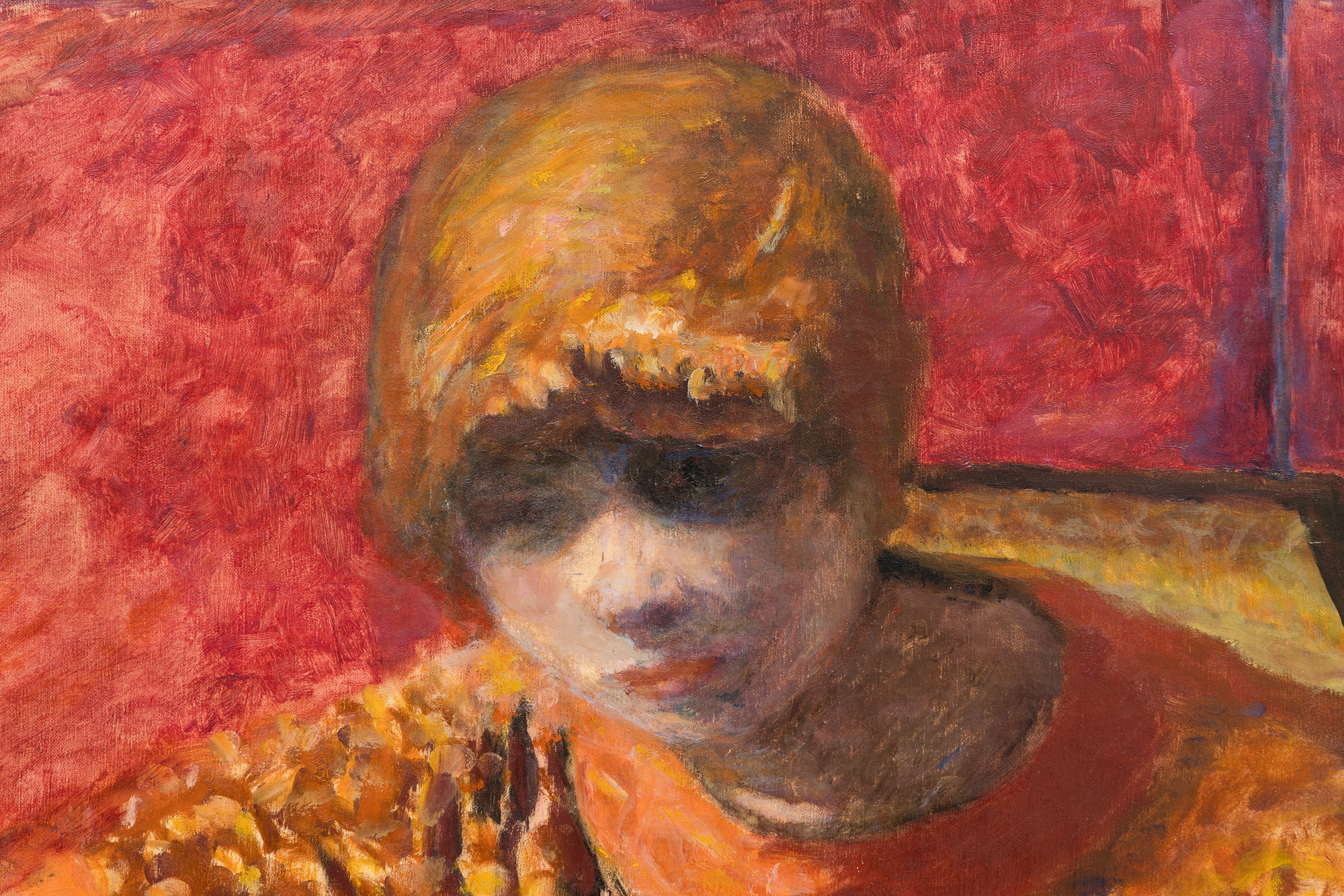
<div>Pierre Bonnard’s <em>La robe de chambre rouge (Marthe Bonnard)</em> (1912) is a richly intimate portrait of the artist’s lifelong muse and wife, Marthe de Meligny, painted at a moment when Bonnard was redefining modern interior painting through color, memory, and psychological nuance. Seated and absorbed in a private moment, Marthe is enveloped by a saturated red ground that presses close to the picture plane, dissolving traditional depth in favor of chromatic intensity. Her patterned robe and softly modeled face emerge through Bonnard’s layered brushwork, where color functions less as description than as emotional atmosphere. </div><br><br><div> </div><br><br><div>Painted in 1912, the work was exhibited extensively from the year of its creation, appearing in seven exhibitions across Paris, Rotterdam, and Munich, signaling its immediate recognition within Bonnard’s circle and the broader European avant-garde. The painting also boasts a distinguished provenance, having passed through the collections of notable French Jewish collector Alphonse Kahn; Eugène Blot, the influential gallerist, collector, and sculpture castor; and Jacques Dupont, the celebrated Olympic cyclist. </div><br><br><div> </div><br><br><div><em>La robe de chambre rouge</em> is published seven times, including Bonnard’s 1968 catalogue raisonné, where it is listed as no. 674. The artist’s portraits of Marthe occupy a central place in his oeuvre. Closely related examples are held in the permanent collections of major institutions such as the Tate, the Museum of Modern Art, the Guggenheim, and The Metropolitan Museum of Art, underscoring the enduring significance of these deeply personal yet formally radical compositions. </div> <div>Pierre Bonnard’s <em>La robe de chambre rouge (Marthe Bonnard)</em> (1912) is a richly intimate portrait of the artist’s lifelong muse and wife, Marthe de Meligny, painted at a moment when Bonnard was redefining modern interior painting through color, memory, and psychological nuance. Seated and absorbed in a private moment, Marthe is enveloped by a saturated red ground that presses close to the picture plane, dissolving traditional depth in favor of chromatic intensity. Her patterned robe and softly modeled face emerge through Bonnard’s layered brushwork, where color functions less as description than as emotional atmosphere. </div><br><br><div> </div><br><br><div>Painted in 1912, the work was exhibited extensively from the year of its creation, appearing in seven exhibitions across Paris, Rotterdam, and Munich, signaling its immediate recognition within Bonnard’s circle and the broader European avant-garde. The painting also boasts a distinguished provenance, having passed through the collections of notable French Jewish collector Alphonse Kahn; Eugène Blot, the influential gallerist, collector, and sculpture castor; and Jacques Dupont, the celebrated Olympic cyclist. </div><br><br><div> </div><br><br><div><em>La robe de chambre rouge</em> is published seven times, including Bonnard’s 1968 catalogue raisonné, where it is listed as no. 674. The artist’s portraits of Marthe occupy a central place in his oeuvre. Closely related examples are held in the permanent collections of major institutions such as the Tate, the Museum of Modern Art, the Guggenheim, and The Metropolitan Museum of Art, underscoring the enduring significance of these deeply personal yet formally radical compositions. </div> <div>Pierre Bonnard’s <em>La robe de chambre rouge (Marthe Bonnard)</em> (1912) is a richly intimate portrait of the artist’s lifelong muse and wife, Marthe de Meligny, painted at a moment when Bonnard was redefining modern interior painting through color, memory, and psychological nuance. Seated and absorbed in a private moment, Marthe is enveloped by a saturated red ground that presses close to the picture plane, dissolving traditional depth in favor of chromatic intensity. Her patterned robe and softly modeled face emerge through Bonnard’s layered brushwork, where color functions less as description than as emotional atmosphere. </div><br><br><div> </div><br><br><div>Painted in 1912, the work was exhibited extensively from the year of its creation, appearing in seven exhibitions across Paris, Rotterdam, and Munich, signaling its immediate recognition within Bonnard’s circle and the broader European avant-garde. The painting also boasts a distinguished provenance, having passed through the collections of notable French Jewish collector Alphonse Kahn; Eugène Blot, the influential gallerist, collector, and sculpture castor; and Jacques Dupont, the celebrated Olympic cyclist. </div><br><br><div> </div><br><br><div><em>La robe de chambre rouge</em> is published seven times, including Bonnard’s 1968 catalogue raisonné, where it is listed as no. 674. The artist’s portraits of Marthe occupy a central place in his oeuvre. Closely related examples are held in the permanent collections of major institutions such as the Tate, the Museum of Modern Art, the Guggenheim, and The Metropolitan Museum of Art, underscoring the enduring significance of these deeply personal yet formally radical compositions. </div> <div>Pierre Bonnard’s <em>La robe de chambre rouge (Marthe Bonnard)</em> (1912) is a richly intimate portrait of the artist’s lifelong muse and wife, Marthe de Meligny, painted at a moment when Bonnard was redefining modern interior painting through color, memory, and psychological nuance. Seated and absorbed in a private moment, Marthe is enveloped by a saturated red ground that presses close to the picture plane, dissolving traditional depth in favor of chromatic intensity. Her patterned robe and softly modeled face emerge through Bonnard’s layered brushwork, where color functions less as description than as emotional atmosphere. </div><br><br><div> </div><br><br><div>Painted in 1912, the work was exhibited extensively from the year of its creation, appearing in seven exhibitions across Paris, Rotterdam, and Munich, signaling its immediate recognition within Bonnard’s circle and the broader European avant-garde. The painting also boasts a distinguished provenance, having passed through the collections of notable French Jewish collector Alphonse Kahn; Eugène Blot, the influential gallerist, collector, and sculpture castor; and Jacques Dupont, the celebrated Olympic cyclist. </div><br><br><div> </div><br><br><div><em>La robe de chambre rouge</em> is published seven times, including Bonnard’s 1968 catalogue raisonné, where it is listed as no. 674. The artist’s portraits of Marthe occupy a central place in his oeuvre. Closely related examples are held in the permanent collections of major institutions such as the Tate, the Museum of Modern Art, the Guggenheim, and The Metropolitan Museum of Art, underscoring the enduring significance of these deeply personal yet formally radical compositions. </div> <div>Pierre Bonnard’s <em>La robe de chambre rouge (Marthe Bonnard)</em> (1912) is a richly intimate portrait of the artist’s lifelong muse and wife, Marthe de Meligny, painted at a moment when Bonnard was redefining modern interior painting through color, memory, and psychological nuance. Seated and absorbed in a private moment, Marthe is enveloped by a saturated red ground that presses close to the picture plane, dissolving traditional depth in favor of chromatic intensity. Her patterned robe and softly modeled face emerge through Bonnard’s layered brushwork, where color functions less as description than as emotional atmosphere. </div><br><br><div> </div><br><br><div>Painted in 1912, the work was exhibited extensively from the year of its creation, appearing in seven exhibitions across Paris, Rotterdam, and Munich, signaling its immediate recognition within Bonnard’s circle and the broader European avant-garde. The painting also boasts a distinguished provenance, having passed through the collections of notable French Jewish collector Alphonse Kahn; Eugène Blot, the influential gallerist, collector, and sculpture castor; and Jacques Dupont, the celebrated Olympic cyclist. </div><br><br><div> </div><br><br><div><em>La robe de chambre rouge</em> is published seven times, including Bonnard’s 1968 catalogue raisonné, where it is listed as no. 674. The artist’s portraits of Marthe occupy a central place in his oeuvre. Closely related examples are held in the permanent collections of major institutions such as the Tate, the Museum of Modern Art, the Guggenheim, and The Metropolitan Museum of Art, underscoring the enduring significance of these deeply personal yet formally radical compositions. </div> <div>Pierre Bonnard’s <em>La robe de chambre rouge (Marthe Bonnard)</em> (1912) is a richly intimate portrait of the artist’s lifelong muse and wife, Marthe de Meligny, painted at a moment when Bonnard was redefining modern interior painting through color, memory, and psychological nuance. Seated and absorbed in a private moment, Marthe is enveloped by a saturated red ground that presses close to the picture plane, dissolving traditional depth in favor of chromatic intensity. Her patterned robe and softly modeled face emerge through Bonnard’s layered brushwork, where color functions less as description than as emotional atmosphere. </div><br><br><div> </div><br><br><div>Painted in 1912, the work was exhibited extensively from the year of its creation, appearing in seven exhibitions across Paris, Rotterdam, and Munich, signaling its immediate recognition within Bonnard’s circle and the broader European avant-garde. The painting also boasts a distinguished provenance, having passed through the collections of notable French Jewish collector Alphonse Kahn; Eugène Blot, the influential gallerist, collector, and sculpture castor; and Jacques Dupont, the celebrated Olympic cyclist. </div><br><br><div> </div><br><br><div><em>La robe de chambre rouge</em> is published seven times, including Bonnard’s 1968 catalogue raisonné, where it is listed as no. 674. The artist’s portraits of Marthe occupy a central place in his oeuvre. Closely related examples are held in the permanent collections of major institutions such as the Tate, the Museum of Modern Art, the Guggenheim, and The Metropolitan Museum of Art, underscoring the enduring significance of these deeply personal yet formally radical compositions. </div> <div>Pierre Bonnard’s <em>La robe de chambre rouge (Marthe Bonnard)</em> (1912) is a richly intimate portrait of the artist’s lifelong muse and wife, Marthe de Meligny, painted at a moment when Bonnard was redefining modern interior painting through color, memory, and psychological nuance. Seated and absorbed in a private moment, Marthe is enveloped by a saturated red ground that presses close to the picture plane, dissolving traditional depth in favor of chromatic intensity. Her patterned robe and softly modeled face emerge through Bonnard’s layered brushwork, where color functions less as description than as emotional atmosphere. </div><br><br><div> </div><br><br><div>Painted in 1912, the work was exhibited extensively from the year of its creation, appearing in seven exhibitions across Paris, Rotterdam, and Munich, signaling its immediate recognition within Bonnard’s circle and the broader European avant-garde. The painting also boasts a distinguished provenance, having passed through the collections of notable French Jewish collector Alphonse Kahn; Eugène Blot, the influential gallerist, collector, and sculpture castor; and Jacques Dupont, the celebrated Olympic cyclist. </div><br><br><div> </div><br><br><div><em>La robe de chambre rouge</em> is published seven times, including Bonnard’s 1968 catalogue raisonné, where it is listed as no. 674. The artist’s portraits of Marthe occupy a central place in his oeuvre. Closely related examples are held in the permanent collections of major institutions such as the Tate, the Museum of Modern Art, the Guggenheim, and The Metropolitan Museum of Art, underscoring the enduring significance of these deeply personal yet formally radical compositions. </div>
Der rote Morgenmantel (Marthe Bonnard)191221 x 27 1/4 in.(53,34 x 69,22 cm) Öl auf Leinwand
Provenienz
Galerie Bernheim-Jeune, Paris, erworben vom Künstler
Alphonse Kahn, Saint-Germain-en-Laye, erworben von oben
Me Lair-Dubreuil, Hôtel Drouot, Paris, 20. November 1922, Los 40 (mit dem Titel „La robe de chambre orange”)
Eugène Blot, Paris, erworben bei der oben genannten Auktion
Me Baudoin, Paris, 2. Juni 1933, Los 33 (mit dem Titel „Femme assise dans un intérieur”)
Sammlung Huet, Paris, erworben bei der oben genannten Auktion
Jacques Dupont, Paris, Dezember 1940
Privatsammlung, aus dem oben genannten Nachlass
Christie’s, Paris, O
...Mehr.....17. Oktober 2018, Los 37
Privatsammlung, erworben bei der oben genannten Auktion
Ausstellung
Paris, Galerie Bernheim-Jeune, Bonnard, Œuvres récentes, 17. Juni – 6. Juli 1912, Nr. 15
Paris, Galerie Bernheim-Jeune, Pierre Bonnard, Œuvres récentes, 19. Mai – 7. Juni 1913
Paris, Galerie d'art Braun & Cie, Portraits de Pierre Bonnard, Juni 1933, Nr. 21, S. 4 (mit dem Titel „Portrait de femme au turban”)
Paris, Galerie Frommont, Die Gefährtin des Malers, 1953
Rotterdam, Museum Boymans-van Beuningen, Bonnard, 1953, Nr. 45 (datiert „vers 1910-11”)
Paris, Maison de la Pensée française, Pierre Bonnard, Sommer 1955, Nr. 20
München, Haus der Kunst; Paris, Orangerie des Tuileries, Pierre Bonnard, Centenaire de sa naissance, 8. Oktober 1966 – 15. April 1967, Nr. 75
Literaturhinweise
Le courrier européen, 23. Mai 1913 (illustriert, mit dem Titel Étude de femme)
Gustave Coquiot, Les indépendants, 1884-1920, Paris, 1921, S. 78-79 (illustriert)
Gustave Coquiot, Bonnard, Paris, 1922, S. 54 (mit dem Titel „La robe de chambre orangée”)
Léon Werth, Bonnard, Paris, 1923 (abgebildet, Tafel 25)
André Fage, Der Sammler moderner Gemälde, Paris, 1930, S. 252
Galerie d'art Braun & Cie, Portraits de Pierre Bonnard, Paris, 1933, Nr. 21, S. 4 (mit dem Titel „Portrait de femme au turban”)
M.-T. Mauguis, Kunst, 25. Juni 1955
Haus der Kunst & Orangerie des Tuileries, Pierre Bonnard, Centenaire de sa naissance, München & Paris, 1967, Nr. 75 (abgebildet)
Raymond Cogniat, Bonnard, Paris, 1968 (abgebildet auf dem Umschlag)
Jean & Henry Dauberville, Bonnard, Catalogue raisonné de l'œuvre peint, 1906-1919, Paris, 1968, Band II, Nr. 674, S. 247 (abgebildet)
...WENIGER.....
Pierre Bonnards La robe de chambre rouge (Marthe Bonnard) (1912) ist ein sehr intimes Porträt der lebenslangen Muse und Ehefrau des Künstlers, Marthe de Meligny, gemalt zu einer Zeit, als Bonnard die moderne Interieurmalerei durch Farbe, Erinnerung und psychologische Nuancen neu definierte. Marthe sitzt versunken in einen privaten Moment vertieft und ist umhüllt von einem satten roten Hintergrund, der sich dicht an die Bildebene drängt und die traditionelle Tiefe zugunsten chromatischer Intensität auflöst. Ihr gemusterter Morgenmantel und ihr sanft modelliertes Gesicht treten durch Bonnards vielschichtige Pinselführung hervor, bei der Farbe weniger als Beschreibung denn als emotionale Atmosphäre fungiert.


Das 1912 entstandene Werk wurde seit dem Jahr seiner Entstehung vielfach ausgestellt und war in sieben Ausstellungen in Paris, Rotterdam und München zu sehen, was seine sofortige Anerkennung in Bonnards Kreis und der breiteren europäischen Avantgarde signalisierte. Das Gemälde kann auch auf eine bedeutende Provenienz verweisen, da es sich im Besitz des namhaften französischen jüdischen Sammlers Alphonse Kahn, des einflussreichen Galeristen, Sammlers und Bildhauers Eugène Blot sowie des berühmten olympischen Radrennfahrers Jacques Dupont befand.


La robe de chambre rouge wurde sieben Mal veröffentlicht, darunter in Bonnards Werkverzeichnis von 1968, wo es unter der Nummer 674 aufgeführt ist. Die Porträts der Marthe nehmen einen zentralen Platz im Œuvre des Künstlers ein. Eng verwandte Beispiele befinden sich in den ständigen Sammlungen bedeutender Institutionen wie der Tate, dem Museum of Modern Art, dem Guggenheim und dem Metropolitan Museum of Art, was die anhaltende Bedeutung dieser zutiefst persönlichen und dennoch formal radikalen Kompositionen unterstreicht.
Fragen Sie