MENÜ
Heidekraut James
SUCHEN


  • Startseite
  • Über
    • Palmwüste
    • Jackson Loch
    • New York
    • London
    • Los Angeles
    • Montecito
    • Berater
    • Dienstleistungen
  • Besichtigungsraum
  • Künstler
    • Künstler
    • Kategorien
  • Kunstwerk
  • Ausstellungen
  • Veröffentlichungen
    • Galerie Touren
    • Ausstellungsführungen
    • Videos
    • Kataloge
  • Lernen Sie
    • Kunst als Investition
    • Drücken
    • Neuigkeiten
    • Bildung
  • Verkaufen
  • Neu eingetroffen
  • Kontakt
  • Beratung
  • Startseite
  • Über
    • Palmwüste
    • Jackson Loch
    • New York
    • London
    • Los Angeles
    • Montecito
    • Berater
    • Dienstleistungen
  • Besichtigungsraum
  • Künstler
    • Künstler
    • Kategorien
  • Kunstwerk
  • Ausstellungen
  • Veröffentlichungen
    • Galerie Touren
    • Ausstellungsführungen
    • Videos
    • Kataloge
  • Lernen Sie
    • Kunst als Investition
    • Drücken
    • Neuigkeiten
    • Bildung
  • Verkaufen
  • Neu eingetroffen
  • Kontakt
  • Beratung

Post-Navigation

Zeitgenössische Sammlung

VERÖFFENTLICHT IN: Kataloge

Heather James fine Art präsentiert eine Auswahl von Kunstwerken aus unserer Sammlung Zeitgenössische Kunst

Auszug zeitgenössischer Werke verfügbar

<div>When forty rural Sacramento Delta landscapes by Wayne Thiebaud were unveiled at a San Francisco gallery opening in November 1997, attendees were amazed by paintings they never anticipated. This new frontier betrayed neither Thiebaud’s mastery of confectionary-shop colors nor his impeccable eye for formal relationships. Rather, his admirers were shocked to learn that all but seven of these forty interpretations had been completed in just two years. As his son Paul recalled, “the refinements of my father’s artistic process were ever changing in a chameleon-like frenzy.” The new direction had proved an exhilarating experience, each painting an affirmation of Wayne Thiebaud’s impassioned response to the fields and levees of the local environment he dearly loved.   </div><br><br><div> </div><br><br><div>Viewed from the perspective of a bird or a plane, "The Riverhouse" is an agrarian tapestry conceived with a kaleidoscopic range of shapes and simple forms; fields striped with furrows or striated fans, deliriously colored parallelograms and trapezoids, an orchard garnished pizza-shaped wedge, and a boldly limned river, the lifeline of a thirsty California central valley largely dependent upon transported water. "The Riverhouse" is a painting that ‘moves’ between seamlessly shifting planes of aerial mapping that recalls Richard Diebenkorn’s stroke of insight when he took his first commercial flight the spring of 1951, and those partitions engaging a more standard vanishing point perspective. Thiebaud explained his process as “orchestrating with as much variety and tempo as I can.” Brightly lit with a fauve-like intensity, "The Riverhouse" is a heady concoction of vibrant pigment and rich impasto, one that recalls his indebtedness to Pierre Bonnard whose color Thiebaud referred to as “a bucket full of hot coals and ice cubes.” Among his many other influences, the insertion of objects — often tiny — that defy a rational sense of scale that reflects his interest in Chinese landscape painting.  As always, his mastery as a painter recalls his titular pies and cakes with their bewitching rainbow-like halos and side-by-side colors of equal intensity but differing in hues to create the vibratory effect of an aura, what Thiebaud explained “denotes an attempt to develop as much energy and light and visual power as you can.” </div><br><br><div> </div><br><br><div>Thiebaud’s Sacramento Delta landscapes are an integral and important part of his oeuvre. Paintings such as "The Riverhouse" rival the best abstract art of the twentieth century. His good friend, Willem de Kooning thought so, too.</div>
WAYNE THIEBAUD
Das Flusshaus
2001/2005
18 x 35 3/4 Zoll.
Öl auf Leinwand

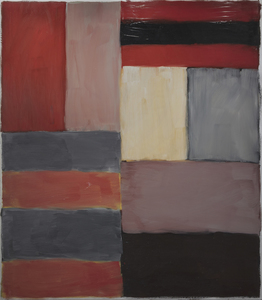
The frame of reference for Irish American Sean Scully’s signature blocks and stripes is vast. From Malevich’s central premise that geometry can provide the means for universal understanding to Rothko’s impassioned approach to color and rendering of the dramatic sublime, Scully learned how to condense the splendor of the natural world into simple modes of color, light, and composition. Born in Dublin in 1945 and London-raised, Scully was well-schooled in figurative drawing when he decided to catch the spirit of his lodestar, Henri Matisse, by visiting Morocco in 1969. He was captivated by the dazzling tessellated mosaics and richly dyed fabrics and began to paint grids and stipes of color. Subsequent adventures provided further inspiration as the play of intense light on the reflective surfaces of Mayan ruins and the ancient slabs of stone at Stonehenge brought the sensation of light, space, and geometric movement to Scully’s paintings. The ability to trace the impact of Scully’s travels throughout his paintings reaffirms the value of abstract art as a touchstone for real-life experience.<br><br><br>Painted in rich, deep hues and layered, nuanced surfaces, Grey Red is both poetic and full of muscular formalism. Scully appropriately refers to these elemental forms as ‘bricks,’ suggesting the formal calculations of an architect. As he explained, “these relationships that I see in the street doorways, in windows between buildings, and in the traces of structures that were once full of life, I take for my work. I use these colors and forms and put them together in a way that perhaps reminds you of something, though you’re not sure of that” (David Carrier, Sean Scully, 2004, pg. 98). His approach is organic, less formulaic; intuitive painter’s choices are layering one color upon another so that contrasting hues and colors vibrate with subliminal energy. Diebenkorn comes to mind in his pursuit of radiant light. But here, the radiant bands of terracotta red, gray, taupe, and black of Grey Red resonate with deep, smoldering energy and evoke far more affecting passion than you would think it could impart. As his good friend, Bono wrote, “Sean approaches the canvas like a kickboxer, a plasterer, a builder. The quality of painting screams of a life being lived.”
FEATURED
SEAN SCULLY
Grau Rot
2012
85 x 75 Zoll.
Öl auf Aluminium

<div><font face=Lato size=3 color=black>Lynne Mapp Drexler’s <em>Spring Sun</em> (1971) exemplifies the vibrant, lyrical abstraction that has brought her renewed recognition in recent years. Composed of concentric circles, cascading brushstrokes, and radiant hues of yellow, orange, and red, the canvas pulses with the rhythm of light and season. Drexler’s painterly vocabulary—layering gestural strokes over pointillist clusters—creates a dynamic surface that evokes both natural phenomena and musical structure, reflecting her lifelong love of symphonic composition.</font></div><br><br><div><font face=Lato size=3> </font></div><br><br><div><font face=Lato size=3 color=black>Painted in 1971, <em>Spring Sun</em> belongs to an important moment in Drexler’s career when she was synthesizing her studies under Hans Hofmann and Robert Motherwell into a personal visual language rooted in color and pattern. The immersive composition suggests not only the brilliance of spring sunlight but also the expressive intensity with which Drexler approached abstraction.</font></div><br><br><div><font face=Lato size=3> </font></div><br><br><div><font face=Lato size=3 color=black>Her contributions have been increasingly recognized by major institutions. The Portland Museum of Art presented a landmark retrospective, <em>Lynne Drexler: Color Notes</em> (2022–2023), and her work has also been exhibited at MoMA PS1 and the Parrish Art Museum. <em>Spring Sun</em> demonstrates why Drexler is now regarded as a vital figure within the second generation of Abstract Expressionists, whose bold use of color and structure continues to resonate with contemporary audiences.</font></div>
FEATURED
LYNNE MAPP DREXLER
Frühlingssonne
1971
35 5/8 x 39 3/4 x 1 Zoll
Öl auf Leinwand

<div><font face=Lato size=3 color=black>Kenneth Noland’s <em>Gray Reflection</em> (1978) comes from the late 1970s, when the artist was deeply engaged with shaped canvases and the refinement of surface and form. The cool slate ground is animated by faint tonal shifts and angled color bands that cut across the polygonal field, creating both balance and quiet momentum.<br><br></font></div><br><br><div><font face=Lato size=3 color=black>This period was far less prolific than his celebrated 1960s circle paintings, making works such as <em>Gray Reflection </em>comparatively rare. While not part of a named series, it resonates with other late-1970s explorations like <em>Burnt Beige </em>at the Cranbrook Art Museum.<br><br></font></div><br><br><div><font face=Lato size=3 color=black>Noland, a central figure of post-painterly abstraction alongside Morris Louis and Helen Frankenthaler, is represented in major museum collections including MoMA, Tate, and the National Gallery of Art.</font></div>
KENNETH NOLAND
Graue Reflexion
1978
66 1/4 x 88 1/2 Zoll
Acryl auf Leinwand

<div><font face=Lato size=3 color=black>Known for his ability to blend traditional Japanese techniques with modern aesthetics, Hiroshi Senju's sublime depictions of bands of cascading veils of paint evoke sensations of tranquility and awe. Senju began exploring waterfall imagery in the early 1990s, pouring translucent pigment onto mulberry paper mounted on board, creating cascading movement. In this work, "<em>Waterfall," </em>he masterfully bonds ribbons of cascading water into two curtain-like ethereal panels. Senju's interest in synesthesia is undeniable. "<em>Waterfall</em>" conjures sound, smell, and feel sensations as much as the rushing water's appearance. In the present work, he placed these dynamic elements in a context that grounds the viewer's sense of place within the natural world. A wedge of blue in the upper left corner contrasts the otherwise monochromatic palette, providing a sky association bounded by a hillside or cliff (for which Senju is known). Additionally, as the cascading water descends, it reaches a destination expanse at the bottom of the picture plane, where the force of the water disperses into a fine mist at the point of contact, serving as a visual anchor. </font></div><br><br><div><font face=Lato size=3 color=black> </font></div><br><br><div><font face=Lato size=3 color=black>Senju's finesse is evident throughout. He uses mulberry paper, a traditional Japanese material known for its delicate texture and strength. The paper's natural fibers absorb pigments in ways that create subtle gradients and fluidity, enhancing the visual effect of the cascading water. He employs traditional Nihonga techniques, such as layering washes to build depth and movement and utilizing varied brush strokes to achieve different effects. Additionally, he incorporates modern methods like the airbrush to apply fine mists of pigment, creating smooth and seamless gradients that mimic the delicate spray and vapor associated with cascading water.</font></div><br><br><div> </div><br><br><div><font face=Lato size=3 color=black>Hiroshi Senju pays homage to the traditional art forms of his heritage while pushing the boundaries of contemporary art. His ability to convey the sublime through simplicity and abstraction makes this artwork a testament to his unique vision and artistic mastery. It stands as a serene reminder of nature's timeless beauty, captured through the ability of a master painter and artist.  </font></div>
FEATURED
HIROSHI SENJU
Wasserfall
2021
36 x 46 Zoll
Naturpigmente und Platin auf japanischem Maulbeerpapier, auf Karton aufgezogen

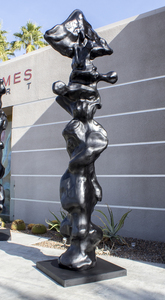
HERB ALPERT - Pfeilspitze - Bronze - 201 x 48 x 48 x 48 in.
HERB ALPERT
Pfeilspitze
2015
201 x 48 x 48 x 48 Zoll.
Bronze

<div>Andrew Wyeth’s "Quart and a Half" (1961) belongs to a deeply personal sequence of works inspired by a single day he and his wife, Betsy, spent picking blueberries in a field as a storm gathered. That afternoon became the genesis for one of Wyeth’s most iconic tempera paintings, "Distant Thunder" (1961), which depicts Betsy reclining in the grass with their dog, suffused with a charged stillness before the storm. A preparatory watercolor, "Blueberries, Study for Distant Thunder" (1961, Farnsworth Art Museum), further traces the theme. "Quart and a Half" marks the haunting aftermath, shifting focus from figure to still life: a blueberry carton and tin cup sit abandoned in the grass, their utilitarian presence transformed into emblems of memory and absence. </div><br><br><div> </div><br><br><div>The composition is stripped to essentials—a high horizon line, a darkened field, and the luminous carton and cup catching the eye. The disturbed grass, delicately rendered in intricate strokes, becomes a subtle index of Betsy’s earlier presence, now vanished. That empty imprint became the emotional core of the painting, an emblem of transience. As an early still life, the work reveals Wyeth’s ability to invest the simplest objects with profound emotional resonance, extending the still-life tradition, long associated with mortality and the ephemeral nature of life, into a meditation on the quiet echoes of lived experience. Executed in watercolor, the painting also highlights Wyeth’s balance of spontaneity and restraint, the flickering grasses animated with immediacy yet anchored by a deliberate compositional rigor. </div><br><br><div> </div><br><br><div>"Quart and a Half" also holds distinguished exhibition history. It was featured in the traveling retrospective "Andrew Wyeth: Temperas, Watercolors, Dry Brush, Drawings 1938 into 1966", shown at the Philadelphia Museum of Art, the Baltimore Museum of Art, and the Whitney Museum of American Art (1966–67). Earlier, the work was chosen as the cover image for the catalogue of the 1963 University of Arizona Art Gallery exhibition, underscoring its importance within Wyeth’s oeuvre. Together with "Distant Thunder" and its study, this watercolor transforms a shared picnic into an enduring meditation on memory, impermanence, and the poetry of everyday life. </div>
FEATURED
ANDREW WYETH WYETH
Anderthalb Quart
1961
21 x 29 1/4 Zoll.
Aquarell auf Papier

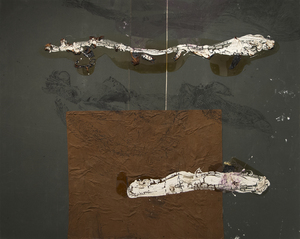
This painting has remained in the same private collection since its creation.  Along with its companion work, "Untitled" (1991) was on display in the lobby of Chicago's Heller International Building at 500 West Monroe Street from the building's opening in 1992 until its renovation in 2015.<br><br>The November 2018 sale of Schnabel's "Large Rose Painting, (Near Van Gogh's Grave)" for $1.2 million at auction demonstrates a strong demand for the artist's work. This major sale was only the second-highest price paid for a Schnabel at auction: the record was set in November of 2017 when "Ethnic Type #14" sold for $1.4 million.  <br><br>A recent museum exhibition, "Julian Schnabel: Symbols of Actual Life" at the Legion of Honor, Fine Arts Museums of San Francisco, in 2018, featured several of Schnabel's large-scale paintings.
FEATURED
JULIANISCHES SCHNABEL
Ohne Titel
1991
96 x 120 Zoll
Öl, Harz, Gesso, Stoff und Leder auf gesäumtem Tropfentuch

HERB ALPERT – Ohne Titel – Bronze – 102 x 40 x 20 Zoll
HERB ALPERT
Ohne Titel
102 x 40 x 20 Zoll
Bronze

Roger Brown ist bekannt für seine persönliche und oft fantastische Bildsprache und seine stark stilisierten Gemälde mit Figuren und Objekten, die sein Interesse an alltäglichen Erfahrungen widerspiegeln. Acid Rain erforscht Themen des modernen Lebens und soziale Kommentare, die die Rolle des Künstlers in der Gesellschaft und das Potenzial der Kunst, Veränderungen zu bewirken, widerspiegeln. Auf einer persönlicheren Ebene kann das Thema des sauren Regens zersetzende emotionale oder psychologische Zustände symbolisieren, wie Depression, Angst oder das Gefühl, von Umständen überwältigt zu werden, die sich der eigenen Kontrolle entziehen. So wie der saure Regen ein weitgehend unsichtbares, aber verheerendes Umweltproblem darstellte, motivierte die Krise der aufkommenden HIV/AIDS-Epidemie Brown wahrscheinlich dazu, das Werk zu schaffen, um persönlichen Kummer zu verarbeiten, die unzureichende Reaktion der politischen Führung zu kritisieren und für Mitgefühl, Verständnis und medizinische Forschung einzutreten.
FEATURED
ROGER BROWN
Saurer Regen
1984
48 x 72 x 2 Zoll.
Öl auf Leinwand

JEPPE HEIN – Geometric Mirrors VII – Aluminium, Edelstahl und hochglanzpolierter Stahl (Superspiegel) – 78 3/4 x 72 3/4 x 39 3/8 Zoll
FEATURED
JEPPE HEIN
Geometrische Spiegel VII
2012
78 3/4 x 72 3/4 x 39 3/8 Zoll
Aluminium, Edelstahl und hochglanzpolierter Stahl (Super Mirror)

Fragen Sie
Kurzform für die Teilnehmerliste

VERBINDEN

Zurück zum Anfang
© Copyright 2026 Heather James. Alle Rechte vorbehalten.
  • Datenschutzerklärung
  • Allgemeine Geschäftsbedingungen

Vielen Dank für Ihre Kontaktaufnahme!

Möchten Sie Ihre Kunstpräferenzen anpassen?

Gehen Sie zu Kommunikationspräferenzen

Bildung

Bildung ist bei Heather James Art Advisory von größter Bedeutung. Egal, ob Sie ein erfahrener Sammler sind oder gerade erst anfangen, wir wollen mit unseren Kunden wachsen und glauben fest daran, dass wir unseren Kunden Informationen und Einblicke geben, damit sie lernen und ihre Kunstinteressen kultivieren können.

Kuratieren

Heather James Art Advisory verfügt über jahrzehntelange Erfahrung als Kuratorin und wird dabei von unseren leitenden Kuratoren unterstützt, die weltweit Ausstellungen in Museen, Galerien und in Privatwohnungen organisiert haben. Indem wir ästhetische und kunsthistorische Elemente zusammenbringen, helfen wir Ihrer Sammlung und Ihrem Zuhause, Ihre künstlerischen Interessen widerzuspiegeln.

Logistik

HJ Art Advisory bietet eine komplette Logistik für die Handhabung, den Transport und die Überwachung der Kunstwerke unserer Kunden. Unsere Beaufsichtigung umfasst jeden Aspekt der Betreuung des Kunstwerks. Wir beaufsichtigen jeden Schritt des Prozesses beim Transport, der Installation und der Lagerung von Kunstwerken. Wir beraten und unterstützen bei der Gestaltung von Rahmen, Beleuchtung, Sicherheitsanforderungen, Konservierung und Zustandsbewertung.

Dokumentation
  • Beim Kauf von Kunstwerken recherchiert HJ Art Advisory die Herkunft des Kunstwerks und holt Zusicherungen und Garantien des Verkäufers ein, dass der Verkäufer über gültige Eigentumsrechte verfügt und dass das Objekt frei von Pfandrechten, Ansprüchen und Belastungen ist.
  • HJ Art Advisory wird eine Entschädigung für die volle Rückerstattung des Kunstwerkes im Falle einer Verletzung der Garantie verlangen (möglicherweise mit dieser Zeile???).
  • Private Verkäufe und Auktionsverfahren: Zu den wichtigen Informationen, die erfasst werden müssen, gehören: Künstler, Titel des Kunstwerks, Datum, Medium, Abmessungen, Preis, Bild, Anbieter, Provenienz, Zertifikate, Rechnung (wenn möglich), Zustandsbericht, Pfandrechte, Rechtsstreitigkeiten, Eigentumstitel.
Museum Leihgaben

Heather James hatte die Ehre, Leihgaben an führende Museen in der ganzen Welt zu vermitteln, darunter das MoMA, das Centre Pompidou und andere. HJ Art Advisory kümmert sich um den gesamten notwendigen Papierkram und die Logistik für unsere Sammler, die sich entschließen, ein Kunstwerk für eine Museumsausstellung zu leihen.

Verkäufe und Akquisitionen

HJ Art Advisory konzentriert sich auf die Beschaffung von Kunstwerken für potenzielle Ankäufe aus Privatverkäufen, Auktionshäusern und Künstleraufträgen. HJ Art Advisory beobachtet kontinuierlich den privaten und öffentlichen Markt auf der Suche nach bedeutenden Kunstwerken, die den Interessen unserer Kunden entsprechen und ihre Sammlungen bereichern. Wir verhandeln im Auftrag eines Sammlers den Verkaufs- oder Verkaufspreis, um für unsere Kunden das bestmögliche Geschäft zu erzielen.

Finanzen
  • HJ Art Advisory unterstützt Kunden bei Asset-Backed-Lending, dem Erwerb von Kunst für Trusts und der Nachlassplanung. Wir bieten unser Fachwissen über den Kunstmarkt an, um unsere Kunden bei der Entscheidungsfindung für ihre Sammlung bestmöglich zu unterstützen. Wir arbeiten mit Nachlässen, Rechtsteams und Finanzberatern zusammen, um unsere Kunden und ihre Ziele bestmöglich zu unterstützen.
  • Heather James Fine Art ist kein eingetragener Anlage-, Rechts- oder Steuerberater. Alle von Heather James Fine Art geäußerten Anlage- und Finanzmeinungen sind Meinungen, die auf persönlichen Recherchen beruhen. Die Wertentwicklung in der Vergangenheit ist weder eine Garantie für zukünftige Erträge noch ist sie notwendigerweise ein Indikator für die zukünftige Wertentwicklung.
Wert & Versicherung

Die HJ Art Advisory Group bewertet und schätzt Kunstsammlungen im Hinblick auf die Bewertung durch Versicherungen, den Erwerb und die Deakzession. Dazu gehört eine eingehende Untersuchung des privaten und öffentlichen Kunstmarktes, um den Wert zu ermitteln.

Authentifizierung

HJ Art Advisory hält die höchsten Standards der Sorgfaltspflicht ein, indem es vor dem Erwerb von Objekten Nachforschungen anstellt und deren Herkunft prüft, um sicherzustellen, dass ein klares Eigentumsrecht erworben werden kann. Solche Nachforschungen beinhalten, sind aber nicht beschränkt auf, die Bestimmung:

  • Eigentumsgeschichte des Objekts
  • Länder, in denen das Objekt gefunden wurde und wann.
  • Ausstellungsgeschichte des Objekts
  • Geschichte der Veröffentlichung des Objekts
  • Etwaige Eigentumsansprüche, falls sie geltend gemacht wurden
  • Datenbanken mit gestohlenen Gegenständen, die für das Objekt relevant sind
  • Die Umstände, unter denen der Gegenstand angeboten wird
  • Einschlägige Forschungsquellen, einschließlich: Das ArtLoss Register oder andere Datenbanken.
  • Garantie- und Entschädigungserklärungen des Verkäufers, die sicherstellen, dass der Verkäufer über gültige Eigentumsrechte verfügt und das Objekt frei von Pfandrechten, Forderungen und Belastungen ist
  • Forschung und Dokumentation zur Zeit des Nationalsozialismus und des Zweiten Weltkriegs gemäß den Leitlinien für den Erwerb von Objekten, die sich wahrscheinlich zwischen 1933 und 1945 im von den Deutschen besetzten Europa befunden haben
Kennerschaft

HJ Art Advisory arbeitet mit und im Namen von Kunden, die neue Sammlungen aufbauen oder über gut etablierte Sammlungen verfügen, und bietet Beratung und ein umfassendes Dienstleistungsangebot. Unser umfangreiches Wissen und unsere langjährige Erfahrung im Kunstgeschäft versetzen unsere hochqualifizierten und erfahrenen Mitarbeiter in die Lage, Beratung und Orientierung auf mehreren Ebenen zu bieten.

Möchten Sie mehr über dieses / diese Werke erfahren? Senden Sie uns eine Nachricht und teilen Sie uns Ihr Interesse mit.

Anfordern - Kunst Einzel
  • English
  • 日本語
  • 中文 (简体)
  • Français
  • Español
  • עברית
  • العربية‏