Atrás

CLAUDE MONET (1840-1926)

 
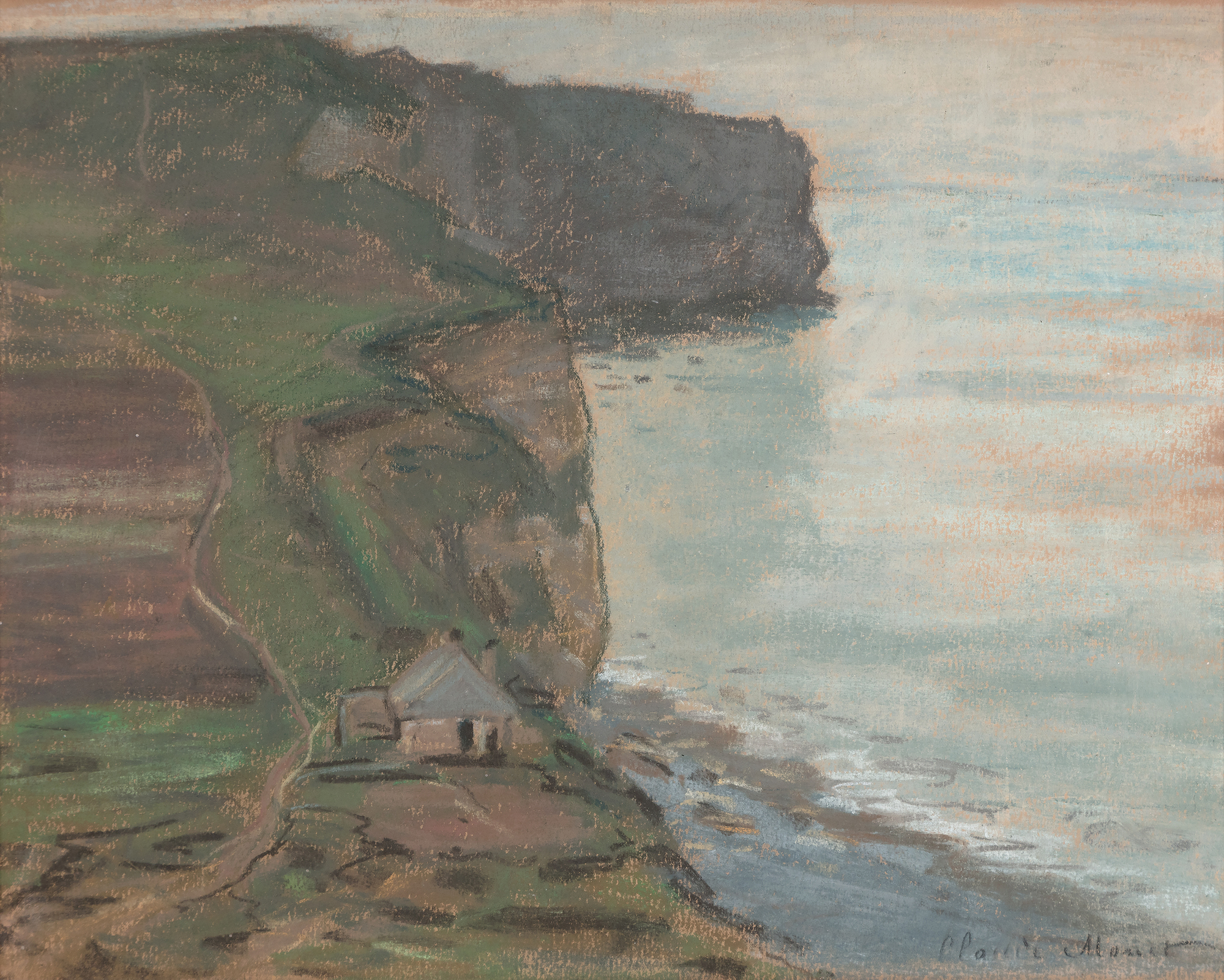
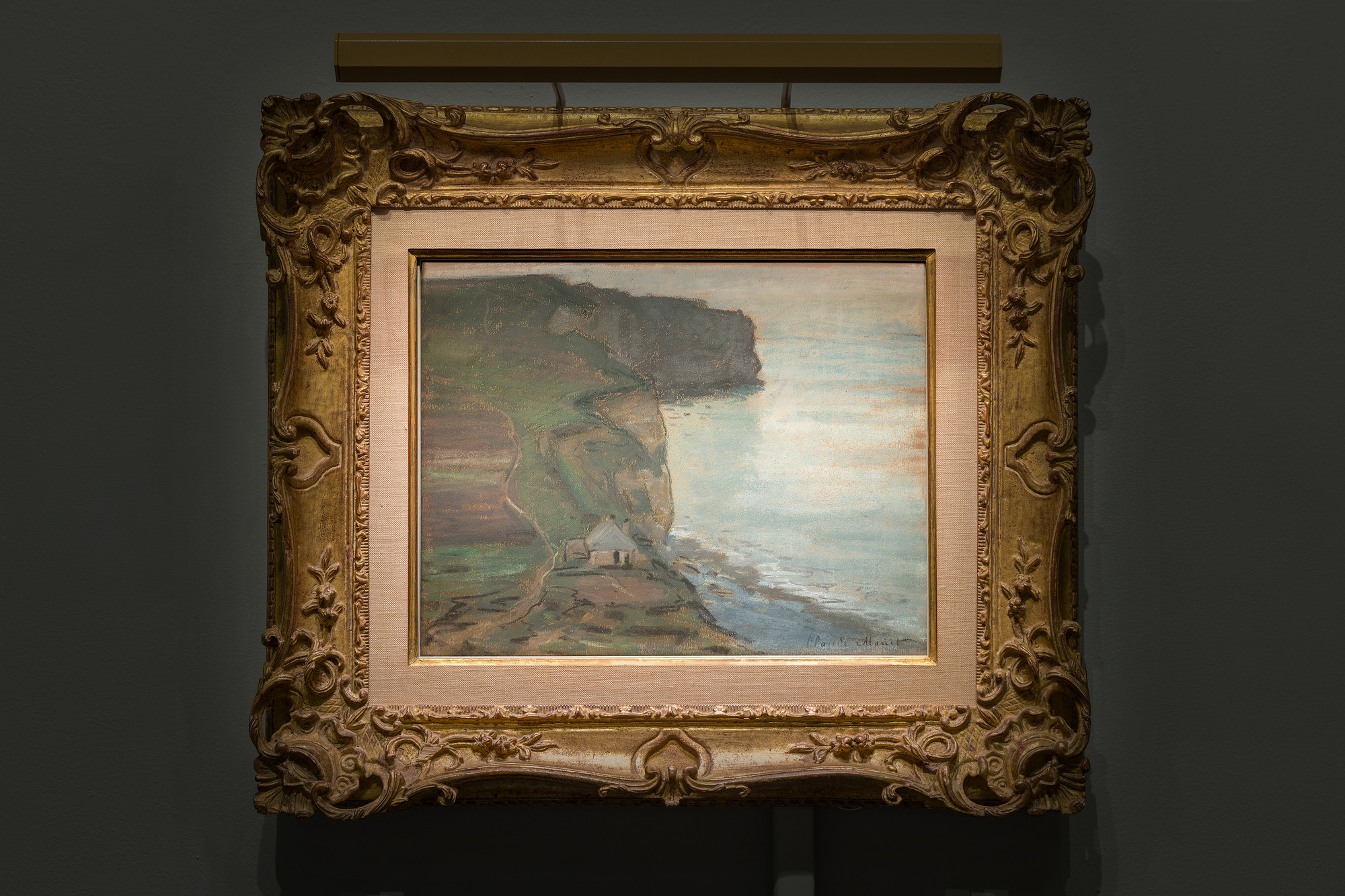
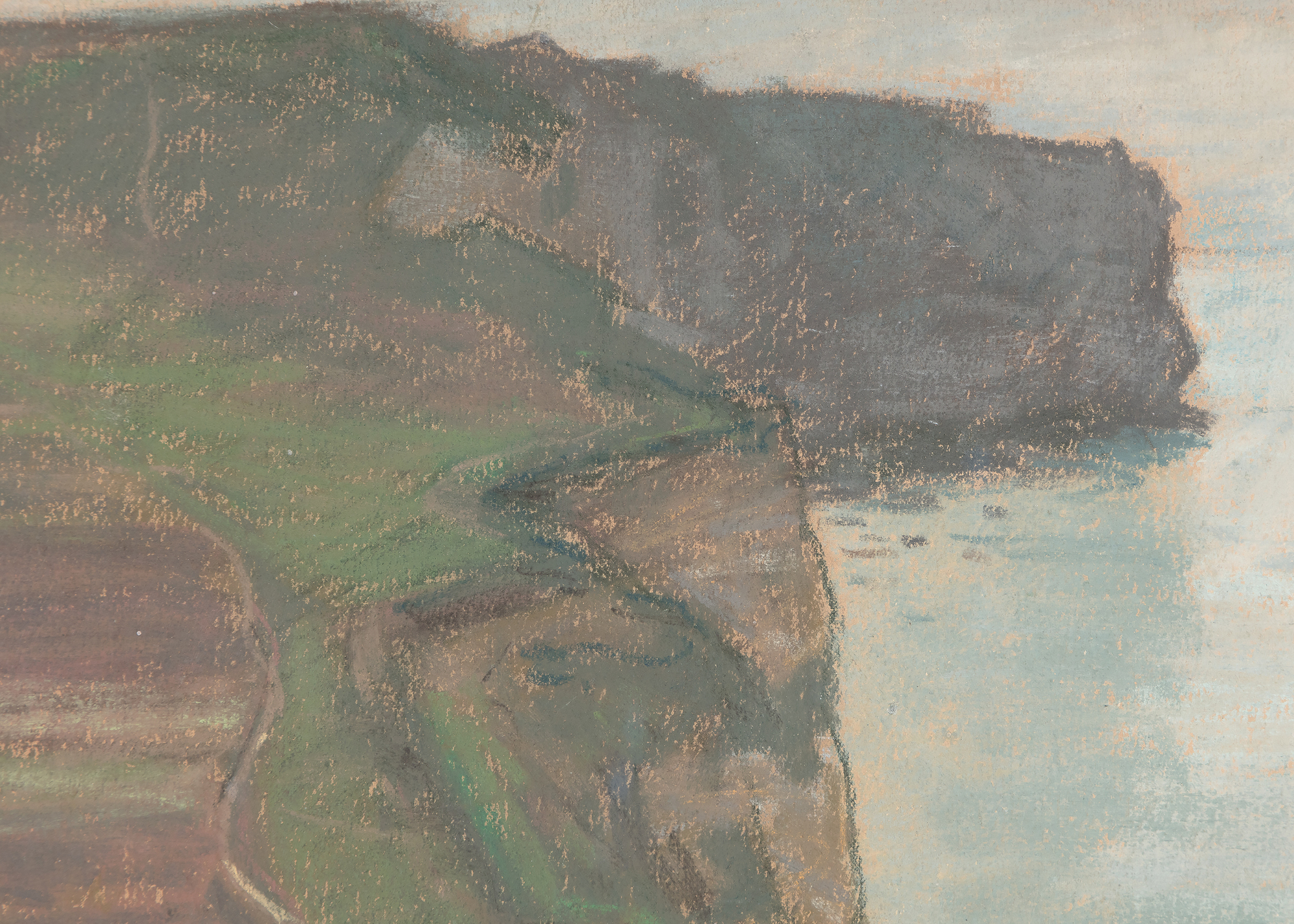
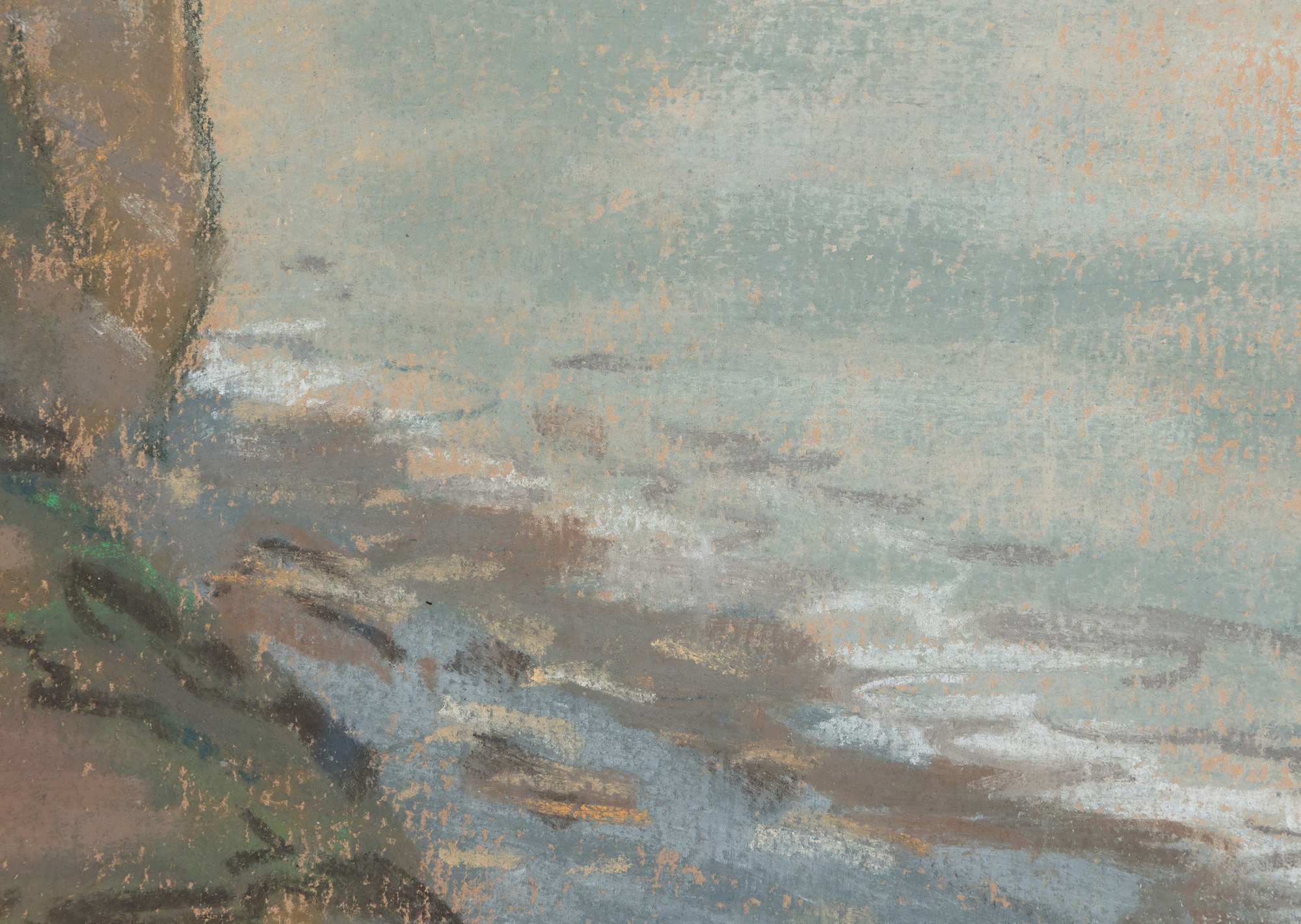
<div><font face=Lato size=3 color="#191919">As the idea of using drawings, whether in pencil or pastel to prepare a painting was at odds with Monet’s publicised creative process, he tended to downplay its importance in his work. However, after his death eight folios containing over four hundred drawings came to light as well as many pastels. This convenient and lightweight medium allowed him to experiment with composition and colour and develop ideas for his oil paintings at speed. He also used pastel to produce finished pictures, as in this example.</font></div><br><br><div><font face=Lato size=3 color="#191919"> </font></div><br><br><div><font face=Lato size=3 color="#191919">During the 1880s Monet returned to the Normandy coast. He found inspiration in the sparkling light and famous limestone cliffs, as had Delacroix and Courbet. As well as working directly in oils, he followed Boudin’s example and used black chalk and pastel to study the effects of light and colour on the sky, sea and land.</font></div><br><br><div><font face=Lato size=3 color="#191919"> </font></div><br><br><div><font face=Lato size=3 color="#191919">In this seascape at Etretat, twenty miles round the coast to the north of Le Havre, Monet has chosen an unusual composition, dividing the landscape down the centre with the vertiginous cliffs; the left half of the picture composed of earthy greens and browns, the right half a sun dappled sea that dissolves into the sky, the horizon only suggested by the lightest touch of charcoal. This picture has a marked difference in atmosphere to another pastel of the nearby Porte d’Aval, dateable to the same period, whose late afternoon sky shows the range of expression that could be achieved with pastel. By the summer of 1885 the year he made this pastel Monet had largely abandoned urban subjects, and was more drawn towards natural phenomena. He painted many views along the coast under different light conditions. As noted in the catalogue raisonné on Monet, this pastel is not a preparatory study for an oil painting, but a wholly original composition. It demonstrates how well the painter understood and enjoyed the versatility of the medium when trying to capture such variable weather.</font></div> <div><font face=Lato size=3 color="#191919">As the idea of using drawings, whether in pencil or pastel to prepare a painting was at odds with Monet’s publicised creative process, he tended to downplay its importance in his work. However, after his death eight folios containing over four hundred drawings came to light as well as many pastels. This convenient and lightweight medium allowed him to experiment with composition and colour and develop ideas for his oil paintings at speed. He also used pastel to produce finished pictures, as in this example.</font></div><br><br><div><font face=Lato size=3 color="#191919"> </font></div><br><br><div><font face=Lato size=3 color="#191919">During the 1880s Monet returned to the Normandy coast. He found inspiration in the sparkling light and famous limestone cliffs, as had Delacroix and Courbet. As well as working directly in oils, he followed Boudin’s example and used black chalk and pastel to study the effects of light and colour on the sky, sea and land.</font></div><br><br><div><font face=Lato size=3 color="#191919"> </font></div><br><br><div><font face=Lato size=3 color="#191919">In this seascape at Etretat, twenty miles round the coast to the north of Le Havre, Monet has chosen an unusual composition, dividing the landscape down the centre with the vertiginous cliffs; the left half of the picture composed of earthy greens and browns, the right half a sun dappled sea that dissolves into the sky, the horizon only suggested by the lightest touch of charcoal. This picture has a marked difference in atmosphere to another pastel of the nearby Porte d’Aval, dateable to the same period, whose late afternoon sky shows the range of expression that could be achieved with pastel. By the summer of 1885 the year he made this pastel Monet had largely abandoned urban subjects, and was more drawn towards natural phenomena. He painted many views along the coast under different light conditions. As noted in the catalogue raisonné on Monet, this pastel is not a preparatory study for an oil painting, but a wholly original composition. It demonstrates how well the painter understood and enjoyed the versatility of the medium when trying to capture such variable weather.</font></div> <div><font face=Lato size=3 color="#191919">As the idea of using drawings, whether in pencil or pastel to prepare a painting was at odds with Monet’s publicised creative process, he tended to downplay its importance in his work. However, after his death eight folios containing over four hundred drawings came to light as well as many pastels. This convenient and lightweight medium allowed him to experiment with composition and colour and develop ideas for his oil paintings at speed. He also used pastel to produce finished pictures, as in this example.</font></div><br><br><div><font face=Lato size=3 color="#191919"> </font></div><br><br><div><font face=Lato size=3 color="#191919">During the 1880s Monet returned to the Normandy coast. He found inspiration in the sparkling light and famous limestone cliffs, as had Delacroix and Courbet. As well as working directly in oils, he followed Boudin’s example and used black chalk and pastel to study the effects of light and colour on the sky, sea and land.</font></div><br><br><div><font face=Lato size=3 color="#191919"> </font></div><br><br><div><font face=Lato size=3 color="#191919">In this seascape at Etretat, twenty miles round the coast to the north of Le Havre, Monet has chosen an unusual composition, dividing the landscape down the centre with the vertiginous cliffs; the left half of the picture composed of earthy greens and browns, the right half a sun dappled sea that dissolves into the sky, the horizon only suggested by the lightest touch of charcoal. This picture has a marked difference in atmosphere to another pastel of the nearby Porte d’Aval, dateable to the same period, whose late afternoon sky shows the range of expression that could be achieved with pastel. By the summer of 1885 the year he made this pastel Monet had largely abandoned urban subjects, and was more drawn towards natural phenomena. He painted many views along the coast under different light conditions. As noted in the catalogue raisonné on Monet, this pastel is not a preparatory study for an oil painting, but a wholly original composition. It demonstrates how well the painter understood and enjoyed the versatility of the medium when trying to capture such variable weather.</font></div> <div><font face=Lato size=3 color="#191919">As the idea of using drawings, whether in pencil or pastel to prepare a painting was at odds with Monet’s publicised creative process, he tended to downplay its importance in his work. However, after his death eight folios containing over four hundred drawings came to light as well as many pastels. This convenient and lightweight medium allowed him to experiment with composition and colour and develop ideas for his oil paintings at speed. He also used pastel to produce finished pictures, as in this example.</font></div><br><br><div><font face=Lato size=3 color="#191919"> </font></div><br><br><div><font face=Lato size=3 color="#191919">During the 1880s Monet returned to the Normandy coast. He found inspiration in the sparkling light and famous limestone cliffs, as had Delacroix and Courbet. As well as working directly in oils, he followed Boudin’s example and used black chalk and pastel to study the effects of light and colour on the sky, sea and land.</font></div><br><br><div><font face=Lato size=3 color="#191919"> </font></div><br><br><div><font face=Lato size=3 color="#191919">In this seascape at Etretat, twenty miles round the coast to the north of Le Havre, Monet has chosen an unusual composition, dividing the landscape down the centre with the vertiginous cliffs; the left half of the picture composed of earthy greens and browns, the right half a sun dappled sea that dissolves into the sky, the horizon only suggested by the lightest touch of charcoal. This picture has a marked difference in atmosphere to another pastel of the nearby Porte d’Aval, dateable to the same period, whose late afternoon sky shows the range of expression that could be achieved with pastel. By the summer of 1885 the year he made this pastel Monet had largely abandoned urban subjects, and was more drawn towards natural phenomena. He painted many views along the coast under different light conditions. As noted in the catalogue raisonné on Monet, this pastel is not a preparatory study for an oil painting, but a wholly original composition. It demonstrates how well the painter understood and enjoyed the versatility of the medium when trying to capture such variable weather.</font></div> <div><font face=Lato size=3 color="#191919">As the idea of using drawings, whether in pencil or pastel to prepare a painting was at odds with Monet’s publicised creative process, he tended to downplay its importance in his work. However, after his death eight folios containing over four hundred drawings came to light as well as many pastels. This convenient and lightweight medium allowed him to experiment with composition and colour and develop ideas for his oil paintings at speed. He also used pastel to produce finished pictures, as in this example.</font></div><br><br><div><font face=Lato size=3 color="#191919"> </font></div><br><br><div><font face=Lato size=3 color="#191919">During the 1880s Monet returned to the Normandy coast. He found inspiration in the sparkling light and famous limestone cliffs, as had Delacroix and Courbet. As well as working directly in oils, he followed Boudin’s example and used black chalk and pastel to study the effects of light and colour on the sky, sea and land.</font></div><br><br><div><font face=Lato size=3 color="#191919"> </font></div><br><br><div><font face=Lato size=3 color="#191919">In this seascape at Etretat, twenty miles round the coast to the north of Le Havre, Monet has chosen an unusual composition, dividing the landscape down the centre with the vertiginous cliffs; the left half of the picture composed of earthy greens and browns, the right half a sun dappled sea that dissolves into the sky, the horizon only suggested by the lightest touch of charcoal. This picture has a marked difference in atmosphere to another pastel of the nearby Porte d’Aval, dateable to the same period, whose late afternoon sky shows the range of expression that could be achieved with pastel. By the summer of 1885 the year he made this pastel Monet had largely abandoned urban subjects, and was more drawn towards natural phenomena. He painted many views along the coast under different light conditions. As noted in the catalogue raisonné on Monet, this pastel is not a preparatory study for an oil painting, but a wholly original composition. It demonstrates how well the painter understood and enjoyed the versatility of the medium when trying to capture such variable weather.</font></div> <div><font face=Lato size=3 color="#191919">As the idea of using drawings, whether in pencil or pastel to prepare a painting was at odds with Monet’s publicised creative process, he tended to downplay its importance in his work. However, after his death eight folios containing over four hundred drawings came to light as well as many pastels. This convenient and lightweight medium allowed him to experiment with composition and colour and develop ideas for his oil paintings at speed. He also used pastel to produce finished pictures, as in this example.</font></div><br><br><div><font face=Lato size=3 color="#191919"> </font></div><br><br><div><font face=Lato size=3 color="#191919">During the 1880s Monet returned to the Normandy coast. He found inspiration in the sparkling light and famous limestone cliffs, as had Delacroix and Courbet. As well as working directly in oils, he followed Boudin’s example and used black chalk and pastel to study the effects of light and colour on the sky, sea and land.</font></div><br><br><div><font face=Lato size=3 color="#191919"> </font></div><br><br><div><font face=Lato size=3 color="#191919">In this seascape at Etretat, twenty miles round the coast to the north of Le Havre, Monet has chosen an unusual composition, dividing the landscape down the centre with the vertiginous cliffs; the left half of the picture composed of earthy greens and browns, the right half a sun dappled sea that dissolves into the sky, the horizon only suggested by the lightest touch of charcoal. This picture has a marked difference in atmosphere to another pastel of the nearby Porte d’Aval, dateable to the same period, whose late afternoon sky shows the range of expression that could be achieved with pastel. By the summer of 1885 the year he made this pastel Monet had largely abandoned urban subjects, and was more drawn towards natural phenomena. He painted many views along the coast under different light conditions. As noted in the catalogue raisonné on Monet, this pastel is not a preparatory study for an oil painting, but a wholly original composition. It demonstrates how well the painter understood and enjoyed the versatility of the medium when trying to capture such variable weather.</font></div> <div><font face=Lato size=3 color="#191919">As the idea of using drawings, whether in pencil or pastel to prepare a painting was at odds with Monet’s publicised creative process, he tended to downplay its importance in his work. However, after his death eight folios containing over four hundred drawings came to light as well as many pastels. This convenient and lightweight medium allowed him to experiment with composition and colour and develop ideas for his oil paintings at speed. He also used pastel to produce finished pictures, as in this example.</font></div><br><br><div><font face=Lato size=3 color="#191919"> </font></div><br><br><div><font face=Lato size=3 color="#191919">During the 1880s Monet returned to the Normandy coast. He found inspiration in the sparkling light and famous limestone cliffs, as had Delacroix and Courbet. As well as working directly in oils, he followed Boudin’s example and used black chalk and pastel to study the effects of light and colour on the sky, sea and land.</font></div><br><br><div><font face=Lato size=3 color="#191919"> </font></div><br><br><div><font face=Lato size=3 color="#191919">In this seascape at Etretat, twenty miles round the coast to the north of Le Havre, Monet has chosen an unusual composition, dividing the landscape down the centre with the vertiginous cliffs; the left half of the picture composed of earthy greens and browns, the right half a sun dappled sea that dissolves into the sky, the horizon only suggested by the lightest touch of charcoal. This picture has a marked difference in atmosphere to another pastel of the nearby Porte d’Aval, dateable to the same period, whose late afternoon sky shows the range of expression that could be achieved with pastel. By the summer of 1885 the year he made this pastel Monet had largely abandoned urban subjects, and was more drawn towards natural phenomena. He painted many views along the coast under different light conditions. As noted in the catalogue raisonné on Monet, this pastel is not a preparatory study for an oil painting, but a wholly original composition. It demonstrates how well the painter understood and enjoyed the versatility of the medium when trying to capture such variable weather.</font></div> <div><font face=Lato size=3 color="#191919">As the idea of using drawings, whether in pencil or pastel to prepare a painting was at odds with Monet’s publicised creative process, he tended to downplay its importance in his work. However, after his death eight folios containing over four hundred drawings came to light as well as many pastels. This convenient and lightweight medium allowed him to experiment with composition and colour and develop ideas for his oil paintings at speed. He also used pastel to produce finished pictures, as in this example.</font></div><br><br><div><font face=Lato size=3 color="#191919"> </font></div><br><br><div><font face=Lato size=3 color="#191919">During the 1880s Monet returned to the Normandy coast. He found inspiration in the sparkling light and famous limestone cliffs, as had Delacroix and Courbet. As well as working directly in oils, he followed Boudin’s example and used black chalk and pastel to study the effects of light and colour on the sky, sea and land.</font></div><br><br><div><font face=Lato size=3 color="#191919"> </font></div><br><br><div><font face=Lato size=3 color="#191919">In this seascape at Etretat, twenty miles round the coast to the north of Le Havre, Monet has chosen an unusual composition, dividing the landscape down the centre with the vertiginous cliffs; the left half of the picture composed of earthy greens and browns, the right half a sun dappled sea that dissolves into the sky, the horizon only suggested by the lightest touch of charcoal. This picture has a marked difference in atmosphere to another pastel of the nearby Porte d’Aval, dateable to the same period, whose late afternoon sky shows the range of expression that could be achieved with pastel. By the summer of 1885 the year he made this pastel Monet had largely abandoned urban subjects, and was more drawn towards natural phenomena. He painted many views along the coast under different light conditions. As noted in the catalogue raisonné on Monet, this pastel is not a preparatory study for an oil painting, but a wholly original composition. It demonstrates how well the painter understood and enjoyed the versatility of the medium when trying to capture such variable weather.</font></div> <div><font face=Lato size=3 color="#191919">As the idea of using drawings, whether in pencil or pastel to prepare a painting was at odds with Monet’s publicised creative process, he tended to downplay its importance in his work. However, after his death eight folios containing over four hundred drawings came to light as well as many pastels. This convenient and lightweight medium allowed him to experiment with composition and colour and develop ideas for his oil paintings at speed. He also used pastel to produce finished pictures, as in this example.</font></div><br><br><div><font face=Lato size=3 color="#191919"> </font></div><br><br><div><font face=Lato size=3 color="#191919">During the 1880s Monet returned to the Normandy coast. He found inspiration in the sparkling light and famous limestone cliffs, as had Delacroix and Courbet. As well as working directly in oils, he followed Boudin’s example and used black chalk and pastel to study the effects of light and colour on the sky, sea and land.</font></div><br><br><div><font face=Lato size=3 color="#191919"> </font></div><br><br><div><font face=Lato size=3 color="#191919">In this seascape at Etretat, twenty miles round the coast to the north of Le Havre, Monet has chosen an unusual composition, dividing the landscape down the centre with the vertiginous cliffs; the left half of the picture composed of earthy greens and browns, the right half a sun dappled sea that dissolves into the sky, the horizon only suggested by the lightest touch of charcoal. This picture has a marked difference in atmosphere to another pastel of the nearby Porte d’Aval, dateable to the same period, whose late afternoon sky shows the range of expression that could be achieved with pastel. By the summer of 1885 the year he made this pastel Monet had largely abandoned urban subjects, and was more drawn towards natural phenomena. He painted many views along the coast under different light conditions. As noted in the catalogue raisonné on Monet, this pastel is not a preparatory study for an oil painting, but a wholly original composition. It demonstrates how well the painter understood and enjoyed the versatility of the medium when trying to capture such variable weather.</font></div> <div><font face=Lato size=3 color="#191919">As the idea of using drawings, whether in pencil or pastel to prepare a painting was at odds with Monet’s publicised creative process, he tended to downplay its importance in his work. However, after his death eight folios containing over four hundred drawings came to light as well as many pastels. This convenient and lightweight medium allowed him to experiment with composition and colour and develop ideas for his oil paintings at speed. He also used pastel to produce finished pictures, as in this example.</font></div><br><br><div><font face=Lato size=3 color="#191919"> </font></div><br><br><div><font face=Lato size=3 color="#191919">During the 1880s Monet returned to the Normandy coast. He found inspiration in the sparkling light and famous limestone cliffs, as had Delacroix and Courbet. As well as working directly in oils, he followed Boudin’s example and used black chalk and pastel to study the effects of light and colour on the sky, sea and land.</font></div><br><br><div><font face=Lato size=3 color="#191919"> </font></div><br><br><div><font face=Lato size=3 color="#191919">In this seascape at Etretat, twenty miles round the coast to the north of Le Havre, Monet has chosen an unusual composition, dividing the landscape down the centre with the vertiginous cliffs; the left half of the picture composed of earthy greens and browns, the right half a sun dappled sea that dissolves into the sky, the horizon only suggested by the lightest touch of charcoal. This picture has a marked difference in atmosphere to another pastel of the nearby Porte d’Aval, dateable to the same period, whose late afternoon sky shows the range of expression that could be achieved with pastel. By the summer of 1885 the year he made this pastel Monet had largely abandoned urban subjects, and was more drawn towards natural phenomena. He painted many views along the coast under different light conditions. As noted in the catalogue raisonné on Monet, this pastel is not a preparatory study for an oil painting, but a wholly original composition. It demonstrates how well the painter understood and enjoyed the versatility of the medium when trying to capture such variable weather.</font></div>
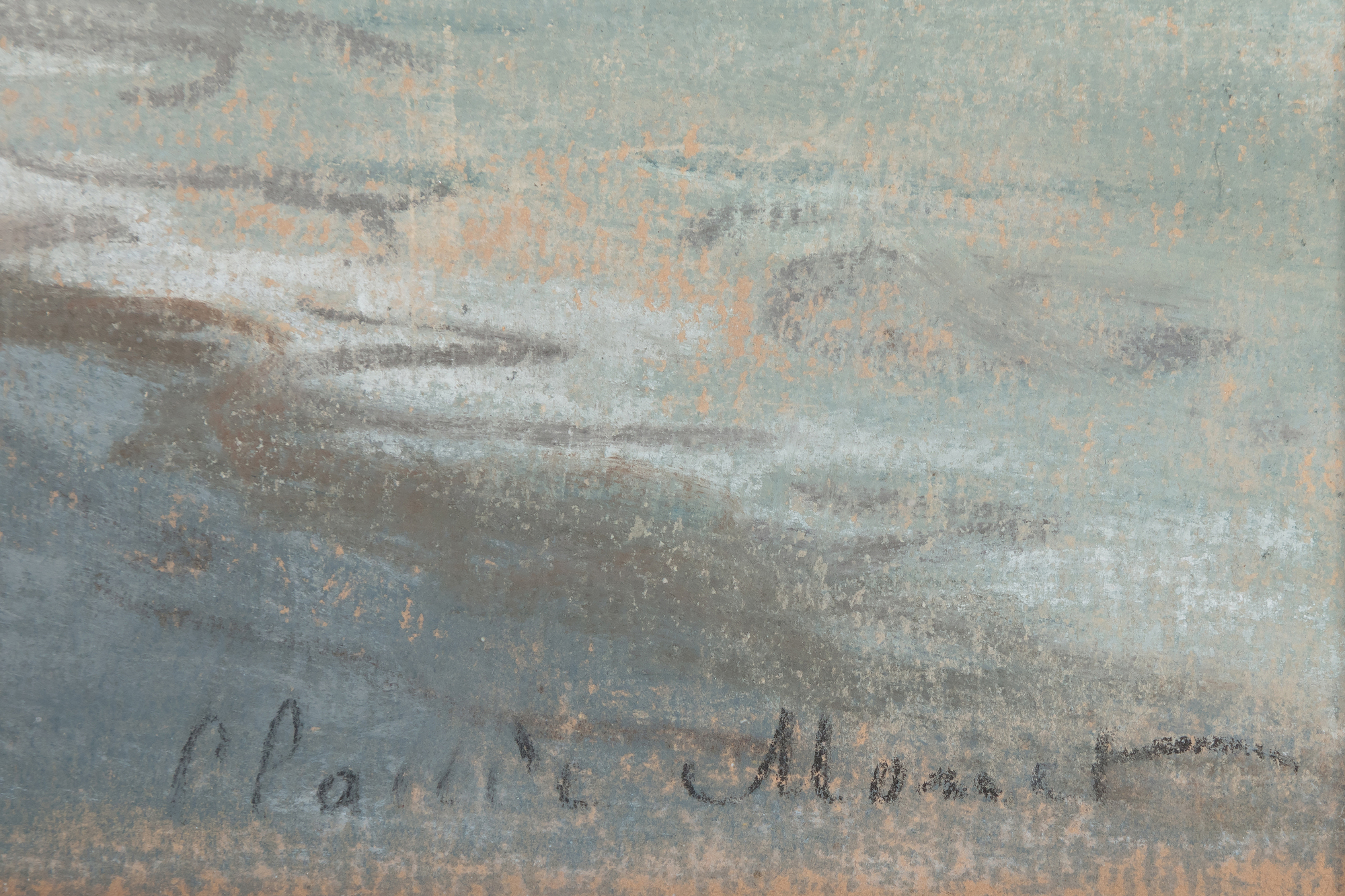
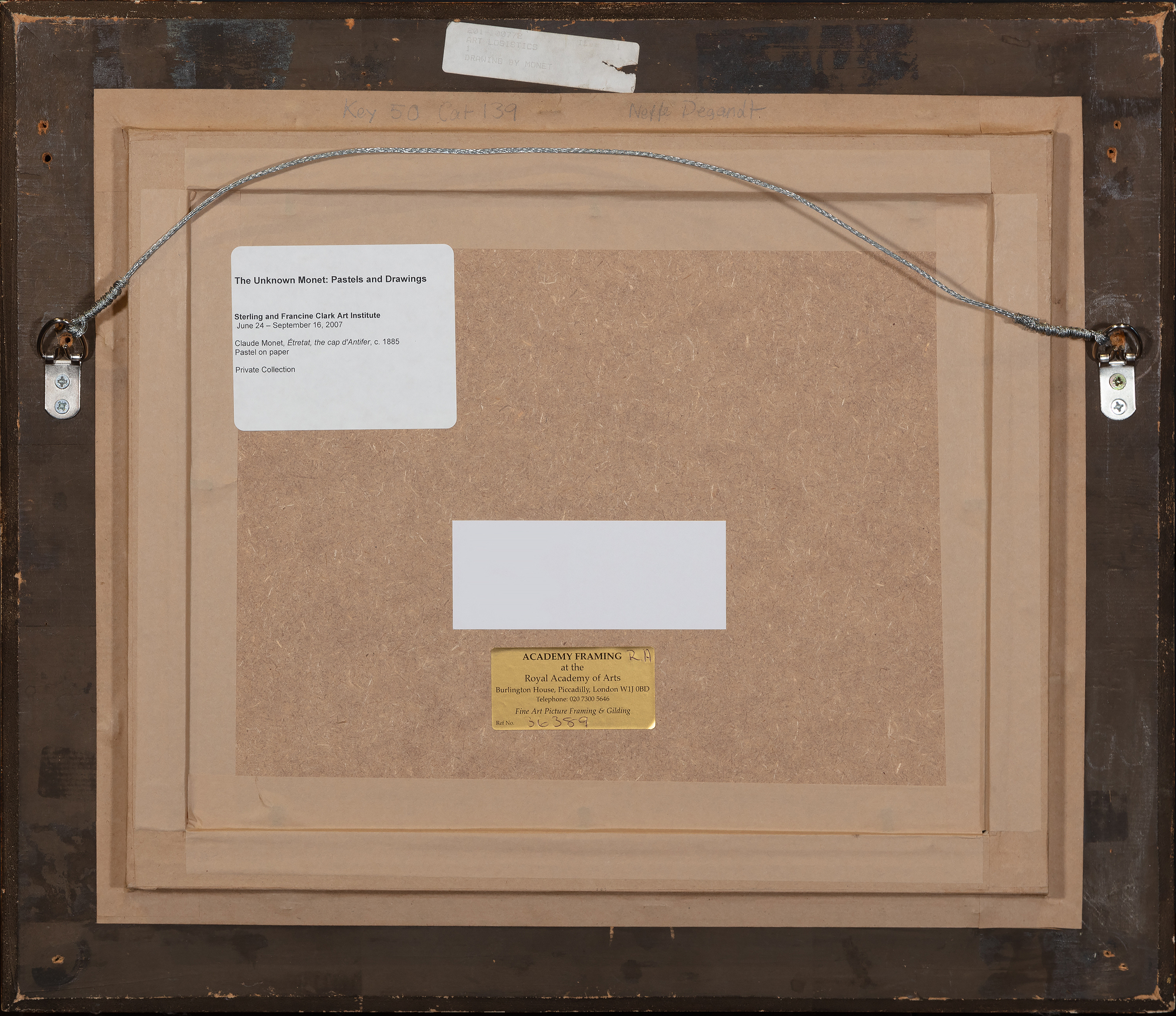
Étretat, el Cabo de Antiferc. 188510 1/2 x 13 3/8 pulgadas(26,67 x 33,97 cm) pastel sobre papel montado sobre cartón
Procedencia
(posiblemente) Mme Materne, c. 1894
I. Stchoukine, París
Hôtel Drouot, París, 24 de marzo de 1900, lote 36
Olivier Vainsère
Galerie Lorenceau, París
Wildenstein & Co., París
Alice Tully, adquirido de los anteriores, 1973
Christie's, Nueva York, 10 de noviembre de 1994, lote 138
Galería Neffe-Degandt, Londres
Colección privada, adquirido de los anteriores, 2002, y desde entonces por descendencia
Colección privada, California
Exposición
East Hampton, Nueva York, Guild Hall, The Sea Around Us, agosto-septiembre de 1953, n.º 45
Washi
...Más....Washington D. C., Adams Davidson Galleries, Los impresionistas franceses y sus seguidores, diciembre de 1971 - enero de 1972.
Londres, Real Academia de las Artes; Williamstown, Instituto de Arte Sterling y Francine Clark, El Monet desconocido: Pasteles y dibujos, marzo-septiembre de 2007, n.º 139.
Literatura
Daniel Wildenstein, Claude Monet, Catálogo razonado, Suplemento a las pinturas, dibujos y pasteles, Lausana, 1991, vol. V, n.º P 80, p. 171 (ilustrado).
James Ganz y Richard Kendell, The Unknown Monet: Pastels and Drawings, Williamstown, MA, 2007, n.º 139, pp. 158-159 y 302 (ilustrado en la p. 158).
...MENOS....
Como la idea de usar dibujos, ya fuera a lápiz o pastel, para preparar una pintura no encajaba con el proceso creativo que Monet había hecho público, él solía restarle importancia en su trabajo. Sin embargo, después de su muerte, aparecieron ocho folios con más de cuatrocientos dibujos, además de muchos pasteles. Este medio, cómodo y ligero, le permitía experimentar con la composición y el color, y desarrollar ideas para sus pinturas al óleo rápidamente. También usaba el pastel para hacer cuadros terminados, como en este ejemplo.


Durante la década de 1880, Monet regresó a la costa de Normandía. Encontró inspiración en la luz resplandeciente y los famosos acantilados de piedra caliza, al igual que Delacroix y Courbet. Además de trabajar directamente con óleos, siguió el ejemplo de Boudin y utilizó tiza negra y pastel para estudiar los efectos de la luz y el color en el cielo, el mar y la tierra.


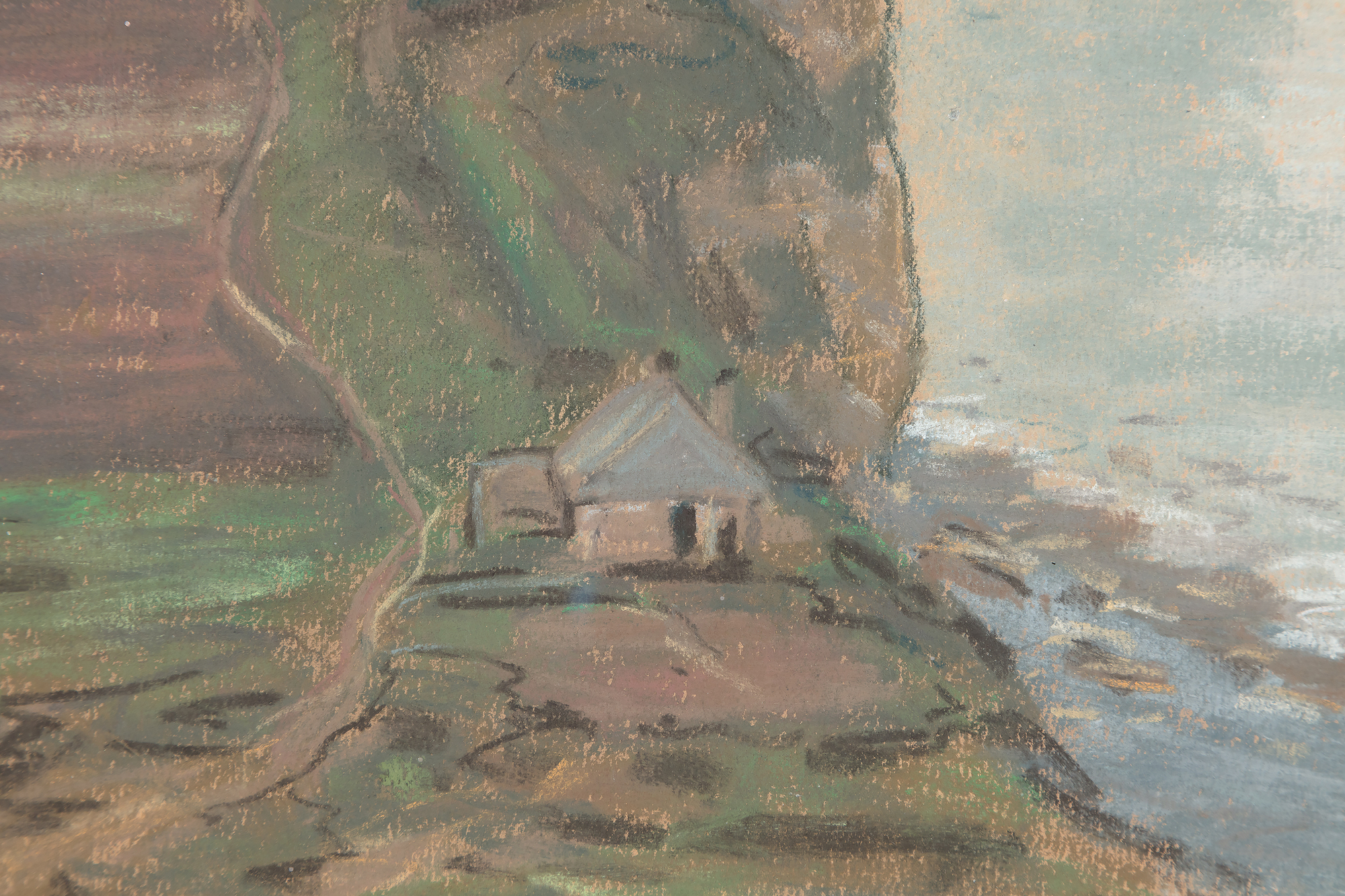
En este paisaje marino de Etretat, a treinta kilómetros al norte de Le Havre, Monet ha elegido una composición inusual, dividiendo el paisaje por el centro con los vertiginosos acantilados; la mitad izquierda del cuadro está compuesta por verdes y marrones terrosos, mientras que la mitad derecha muestra un mar salpicado por el sol que se disuelve en el cielo, con el horizonte sugerido únicamente por un ligero toque de carboncillo. Este cuadro presenta una diferencia notable en cuanto a la atmósfera con respecto a otro pastel de la cercana Porte d'Aval, datable en el mismo periodo, cuyo cielo de última hora de la tarde muestra la gama de expresiones que se podían lograr con el pastel. En el verano de 1885, año en que realizó este pastel, Monet había abandonado en gran medida los temas urbanos y se sentía más atraído por los fenómenos naturales. Pintó muchas vistas a lo largo de la costa en diferentes condiciones de luz. Como se señala en el catálogo razonado de Monet, este pastel no es un estudio preparatorio para un óleo, sino una composición totalmente original. Demuestra lo bien que el pintor comprendía y disfrutaba de la versatilidad del medio al intentar capturar un clima tan variable.
Preguntar