JOANNA POUSETTE-DART (né en 1947)

 
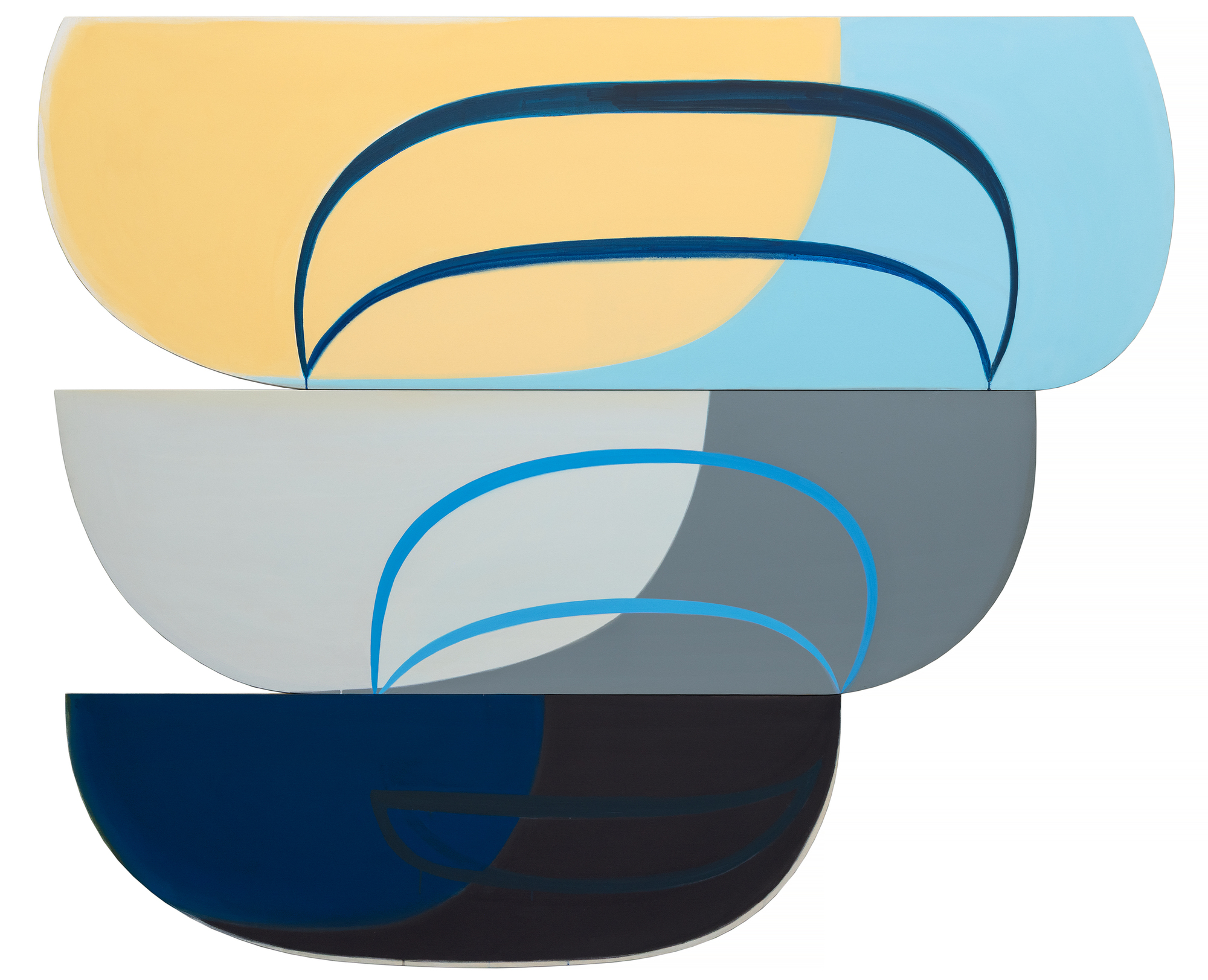
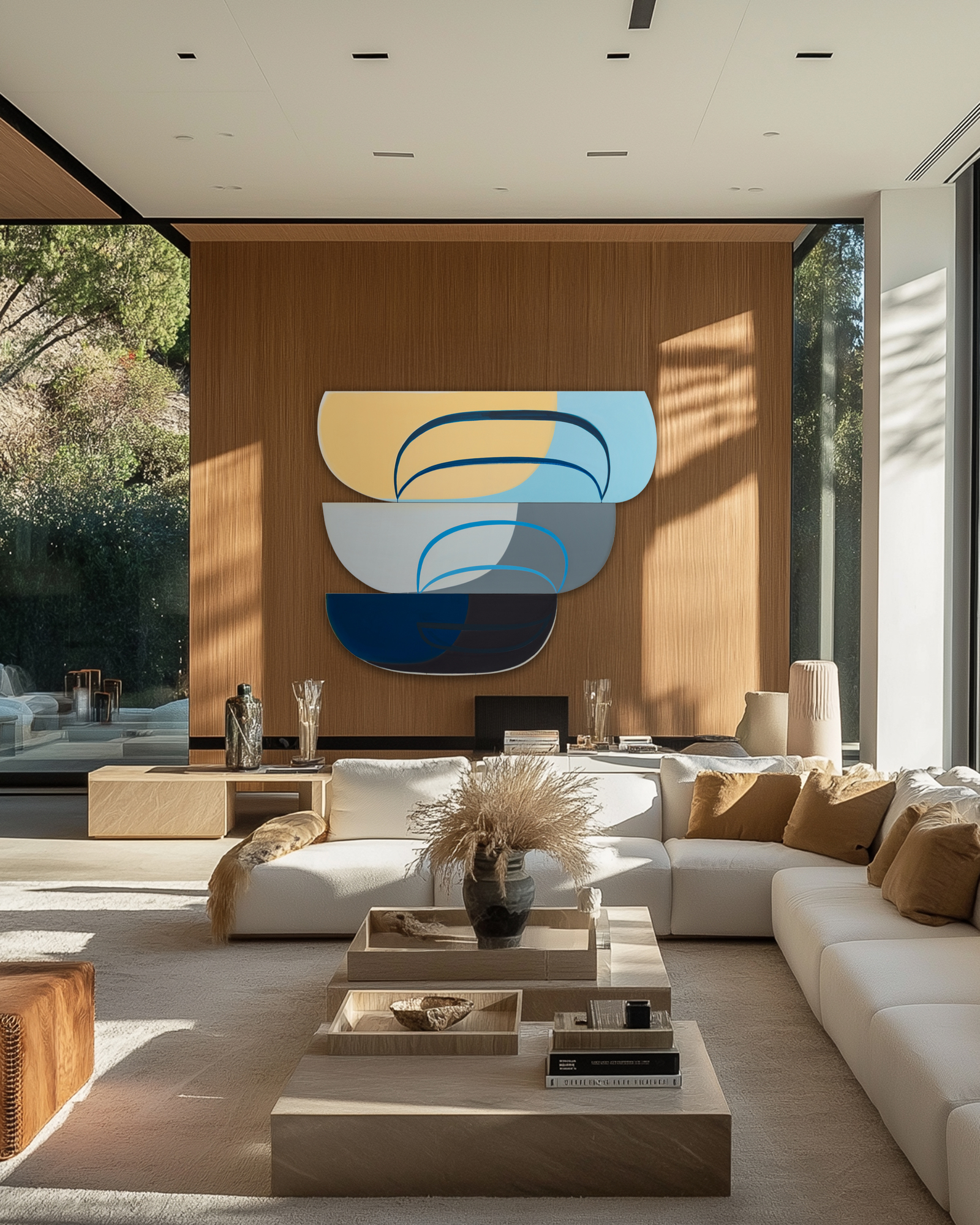
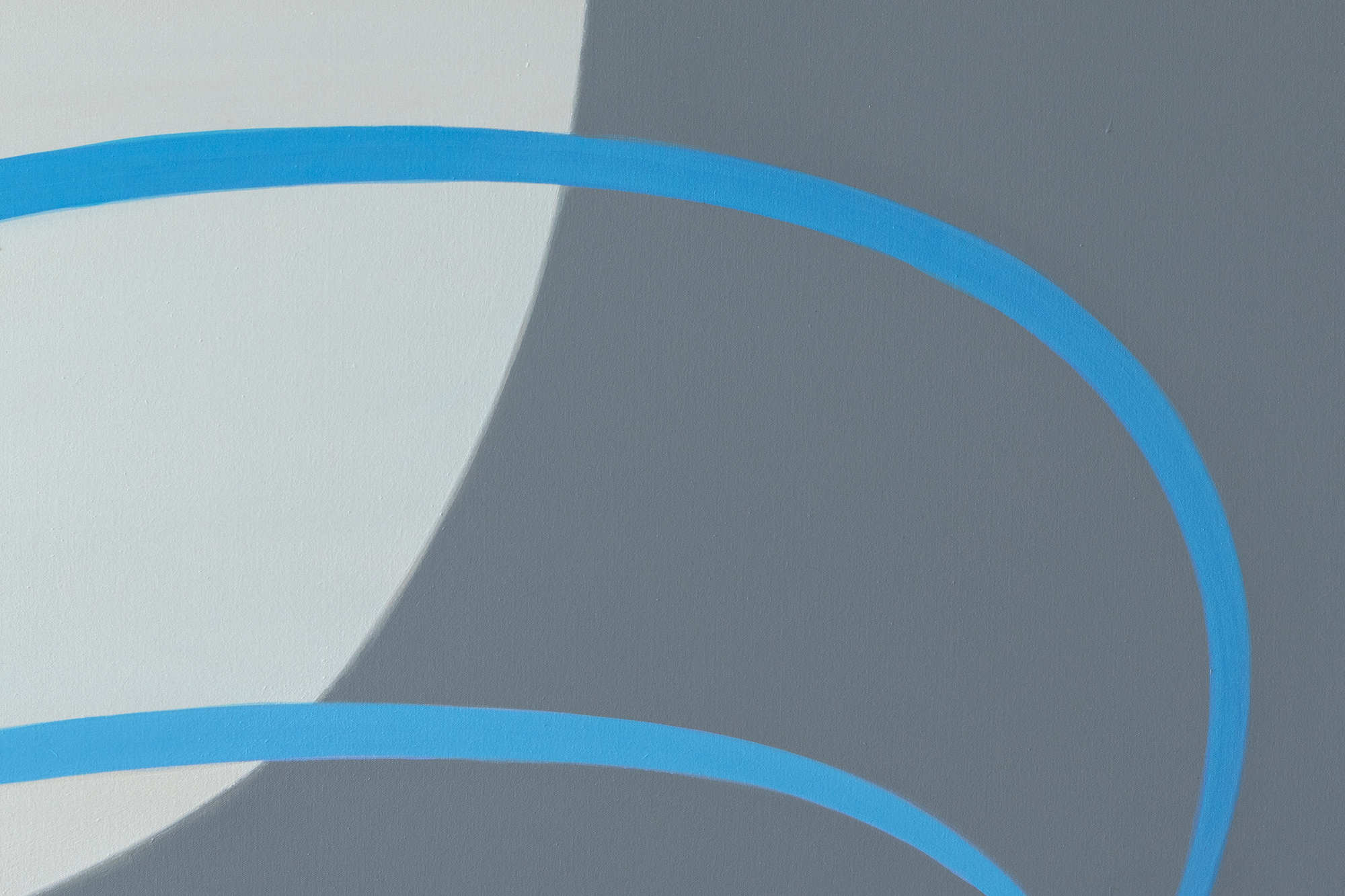
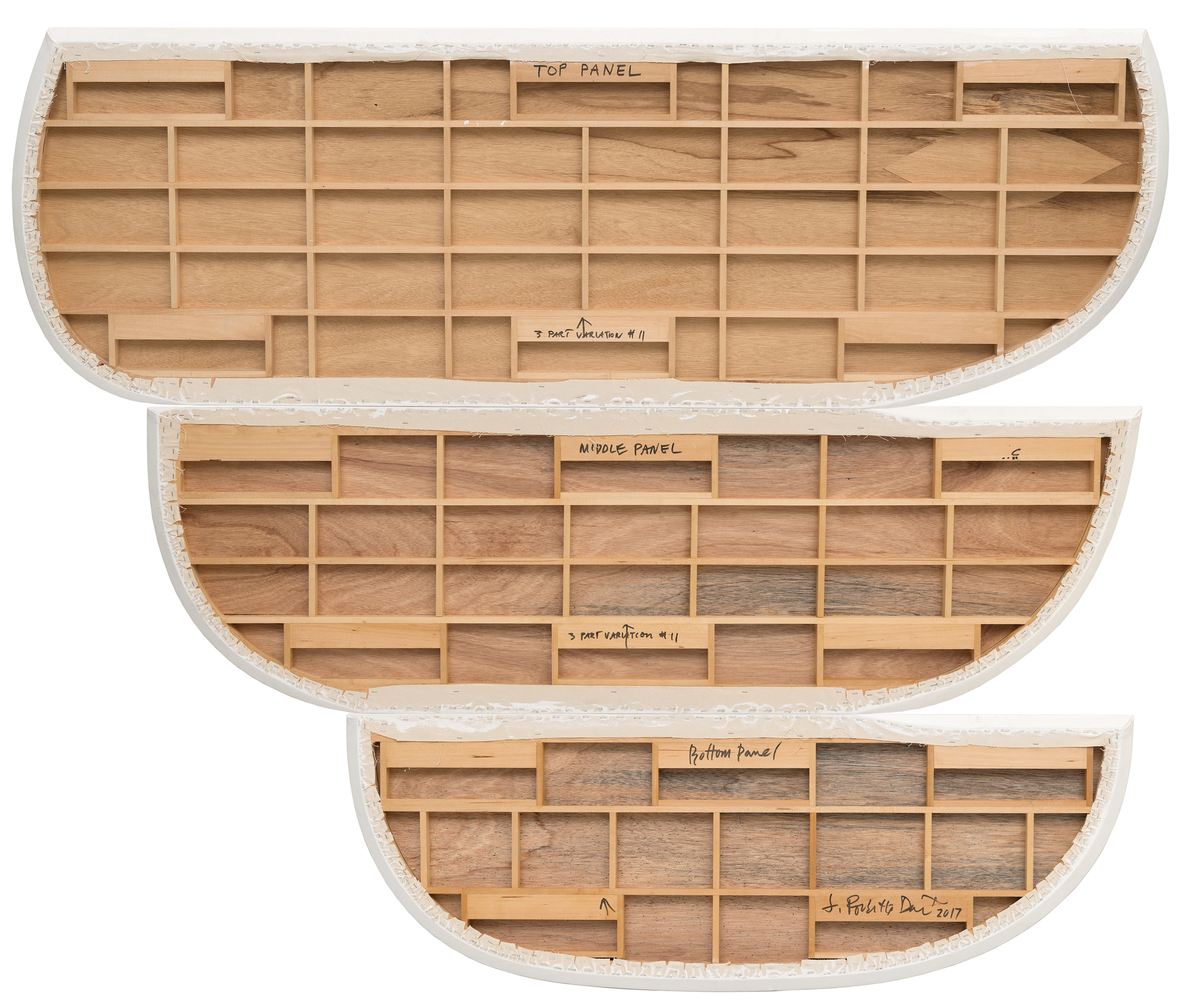
<div>Joanna Pousette-Dart’s 3 Part Variation No. 11 (2017) is composed of three stacked, curvilinear canvases—forms that resemble canoe hulls or slices of a circle—rising in scale from bottom to top. Each panel has its own restrained palette of blues, yellows, and grays, distinct yet resonant with the others. The proportions and curves echo from one to the next, yet no two forms are alike. </div><br><br><div> </div><br><br><div>Within each panel, broad areas of flat color are bisected by rounded shapes whose outer contours align with the painting’s edge. Layered over these are linear arabesque-like structures that visually rhyme—but never directly repeat—the panels’ curves, creating a dynamic interplay between inner drawing and outer shape. The result is both lyrical and precise, a composition where subtle variations generate a complex harmony. </div><br><br><div> </div><br><br><div>The beauty of 3 Part Variation No. 11 lies in these relationships: how forms mirror, diverge, and converge across the three canvases. The effect is meditative, like a visual equation that is at once architectural and deeply personal. </div> <div>Joanna Pousette-Dart’s 3 Part Variation No. 11 (2017) is composed of three stacked, curvilinear canvases—forms that resemble canoe hulls or slices of a circle—rising in scale from bottom to top. Each panel has its own restrained palette of blues, yellows, and grays, distinct yet resonant with the others. The proportions and curves echo from one to the next, yet no two forms are alike. </div><br><br><div> </div><br><br><div>Within each panel, broad areas of flat color are bisected by rounded shapes whose outer contours align with the painting’s edge. Layered over these are linear arabesque-like structures that visually rhyme—but never directly repeat—the panels’ curves, creating a dynamic interplay between inner drawing and outer shape. The result is both lyrical and precise, a composition where subtle variations generate a complex harmony. </div><br><br><div> </div><br><br><div>The beauty of 3 Part Variation No. 11 lies in these relationships: how forms mirror, diverge, and converge across the three canvases. The effect is meditative, like a visual equation that is at once architectural and deeply personal. </div> <div>Joanna Pousette-Dart’s 3 Part Variation No. 11 (2017) is composed of three stacked, curvilinear canvases—forms that resemble canoe hulls or slices of a circle—rising in scale from bottom to top. Each panel has its own restrained palette of blues, yellows, and grays, distinct yet resonant with the others. The proportions and curves echo from one to the next, yet no two forms are alike. </div><br><br><div> </div><br><br><div>Within each panel, broad areas of flat color are bisected by rounded shapes whose outer contours align with the painting’s edge. Layered over these are linear arabesque-like structures that visually rhyme—but never directly repeat—the panels’ curves, creating a dynamic interplay between inner drawing and outer shape. The result is both lyrical and precise, a composition where subtle variations generate a complex harmony. </div><br><br><div> </div><br><br><div>The beauty of 3 Part Variation No. 11 lies in these relationships: how forms mirror, diverge, and converge across the three canvases. The effect is meditative, like a visual equation that is at once architectural and deeply personal. </div> <div>Joanna Pousette-Dart’s 3 Part Variation No. 11 (2017) is composed of three stacked, curvilinear canvases—forms that resemble canoe hulls or slices of a circle—rising in scale from bottom to top. Each panel has its own restrained palette of blues, yellows, and grays, distinct yet resonant with the others. The proportions and curves echo from one to the next, yet no two forms are alike. </div><br><br><div> </div><br><br><div>Within each panel, broad areas of flat color are bisected by rounded shapes whose outer contours align with the painting’s edge. Layered over these are linear arabesque-like structures that visually rhyme—but never directly repeat—the panels’ curves, creating a dynamic interplay between inner drawing and outer shape. The result is both lyrical and precise, a composition where subtle variations generate a complex harmony. </div><br><br><div> </div><br><br><div>The beauty of 3 Part Variation No. 11 lies in these relationships: how forms mirror, diverge, and converge across the three canvases. The effect is meditative, like a visual equation that is at once architectural and deeply personal. </div> <div>Joanna Pousette-Dart’s 3 Part Variation No. 11 (2017) is composed of three stacked, curvilinear canvases—forms that resemble canoe hulls or slices of a circle—rising in scale from bottom to top. Each panel has its own restrained palette of blues, yellows, and grays, distinct yet resonant with the others. The proportions and curves echo from one to the next, yet no two forms are alike. </div><br><br><div> </div><br><br><div>Within each panel, broad areas of flat color are bisected by rounded shapes whose outer contours align with the painting’s edge. Layered over these are linear arabesque-like structures that visually rhyme—but never directly repeat—the panels’ curves, creating a dynamic interplay between inner drawing and outer shape. The result is both lyrical and precise, a composition where subtle variations generate a complex harmony. </div><br><br><div> </div><br><br><div>The beauty of 3 Part Variation No. 11 lies in these relationships: how forms mirror, diverge, and converge across the three canvases. The effect is meditative, like a visual equation that is at once architectural and deeply personal. </div> <div>Joanna Pousette-Dart’s 3 Part Variation No. 11 (2017) is composed of three stacked, curvilinear canvases—forms that resemble canoe hulls or slices of a circle—rising in scale from bottom to top. Each panel has its own restrained palette of blues, yellows, and grays, distinct yet resonant with the others. The proportions and curves echo from one to the next, yet no two forms are alike. </div><br><br><div> </div><br><br><div>Within each panel, broad areas of flat color are bisected by rounded shapes whose outer contours align with the painting’s edge. Layered over these are linear arabesque-like structures that visually rhyme—but never directly repeat—the panels’ curves, creating a dynamic interplay between inner drawing and outer shape. The result is both lyrical and precise, a composition where subtle variations generate a complex harmony. </div><br><br><div> </div><br><br><div>The beauty of 3 Part Variation No. 11 lies in these relationships: how forms mirror, diverge, and converge across the three canvases. The effect is meditative, like a visual equation that is at once architectural and deeply personal. </div> <div>Joanna Pousette-Dart’s 3 Part Variation No. 11 (2017) is composed of three stacked, curvilinear canvases—forms that resemble canoe hulls or slices of a circle—rising in scale from bottom to top. Each panel has its own restrained palette of blues, yellows, and grays, distinct yet resonant with the others. The proportions and curves echo from one to the next, yet no two forms are alike. </div><br><br><div> </div><br><br><div>Within each panel, broad areas of flat color are bisected by rounded shapes whose outer contours align with the painting’s edge. Layered over these are linear arabesque-like structures that visually rhyme—but never directly repeat—the panels’ curves, creating a dynamic interplay between inner drawing and outer shape. The result is both lyrical and precise, a composition where subtle variations generate a complex harmony. </div><br><br><div> </div><br><br><div>The beauty of 3 Part Variation No. 11 lies in these relationships: how forms mirror, diverge, and converge across the three canvases. The effect is meditative, like a visual equation that is at once architectural and deeply personal. </div> <div>Joanna Pousette-Dart’s 3 Part Variation No. 11 (2017) is composed of three stacked, curvilinear canvases—forms that resemble canoe hulls or slices of a circle—rising in scale from bottom to top. Each panel has its own restrained palette of blues, yellows, and grays, distinct yet resonant with the others. The proportions and curves echo from one to the next, yet no two forms are alike. </div><br><br><div> </div><br><br><div>Within each panel, broad areas of flat color are bisected by rounded shapes whose outer contours align with the painting’s edge. Layered over these are linear arabesque-like structures that visually rhyme—but never directly repeat—the panels’ curves, creating a dynamic interplay between inner drawing and outer shape. The result is both lyrical and precise, a composition where subtle variations generate a complex harmony. </div><br><br><div> </div><br><br><div>The beauty of 3 Part Variation No. 11 lies in these relationships: how forms mirror, diverge, and converge across the three canvases. The effect is meditative, like a visual equation that is at once architectural and deeply personal. </div> <div>Joanna Pousette-Dart’s 3 Part Variation No. 11 (2017) is composed of three stacked, curvilinear canvases—forms that resemble canoe hulls or slices of a circle—rising in scale from bottom to top. Each panel has its own restrained palette of blues, yellows, and grays, distinct yet resonant with the others. The proportions and curves echo from one to the next, yet no two forms are alike. </div><br><br><div> </div><br><br><div>Within each panel, broad areas of flat color are bisected by rounded shapes whose outer contours align with the painting’s edge. Layered over these are linear arabesque-like structures that visually rhyme—but never directly repeat—the panels’ curves, creating a dynamic interplay between inner drawing and outer shape. The result is both lyrical and precise, a composition where subtle variations generate a complex harmony. </div><br><br><div> </div><br><br><div>The beauty of 3 Part Variation No. 11 lies in these relationships: how forms mirror, diverge, and converge across the three canvases. The effect is meditative, like a visual equation that is at once architectural and deeply personal. </div> <div>Joanna Pousette-Dart’s 3 Part Variation No. 11 (2017) is composed of three stacked, curvilinear canvases—forms that resemble canoe hulls or slices of a circle—rising in scale from bottom to top. Each panel has its own restrained palette of blues, yellows, and grays, distinct yet resonant with the others. The proportions and curves echo from one to the next, yet no two forms are alike. </div><br><br><div> </div><br><br><div>Within each panel, broad areas of flat color are bisected by rounded shapes whose outer contours align with the painting’s edge. Layered over these are linear arabesque-like structures that visually rhyme—but never directly repeat—the panels’ curves, creating a dynamic interplay between inner drawing and outer shape. The result is both lyrical and precise, a composition where subtle variations generate a complex harmony. </div><br><br><div> </div><br><br><div>The beauty of 3 Part Variation No. 11 lies in these relationships: how forms mirror, diverge, and converge across the three canvases. The effect is meditative, like a visual equation that is at once architectural and deeply personal. </div>
Variation en 3 parties n° 11201776 3/4 x 91 1/2 x 1 1/12 po(194,31 x 232,41 x 3,81 cm) acrylique, toile, panneaux de bois
Provenance
Collection d'artiste
Collection privée, achetée directement auprès de l'artiste
La 3 Part Variation No. 11 (2017) de Joanna Pousette-Dart est composée de trois toiles empilées et curvilignes, dont les formes rappellent celles d'une coque de canoë ou de tranches de cercle, et dont la taille augmente de bas en haut. Chaque panneau possède sa propre palette sobre de bleus, de jaunes et de gris, distincte mais en résonance avec les autres. Les proportions et les courbes se font écho d'un panneau à l'autre, mais aucune forme n'est identique.


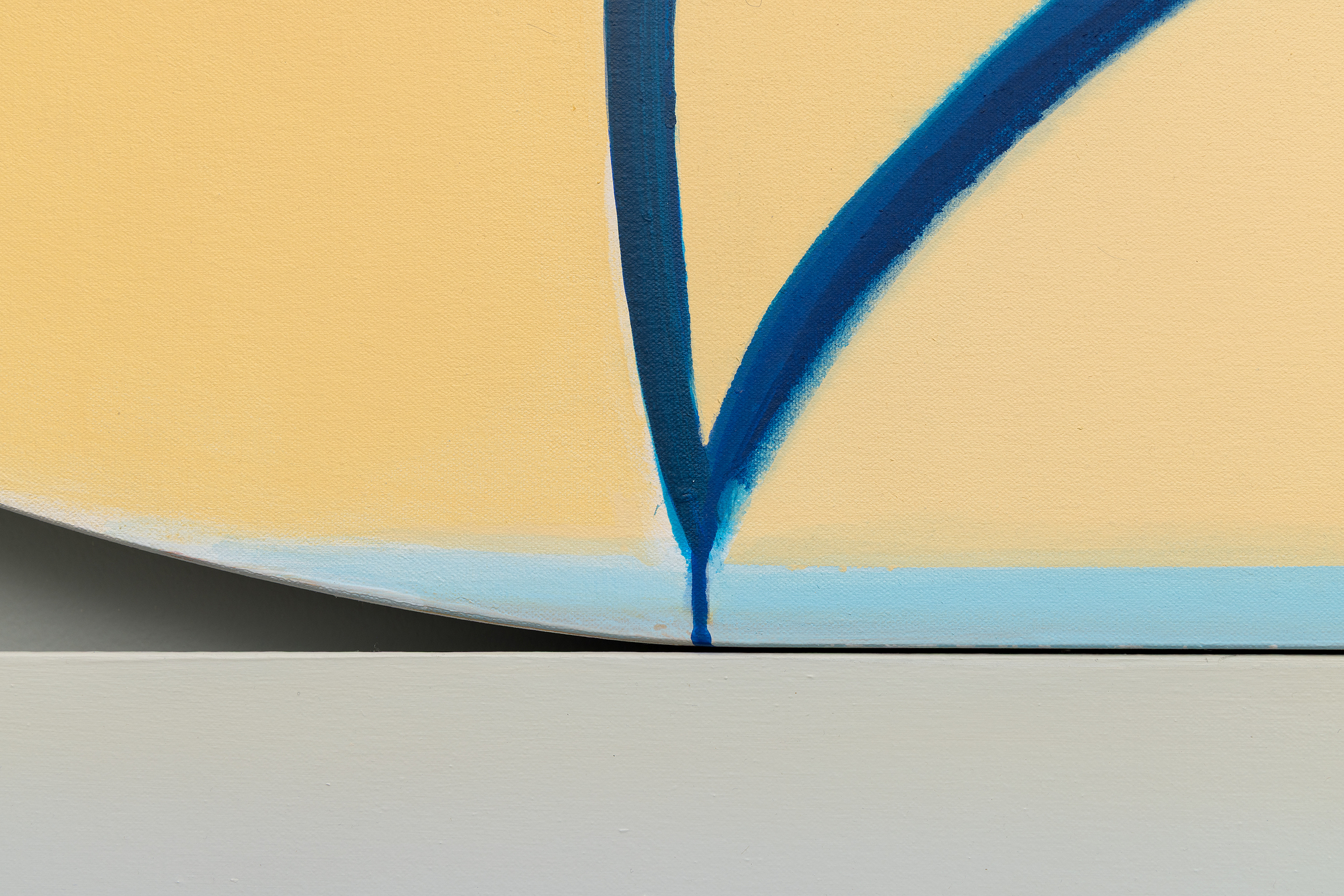
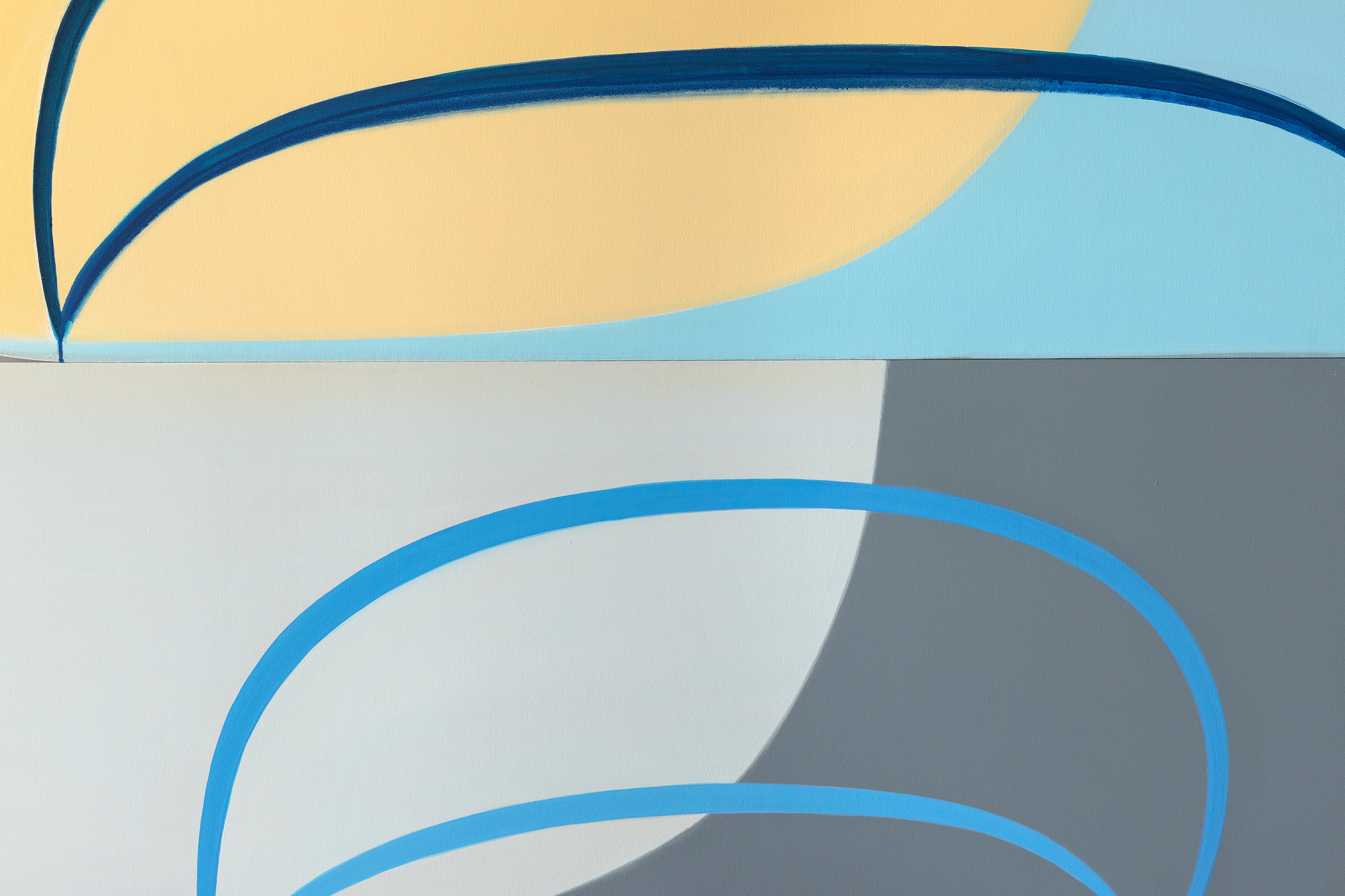
Au sein de chaque panneau, de larges zones de couleur unie sont coupées en deux par des formes arrondies dont les contours extérieurs s'alignent avec le bord du tableau. Par-dessus, des structures linéaires en forme d'arabesques font écho visuellement aux courbes des panneaux, sans jamais les répéter directement, créant ainsi une interaction dynamique entre le dessin intérieur et la forme extérieure. Le résultat est à la fois lyrique et précis, une composition où de subtiles variations génèrent une harmonie complexe.


La beauté de 3 Part Variation No. 11 réside dans ces relations : la façon dont les formes se reflètent, divergent et convergent à travers les trois toiles. L'effet est méditatif, comme une équation visuelle à la fois architecturale et profondément personnelle.
demander