ROBERT INDIANA (1928-2018)

$39,000

 
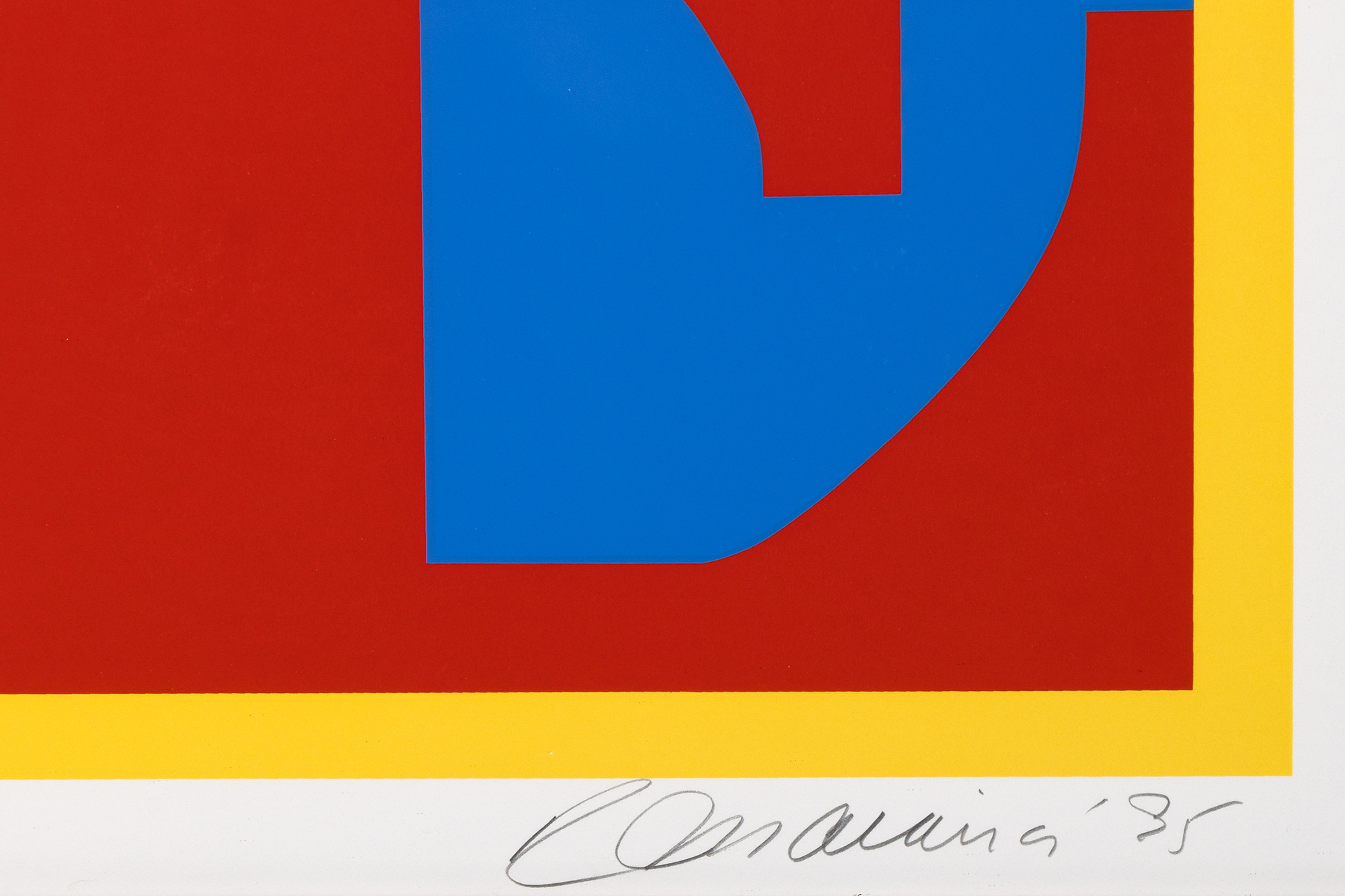
<div><font face=Lato size=3 color="#191919">Robert Indiana’s <em>Heliotherapy</em> reimagines his iconic <em>LOVE</em> motif through a vision of renewal and optimism. Created in 1995, the title refers to sunlight as a source of healing, reflecting Indiana’s desire late in life to revisit his 1960s antiwar symbol with a message of hope and compassion. He enriched the original reds, greens, and blues with radiant bands of yellow, transforming his emblem of love into one of light, warmth, and restoration.</font></div><br><br><div> </div><br><br><div><font face=Lato size=3 color="#191919">The composition echoes Indiana’s celebrated 1965 <em>LOVE</em> Christmas card for the Museum of Modern Art, the image that made him a household name. With its vivid palette and spiritual depth, <em>Heliotherapy</em> stands as a late reflection on love as both universal and curative. Comparable works are held in the collections of the Museum of Modern Art and the Smithsonian American Art Museum, underscoring the enduring legacy of Indiana’s most iconic image.</font></div> <div><font face=Lato size=3 color="#191919">Robert Indiana’s <em>Heliotherapy</em> reimagines his iconic <em>LOVE</em> motif through a vision of renewal and optimism. Created in 1995, the title refers to sunlight as a source of healing, reflecting Indiana’s desire late in life to revisit his 1960s antiwar symbol with a message of hope and compassion. He enriched the original reds, greens, and blues with radiant bands of yellow, transforming his emblem of love into one of light, warmth, and restoration.</font></div><br><br><div> </div><br><br><div><font face=Lato size=3 color="#191919">The composition echoes Indiana’s celebrated 1965 <em>LOVE</em> Christmas card for the Museum of Modern Art, the image that made him a household name. With its vivid palette and spiritual depth, <em>Heliotherapy</em> stands as a late reflection on love as both universal and curative. Comparable works are held in the collections of the Museum of Modern Art and the Smithsonian American Art Museum, underscoring the enduring legacy of Indiana’s most iconic image.</font></div> <div><font face=Lato size=3 color="#191919">Robert Indiana’s <em>Heliotherapy</em> reimagines his iconic <em>LOVE</em> motif through a vision of renewal and optimism. Created in 1995, the title refers to sunlight as a source of healing, reflecting Indiana’s desire late in life to revisit his 1960s antiwar symbol with a message of hope and compassion. He enriched the original reds, greens, and blues with radiant bands of yellow, transforming his emblem of love into one of light, warmth, and restoration.</font></div><br><br><div> </div><br><br><div><font face=Lato size=3 color="#191919">The composition echoes Indiana’s celebrated 1965 <em>LOVE</em> Christmas card for the Museum of Modern Art, the image that made him a household name. With its vivid palette and spiritual depth, <em>Heliotherapy</em> stands as a late reflection on love as both universal and curative. Comparable works are held in the collections of the Museum of Modern Art and the Smithsonian American Art Museum, underscoring the enduring legacy of Indiana’s most iconic image.</font></div> <div><font face=Lato size=3 color="#191919">Robert Indiana’s <em>Heliotherapy</em> reimagines his iconic <em>LOVE</em> motif through a vision of renewal and optimism. Created in 1995, the title refers to sunlight as a source of healing, reflecting Indiana’s desire late in life to revisit his 1960s antiwar symbol with a message of hope and compassion. He enriched the original reds, greens, and blues with radiant bands of yellow, transforming his emblem of love into one of light, warmth, and restoration.</font></div><br><br><div> </div><br><br><div><font face=Lato size=3 color="#191919">The composition echoes Indiana’s celebrated 1965 <em>LOVE</em> Christmas card for the Museum of Modern Art, the image that made him a household name. With its vivid palette and spiritual depth, <em>Heliotherapy</em> stands as a late reflection on love as both universal and curative. Comparable works are held in the collections of the Museum of Modern Art and the Smithsonian American Art Museum, underscoring the enduring legacy of Indiana’s most iconic image.</font></div> <div><font face=Lato size=3 color="#191919">Robert Indiana’s <em>Heliotherapy</em> reimagines his iconic <em>LOVE</em> motif through a vision of renewal and optimism. Created in 1995, the title refers to sunlight as a source of healing, reflecting Indiana’s desire late in life to revisit his 1960s antiwar symbol with a message of hope and compassion. He enriched the original reds, greens, and blues with radiant bands of yellow, transforming his emblem of love into one of light, warmth, and restoration.</font></div><br><br><div> </div><br><br><div><font face=Lato size=3 color="#191919">The composition echoes Indiana’s celebrated 1965 <em>LOVE</em> Christmas card for the Museum of Modern Art, the image that made him a household name. With its vivid palette and spiritual depth, <em>Heliotherapy</em> stands as a late reflection on love as both universal and curative. Comparable works are held in the collections of the Museum of Modern Art and the Smithsonian American Art Museum, underscoring the enduring legacy of Indiana’s most iconic image.</font></div> <div><font face=Lato size=3 color="#191919">Robert Indiana’s <em>Heliotherapy</em> reimagines his iconic <em>LOVE</em> motif through a vision of renewal and optimism. Created in 1995, the title refers to sunlight as a source of healing, reflecting Indiana’s desire late in life to revisit his 1960s antiwar symbol with a message of hope and compassion. He enriched the original reds, greens, and blues with radiant bands of yellow, transforming his emblem of love into one of light, warmth, and restoration.</font></div><br><br><div> </div><br><br><div><font face=Lato size=3 color="#191919">The composition echoes Indiana’s celebrated 1965 <em>LOVE</em> Christmas card for the Museum of Modern Art, the image that made him a household name. With its vivid palette and spiritual depth, <em>Heliotherapy</em> stands as a late reflection on love as both universal and curative. Comparable works are held in the collections of the Museum of Modern Art and the Smithsonian American Art Museum, underscoring the enduring legacy of Indiana’s most iconic image.</font></div> <div><font face=Lato size=3 color="#191919">Robert Indiana’s <em>Heliotherapy</em> reimagines his iconic <em>LOVE</em> motif through a vision of renewal and optimism. Created in 1995, the title refers to sunlight as a source of healing, reflecting Indiana’s desire late in life to revisit his 1960s antiwar symbol with a message of hope and compassion. He enriched the original reds, greens, and blues with radiant bands of yellow, transforming his emblem of love into one of light, warmth, and restoration.</font></div><br><br><div> </div><br><br><div><font face=Lato size=3 color="#191919">The composition echoes Indiana’s celebrated 1965 <em>LOVE</em> Christmas card for the Museum of Modern Art, the image that made him a household name. With its vivid palette and spiritual depth, <em>Heliotherapy</em> stands as a late reflection on love as both universal and curative. Comparable works are held in the collections of the Museum of Modern Art and the Smithsonian American Art Museum, underscoring the enduring legacy of Indiana’s most iconic image.</font></div> <div><font face=Lato size=3 color="#191919">Robert Indiana’s <em>Heliotherapy</em> reimagines his iconic <em>LOVE</em> motif through a vision of renewal and optimism. Created in 1995, the title refers to sunlight as a source of healing, reflecting Indiana’s desire late in life to revisit his 1960s antiwar symbol with a message of hope and compassion. He enriched the original reds, greens, and blues with radiant bands of yellow, transforming his emblem of love into one of light, warmth, and restoration.</font></div><br><br><div> </div><br><br><div><font face=Lato size=3 color="#191919">The composition echoes Indiana’s celebrated 1965 <em>LOVE</em> Christmas card for the Museum of Modern Art, the image that made him a household name. With its vivid palette and spiritual depth, <em>Heliotherapy</em> stands as a late reflection on love as both universal and curative. Comparable works are held in the collections of the Museum of Modern Art and the Smithsonian American Art Museum, underscoring the enduring legacy of Indiana’s most iconic image.</font></div> <div><font face=Lato size=3 color="#191919">Robert Indiana’s <em>Heliotherapy</em> reimagines his iconic <em>LOVE</em> motif through a vision of renewal and optimism. Created in 1995, the title refers to sunlight as a source of healing, reflecting Indiana’s desire late in life to revisit his 1960s antiwar symbol with a message of hope and compassion. He enriched the original reds, greens, and blues with radiant bands of yellow, transforming his emblem of love into one of light, warmth, and restoration.</font></div><br><br><div> </div><br><br><div><font face=Lato size=3 color="#191919">The composition echoes Indiana’s celebrated 1965 <em>LOVE</em> Christmas card for the Museum of Modern Art, the image that made him a household name. With its vivid palette and spiritual depth, <em>Heliotherapy</em> stands as a late reflection on love as both universal and curative. Comparable works are held in the collections of the Museum of Modern Art and the Smithsonian American Art Museum, underscoring the enduring legacy of Indiana’s most iconic image.</font></div> <div><font face=Lato size=3 color="#191919">Robert Indiana’s <em>Heliotherapy</em> reimagines his iconic <em>LOVE</em> motif through a vision of renewal and optimism. Created in 1995, the title refers to sunlight as a source of healing, reflecting Indiana’s desire late in life to revisit his 1960s antiwar symbol with a message of hope and compassion. He enriched the original reds, greens, and blues with radiant bands of yellow, transforming his emblem of love into one of light, warmth, and restoration.</font></div><br><br><div> </div><br><br><div><font face=Lato size=3 color="#191919">The composition echoes Indiana’s celebrated 1965 <em>LOVE</em> Christmas card for the Museum of Modern Art, the image that made him a household name. With its vivid palette and spiritual depth, <em>Heliotherapy</em> stands as a late reflection on love as both universal and curative. Comparable works are held in the collections of the Museum of Modern Art and the Smithsonian American Art Museum, underscoring the enduring legacy of Indiana’s most iconic image.</font></div>
Héliothérapie Amour199537 x 37 1/2 po(93,98 x 95,25 cm) sérigraphie en couleurs
Provenance
avec ArtBrokerage
Collection privée, Colorado, acquise auprès de la source ci-dessus, 2012
Héliothérapie de Robert Indiana réinvente son motif emblématique LOVE à travers une vision de renouveau et d'optimisme. Créée en 1995, l'œuvre tire son titre de la lumière du soleil, source de guérison, reflétant le désir tardif d'Indiana de revisiter son symbole anti-guerre des années 1960 avec un message d'espoir et de compassion. Il a enrichi les rouges, verts et bleus originaux de bandes jaunes rayonnantes, transformant son emblème d'amour en un symbole de lumière, de chaleur et de restauration.


La composition fait écho à la célèbre carte de Noël LOVE réalisée par Indiana en 1965 pour le Museum of Modern Art, l'image qui l'a rendu célèbre. Avec sa palette vive et sa profondeur spirituelle, Heliotherapy est une réflexion tardive sur l'amour comme universel et curatif. Des œuvres comparables font partie des collections du Museum of Modern Art et du Smithsonian American Art Museum, soulignant l'héritage durable de l'image la plus emblématique d'Indiana.
demander