Précédent

MAURICE DE VLAMINCK (1876-1958)

$125,000

 
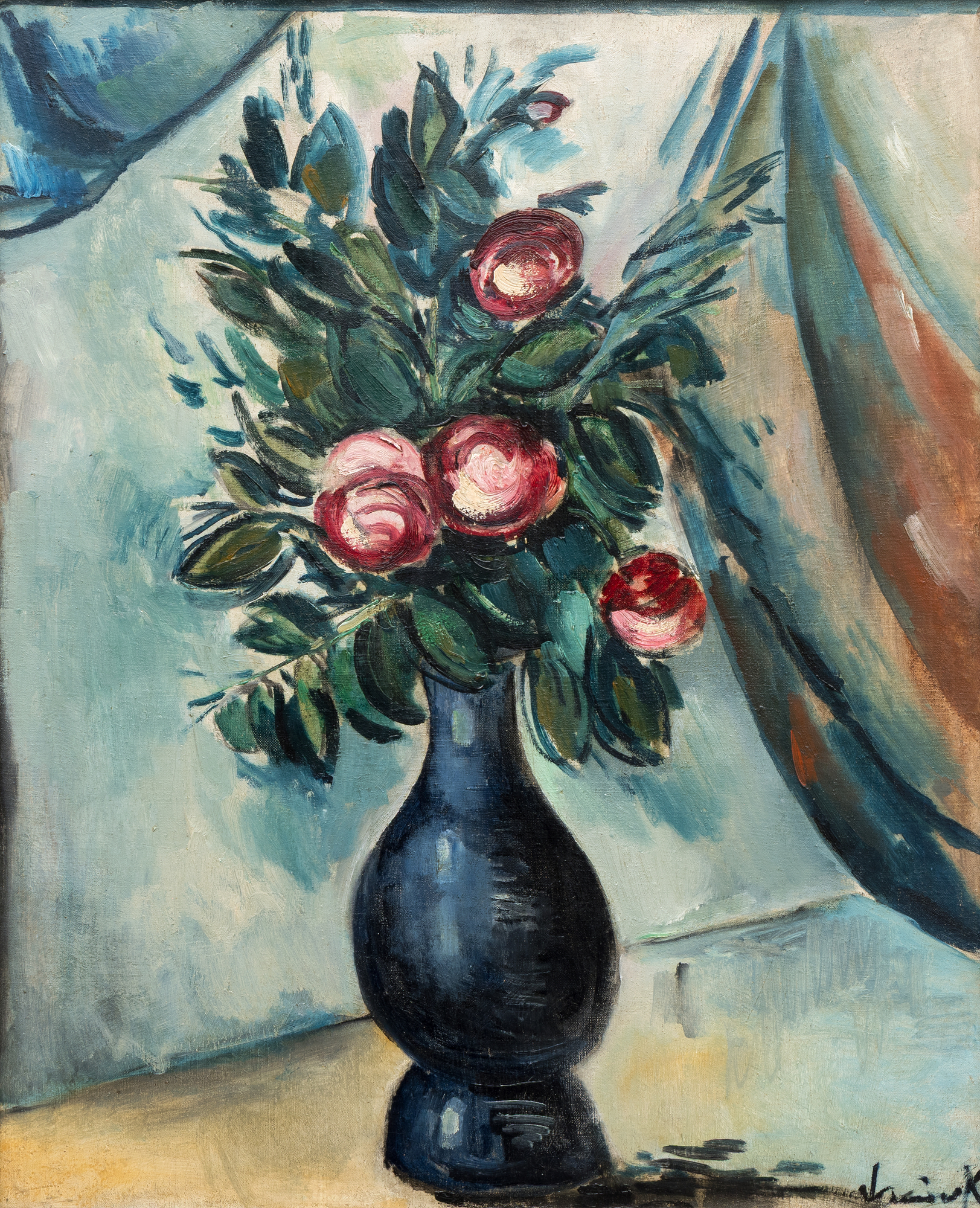
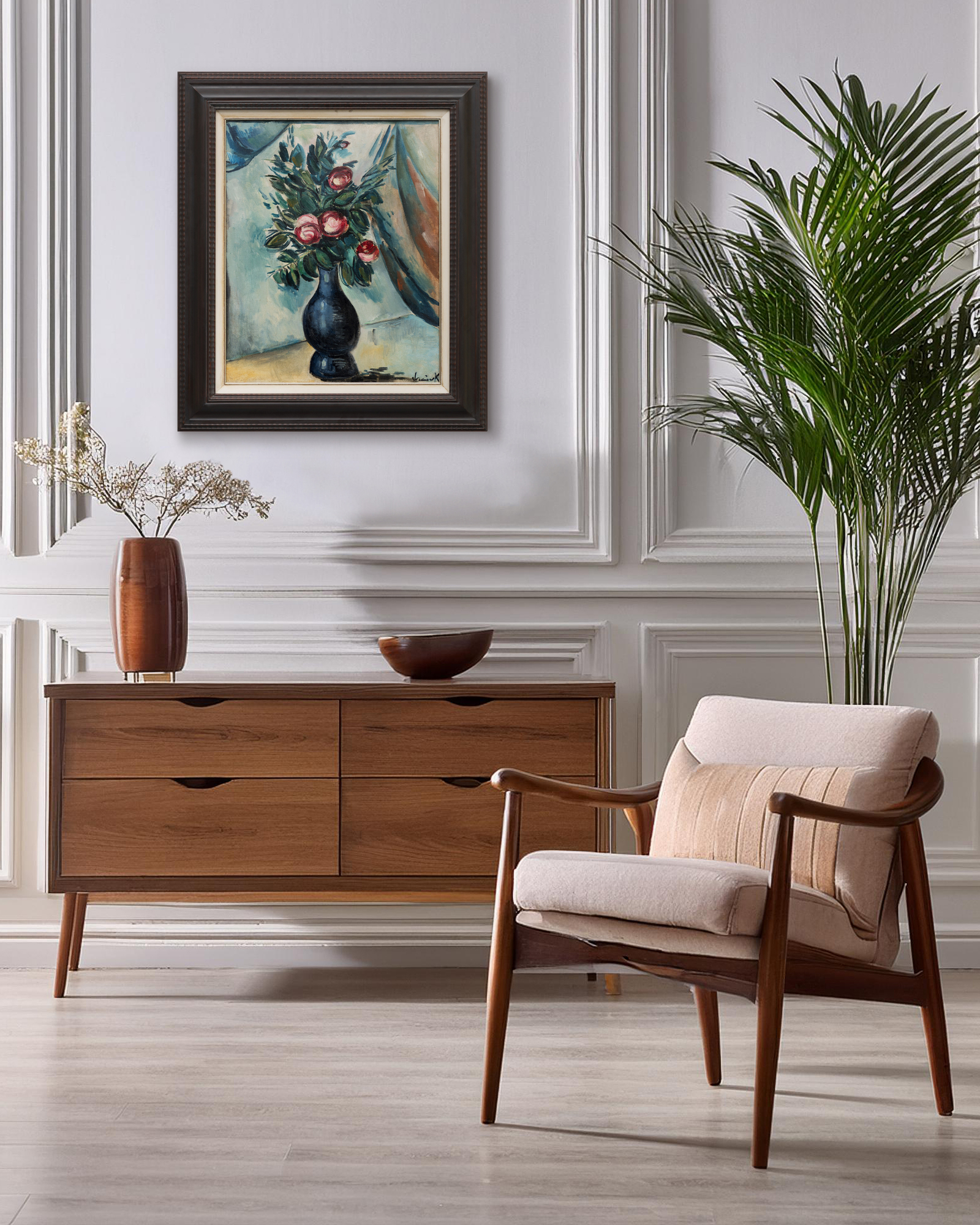
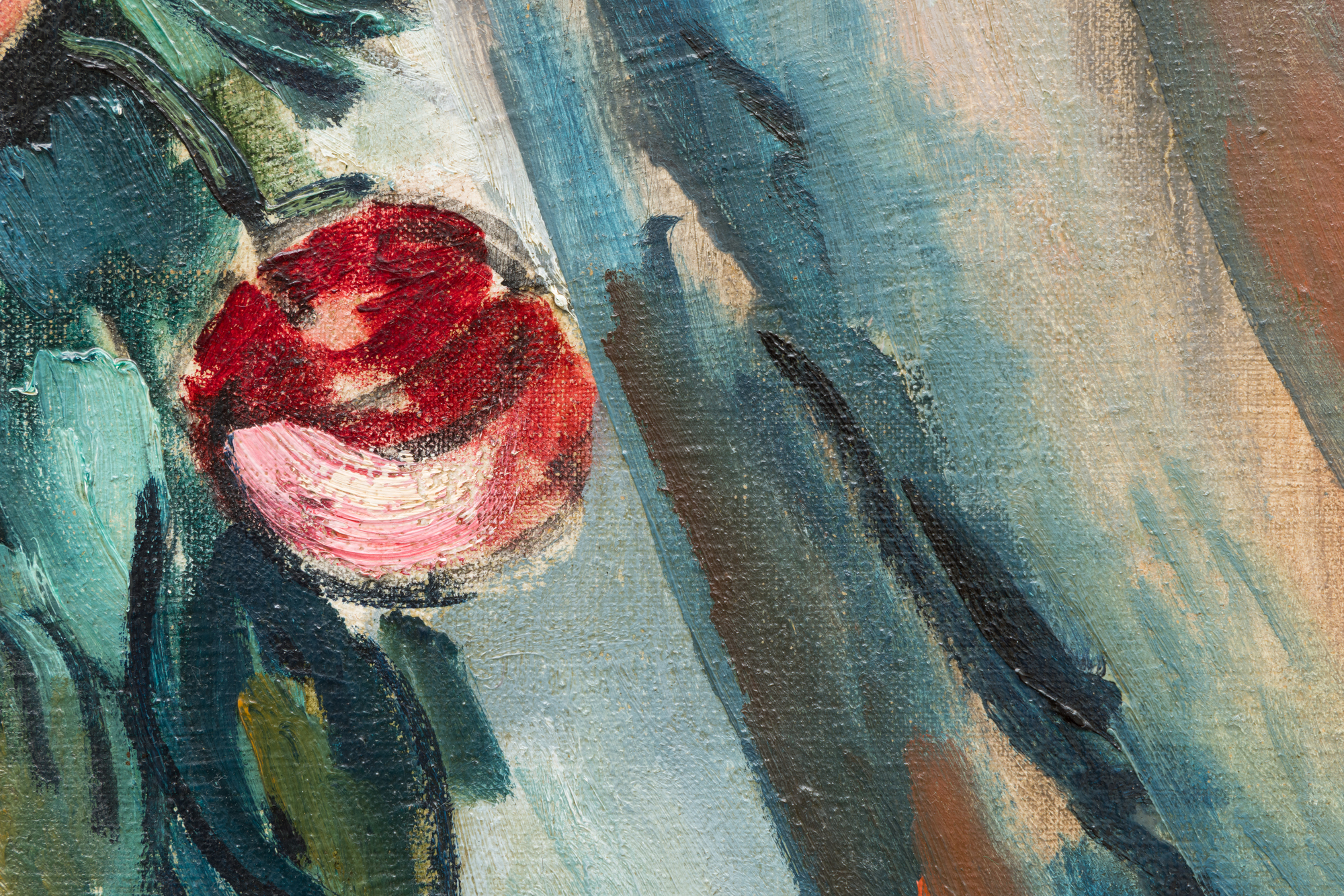
<div>Maurice de Vlaminck’s <em>Bouquet de Pivoines dans un Vase Bleu</em> (1913–14) is a prime-period still life that channels the artist’s Fauvist audacity into an image of exuberant, painterly force. A dense spray of peonies—painted as spiraling bursts of pinks, reds, and creamy whites—pushes outward from a deep blue vase, its rounded form anchoring the composition. With vigorous, directional brushstrokes, Vlaminck animates petals and foliage into a rhythmic surge, turning a traditional tabletop motif into a study of movement, texture, and chromatic intensity. </div><br><br><div> </div><br><br><div>As one of the core founders of Fauvism, Vlaminck was celebrated for his radical, non-naturalistic use of color, and this work retains that avant-garde approach. Cool blues and sea-greens collide with hot, saturated reds, while the background drapery and angled planes are simplified into sweeping passages that heighten contrast and speed. The paint surface remains boldly worked, emphasizing the physicality of oil on canvas and the immediacy of the artist’s hand. A prominent signature reinforces the picture’s assertive presence and its sense of completed statement. </div><br><br><div> </div><br><br><div>The painting will be included in the forthcoming critical catalogue of Maurice de Vlaminck’s works, currently being prepared by Maïté Vallès-Bled and Godeliève de Vlaminck under the auspices of the Wildenstein Institute. Renewed international attention to Vlaminck’s achievements—including a recent retrospective at Museum Barberini in Potsdam, the first in nearly a century—has reaffirmed his vital role in the development of modern painting. <em>Bouquet de Pivoines dans un Vase Bleu </em>captures that legacy: unapologetically modern and powered by color as expression. </div> <div>Maurice de Vlaminck’s <em>Bouquet de Pivoines dans un Vase Bleu</em> (1913–14) is a prime-period still life that channels the artist’s Fauvist audacity into an image of exuberant, painterly force. A dense spray of peonies—painted as spiraling bursts of pinks, reds, and creamy whites—pushes outward from a deep blue vase, its rounded form anchoring the composition. With vigorous, directional brushstrokes, Vlaminck animates petals and foliage into a rhythmic surge, turning a traditional tabletop motif into a study of movement, texture, and chromatic intensity. </div><br><br><div> </div><br><br><div>As one of the core founders of Fauvism, Vlaminck was celebrated for his radical, non-naturalistic use of color, and this work retains that avant-garde approach. Cool blues and sea-greens collide with hot, saturated reds, while the background drapery and angled planes are simplified into sweeping passages that heighten contrast and speed. The paint surface remains boldly worked, emphasizing the physicality of oil on canvas and the immediacy of the artist’s hand. A prominent signature reinforces the picture’s assertive presence and its sense of completed statement. </div><br><br><div> </div><br><br><div>The painting will be included in the forthcoming critical catalogue of Maurice de Vlaminck’s works, currently being prepared by Maïté Vallès-Bled and Godeliève de Vlaminck under the auspices of the Wildenstein Institute. Renewed international attention to Vlaminck’s achievements—including a recent retrospective at Museum Barberini in Potsdam, the first in nearly a century—has reaffirmed his vital role in the development of modern painting. <em>Bouquet de Pivoines dans un Vase Bleu </em>captures that legacy: unapologetically modern and powered by color as expression. </div> <div>Maurice de Vlaminck’s <em>Bouquet de Pivoines dans un Vase Bleu</em> (1913–14) is a prime-period still life that channels the artist’s Fauvist audacity into an image of exuberant, painterly force. A dense spray of peonies—painted as spiraling bursts of pinks, reds, and creamy whites—pushes outward from a deep blue vase, its rounded form anchoring the composition. With vigorous, directional brushstrokes, Vlaminck animates petals and foliage into a rhythmic surge, turning a traditional tabletop motif into a study of movement, texture, and chromatic intensity. </div><br><br><div> </div><br><br><div>As one of the core founders of Fauvism, Vlaminck was celebrated for his radical, non-naturalistic use of color, and this work retains that avant-garde approach. Cool blues and sea-greens collide with hot, saturated reds, while the background drapery and angled planes are simplified into sweeping passages that heighten contrast and speed. The paint surface remains boldly worked, emphasizing the physicality of oil on canvas and the immediacy of the artist’s hand. A prominent signature reinforces the picture’s assertive presence and its sense of completed statement. </div><br><br><div> </div><br><br><div>The painting will be included in the forthcoming critical catalogue of Maurice de Vlaminck’s works, currently being prepared by Maïté Vallès-Bled and Godeliève de Vlaminck under the auspices of the Wildenstein Institute. Renewed international attention to Vlaminck’s achievements—including a recent retrospective at Museum Barberini in Potsdam, the first in nearly a century—has reaffirmed his vital role in the development of modern painting. <em>Bouquet de Pivoines dans un Vase Bleu </em>captures that legacy: unapologetically modern and powered by color as expression. </div> <div>Maurice de Vlaminck’s <em>Bouquet de Pivoines dans un Vase Bleu</em> (1913–14) is a prime-period still life that channels the artist’s Fauvist audacity into an image of exuberant, painterly force. A dense spray of peonies—painted as spiraling bursts of pinks, reds, and creamy whites—pushes outward from a deep blue vase, its rounded form anchoring the composition. With vigorous, directional brushstrokes, Vlaminck animates petals and foliage into a rhythmic surge, turning a traditional tabletop motif into a study of movement, texture, and chromatic intensity. </div><br><br><div> </div><br><br><div>As one of the core founders of Fauvism, Vlaminck was celebrated for his radical, non-naturalistic use of color, and this work retains that avant-garde approach. Cool blues and sea-greens collide with hot, saturated reds, while the background drapery and angled planes are simplified into sweeping passages that heighten contrast and speed. The paint surface remains boldly worked, emphasizing the physicality of oil on canvas and the immediacy of the artist’s hand. A prominent signature reinforces the picture’s assertive presence and its sense of completed statement. </div><br><br><div> </div><br><br><div>The painting will be included in the forthcoming critical catalogue of Maurice de Vlaminck’s works, currently being prepared by Maïté Vallès-Bled and Godeliève de Vlaminck under the auspices of the Wildenstein Institute. Renewed international attention to Vlaminck’s achievements—including a recent retrospective at Museum Barberini in Potsdam, the first in nearly a century—has reaffirmed his vital role in the development of modern painting. <em>Bouquet de Pivoines dans un Vase Bleu </em>captures that legacy: unapologetically modern and powered by color as expression. </div> <div>Maurice de Vlaminck’s <em>Bouquet de Pivoines dans un Vase Bleu</em> (1913–14) is a prime-period still life that channels the artist’s Fauvist audacity into an image of exuberant, painterly force. A dense spray of peonies—painted as spiraling bursts of pinks, reds, and creamy whites—pushes outward from a deep blue vase, its rounded form anchoring the composition. With vigorous, directional brushstrokes, Vlaminck animates petals and foliage into a rhythmic surge, turning a traditional tabletop motif into a study of movement, texture, and chromatic intensity. </div><br><br><div> </div><br><br><div>As one of the core founders of Fauvism, Vlaminck was celebrated for his radical, non-naturalistic use of color, and this work retains that avant-garde approach. Cool blues and sea-greens collide with hot, saturated reds, while the background drapery and angled planes are simplified into sweeping passages that heighten contrast and speed. The paint surface remains boldly worked, emphasizing the physicality of oil on canvas and the immediacy of the artist’s hand. A prominent signature reinforces the picture’s assertive presence and its sense of completed statement. </div><br><br><div> </div><br><br><div>The painting will be included in the forthcoming critical catalogue of Maurice de Vlaminck’s works, currently being prepared by Maïté Vallès-Bled and Godeliève de Vlaminck under the auspices of the Wildenstein Institute. Renewed international attention to Vlaminck’s achievements—including a recent retrospective at Museum Barberini in Potsdam, the first in nearly a century—has reaffirmed his vital role in the development of modern painting. <em>Bouquet de Pivoines dans un Vase Bleu </em>captures that legacy: unapologetically modern and powered by color as expression. </div> <div>Maurice de Vlaminck’s <em>Bouquet de Pivoines dans un Vase Bleu</em> (1913–14) is a prime-period still life that channels the artist’s Fauvist audacity into an image of exuberant, painterly force. A dense spray of peonies—painted as spiraling bursts of pinks, reds, and creamy whites—pushes outward from a deep blue vase, its rounded form anchoring the composition. With vigorous, directional brushstrokes, Vlaminck animates petals and foliage into a rhythmic surge, turning a traditional tabletop motif into a study of movement, texture, and chromatic intensity. </div><br><br><div> </div><br><br><div>As one of the core founders of Fauvism, Vlaminck was celebrated for his radical, non-naturalistic use of color, and this work retains that avant-garde approach. Cool blues and sea-greens collide with hot, saturated reds, while the background drapery and angled planes are simplified into sweeping passages that heighten contrast and speed. The paint surface remains boldly worked, emphasizing the physicality of oil on canvas and the immediacy of the artist’s hand. A prominent signature reinforces the picture’s assertive presence and its sense of completed statement. </div><br><br><div> </div><br><br><div>The painting will be included in the forthcoming critical catalogue of Maurice de Vlaminck’s works, currently being prepared by Maïté Vallès-Bled and Godeliève de Vlaminck under the auspices of the Wildenstein Institute. Renewed international attention to Vlaminck’s achievements—including a recent retrospective at Museum Barberini in Potsdam, the first in nearly a century—has reaffirmed his vital role in the development of modern painting. <em>Bouquet de Pivoines dans un Vase Bleu </em>captures that legacy: unapologetically modern and powered by color as expression. </div> <div>Maurice de Vlaminck’s <em>Bouquet de Pivoines dans un Vase Bleu</em> (1913–14) is a prime-period still life that channels the artist’s Fauvist audacity into an image of exuberant, painterly force. A dense spray of peonies—painted as spiraling bursts of pinks, reds, and creamy whites—pushes outward from a deep blue vase, its rounded form anchoring the composition. With vigorous, directional brushstrokes, Vlaminck animates petals and foliage into a rhythmic surge, turning a traditional tabletop motif into a study of movement, texture, and chromatic intensity. </div><br><br><div> </div><br><br><div>As one of the core founders of Fauvism, Vlaminck was celebrated for his radical, non-naturalistic use of color, and this work retains that avant-garde approach. Cool blues and sea-greens collide with hot, saturated reds, while the background drapery and angled planes are simplified into sweeping passages that heighten contrast and speed. The paint surface remains boldly worked, emphasizing the physicality of oil on canvas and the immediacy of the artist’s hand. A prominent signature reinforces the picture’s assertive presence and its sense of completed statement. </div><br><br><div> </div><br><br><div>The painting will be included in the forthcoming critical catalogue of Maurice de Vlaminck’s works, currently being prepared by Maïté Vallès-Bled and Godeliève de Vlaminck under the auspices of the Wildenstein Institute. Renewed international attention to Vlaminck’s achievements—including a recent retrospective at Museum Barberini in Potsdam, the first in nearly a century—has reaffirmed his vital role in the development of modern painting. <em>Bouquet de Pivoines dans un Vase Bleu </em>captures that legacy: unapologetically modern and powered by color as expression. </div> <div>Maurice de Vlaminck’s <em>Bouquet de Pivoines dans un Vase Bleu</em> (1913–14) is a prime-period still life that channels the artist’s Fauvist audacity into an image of exuberant, painterly force. A dense spray of peonies—painted as spiraling bursts of pinks, reds, and creamy whites—pushes outward from a deep blue vase, its rounded form anchoring the composition. With vigorous, directional brushstrokes, Vlaminck animates petals and foliage into a rhythmic surge, turning a traditional tabletop motif into a study of movement, texture, and chromatic intensity. </div><br><br><div> </div><br><br><div>As one of the core founders of Fauvism, Vlaminck was celebrated for his radical, non-naturalistic use of color, and this work retains that avant-garde approach. Cool blues and sea-greens collide with hot, saturated reds, while the background drapery and angled planes are simplified into sweeping passages that heighten contrast and speed. The paint surface remains boldly worked, emphasizing the physicality of oil on canvas and the immediacy of the artist’s hand. A prominent signature reinforces the picture’s assertive presence and its sense of completed statement. </div><br><br><div> </div><br><br><div>The painting will be included in the forthcoming critical catalogue of Maurice de Vlaminck’s works, currently being prepared by Maïté Vallès-Bled and Godeliève de Vlaminck under the auspices of the Wildenstein Institute. Renewed international attention to Vlaminck’s achievements—including a recent retrospective at Museum Barberini in Potsdam, the first in nearly a century—has reaffirmed his vital role in the development of modern painting. <em>Bouquet de Pivoines dans un Vase Bleu </em>captures that legacy: unapologetically modern and powered by color as expression. </div> <div>Maurice de Vlaminck’s <em>Bouquet de Pivoines dans un Vase Bleu</em> (1913–14) is a prime-period still life that channels the artist’s Fauvist audacity into an image of exuberant, painterly force. A dense spray of peonies—painted as spiraling bursts of pinks, reds, and creamy whites—pushes outward from a deep blue vase, its rounded form anchoring the composition. With vigorous, directional brushstrokes, Vlaminck animates petals and foliage into a rhythmic surge, turning a traditional tabletop motif into a study of movement, texture, and chromatic intensity. </div><br><br><div> </div><br><br><div>As one of the core founders of Fauvism, Vlaminck was celebrated for his radical, non-naturalistic use of color, and this work retains that avant-garde approach. Cool blues and sea-greens collide with hot, saturated reds, while the background drapery and angled planes are simplified into sweeping passages that heighten contrast and speed. The paint surface remains boldly worked, emphasizing the physicality of oil on canvas and the immediacy of the artist’s hand. A prominent signature reinforces the picture’s assertive presence and its sense of completed statement. </div><br><br><div> </div><br><br><div>The painting will be included in the forthcoming critical catalogue of Maurice de Vlaminck’s works, currently being prepared by Maïté Vallès-Bled and Godeliève de Vlaminck under the auspices of the Wildenstein Institute. Renewed international attention to Vlaminck’s achievements—including a recent retrospective at Museum Barberini in Potsdam, the first in nearly a century—has reaffirmed his vital role in the development of modern painting. <em>Bouquet de Pivoines dans un Vase Bleu </em>captures that legacy: unapologetically modern and powered by color as expression. </div> <div>Maurice de Vlaminck’s <em>Bouquet de Pivoines dans un Vase Bleu</em> (1913–14) is a prime-period still life that channels the artist’s Fauvist audacity into an image of exuberant, painterly force. A dense spray of peonies—painted as spiraling bursts of pinks, reds, and creamy whites—pushes outward from a deep blue vase, its rounded form anchoring the composition. With vigorous, directional brushstrokes, Vlaminck animates petals and foliage into a rhythmic surge, turning a traditional tabletop motif into a study of movement, texture, and chromatic intensity. </div><br><br><div> </div><br><br><div>As one of the core founders of Fauvism, Vlaminck was celebrated for his radical, non-naturalistic use of color, and this work retains that avant-garde approach. Cool blues and sea-greens collide with hot, saturated reds, while the background drapery and angled planes are simplified into sweeping passages that heighten contrast and speed. The paint surface remains boldly worked, emphasizing the physicality of oil on canvas and the immediacy of the artist’s hand. A prominent signature reinforces the picture’s assertive presence and its sense of completed statement. </div><br><br><div> </div><br><br><div>The painting will be included in the forthcoming critical catalogue of Maurice de Vlaminck’s works, currently being prepared by Maïté Vallès-Bled and Godeliève de Vlaminck under the auspices of the Wildenstein Institute. Renewed international attention to Vlaminck’s achievements—including a recent retrospective at Museum Barberini in Potsdam, the first in nearly a century—has reaffirmed his vital role in the development of modern painting. <em>Bouquet de Pivoines dans un Vase Bleu </em>captures that legacy: unapologetically modern and powered by color as expression. </div>
Bouquet de pivoines dans un vase bleu1913-191425 3/4 x 21 1/2 po(65,41 x 54,61 cm) huile sur toile
Provenance
Galerie Choiseul, Paris
Collection privée, France
Collection privée, Europe, acquise auprès de la collection ci-dessus
Exposition
Corée du Sud, Seoul Arts Centre, Vlaminck, 4 juin – 21 août 2017 ; puis à l'
Musée d'art préfectoral de Yamanashi, Musée d'art d'Hiroshima, Musée municipal d'art de Kitakyushu, Musée d'art préfectoral de Kumamoto, Musée d'art de la ville de Shizuoka
Littérature
Maithe Valles-Bled, Maurice de Vlaminck : Regards sur L'œuvre et sur l'artiste.1907-1958, Séoul, 2017, p. 35-36, pl. 14 (illustré)
Maithe Valles-Blend, Vlaminck : Regards s
...Plus.....ur l'œuvre et sur l'artiste, 1907-1958, Hiroshima, 2017, p. 28 (illustré)
...MOINS.....
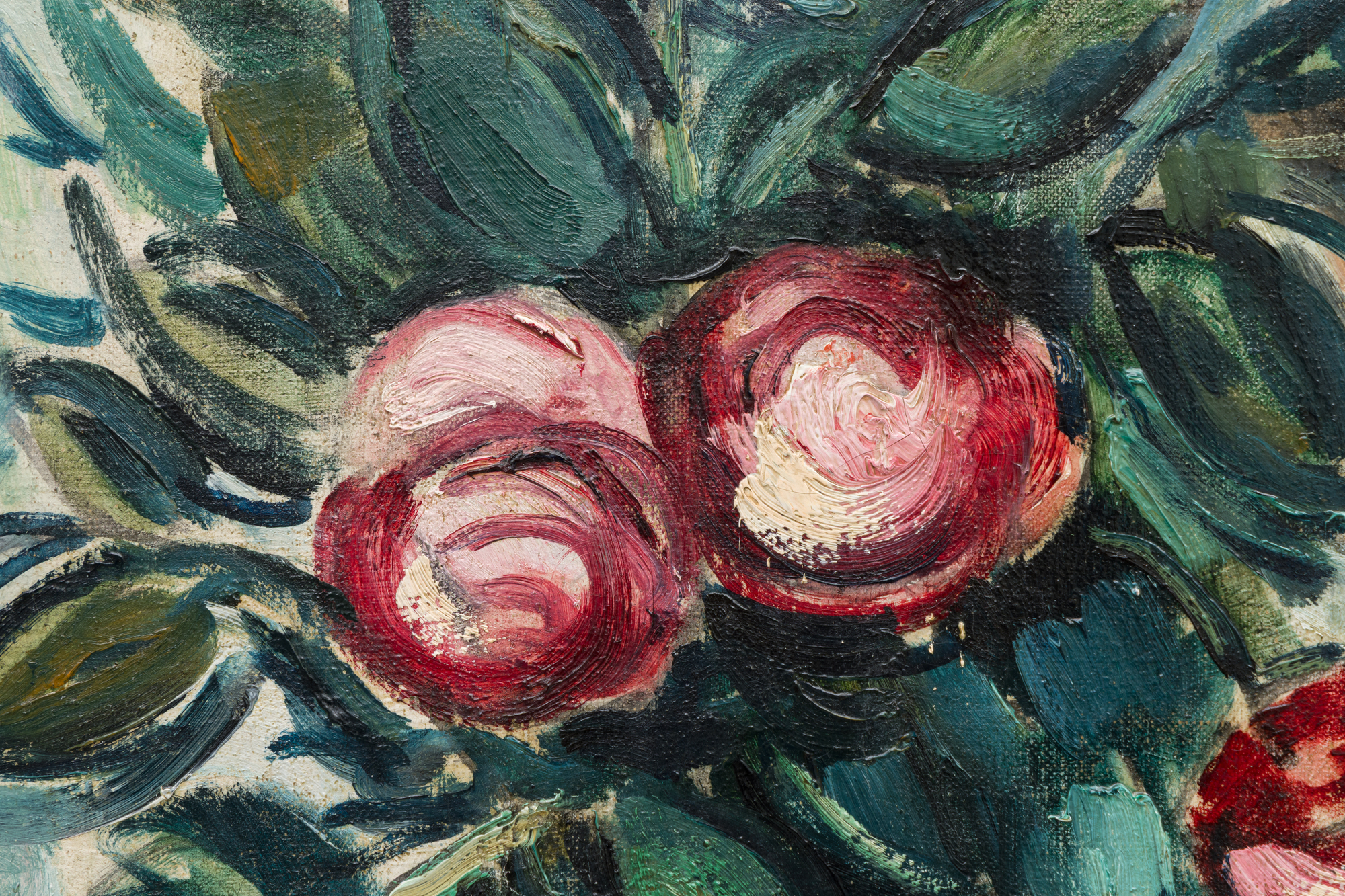
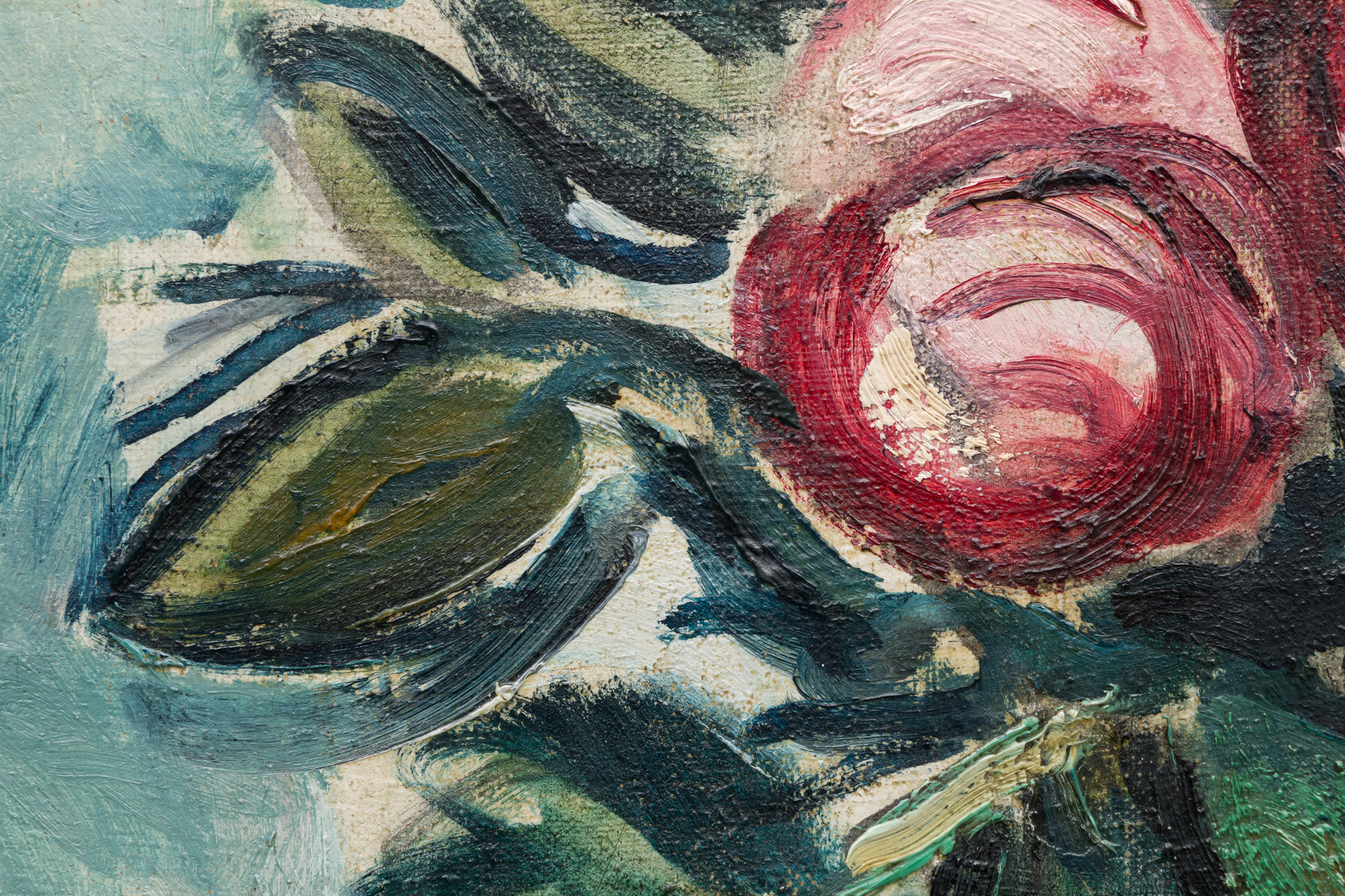
Bouquet de Pivoines dans un Vase Bleu (1913-1914) de Maurice de Vlaminck est une nature morte de la période de maturité de l'artiste qui traduit l'audace fauviste de celui-ci en une image d'une force picturale exubérante. Une dense gerbe de pivoines, peintes comme des éclats spiralés de roses, de rouges et de blancs crème, jaillit d'un vase bleu profond, dont la forme arrondie ancrent la composition. À l'aide de coups de pinceau vigoureux et directionnels, Vlaminck anime les pétales et le feuillage dans un élan rythmique, transformant un motif traditionnel de table en une étude du mouvement, de la texture et de l'intensité chromatique.


En tant que l'un des fondateurs du fauvisme, Vlaminck était célèbre pour son utilisation radicale et non naturaliste de la couleur, et cette œuvre conserve cette approche avant-gardiste. Les bleus froids et les verts marins s'opposent aux rouges chauds et saturés, tandis que les draperies en arrière-plan et les plans inclinés sont simplifiés en passages larges qui accentuent le contraste et la vitesse. La surface picturale reste travaillée avec audace, soulignant la physicalité de l'huile sur toile et l'immédiateté de la main de l'artiste. Une signature proéminente renforce la présence affirmée du tableau et son caractère achevé.


Le tableau figurera dans le prochain catalogue critique des œuvres de Maurice de Vlaminck, actuellement en préparation par Maïté Vallès-Bled et Godeliève de Vlaminck sous les auspices du Wildenstein Institute. Le regain d'intérêt international pour l'œuvre de Vlaminck, notamment avec la récente rétrospective au musée Barberini de Potsdam, la première depuis près d'un siècle, a réaffirmé son rôle essentiel dans le développement de la peinture moderne. Bouquet de Pivoines dans un Vase Bleu incarne cet héritage : résolument moderne et porté par la couleur comme moyen d'expression.
demander