Précédent

JOSEPH KLEITSCH (1882-1931)

$275,000

 
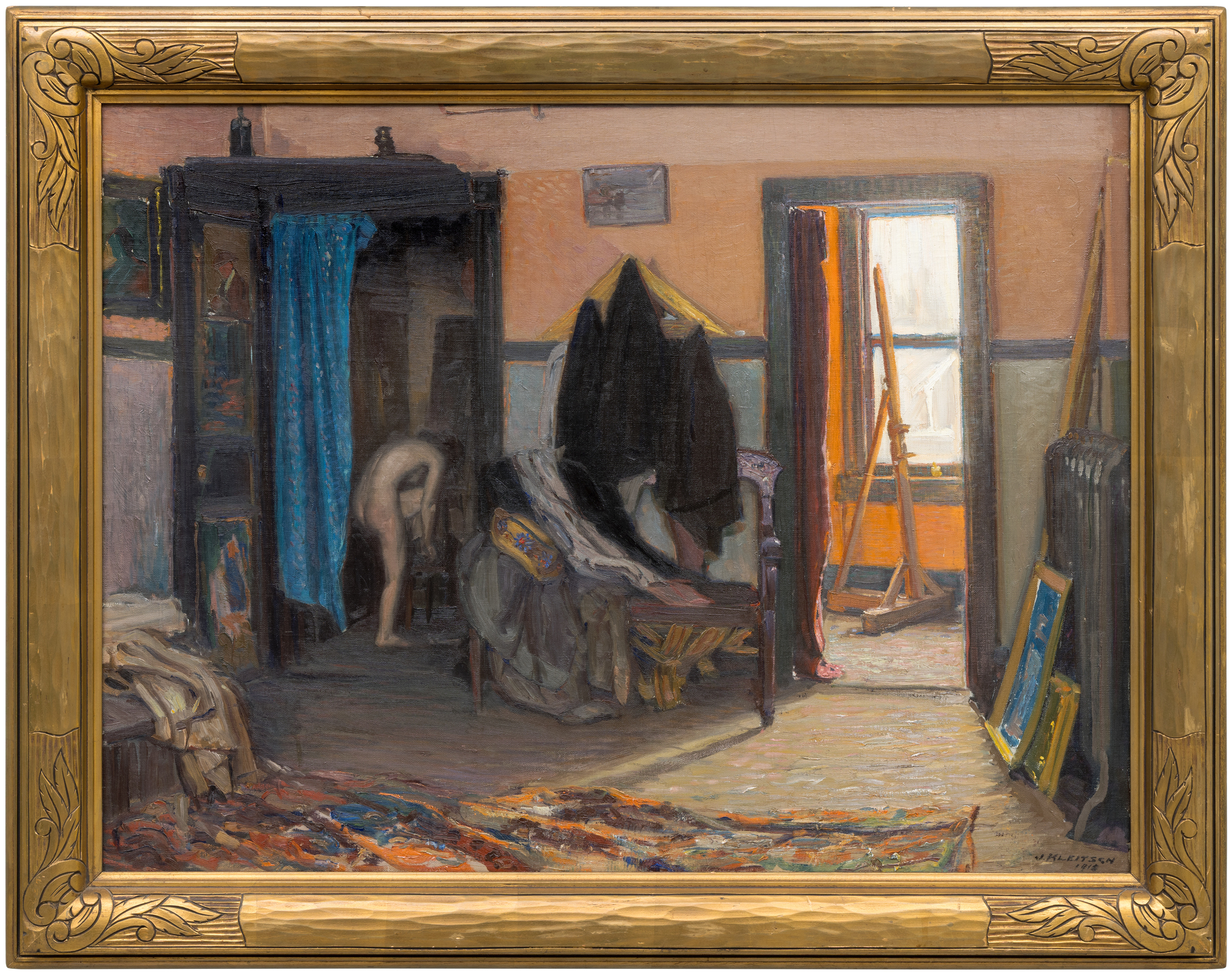
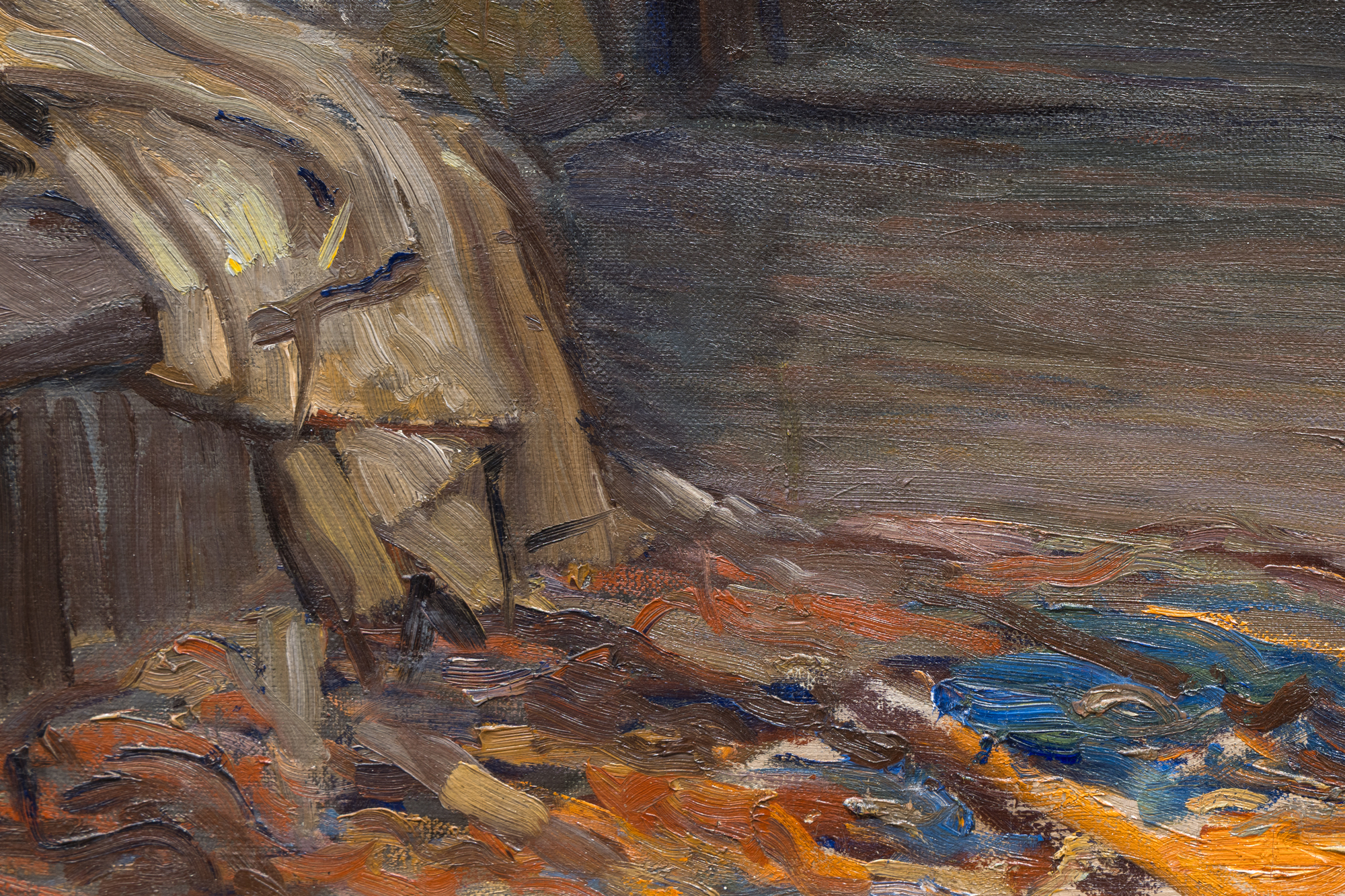
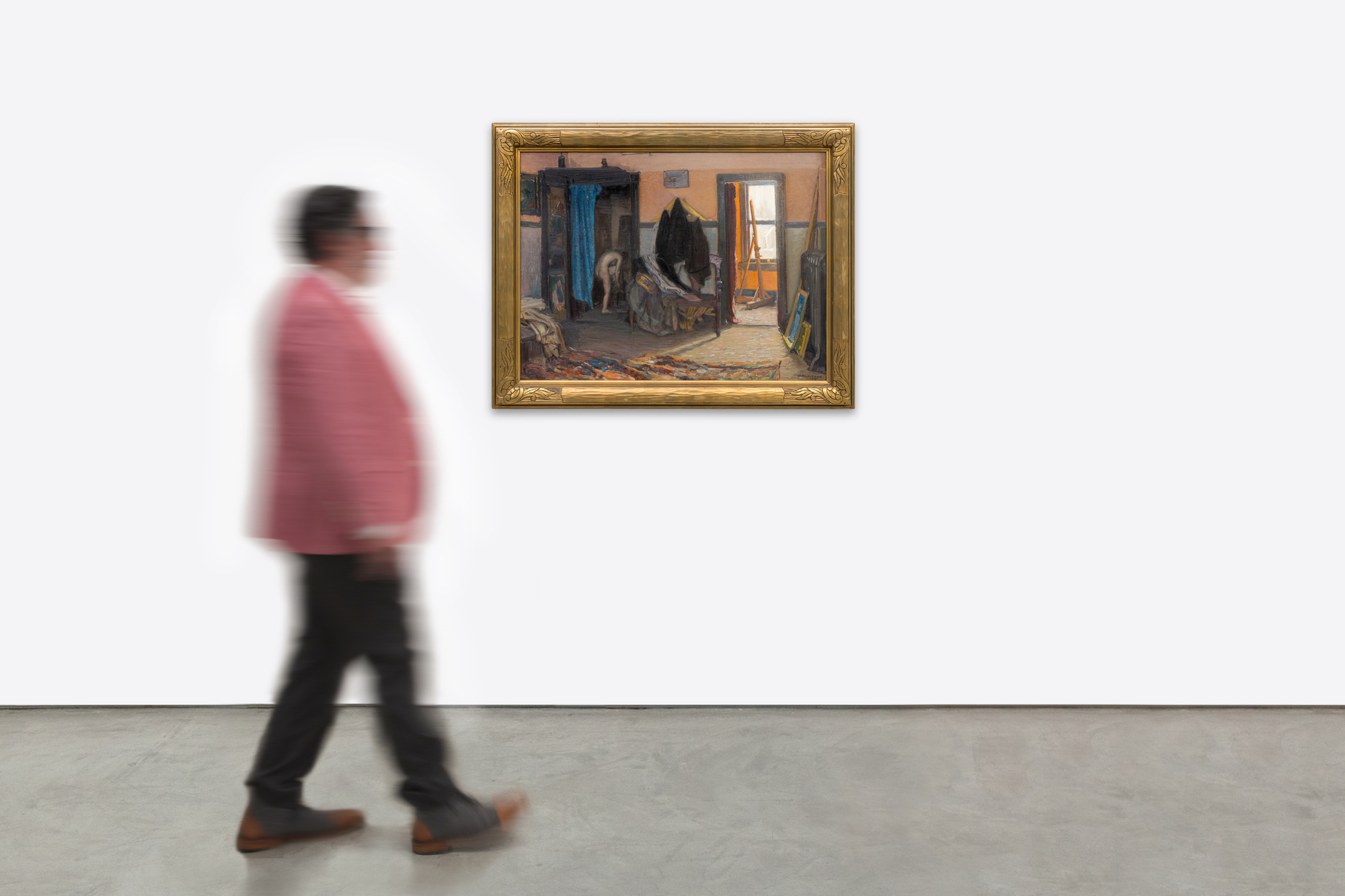
<div>Joseph Kleitsch’s <em>Studio Interior</em> (1918) is a compelling early work that reflects the artist’s academic-realist foundation and marks a pivotal moment just before his relocation from the Chicago to California. Painted shortly before this transition, the work reveals Kleitsch’s disciplined approach to composition and observation, shaped by his rigorous training in Budapest, Munich, and Paris. The scene depicts a quiet, lived-in studio space, where light enters through an open doorway to animate furniture, canvases, and everyday objects with a subdued yet attentive handling of color and tone. </div><br><br><div> </div><br><br><div>The interior is constructed with careful spatial logic and an emphasis on structure, underscoring Kleitsch’s preference for academic realism at this stage of his career. While in Chicago, his portrait and interior scenes were often distinguished by a “jeweled” palette—rich, saturated hues deployed with restraint—and that sensibility is evident here in the layered colors that enliven the otherwise low-keyed room. Subtle shifts in light guide the eye through the composition, balancing chromatic richness with solidity and calm. </div><br><br><div> </div><br><br><div>In the years leading up to his move west, Kleitsch was actively involved with Chicago’s artistic institutions, including the Palette and Chisel Club and the Art Institute of Chicago, situating him within a dynamic environment of evolving modern influences. During this time, Impressionist and Post-Impressionist works were increasingly visible in American exhibitions. While Kleitsch maintains a measured realism here, the Impressionist influence was incubating; he would later become renowned as a “master of gorgeous color” owing to the high-keyed vibrant palette of his California landscapes. </div><br><br><div> </div><br><br><div><em>Studio Interior</em> has been exhibited twice, both times in California, as part of exhibitions highlighting Kleitsch’s importance to the history of California art. Seen in retrospect, the painting offers a revealing glimpse of the artist’s roots before his later, more luminous California landscapes would come to define his legacy. </div><br><br><div> </div><br><br><div> </div> <div>Joseph Kleitsch’s <em>Studio Interior</em> (1918) is a compelling early work that reflects the artist’s academic-realist foundation and marks a pivotal moment just before his relocation from the Chicago to California. Painted shortly before this transition, the work reveals Kleitsch’s disciplined approach to composition and observation, shaped by his rigorous training in Budapest, Munich, and Paris. The scene depicts a quiet, lived-in studio space, where light enters through an open doorway to animate furniture, canvases, and everyday objects with a subdued yet attentive handling of color and tone. </div><br><br><div> </div><br><br><div>The interior is constructed with careful spatial logic and an emphasis on structure, underscoring Kleitsch’s preference for academic realism at this stage of his career. While in Chicago, his portrait and interior scenes were often distinguished by a “jeweled” palette—rich, saturated hues deployed with restraint—and that sensibility is evident here in the layered colors that enliven the otherwise low-keyed room. Subtle shifts in light guide the eye through the composition, balancing chromatic richness with solidity and calm. </div><br><br><div> </div><br><br><div>In the years leading up to his move west, Kleitsch was actively involved with Chicago’s artistic institutions, including the Palette and Chisel Club and the Art Institute of Chicago, situating him within a dynamic environment of evolving modern influences. During this time, Impressionist and Post-Impressionist works were increasingly visible in American exhibitions. While Kleitsch maintains a measured realism here, the Impressionist influence was incubating; he would later become renowned as a “master of gorgeous color” owing to the high-keyed vibrant palette of his California landscapes. </div><br><br><div> </div><br><br><div><em>Studio Interior</em> has been exhibited twice, both times in California, as part of exhibitions highlighting Kleitsch’s importance to the history of California art. Seen in retrospect, the painting offers a revealing glimpse of the artist’s roots before his later, more luminous California landscapes would come to define his legacy. </div><br><br><div> </div><br><br><div> </div> <div>Joseph Kleitsch’s <em>Studio Interior</em> (1918) is a compelling early work that reflects the artist’s academic-realist foundation and marks a pivotal moment just before his relocation from the Chicago to California. Painted shortly before this transition, the work reveals Kleitsch’s disciplined approach to composition and observation, shaped by his rigorous training in Budapest, Munich, and Paris. The scene depicts a quiet, lived-in studio space, where light enters through an open doorway to animate furniture, canvases, and everyday objects with a subdued yet attentive handling of color and tone. </div><br><br><div> </div><br><br><div>The interior is constructed with careful spatial logic and an emphasis on structure, underscoring Kleitsch’s preference for academic realism at this stage of his career. While in Chicago, his portrait and interior scenes were often distinguished by a “jeweled” palette—rich, saturated hues deployed with restraint—and that sensibility is evident here in the layered colors that enliven the otherwise low-keyed room. Subtle shifts in light guide the eye through the composition, balancing chromatic richness with solidity and calm. </div><br><br><div> </div><br><br><div>In the years leading up to his move west, Kleitsch was actively involved with Chicago’s artistic institutions, including the Palette and Chisel Club and the Art Institute of Chicago, situating him within a dynamic environment of evolving modern influences. During this time, Impressionist and Post-Impressionist works were increasingly visible in American exhibitions. While Kleitsch maintains a measured realism here, the Impressionist influence was incubating; he would later become renowned as a “master of gorgeous color” owing to the high-keyed vibrant palette of his California landscapes. </div><br><br><div> </div><br><br><div><em>Studio Interior</em> has been exhibited twice, both times in California, as part of exhibitions highlighting Kleitsch’s importance to the history of California art. Seen in retrospect, the painting offers a revealing glimpse of the artist’s roots before his later, more luminous California landscapes would come to define his legacy. </div><br><br><div> </div><br><br><div> </div> <div>Joseph Kleitsch’s <em>Studio Interior</em> (1918) is a compelling early work that reflects the artist’s academic-realist foundation and marks a pivotal moment just before his relocation from the Chicago to California. Painted shortly before this transition, the work reveals Kleitsch’s disciplined approach to composition and observation, shaped by his rigorous training in Budapest, Munich, and Paris. The scene depicts a quiet, lived-in studio space, where light enters through an open doorway to animate furniture, canvases, and everyday objects with a subdued yet attentive handling of color and tone. </div><br><br><div> </div><br><br><div>The interior is constructed with careful spatial logic and an emphasis on structure, underscoring Kleitsch’s preference for academic realism at this stage of his career. While in Chicago, his portrait and interior scenes were often distinguished by a “jeweled” palette—rich, saturated hues deployed with restraint—and that sensibility is evident here in the layered colors that enliven the otherwise low-keyed room. Subtle shifts in light guide the eye through the composition, balancing chromatic richness with solidity and calm. </div><br><br><div> </div><br><br><div>In the years leading up to his move west, Kleitsch was actively involved with Chicago’s artistic institutions, including the Palette and Chisel Club and the Art Institute of Chicago, situating him within a dynamic environment of evolving modern influences. During this time, Impressionist and Post-Impressionist works were increasingly visible in American exhibitions. While Kleitsch maintains a measured realism here, the Impressionist influence was incubating; he would later become renowned as a “master of gorgeous color” owing to the high-keyed vibrant palette of his California landscapes. </div><br><br><div> </div><br><br><div><em>Studio Interior</em> has been exhibited twice, both times in California, as part of exhibitions highlighting Kleitsch’s importance to the history of California art. Seen in retrospect, the painting offers a revealing glimpse of the artist’s roots before his later, more luminous California landscapes would come to define his legacy. </div><br><br><div> </div><br><br><div> </div> <div>Joseph Kleitsch’s <em>Studio Interior</em> (1918) is a compelling early work that reflects the artist’s academic-realist foundation and marks a pivotal moment just before his relocation from the Chicago to California. Painted shortly before this transition, the work reveals Kleitsch’s disciplined approach to composition and observation, shaped by his rigorous training in Budapest, Munich, and Paris. The scene depicts a quiet, lived-in studio space, where light enters through an open doorway to animate furniture, canvases, and everyday objects with a subdued yet attentive handling of color and tone. </div><br><br><div> </div><br><br><div>The interior is constructed with careful spatial logic and an emphasis on structure, underscoring Kleitsch’s preference for academic realism at this stage of his career. While in Chicago, his portrait and interior scenes were often distinguished by a “jeweled” palette—rich, saturated hues deployed with restraint—and that sensibility is evident here in the layered colors that enliven the otherwise low-keyed room. Subtle shifts in light guide the eye through the composition, balancing chromatic richness with solidity and calm. </div><br><br><div> </div><br><br><div>In the years leading up to his move west, Kleitsch was actively involved with Chicago’s artistic institutions, including the Palette and Chisel Club and the Art Institute of Chicago, situating him within a dynamic environment of evolving modern influences. During this time, Impressionist and Post-Impressionist works were increasingly visible in American exhibitions. While Kleitsch maintains a measured realism here, the Impressionist influence was incubating; he would later become renowned as a “master of gorgeous color” owing to the high-keyed vibrant palette of his California landscapes. </div><br><br><div> </div><br><br><div><em>Studio Interior</em> has been exhibited twice, both times in California, as part of exhibitions highlighting Kleitsch’s importance to the history of California art. Seen in retrospect, the painting offers a revealing glimpse of the artist’s roots before his later, more luminous California landscapes would come to define his legacy. </div><br><br><div> </div><br><br><div> </div> <div>Joseph Kleitsch’s <em>Studio Interior</em> (1918) is a compelling early work that reflects the artist’s academic-realist foundation and marks a pivotal moment just before his relocation from the Chicago to California. Painted shortly before this transition, the work reveals Kleitsch’s disciplined approach to composition and observation, shaped by his rigorous training in Budapest, Munich, and Paris. The scene depicts a quiet, lived-in studio space, where light enters through an open doorway to animate furniture, canvases, and everyday objects with a subdued yet attentive handling of color and tone. </div><br><br><div> </div><br><br><div>The interior is constructed with careful spatial logic and an emphasis on structure, underscoring Kleitsch’s preference for academic realism at this stage of his career. While in Chicago, his portrait and interior scenes were often distinguished by a “jeweled” palette—rich, saturated hues deployed with restraint—and that sensibility is evident here in the layered colors that enliven the otherwise low-keyed room. Subtle shifts in light guide the eye through the composition, balancing chromatic richness with solidity and calm. </div><br><br><div> </div><br><br><div>In the years leading up to his move west, Kleitsch was actively involved with Chicago’s artistic institutions, including the Palette and Chisel Club and the Art Institute of Chicago, situating him within a dynamic environment of evolving modern influences. During this time, Impressionist and Post-Impressionist works were increasingly visible in American exhibitions. While Kleitsch maintains a measured realism here, the Impressionist influence was incubating; he would later become renowned as a “master of gorgeous color” owing to the high-keyed vibrant palette of his California landscapes. </div><br><br><div> </div><br><br><div><em>Studio Interior</em> has been exhibited twice, both times in California, as part of exhibitions highlighting Kleitsch’s importance to the history of California art. Seen in retrospect, the painting offers a revealing glimpse of the artist’s roots before his later, more luminous California landscapes would come to define his legacy. </div><br><br><div> </div><br><br><div> </div> <div>Joseph Kleitsch’s <em>Studio Interior</em> (1918) is a compelling early work that reflects the artist’s academic-realist foundation and marks a pivotal moment just before his relocation from the Chicago to California. Painted shortly before this transition, the work reveals Kleitsch’s disciplined approach to composition and observation, shaped by his rigorous training in Budapest, Munich, and Paris. The scene depicts a quiet, lived-in studio space, where light enters through an open doorway to animate furniture, canvases, and everyday objects with a subdued yet attentive handling of color and tone. </div><br><br><div> </div><br><br><div>The interior is constructed with careful spatial logic and an emphasis on structure, underscoring Kleitsch’s preference for academic realism at this stage of his career. While in Chicago, his portrait and interior scenes were often distinguished by a “jeweled” palette—rich, saturated hues deployed with restraint—and that sensibility is evident here in the layered colors that enliven the otherwise low-keyed room. Subtle shifts in light guide the eye through the composition, balancing chromatic richness with solidity and calm. </div><br><br><div> </div><br><br><div>In the years leading up to his move west, Kleitsch was actively involved with Chicago’s artistic institutions, including the Palette and Chisel Club and the Art Institute of Chicago, situating him within a dynamic environment of evolving modern influences. During this time, Impressionist and Post-Impressionist works were increasingly visible in American exhibitions. While Kleitsch maintains a measured realism here, the Impressionist influence was incubating; he would later become renowned as a “master of gorgeous color” owing to the high-keyed vibrant palette of his California landscapes. </div><br><br><div> </div><br><br><div><em>Studio Interior</em> has been exhibited twice, both times in California, as part of exhibitions highlighting Kleitsch’s importance to the history of California art. Seen in retrospect, the painting offers a revealing glimpse of the artist’s roots before his later, more luminous California landscapes would come to define his legacy. </div><br><br><div> </div><br><br><div> </div> <div>Joseph Kleitsch’s <em>Studio Interior</em> (1918) is a compelling early work that reflects the artist’s academic-realist foundation and marks a pivotal moment just before his relocation from the Chicago to California. Painted shortly before this transition, the work reveals Kleitsch’s disciplined approach to composition and observation, shaped by his rigorous training in Budapest, Munich, and Paris. The scene depicts a quiet, lived-in studio space, where light enters through an open doorway to animate furniture, canvases, and everyday objects with a subdued yet attentive handling of color and tone. </div><br><br><div> </div><br><br><div>The interior is constructed with careful spatial logic and an emphasis on structure, underscoring Kleitsch’s preference for academic realism at this stage of his career. While in Chicago, his portrait and interior scenes were often distinguished by a “jeweled” palette—rich, saturated hues deployed with restraint—and that sensibility is evident here in the layered colors that enliven the otherwise low-keyed room. Subtle shifts in light guide the eye through the composition, balancing chromatic richness with solidity and calm. </div><br><br><div> </div><br><br><div>In the years leading up to his move west, Kleitsch was actively involved with Chicago’s artistic institutions, including the Palette and Chisel Club and the Art Institute of Chicago, situating him within a dynamic environment of evolving modern influences. During this time, Impressionist and Post-Impressionist works were increasingly visible in American exhibitions. While Kleitsch maintains a measured realism here, the Impressionist influence was incubating; he would later become renowned as a “master of gorgeous color” owing to the high-keyed vibrant palette of his California landscapes. </div><br><br><div> </div><br><br><div><em>Studio Interior</em> has been exhibited twice, both times in California, as part of exhibitions highlighting Kleitsch’s importance to the history of California art. Seen in retrospect, the painting offers a revealing glimpse of the artist’s roots before his later, more luminous California landscapes would come to define his legacy. </div><br><br><div> </div><br><br><div> </div> <div>Joseph Kleitsch’s <em>Studio Interior</em> (1918) is a compelling early work that reflects the artist’s academic-realist foundation and marks a pivotal moment just before his relocation from the Chicago to California. Painted shortly before this transition, the work reveals Kleitsch’s disciplined approach to composition and observation, shaped by his rigorous training in Budapest, Munich, and Paris. The scene depicts a quiet, lived-in studio space, where light enters through an open doorway to animate furniture, canvases, and everyday objects with a subdued yet attentive handling of color and tone. </div><br><br><div> </div><br><br><div>The interior is constructed with careful spatial logic and an emphasis on structure, underscoring Kleitsch’s preference for academic realism at this stage of his career. While in Chicago, his portrait and interior scenes were often distinguished by a “jeweled” palette—rich, saturated hues deployed with restraint—and that sensibility is evident here in the layered colors that enliven the otherwise low-keyed room. Subtle shifts in light guide the eye through the composition, balancing chromatic richness with solidity and calm. </div><br><br><div> </div><br><br><div>In the years leading up to his move west, Kleitsch was actively involved with Chicago’s artistic institutions, including the Palette and Chisel Club and the Art Institute of Chicago, situating him within a dynamic environment of evolving modern influences. During this time, Impressionist and Post-Impressionist works were increasingly visible in American exhibitions. While Kleitsch maintains a measured realism here, the Impressionist influence was incubating; he would later become renowned as a “master of gorgeous color” owing to the high-keyed vibrant palette of his California landscapes. </div><br><br><div> </div><br><br><div><em>Studio Interior</em> has been exhibited twice, both times in California, as part of exhibitions highlighting Kleitsch’s importance to the history of California art. Seen in retrospect, the painting offers a revealing glimpse of the artist’s roots before his later, more luminous California landscapes would come to define his legacy. </div><br><br><div> </div><br><br><div> </div> <div>Joseph Kleitsch’s <em>Studio Interior</em> (1918) is a compelling early work that reflects the artist’s academic-realist foundation and marks a pivotal moment just before his relocation from the Chicago to California. Painted shortly before this transition, the work reveals Kleitsch’s disciplined approach to composition and observation, shaped by his rigorous training in Budapest, Munich, and Paris. The scene depicts a quiet, lived-in studio space, where light enters through an open doorway to animate furniture, canvases, and everyday objects with a subdued yet attentive handling of color and tone. </div><br><br><div> </div><br><br><div>The interior is constructed with careful spatial logic and an emphasis on structure, underscoring Kleitsch’s preference for academic realism at this stage of his career. While in Chicago, his portrait and interior scenes were often distinguished by a “jeweled” palette—rich, saturated hues deployed with restraint—and that sensibility is evident here in the layered colors that enliven the otherwise low-keyed room. Subtle shifts in light guide the eye through the composition, balancing chromatic richness with solidity and calm. </div><br><br><div> </div><br><br><div>In the years leading up to his move west, Kleitsch was actively involved with Chicago’s artistic institutions, including the Palette and Chisel Club and the Art Institute of Chicago, situating him within a dynamic environment of evolving modern influences. During this time, Impressionist and Post-Impressionist works were increasingly visible in American exhibitions. While Kleitsch maintains a measured realism here, the Impressionist influence was incubating; he would later become renowned as a “master of gorgeous color” owing to the high-keyed vibrant palette of his California landscapes. </div><br><br><div> </div><br><br><div><em>Studio Interior</em> has been exhibited twice, both times in California, as part of exhibitions highlighting Kleitsch’s importance to the history of California art. Seen in retrospect, the painting offers a revealing glimpse of the artist’s roots before his later, more luminous California landscapes would come to define his legacy. </div><br><br><div> </div><br><br><div> </div>
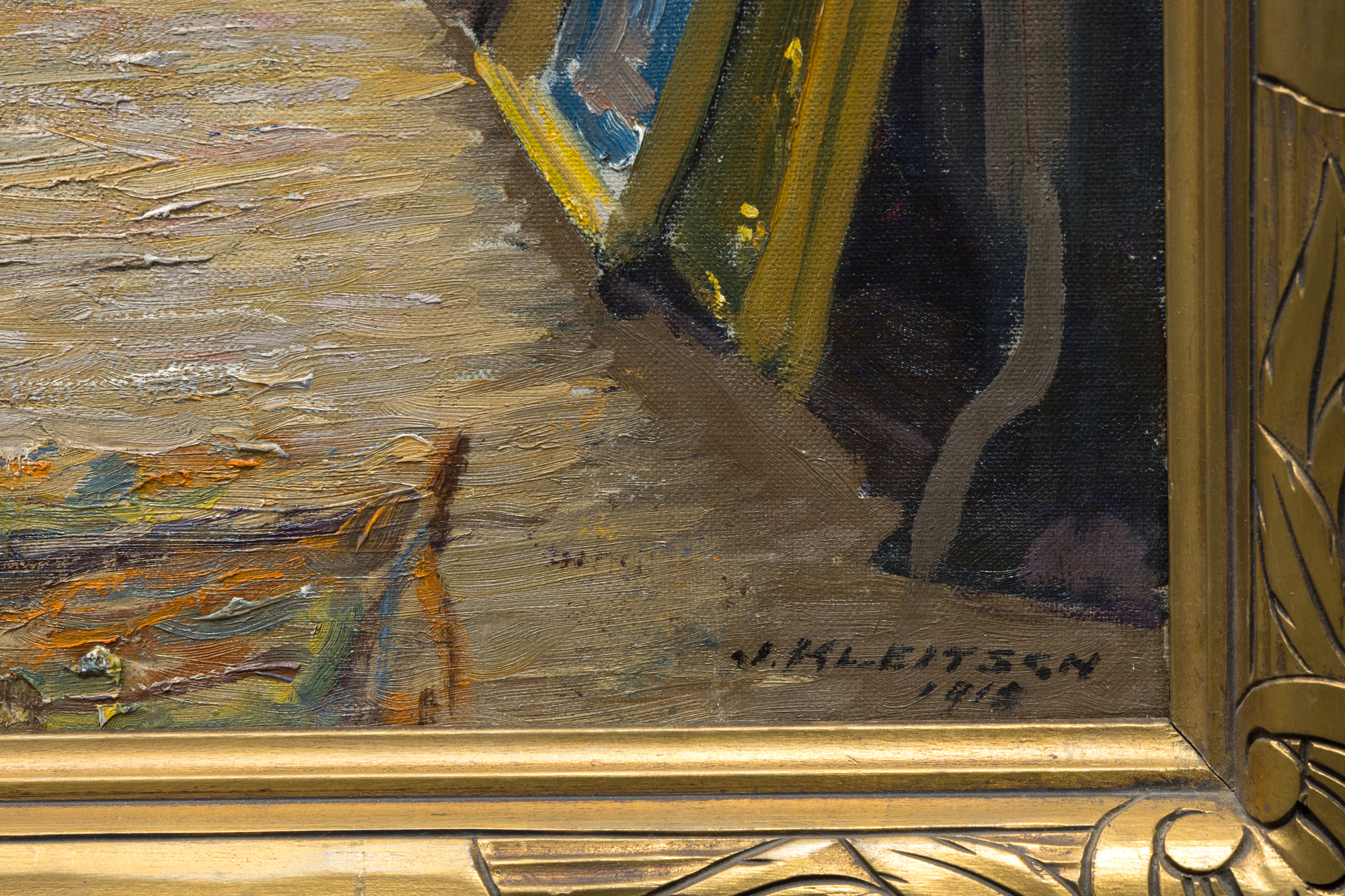
Intérieur du studio191830 x 40 po(76,2 x 101,6 cm) huile sur toile
Provenance
George Stern Fine Arts
Collection privée, acquise auprès de la galerie susmentionnée, 2012
Exposition
Pasadena, Californie, Pasadena Museum of California Art, Les années folles : portraits et peintures figuratives de Joseph Kleitsch, du 5 mars au 6 août 2017
Laguna Beach, Californie, Laguna Art Museum, Joseph Kleitsch : à l'étranger et chez lui dans le vieux Laguna, du 24 juin au 24 septembre 2023
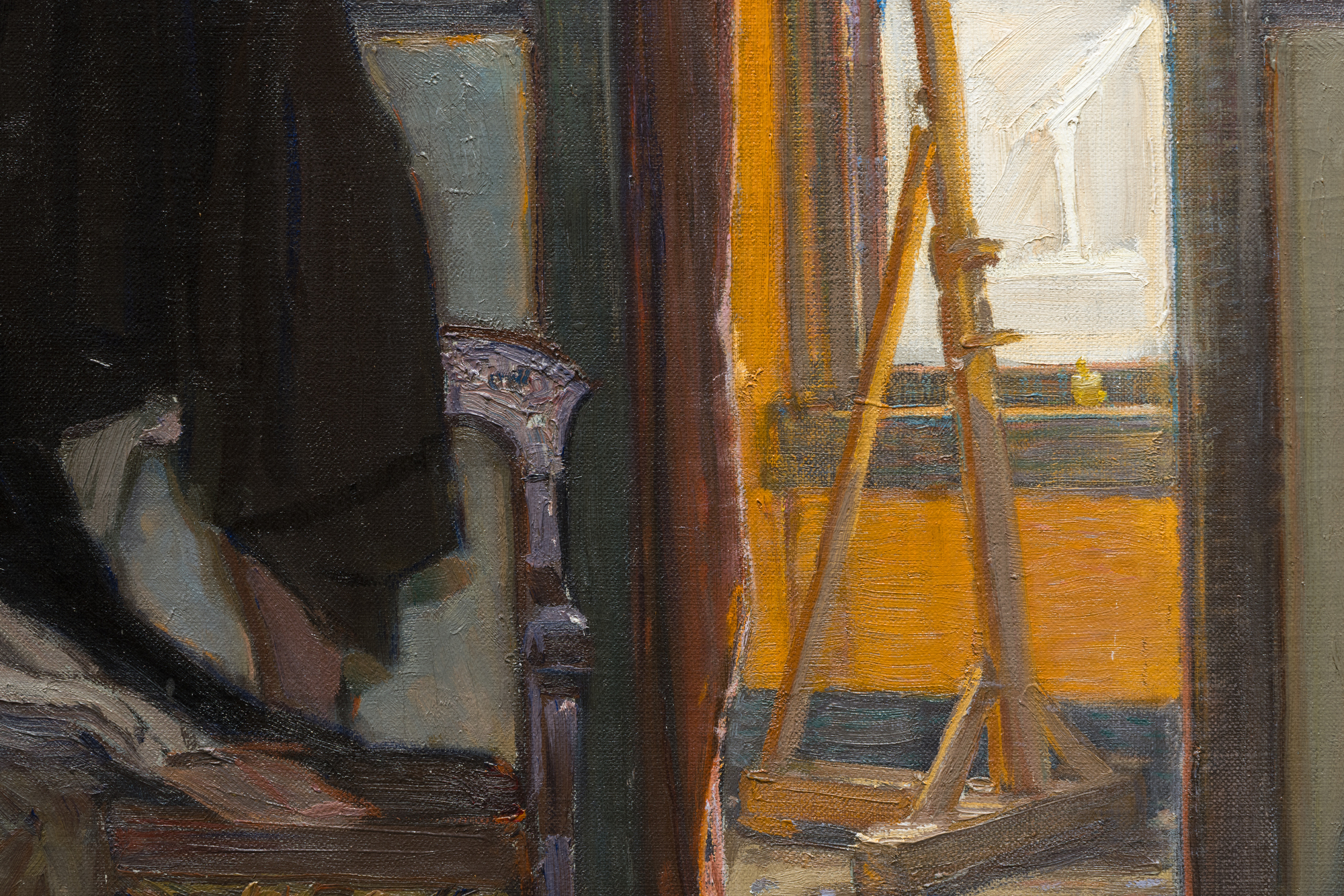
L'intérieur de l'atelier de Joseph Kleitsch (1918) est une œuvre fascinante qui reflète les bases académiques et réalistes de l'artiste et marque un moment charnière juste avant son déménagement de Chicago vers la Californie. Peinte peu avant cette transition, l'œuvre révèle l'approche disciplinée de Kleitsch en matière de composition et d'observation, façonnée par sa formation rigoureuse à Budapest, Munich et Paris. La scène dépeint un atelier calme et habité, où la lumière pénètre par une porte ouverte pour animer le mobilier, les toiles et les objets du quotidien, avec une utilisation sobre mais attentive des couleurs et des tons.


L'intérieur est construit avec une logique spatiale minutieuse et un accent mis sur la structure, soulignant la préférence de Kleitsch pour le réalisme académique à ce stade de sa carrière. À Chicago, ses portraits et ses scènes d'intérieur se distinguaient souvent par une palette « précieuse » - des teintes riches et saturées utilisées avec retenue - et cette sensibilité est évidente ici dans les couleurs superposées qui animent cette pièce autrement sobre. De subtils changements de lumière guident le regard à travers la composition, équilibrant la richesse chromatique avec la solidité et le calme.


Au cours des années qui ont précédé son déménagement vers l'ouest, Kleitsch s'est activement impliqué dans les institutions artistiques de Chicago, notamment le Palette and Chisel Club et l'Art Institute of Chicago, ce qui l'a placé dans un environnement dynamique d'influences modernes en pleine évolution. À cette époque, les œuvres impressionnistes et postimpressionnistes étaient de plus en plus présentes dans les expositions américaines. Si Kleitsch conserve ici un réalisme mesuré, l'influence impressionniste était en gestation ; il deviendra plus tard célèbre comme « maître des couleurs magnifiques » grâce à la palette vibrante et lumineuse de ses paysages californiens.


Studio Interior a été exposé à deux reprises, les deux fois en Californie, dans le cadre d'expositions soulignant l'importance de Kleitsch dans l'histoire de l'art californien. Rétrospectivement, le tableau offre un aperçu révélateur des racines de l'artiste avant que ses paysages californiens plus lumineux ne viennent définir son héritage.


demander