Précédent

WINSLOW HOMER (1836-1910)

$275,000

 
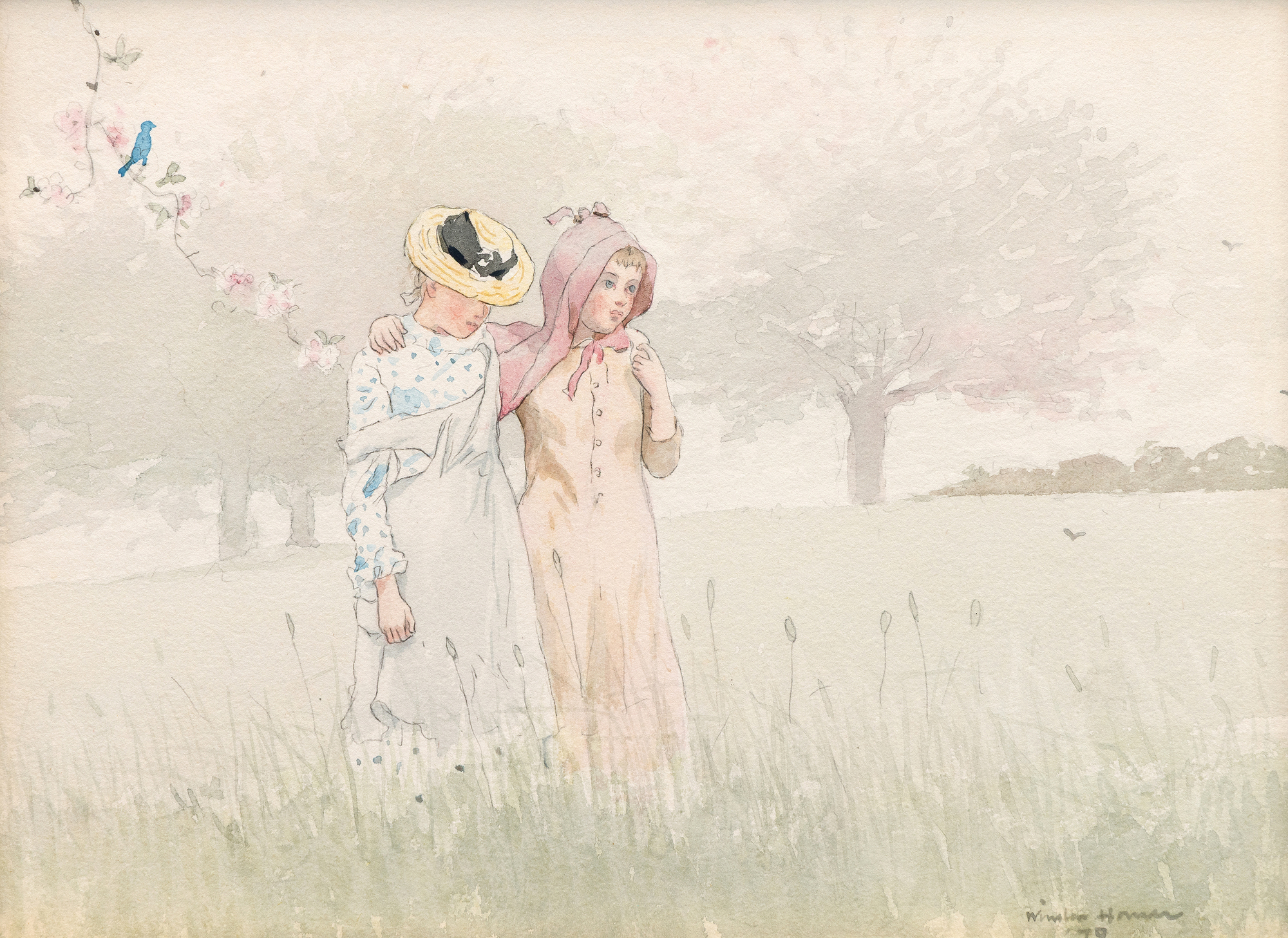
<div><font face=Lato size=3 color=black><em>Houghton Farms (Girls Strolling in an Orchard)</em> belongs to a pivotal moment in Winslow Homers career, created during the late 1870s as he transitioned from the wartime subjects that first brought him acclaim to the watercolor medium and domestic pastoral themes that would secure his place in the American canon. This period marked Homers sustained engagement with Houghton Farm in Mountainville in the Hudson Valley, where he spent extended time with his childhood friend and patron Lawson Valentine. Over these visits Homer produced approximately fifty watercolors, forming one of the most important bodies of early work in the medium. The significance of this output was later celebrated in the 2009 exhibition at Syracuse Art Galleries, <em>Winslow Homers Empire State: Houghton Farm and Beyond</em>.</font></div><br><br><div> </div><br><br><div><font face=Lato size=3 color=black>This watercolor is included in the artists catalogue raisonne and relates closely to other early examples from Houghton Farm, including <em>Fresh Air</em> from 1878 in the collection of the Brooklyn Museum. Its serene orchard scene, rendered with a soft and muted palette, reflects the themes of nostalgia, calm, and peace that define Homer's Restoration period. The transparency of the watercolor medium allows Homer to create a delicate, atmospheric impression of a misty morning, animated by touches of bright color in the figures dress patterns, the bow on a hat, a headwrap, and the bluebird perched on a branch.</font></div><br><br><div> </div><br><br><div><font face=Lato size=3 color=black>The continued importance of Homer's watercolor practice is affirmed by the current exhibition at the Museum of Fine Arts Boston, <em>Of Light and Air: Winslow Homer in Watercolor</em>, which underscores the enduring resonance of works from this transformative period. <em>Houghton Farms (Girls Strolling in an Orchard)</em> stands as a beautifully preserved example from the moment when Homer embraced watercolor as his primary mode of expression, illuminating the quiet lyricism that came to define his mature art.</font></div> <div><font face=Lato size=3 color=black><em>Houghton Farms (Girls Strolling in an Orchard)</em> belongs to a pivotal moment in Winslow Homers career, created during the late 1870s as he transitioned from the wartime subjects that first brought him acclaim to the watercolor medium and domestic pastoral themes that would secure his place in the American canon. This period marked Homers sustained engagement with Houghton Farm in Mountainville in the Hudson Valley, where he spent extended time with his childhood friend and patron Lawson Valentine. Over these visits Homer produced approximately fifty watercolors, forming one of the most important bodies of early work in the medium. The significance of this output was later celebrated in the 2009 exhibition at Syracuse Art Galleries, <em>Winslow Homers Empire State: Houghton Farm and Beyond</em>.</font></div><br><br><div> </div><br><br><div><font face=Lato size=3 color=black>This watercolor is included in the artists catalogue raisonne and relates closely to other early examples from Houghton Farm, including <em>Fresh Air</em> from 1878 in the collection of the Brooklyn Museum. Its serene orchard scene, rendered with a soft and muted palette, reflects the themes of nostalgia, calm, and peace that define Homer's Restoration period. The transparency of the watercolor medium allows Homer to create a delicate, atmospheric impression of a misty morning, animated by touches of bright color in the figures dress patterns, the bow on a hat, a headwrap, and the bluebird perched on a branch.</font></div><br><br><div> </div><br><br><div><font face=Lato size=3 color=black>The continued importance of Homer's watercolor practice is affirmed by the current exhibition at the Museum of Fine Arts Boston, <em>Of Light and Air: Winslow Homer in Watercolor</em>, which underscores the enduring resonance of works from this transformative period. <em>Houghton Farms (Girls Strolling in an Orchard)</em> stands as a beautifully preserved example from the moment when Homer embraced watercolor as his primary mode of expression, illuminating the quiet lyricism that came to define his mature art.</font></div> <div><font face=Lato size=3 color=black><em>Houghton Farms (Girls Strolling in an Orchard)</em> belongs to a pivotal moment in Winslow Homers career, created during the late 1870s as he transitioned from the wartime subjects that first brought him acclaim to the watercolor medium and domestic pastoral themes that would secure his place in the American canon. This period marked Homers sustained engagement with Houghton Farm in Mountainville in the Hudson Valley, where he spent extended time with his childhood friend and patron Lawson Valentine. Over these visits Homer produced approximately fifty watercolors, forming one of the most important bodies of early work in the medium. The significance of this output was later celebrated in the 2009 exhibition at Syracuse Art Galleries, <em>Winslow Homers Empire State: Houghton Farm and Beyond</em>.</font></div><br><br><div> </div><br><br><div><font face=Lato size=3 color=black>This watercolor is included in the artists catalogue raisonne and relates closely to other early examples from Houghton Farm, including <em>Fresh Air</em> from 1878 in the collection of the Brooklyn Museum. Its serene orchard scene, rendered with a soft and muted palette, reflects the themes of nostalgia, calm, and peace that define Homer's Restoration period. The transparency of the watercolor medium allows Homer to create a delicate, atmospheric impression of a misty morning, animated by touches of bright color in the figures dress patterns, the bow on a hat, a headwrap, and the bluebird perched on a branch.</font></div><br><br><div> </div><br><br><div><font face=Lato size=3 color=black>The continued importance of Homer's watercolor practice is affirmed by the current exhibition at the Museum of Fine Arts Boston, <em>Of Light and Air: Winslow Homer in Watercolor</em>, which underscores the enduring resonance of works from this transformative period. <em>Houghton Farms (Girls Strolling in an Orchard)</em> stands as a beautifully preserved example from the moment when Homer embraced watercolor as his primary mode of expression, illuminating the quiet lyricism that came to define his mature art.</font></div> <div><font face=Lato size=3 color=black><em>Houghton Farms (Girls Strolling in an Orchard)</em> belongs to a pivotal moment in Winslow Homers career, created during the late 1870s as he transitioned from the wartime subjects that first brought him acclaim to the watercolor medium and domestic pastoral themes that would secure his place in the American canon. This period marked Homers sustained engagement with Houghton Farm in Mountainville in the Hudson Valley, where he spent extended time with his childhood friend and patron Lawson Valentine. Over these visits Homer produced approximately fifty watercolors, forming one of the most important bodies of early work in the medium. The significance of this output was later celebrated in the 2009 exhibition at Syracuse Art Galleries, <em>Winslow Homers Empire State: Houghton Farm and Beyond</em>.</font></div><br><br><div> </div><br><br><div><font face=Lato size=3 color=black>This watercolor is included in the artists catalogue raisonne and relates closely to other early examples from Houghton Farm, including <em>Fresh Air</em> from 1878 in the collection of the Brooklyn Museum. Its serene orchard scene, rendered with a soft and muted palette, reflects the themes of nostalgia, calm, and peace that define Homer's Restoration period. The transparency of the watercolor medium allows Homer to create a delicate, atmospheric impression of a misty morning, animated by touches of bright color in the figures dress patterns, the bow on a hat, a headwrap, and the bluebird perched on a branch.</font></div><br><br><div> </div><br><br><div><font face=Lato size=3 color=black>The continued importance of Homer's watercolor practice is affirmed by the current exhibition at the Museum of Fine Arts Boston, <em>Of Light and Air: Winslow Homer in Watercolor</em>, which underscores the enduring resonance of works from this transformative period. <em>Houghton Farms (Girls Strolling in an Orchard)</em> stands as a beautifully preserved example from the moment when Homer embraced watercolor as his primary mode of expression, illuminating the quiet lyricism that came to define his mature art.</font></div> <div><font face=Lato size=3 color=black><em>Houghton Farms (Girls Strolling in an Orchard)</em> belongs to a pivotal moment in Winslow Homers career, created during the late 1870s as he transitioned from the wartime subjects that first brought him acclaim to the watercolor medium and domestic pastoral themes that would secure his place in the American canon. This period marked Homers sustained engagement with Houghton Farm in Mountainville in the Hudson Valley, where he spent extended time with his childhood friend and patron Lawson Valentine. Over these visits Homer produced approximately fifty watercolors, forming one of the most important bodies of early work in the medium. The significance of this output was later celebrated in the 2009 exhibition at Syracuse Art Galleries, <em>Winslow Homers Empire State: Houghton Farm and Beyond</em>.</font></div><br><br><div> </div><br><br><div><font face=Lato size=3 color=black>This watercolor is included in the artists catalogue raisonne and relates closely to other early examples from Houghton Farm, including <em>Fresh Air</em> from 1878 in the collection of the Brooklyn Museum. Its serene orchard scene, rendered with a soft and muted palette, reflects the themes of nostalgia, calm, and peace that define Homer's Restoration period. The transparency of the watercolor medium allows Homer to create a delicate, atmospheric impression of a misty morning, animated by touches of bright color in the figures dress patterns, the bow on a hat, a headwrap, and the bluebird perched on a branch.</font></div><br><br><div> </div><br><br><div><font face=Lato size=3 color=black>The continued importance of Homer's watercolor practice is affirmed by the current exhibition at the Museum of Fine Arts Boston, <em>Of Light and Air: Winslow Homer in Watercolor</em>, which underscores the enduring resonance of works from this transformative period. <em>Houghton Farms (Girls Strolling in an Orchard)</em> stands as a beautifully preserved example from the moment when Homer embraced watercolor as his primary mode of expression, illuminating the quiet lyricism that came to define his mature art.</font></div> <div><font face=Lato size=3 color=black><em>Houghton Farms (Girls Strolling in an Orchard)</em> belongs to a pivotal moment in Winslow Homers career, created during the late 1870s as he transitioned from the wartime subjects that first brought him acclaim to the watercolor medium and domestic pastoral themes that would secure his place in the American canon. This period marked Homers sustained engagement with Houghton Farm in Mountainville in the Hudson Valley, where he spent extended time with his childhood friend and patron Lawson Valentine. Over these visits Homer produced approximately fifty watercolors, forming one of the most important bodies of early work in the medium. The significance of this output was later celebrated in the 2009 exhibition at Syracuse Art Galleries, <em>Winslow Homers Empire State: Houghton Farm and Beyond</em>.</font></div><br><br><div> </div><br><br><div><font face=Lato size=3 color=black>This watercolor is included in the artists catalogue raisonne and relates closely to other early examples from Houghton Farm, including <em>Fresh Air</em> from 1878 in the collection of the Brooklyn Museum. Its serene orchard scene, rendered with a soft and muted palette, reflects the themes of nostalgia, calm, and peace that define Homer's Restoration period. The transparency of the watercolor medium allows Homer to create a delicate, atmospheric impression of a misty morning, animated by touches of bright color in the figures dress patterns, the bow on a hat, a headwrap, and the bluebird perched on a branch.</font></div><br><br><div> </div><br><br><div><font face=Lato size=3 color=black>The continued importance of Homer's watercolor practice is affirmed by the current exhibition at the Museum of Fine Arts Boston, <em>Of Light and Air: Winslow Homer in Watercolor</em>, which underscores the enduring resonance of works from this transformative period. <em>Houghton Farms (Girls Strolling in an Orchard)</em> stands as a beautifully preserved example from the moment when Homer embraced watercolor as his primary mode of expression, illuminating the quiet lyricism that came to define his mature art.</font></div> <div><font face=Lato size=3 color=black><em>Houghton Farms (Girls Strolling in an Orchard)</em> belongs to a pivotal moment in Winslow Homers career, created during the late 1870s as he transitioned from the wartime subjects that first brought him acclaim to the watercolor medium and domestic pastoral themes that would secure his place in the American canon. This period marked Homers sustained engagement with Houghton Farm in Mountainville in the Hudson Valley, where he spent extended time with his childhood friend and patron Lawson Valentine. Over these visits Homer produced approximately fifty watercolors, forming one of the most important bodies of early work in the medium. The significance of this output was later celebrated in the 2009 exhibition at Syracuse Art Galleries, <em>Winslow Homers Empire State: Houghton Farm and Beyond</em>.</font></div><br><br><div> </div><br><br><div><font face=Lato size=3 color=black>This watercolor is included in the artists catalogue raisonne and relates closely to other early examples from Houghton Farm, including <em>Fresh Air</em> from 1878 in the collection of the Brooklyn Museum. Its serene orchard scene, rendered with a soft and muted palette, reflects the themes of nostalgia, calm, and peace that define Homer's Restoration period. The transparency of the watercolor medium allows Homer to create a delicate, atmospheric impression of a misty morning, animated by touches of bright color in the figures dress patterns, the bow on a hat, a headwrap, and the bluebird perched on a branch.</font></div><br><br><div> </div><br><br><div><font face=Lato size=3 color=black>The continued importance of Homer's watercolor practice is affirmed by the current exhibition at the Museum of Fine Arts Boston, <em>Of Light and Air: Winslow Homer in Watercolor</em>, which underscores the enduring resonance of works from this transformative period. <em>Houghton Farms (Girls Strolling in an Orchard)</em> stands as a beautifully preserved example from the moment when Homer embraced watercolor as his primary mode of expression, illuminating the quiet lyricism that came to define his mature art.</font></div>
Houghton Farms (Filles se promenant dans un verger)18799 1/2 x 13 po(24,13 x 33,02 cm) aquarelle et graphite sur papier
Provenance
(probablement avec) Wm. A. Butters & Co., Chicago, vente Homer, 10 décembre 1879
James H. Dole, Chicago, vers 1881
George S. Dole, Galesburg, Illinois, fils du précédent, 1902
Mme George S. Dole, Galesburg, Illinois (puis Minneapolis), 1934
John J. Foley, Minneapolis, probablement le gendre de Mme George S. Dole
Kennedy Galleries, New York, 1963
Madison H. Lewis, New York, 1963
Elizabeth Sanford Lewis (Mme Madison H. Lewis, plus tard Mme W. Leicester Van Leer), New York, par legs, vers 1980
Christie's, 6 décembre
...Plus..... 1991, vente 7380, n° 44
Debra Force Fine Art, Inc., en 1999
Collection Privée, Floride
Collection privée, Boston
Collection privée
 
Exposition
Chicago, Illinois, Wm. A. Butters & Co., Aquarelles originales et croquis au fusain d'après nature par Winslow Homer, décembre 1879
Chicago, Illinois, Exposition industrielle interétatique de Chicago, neuvième exposition annuelle, 7 septembre - 22 octobre 1881, n° 211 (sous le titre The Walk)
Chicago, Illinois, Exposition industrielle interétatique de Chicago, douzième exposition annuelle, 3 septembre - 18 octobre 1884, n° 432 (sous le titre Blossoms)
Chicago, Illinois, Exposition industrielle interétatique de Chicago, quinzième exposition annuelle, 7 septembre - 23 octobre 1887, n° 489 (sous le titre Blossoms)
Chicago, Illinois, Exposition industrielle interétatique de Chicago, dix-huitième exposition annuelle, 3 septembre - 18 octobre 1890, n° 408 (sous le titre « Sous le pommier »)
Littérature
Lloyd Goodrich et Abigail Booth Gerdts, Record of Works by Winslow Homer, Volume III : 1877 à mars 1881, New York, 2005, p. 258, n° 850 (illustré)
...MOINS.....
Houghton Farms (Girls Strolling in an Orchard) appartient à une période charnière de la carrière de Winslow Homer. Réalisée à la fin des années 1870, cette œuvre marque sa transition des sujets liés à la guerre, qui lui ont valu ses premiers succès, vers l'aquarelle et les thèmes pastoraux domestiques qui lui ont assuré une place dans le panthéon américain. Cette période marque l'engagement soutenu de Homer auprès de la ferme Houghton à Mountainville, dans la vallée de l'Hudson, où il passe beaucoup de temps avec son ami d'enfance et mécène Lawson Valentine. Au cours de ces visites, Homer réalise environ cinquante aquarelles, qui constituent l'un des ensembles les plus importants de ses premières œuvres dans ce médium. L'importance de cette production a été célébrée plus tard dans l'exposition de 2009 à la Syracuse Art Galleries, Winslow Homer's Empire State: Houghton Farm and Beyond.


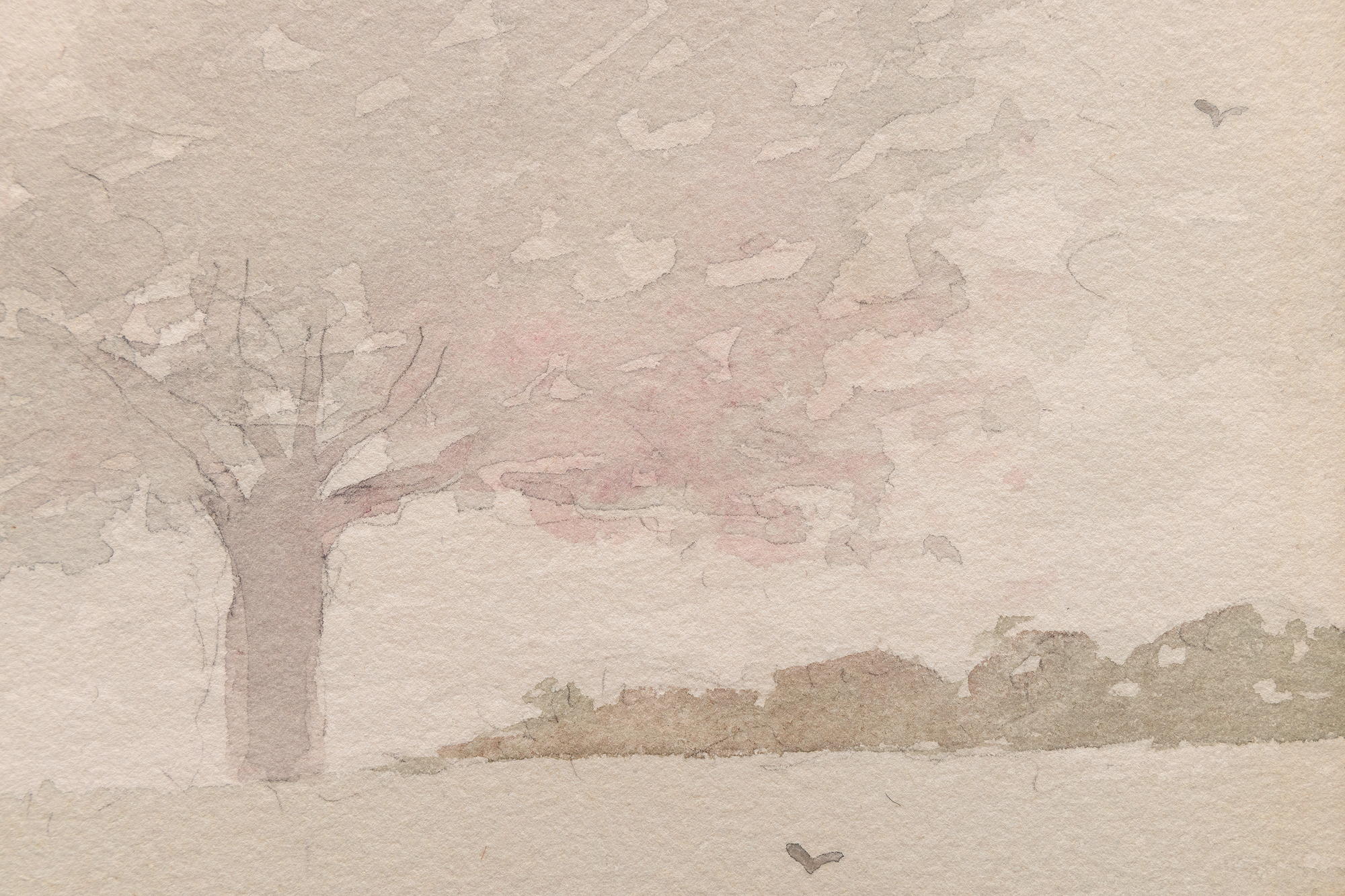
Cette aquarelle figure dans le catalogue raisonné de l'artiste et est étroitement liée à d'autres exemples précoces de la ferme Houghton, notamment Fresh Air de 1878, qui fait partie de la collection du Brooklyn Museum. Sa scène sereine dans un verger, rendue avec une palette douce et discrète, reflète les thèmes de la nostalgie, du calme et de la paix qui définissent la période de restauration de Homer. La transparence de l'aquarelle permet à Homer de créer une impression délicate et atmosphérique d'un matin brumeux, animée par des touches de couleurs vives dans les motifs des robes des personnages, le nœud sur un chapeau, un foulard et l'oiseau bleu perché sur une branche.


L'importance continue de la pratique de l'aquarelle par Homer est confirmée par l'exposition actuelle au Museum of Fine Arts de Boston, Of Light and Air: Winslow Homer in Watercolor, qui souligne la résonance durable des œuvres de cette période de transformation. Houghton Farms (Girls Strolling in an Orchard) est un exemple magnifiquement préservé du moment où Homer a adopté l'aquarelle comme principal mode d'expression, mettant en lumière le lyrisme tranquille qui a fini par définir son art mature.
demander