Précédent

CLAUDE MONET(1840-1926)

 
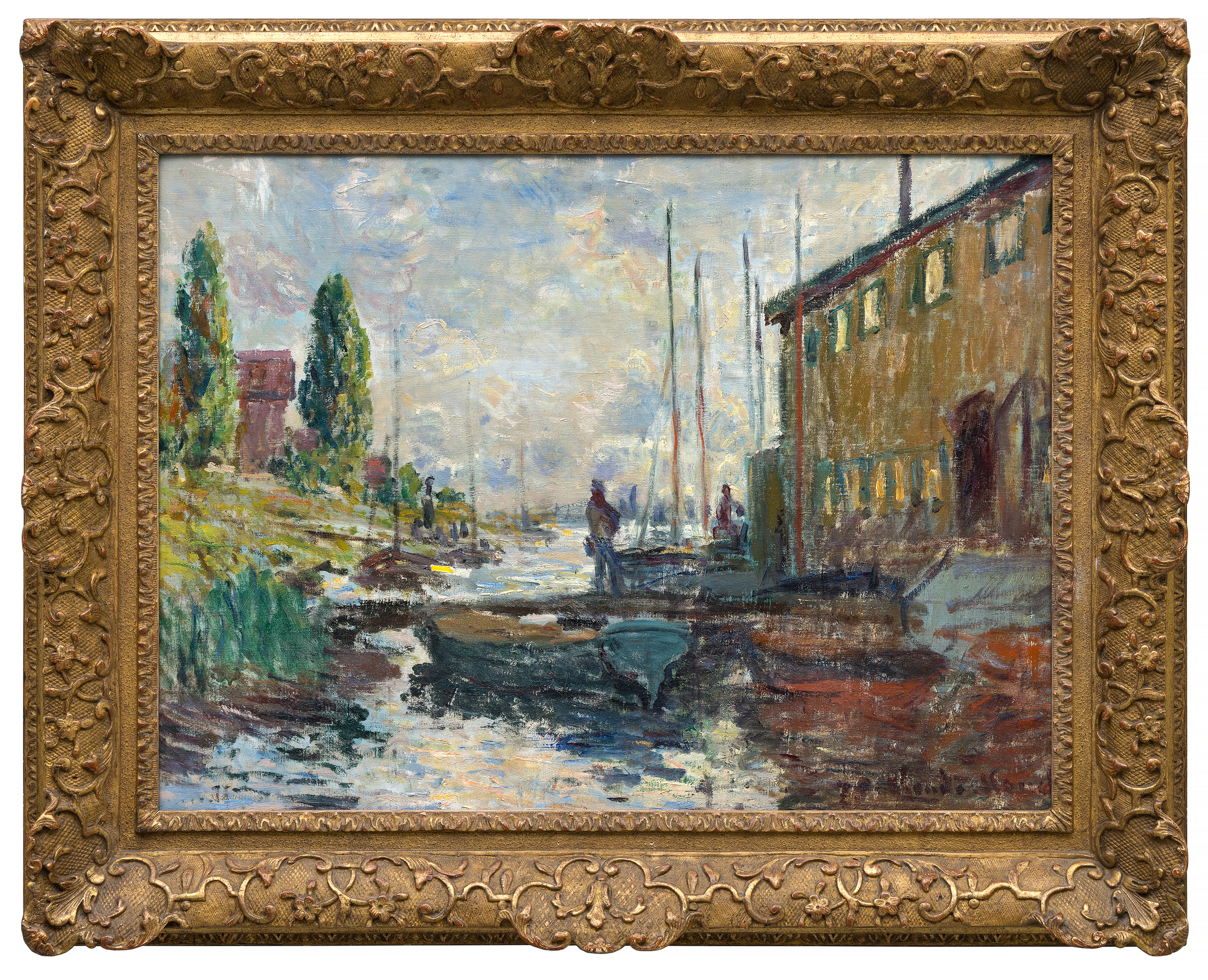
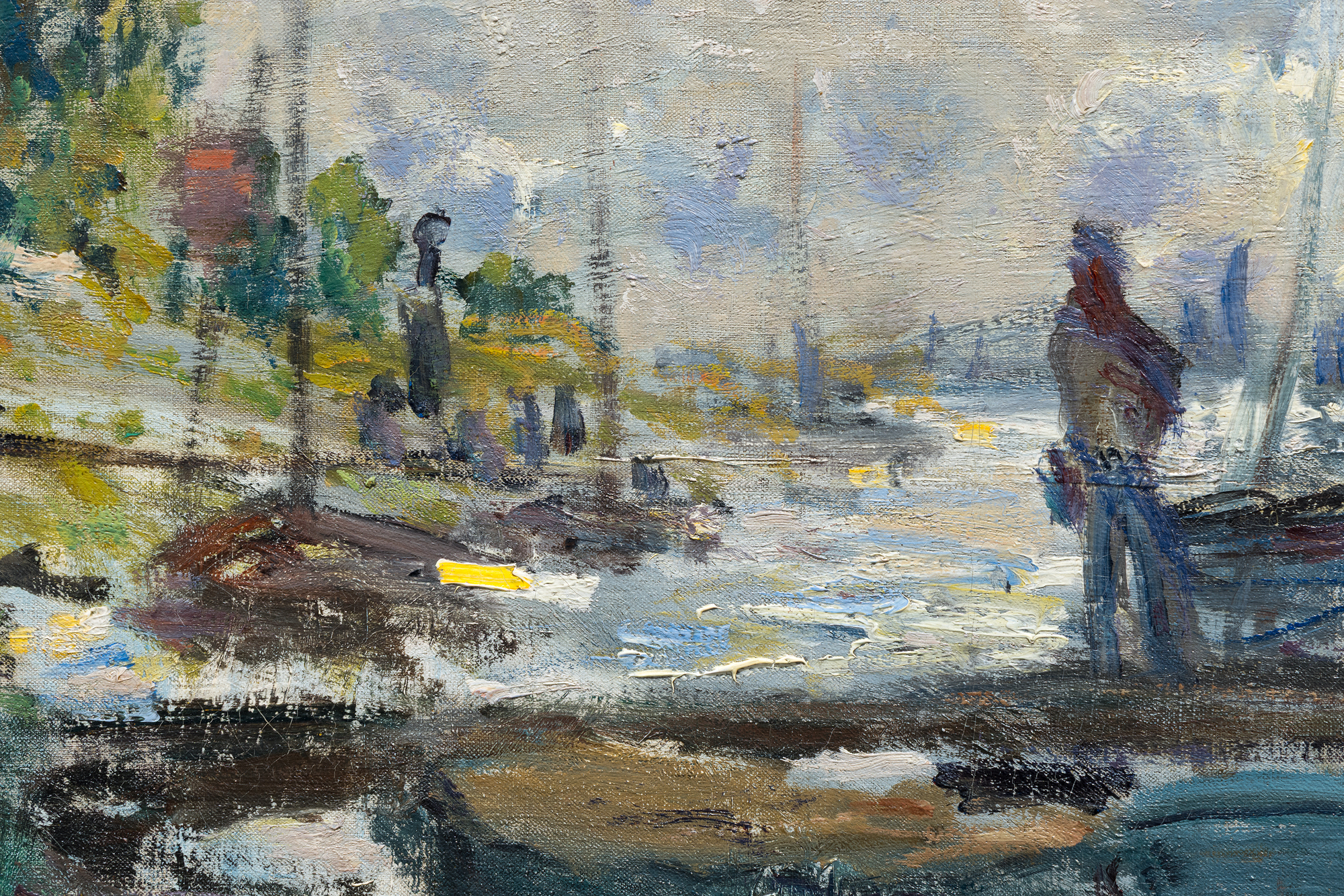
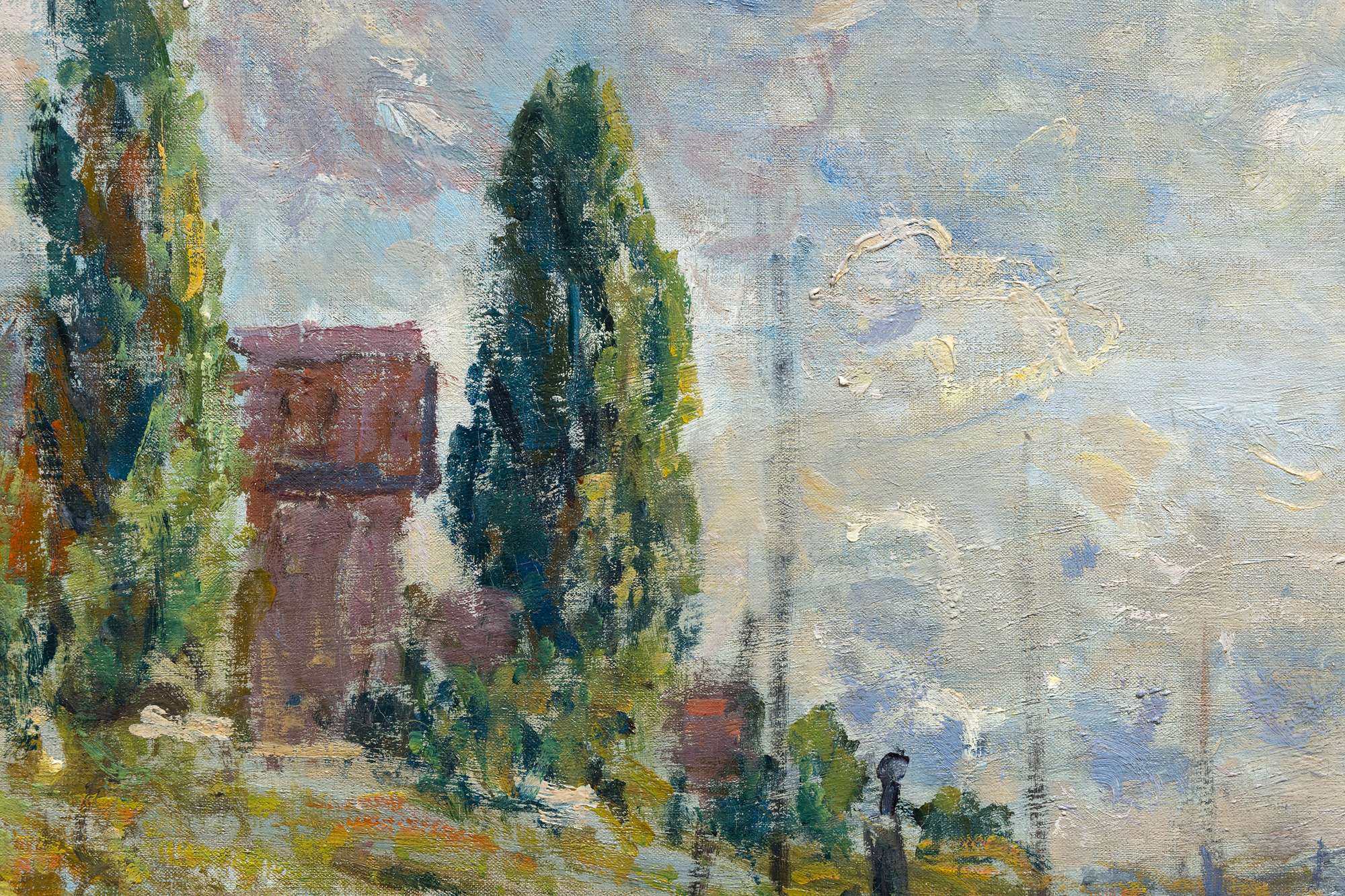
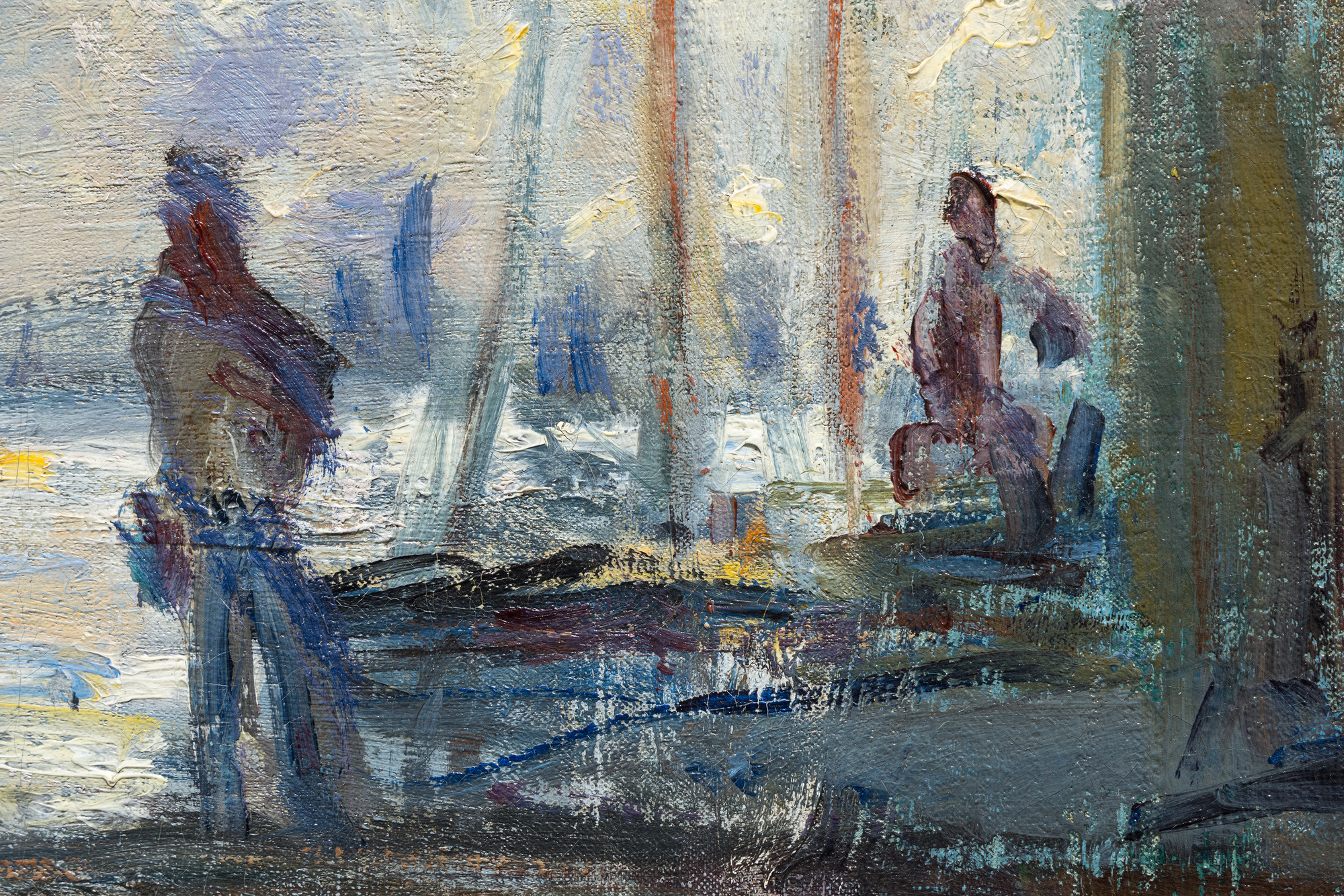
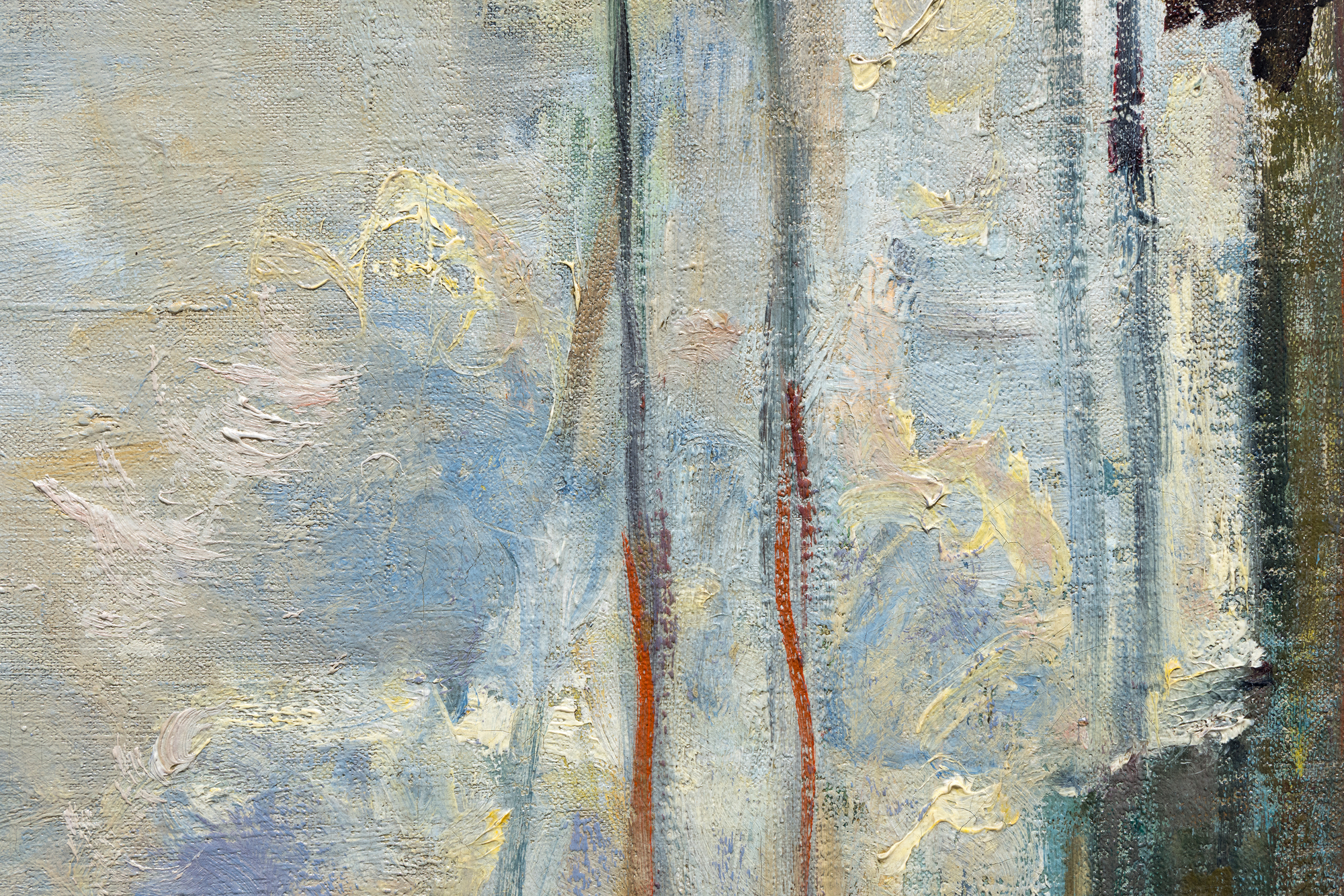
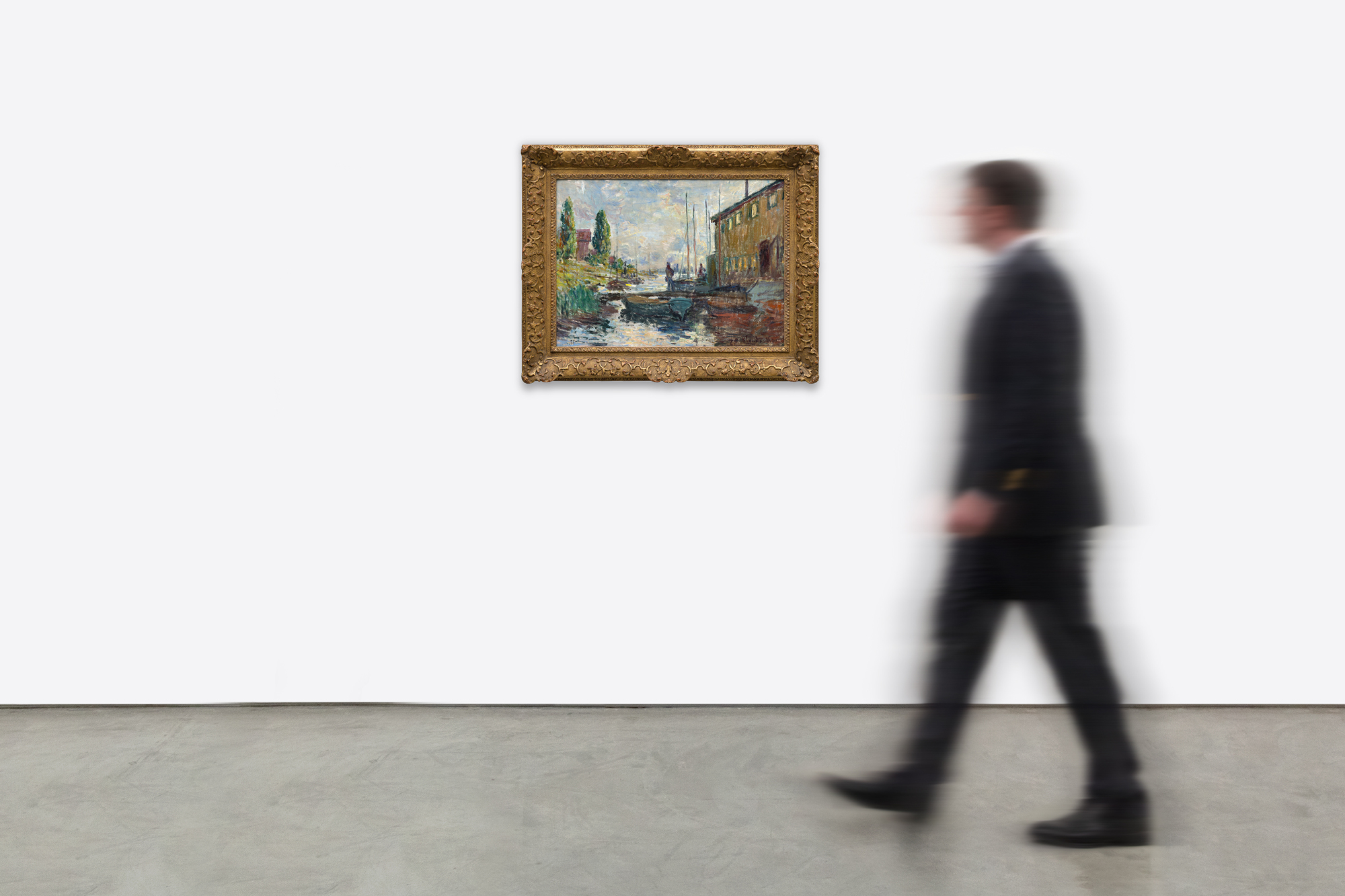
<div>Claude Monet’s <em>Le bassin d’Argenteuil</em> (1875) is a luminous example from one of the most pivotal periods of his career, painted in the late spring or summer of 1875, just one year after the groundbreaking first Impressionist exhibition. Set along the Seine at Argenteuil, the composition captures a quiet basin animated by small boats, figures, and reflections, rendered with loose, expressive brushwork that conveys the fleeting effects of light and atmosphere. The gentle diffusion of water and sky creates a shimmering surface, perfectly suited to Monet’s plein air practice and his desire to record perception in the moment. </div><br><br><div> </div><br><br><div>Argenteuil was central to the crystallization of Impressionism, marking a time when its ideas, subject matter, and collaborative spirit fully coalesced. Between 1871 and 1878, Monet’s presence there drew fellow artists including Renoir, Manet, Sisley, and Caillebotte, fostering an environment of shared experimentation and innovation. </div><br><br><div> </div><br><br><div>The painting’s early provenance further enhances its significance. It was owned by Oscar A. H. Schmitz, the German writer and intellectual known for his writings on Jungian psychology and his discerning collection of 19th-century art. Following Schmitz’s unexpected death in 1933, the collection was sent to the Kunstmuseum Basel. In 1936, the art dealer Wildenstein & Co. took over 62 works from the collection and organized a major exhibition and sale in Paris and New York.<em> Le bassin d’Argenteuil</em> is included in the Daniel Wildenstein catalogue raisonné (1996), vol. II, p. 153, as no. 371, and is published in eight books. </div> <div>Claude Monet’s <em>Le bassin d’Argenteuil</em> (1875) is a luminous example from one of the most pivotal periods of his career, painted in the late spring or summer of 1875, just one year after the groundbreaking first Impressionist exhibition. Set along the Seine at Argenteuil, the composition captures a quiet basin animated by small boats, figures, and reflections, rendered with loose, expressive brushwork that conveys the fleeting effects of light and atmosphere. The gentle diffusion of water and sky creates a shimmering surface, perfectly suited to Monet’s plein air practice and his desire to record perception in the moment. </div><br><br><div> </div><br><br><div>Argenteuil was central to the crystallization of Impressionism, marking a time when its ideas, subject matter, and collaborative spirit fully coalesced. Between 1871 and 1878, Monet’s presence there drew fellow artists including Renoir, Manet, Sisley, and Caillebotte, fostering an environment of shared experimentation and innovation. </div><br><br><div> </div><br><br><div>The painting’s early provenance further enhances its significance. It was owned by Oscar A. H. Schmitz, the German writer and intellectual known for his writings on Jungian psychology and his discerning collection of 19th-century art. Following Schmitz’s unexpected death in 1933, the collection was sent to the Kunstmuseum Basel. In 1936, the art dealer Wildenstein & Co. took over 62 works from the collection and organized a major exhibition and sale in Paris and New York.<em> Le bassin d’Argenteuil</em> is included in the Daniel Wildenstein catalogue raisonné (1996), vol. II, p. 153, as no. 371, and is published in eight books. </div> <div>Claude Monet’s <em>Le bassin d’Argenteuil</em> (1875) is a luminous example from one of the most pivotal periods of his career, painted in the late spring or summer of 1875, just one year after the groundbreaking first Impressionist exhibition. Set along the Seine at Argenteuil, the composition captures a quiet basin animated by small boats, figures, and reflections, rendered with loose, expressive brushwork that conveys the fleeting effects of light and atmosphere. The gentle diffusion of water and sky creates a shimmering surface, perfectly suited to Monet’s plein air practice and his desire to record perception in the moment. </div><br><br><div> </div><br><br><div>Argenteuil was central to the crystallization of Impressionism, marking a time when its ideas, subject matter, and collaborative spirit fully coalesced. Between 1871 and 1878, Monet’s presence there drew fellow artists including Renoir, Manet, Sisley, and Caillebotte, fostering an environment of shared experimentation and innovation. </div><br><br><div> </div><br><br><div>The painting’s early provenance further enhances its significance. It was owned by Oscar A. H. Schmitz, the German writer and intellectual known for his writings on Jungian psychology and his discerning collection of 19th-century art. Following Schmitz’s unexpected death in 1933, the collection was sent to the Kunstmuseum Basel. In 1936, the art dealer Wildenstein & Co. took over 62 works from the collection and organized a major exhibition and sale in Paris and New York.<em> Le bassin d’Argenteuil</em> is included in the Daniel Wildenstein catalogue raisonné (1996), vol. II, p. 153, as no. 371, and is published in eight books. </div> <div>Claude Monet’s <em>Le bassin d’Argenteuil</em> (1875) is a luminous example from one of the most pivotal periods of his career, painted in the late spring or summer of 1875, just one year after the groundbreaking first Impressionist exhibition. Set along the Seine at Argenteuil, the composition captures a quiet basin animated by small boats, figures, and reflections, rendered with loose, expressive brushwork that conveys the fleeting effects of light and atmosphere. The gentle diffusion of water and sky creates a shimmering surface, perfectly suited to Monet’s plein air practice and his desire to record perception in the moment. </div><br><br><div> </div><br><br><div>Argenteuil was central to the crystallization of Impressionism, marking a time when its ideas, subject matter, and collaborative spirit fully coalesced. Between 1871 and 1878, Monet’s presence there drew fellow artists including Renoir, Manet, Sisley, and Caillebotte, fostering an environment of shared experimentation and innovation. </div><br><br><div> </div><br><br><div>The painting’s early provenance further enhances its significance. It was owned by Oscar A. H. Schmitz, the German writer and intellectual known for his writings on Jungian psychology and his discerning collection of 19th-century art. Following Schmitz’s unexpected death in 1933, the collection was sent to the Kunstmuseum Basel. In 1936, the art dealer Wildenstein & Co. took over 62 works from the collection and organized a major exhibition and sale in Paris and New York.<em> Le bassin d’Argenteuil</em> is included in the Daniel Wildenstein catalogue raisonné (1996), vol. II, p. 153, as no. 371, and is published in eight books. </div> <div>Claude Monet’s <em>Le bassin d’Argenteuil</em> (1875) is a luminous example from one of the most pivotal periods of his career, painted in the late spring or summer of 1875, just one year after the groundbreaking first Impressionist exhibition. Set along the Seine at Argenteuil, the composition captures a quiet basin animated by small boats, figures, and reflections, rendered with loose, expressive brushwork that conveys the fleeting effects of light and atmosphere. The gentle diffusion of water and sky creates a shimmering surface, perfectly suited to Monet’s plein air practice and his desire to record perception in the moment. </div><br><br><div> </div><br><br><div>Argenteuil was central to the crystallization of Impressionism, marking a time when its ideas, subject matter, and collaborative spirit fully coalesced. Between 1871 and 1878, Monet’s presence there drew fellow artists including Renoir, Manet, Sisley, and Caillebotte, fostering an environment of shared experimentation and innovation. </div><br><br><div> </div><br><br><div>The painting’s early provenance further enhances its significance. It was owned by Oscar A. H. Schmitz, the German writer and intellectual known for his writings on Jungian psychology and his discerning collection of 19th-century art. Following Schmitz’s unexpected death in 1933, the collection was sent to the Kunstmuseum Basel. In 1936, the art dealer Wildenstein & Co. took over 62 works from the collection and organized a major exhibition and sale in Paris and New York.<em> Le bassin d’Argenteuil</em> is included in the Daniel Wildenstein catalogue raisonné (1996), vol. II, p. 153, as no. 371, and is published in eight books. </div> <div>Claude Monet’s <em>Le bassin d’Argenteuil</em> (1875) is a luminous example from one of the most pivotal periods of his career, painted in the late spring or summer of 1875, just one year after the groundbreaking first Impressionist exhibition. Set along the Seine at Argenteuil, the composition captures a quiet basin animated by small boats, figures, and reflections, rendered with loose, expressive brushwork that conveys the fleeting effects of light and atmosphere. The gentle diffusion of water and sky creates a shimmering surface, perfectly suited to Monet’s plein air practice and his desire to record perception in the moment. </div><br><br><div> </div><br><br><div>Argenteuil was central to the crystallization of Impressionism, marking a time when its ideas, subject matter, and collaborative spirit fully coalesced. Between 1871 and 1878, Monet’s presence there drew fellow artists including Renoir, Manet, Sisley, and Caillebotte, fostering an environment of shared experimentation and innovation. </div><br><br><div> </div><br><br><div>The painting’s early provenance further enhances its significance. It was owned by Oscar A. H. Schmitz, the German writer and intellectual known for his writings on Jungian psychology and his discerning collection of 19th-century art. Following Schmitz’s unexpected death in 1933, the collection was sent to the Kunstmuseum Basel. In 1936, the art dealer Wildenstein & Co. took over 62 works from the collection and organized a major exhibition and sale in Paris and New York.<em> Le bassin d’Argenteuil</em> is included in the Daniel Wildenstein catalogue raisonné (1996), vol. II, p. 153, as no. 371, and is published in eight books. </div> <div>Claude Monet’s <em>Le bassin d’Argenteuil</em> (1875) is a luminous example from one of the most pivotal periods of his career, painted in the late spring or summer of 1875, just one year after the groundbreaking first Impressionist exhibition. Set along the Seine at Argenteuil, the composition captures a quiet basin animated by small boats, figures, and reflections, rendered with loose, expressive brushwork that conveys the fleeting effects of light and atmosphere. The gentle diffusion of water and sky creates a shimmering surface, perfectly suited to Monet’s plein air practice and his desire to record perception in the moment. </div><br><br><div> </div><br><br><div>Argenteuil was central to the crystallization of Impressionism, marking a time when its ideas, subject matter, and collaborative spirit fully coalesced. Between 1871 and 1878, Monet’s presence there drew fellow artists including Renoir, Manet, Sisley, and Caillebotte, fostering an environment of shared experimentation and innovation. </div><br><br><div> </div><br><br><div>The painting’s early provenance further enhances its significance. It was owned by Oscar A. H. Schmitz, the German writer and intellectual known for his writings on Jungian psychology and his discerning collection of 19th-century art. Following Schmitz’s unexpected death in 1933, the collection was sent to the Kunstmuseum Basel. In 1936, the art dealer Wildenstein & Co. took over 62 works from the collection and organized a major exhibition and sale in Paris and New York.<em> Le bassin d’Argenteuil</em> is included in the Daniel Wildenstein catalogue raisonné (1996), vol. II, p. 153, as no. 371, and is published in eight books. </div>
Le bassin d'Argenteuil187521 3/4 x 29 1/4 po(55,25 x 74,3 cm) huile sur toile
Provenance
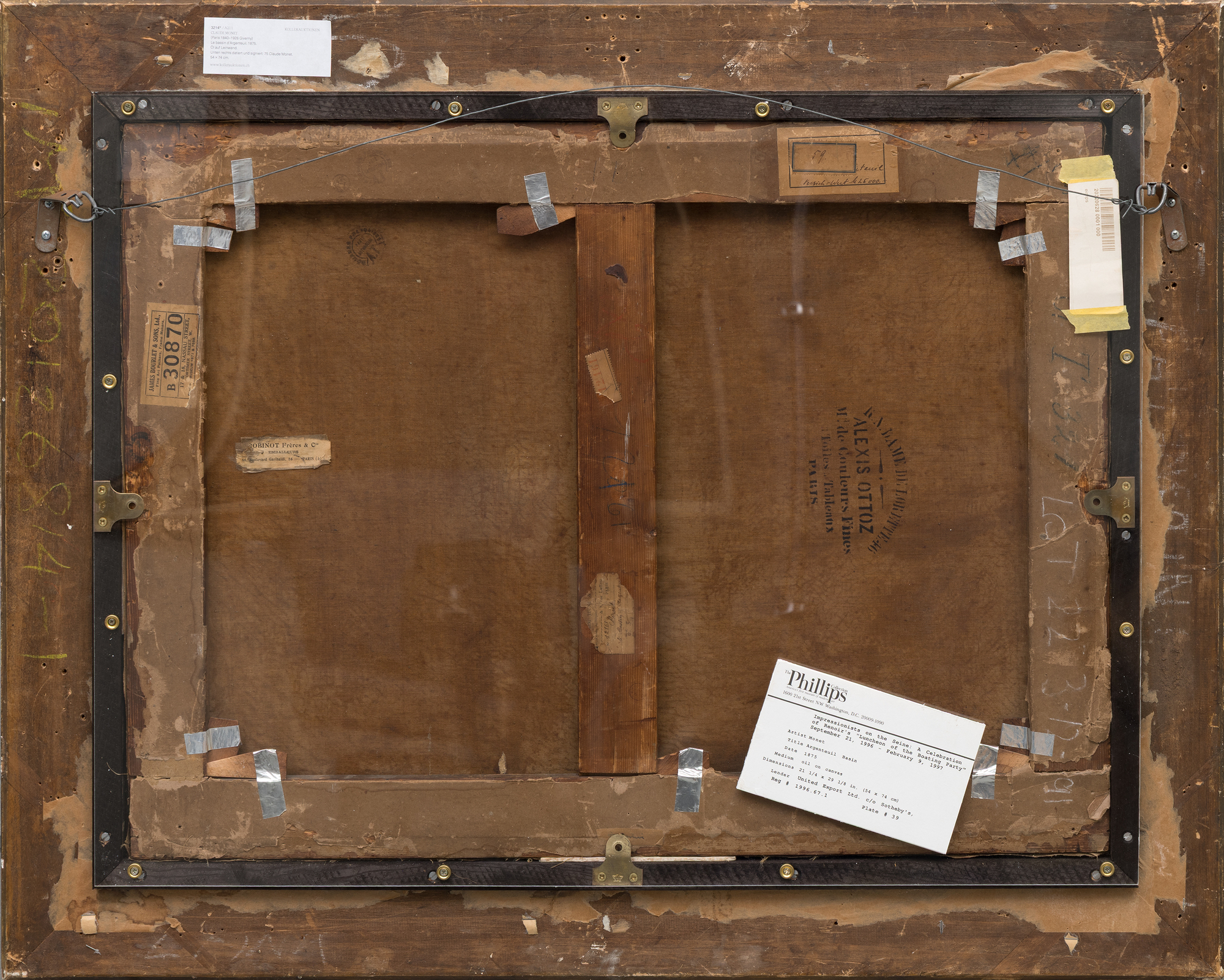
Avec la Galerie Bernheim-Jeune, Paris, n° 12161 (étiquette au verso)
Collection d'Oscar Schmitz, Dresde, 1904
Kunsthaus Zürich, prêt depuis 1931 provenant de la collection d'Oscar Schmitz
Kunstmuseum Basel, prêt depuis 1934 provenant de la collection d'Oscar Schmitz
Wildenstein & Co., Londres, depuis 1936
M. E.W. Fattorini, Grande-Bretagne, 1940
Sotheby's, Londres, 16 avril 1975, lot 25
Collection privée, Angleterre
Sotheby's, Londres, 3 décembre 1991, lot 22
Collection privée, Londres, acquise lors de la vente aux enchères susmentionnée
...Plus.....sur
Collection privée, Europe
Koller Auktionen AG, Zurich, 29 novembre 2024, lot 03214
Collection privée, Londres, acquise lors de la vente aux enchères susmentionnée
Exposition
Zurich, Kunsthaus Zürich, Collection Oscar Schmitz, 14 janvier-14 février 1932, n° 35/47
Balingen, Stadthalle, Claude Monet, 18 juin-31 août 1992, n° 6
Washington, D.C., Phillips Collection, Les impressionnistes sur la Seine : une célébration du « Déjeuner des canotiers » de Renoir, 21 septembre 1996-2 février 1997, n° 39
Littérature
Daniel Wildenstein, Monet. Catalogue raisonné. Werkverzeichnis, Bonn, 1996, vol. II, p. 153, n° 371 (illustré)
Paul Fechter, « Die Sammlung Schmitz », Kunst und Künstler : Illustrierte Monatsschrift für bildende Kunst und Kunstgewerbe, Berlin, octobre 1909, p. 21.
Karl Scheffler, « Die Sammlung Oskar Schmitz in Dresden », Kunst und Künstler : Illustrierte Monatsschrift für bildende Kunst und Kunstgewerbe, Berlin, 1920/21, p. 186.
Marie Dormoy, « La collection Schmitz à Dresde », L’Amour de l’art, Paris, octobre 1926, p. 342.
Daniel Wildenstein, Monet, vie et œuvre, Lausanne/Paris, 1974, vol. I, p. 237, 272 (illustré)
Joel Isaacson, Observation et réflexion. Claude Monet, Oxford, 1978, p. 95, 207 (illustré)
Paul Hayes Tucker, Monet à Argenteuil, New Haven/Londres, 1982, p. 120 (illustré n° XXI)
Daniel Wildenstein, Monet, vie et œuvre, Lausanne/Paris, 1991, vol. V, p. 30 (illustré)
...MOINS.....
Le bassin d'Argenteuil (1875) de Claude Monet est un exemple lumineux de l'une des périodes les plus marquantes de sa carrière, peint à la fin du printemps ou à l'été 1875, un an seulement après la première exposition impressionniste révolutionnaire. Située le long de la Seine à Argenteuil, la composition capture un bassin tranquille animé par de petits bateaux, des personnages et des reflets, rendus par des coups de pinceau libres et expressifs qui traduisent les effets fugaces de la lumière et de l'atmosphère. La douce diffusion de l'eau et du ciel crée une surface scintillante, parfaitement adaptée à la pratique du plein air de Monet et à son désir d'enregistrer la perception dans l'instant.


Argenteuil a joué un rôle central dans la cristallisation de l'impressionnisme, marquant une époque où ses idées, ses thèmes et son esprit de collaboration se sont pleinement cristallisés. Entre 1871 et 1878, la présence de Monet dans cette ville a attiré d'autres artistes, notamment Renoir, Manet, Sisley et Caillebotte, favorisant un environnement propice à l'expérimentation et à l'innovation communes.


La provenance initiale du tableau renforce encore son importance. Il appartenait à Oscar A. H. Schmitz, écrivain et intellectuel allemand connu pour ses écrits sur la psychologie jungienne et sa collection raffinée d'art du XIXe siècle. Après la mort inattendue de Schmitz en 1933, la collection a été envoyée au Kunstmuseum de Bâle. En 1936, le marchand d'art Wildenstein & Co. a repris 62 œuvres de la collection et a organisé une grande exposition et une vente à Paris et à New York. Le bassin d'Argenteuil figure dans le catalogue raisonné de Daniel Wildenstein (1996), vol. II, p. 153, sous le n° 371, et est publié dans huit livres.
demander