ジョセフ・クレイチュ (1882-1931)

$275,000
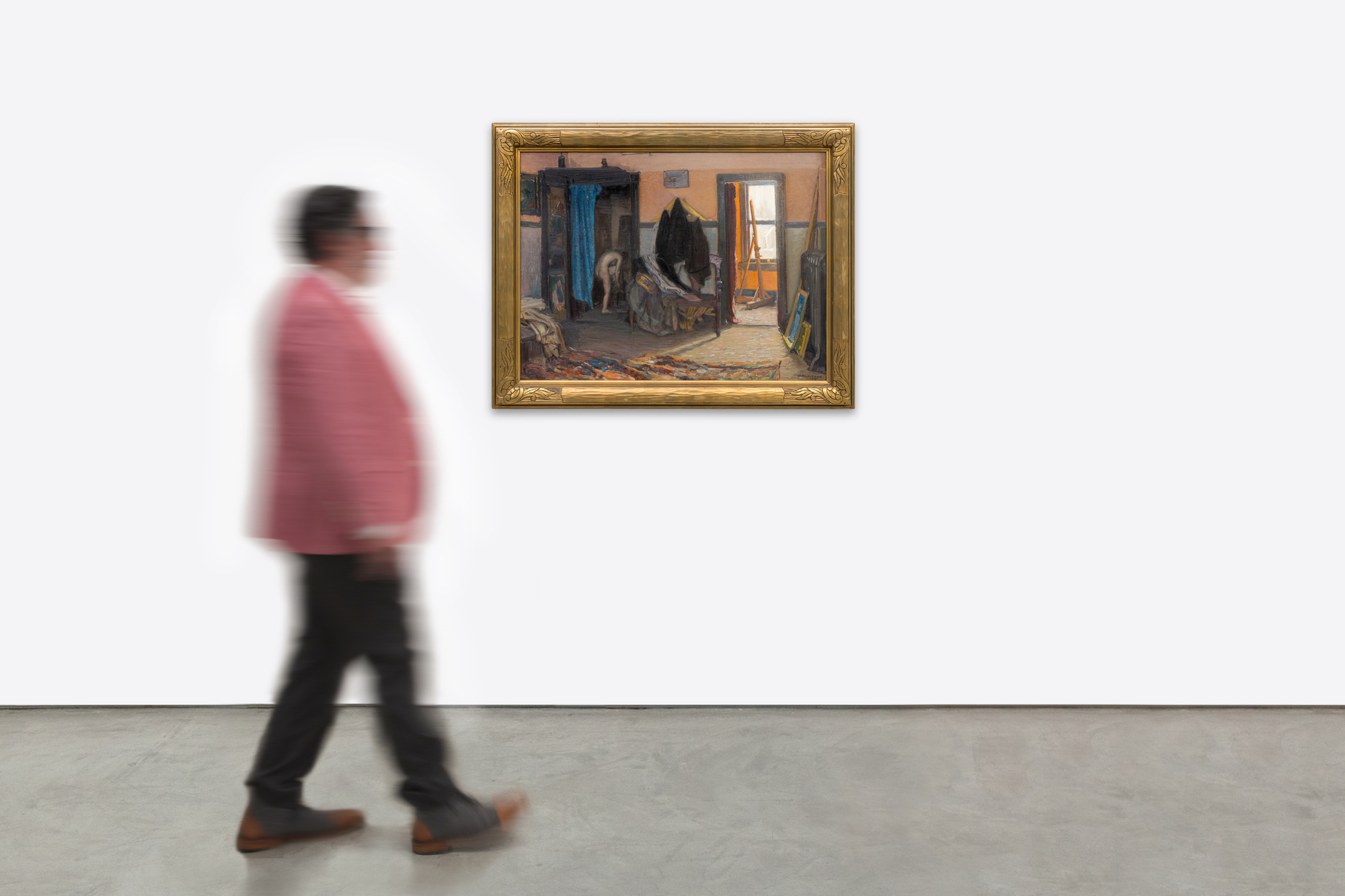
 
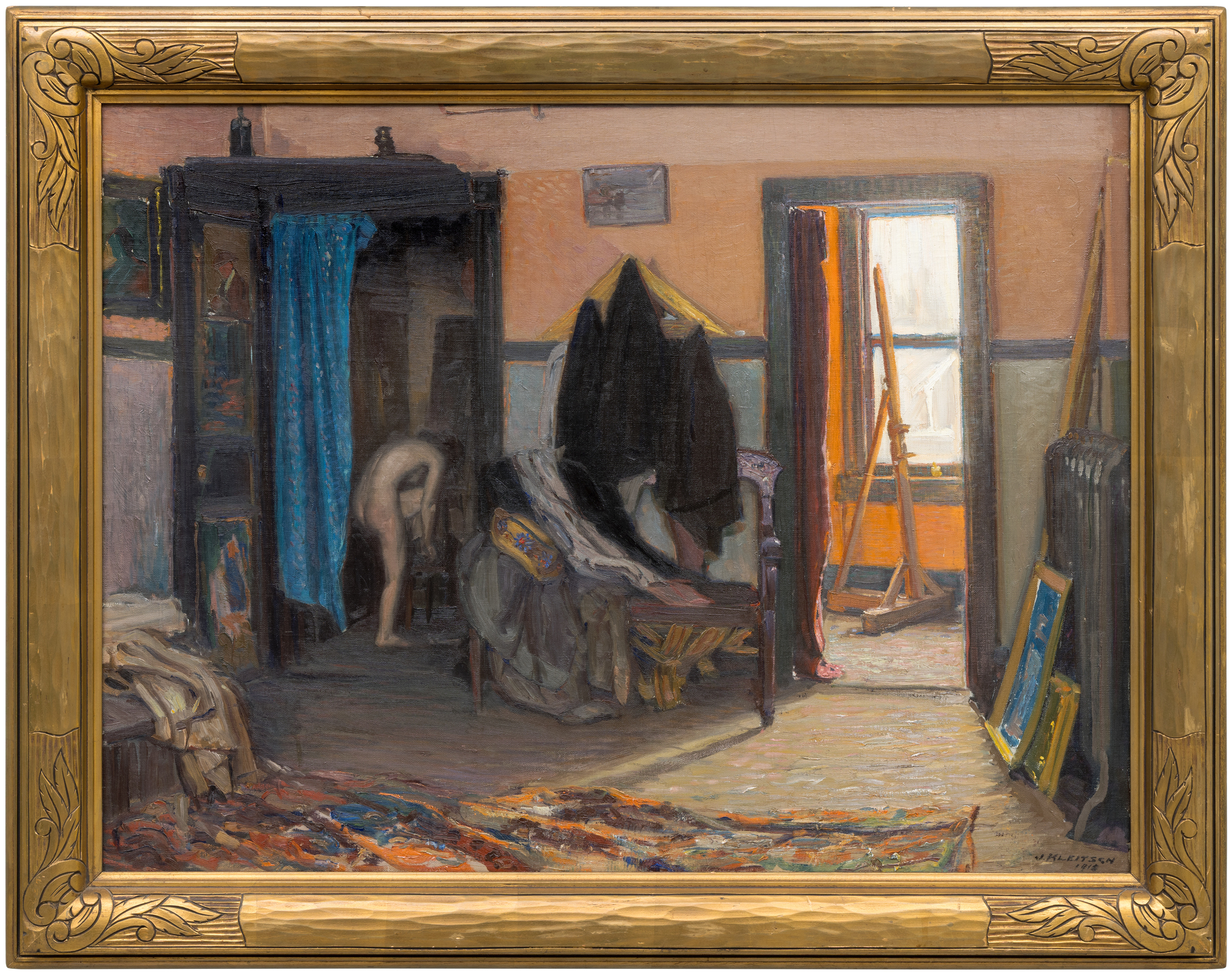
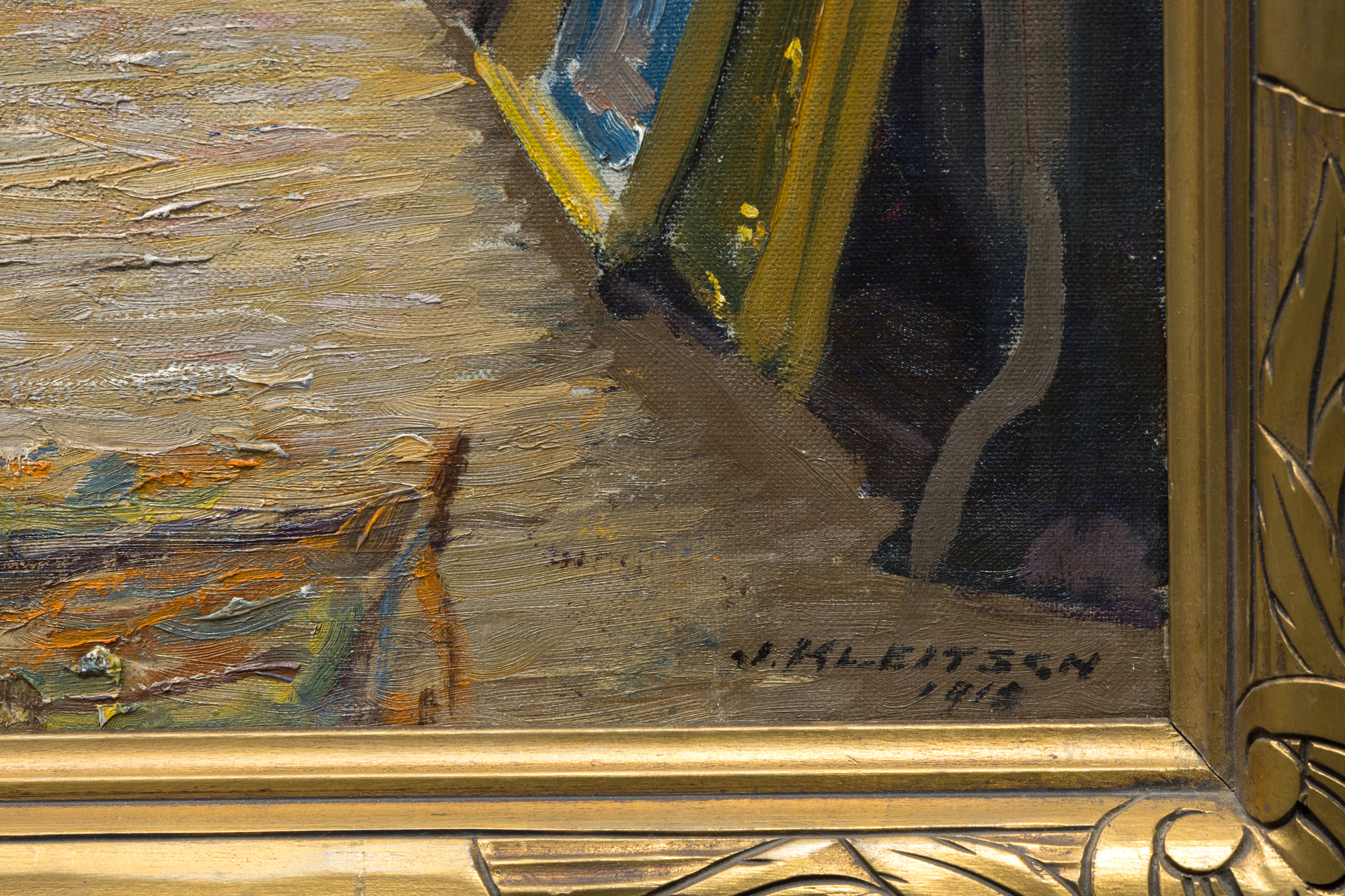
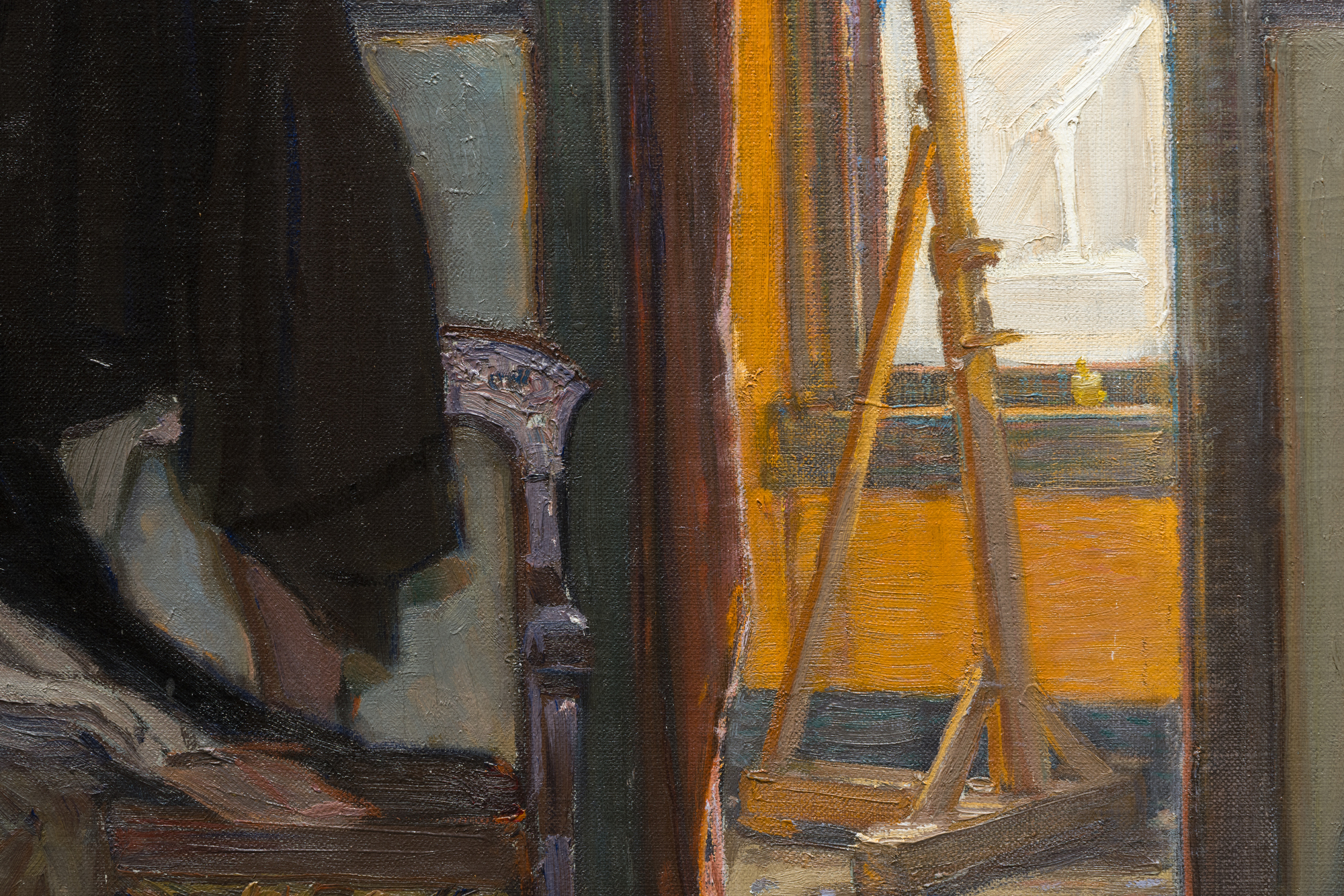
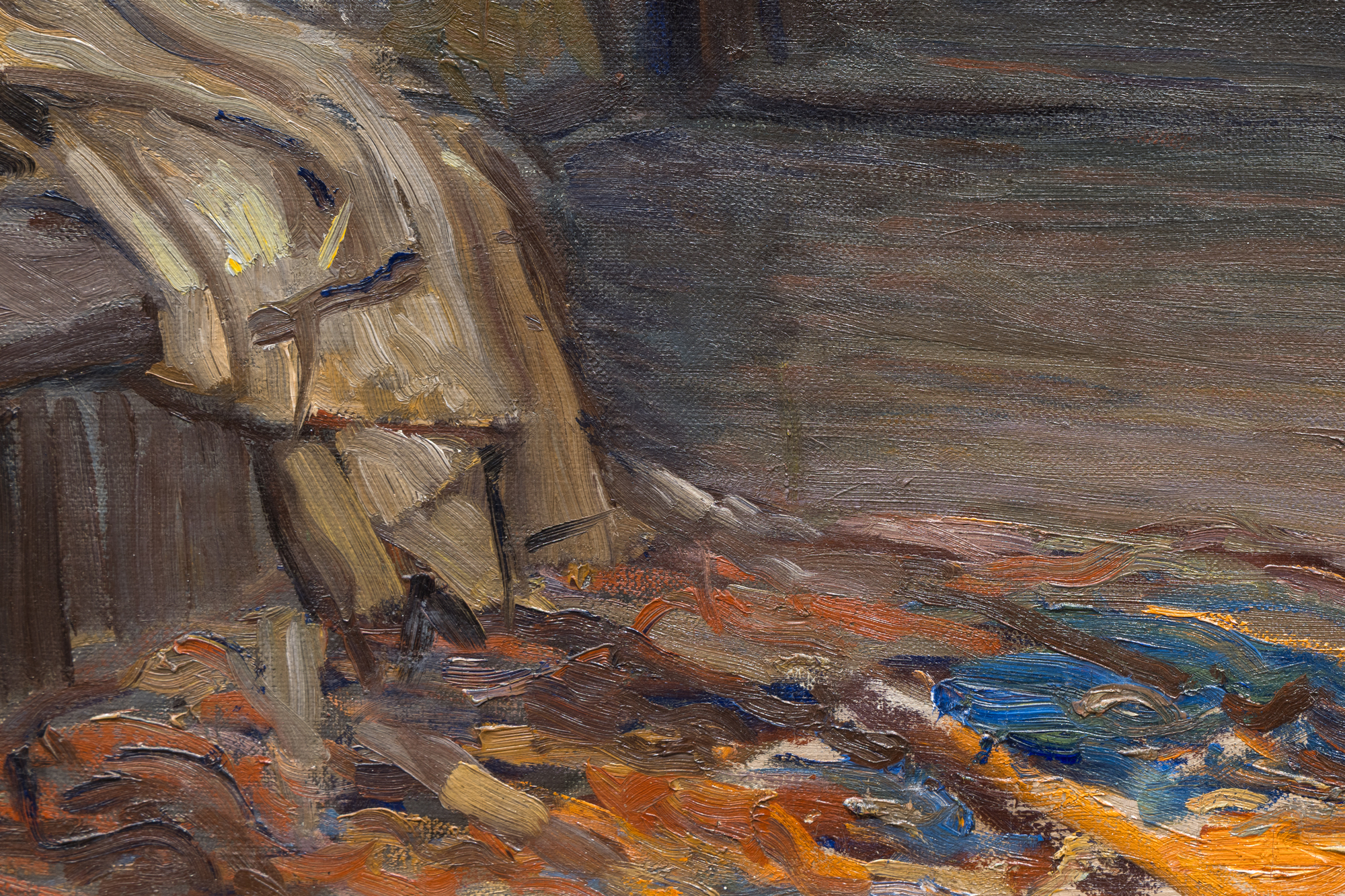
<div>Joseph Kleitsch’s <em>Studio Interior</em> (1918) is a compelling early work that reflects the artist’s academic-realist foundation and marks a pivotal moment just before his relocation from the Chicago to California. Painted shortly before this transition, the work reveals Kleitsch’s disciplined approach to composition and observation, shaped by his rigorous training in Budapest, Munich, and Paris. The scene depicts a quiet, lived-in studio space, where light enters through an open doorway to animate furniture, canvases, and everyday objects with a subdued yet attentive handling of color and tone. </div><br><br><div> </div><br><br><div>The interior is constructed with careful spatial logic and an emphasis on structure, underscoring Kleitsch’s preference for academic realism at this stage of his career. While in Chicago, his portrait and interior scenes were often distinguished by a “jeweled” palette—rich, saturated hues deployed with restraint—and that sensibility is evident here in the layered colors that enliven the otherwise low-keyed room. Subtle shifts in light guide the eye through the composition, balancing chromatic richness with solidity and calm. </div><br><br><div> </div><br><br><div>In the years leading up to his move west, Kleitsch was actively involved with Chicago’s artistic institutions, including the Palette and Chisel Club and the Art Institute of Chicago, situating him within a dynamic environment of evolving modern influences. During this time, Impressionist and Post-Impressionist works were increasingly visible in American exhibitions. While Kleitsch maintains a measured realism here, the Impressionist influence was incubating; he would later become renowned as a “master of gorgeous color” owing to the high-keyed vibrant palette of his California landscapes. </div><br><br><div> </div><br><br><div><em>Studio Interior</em> has been exhibited twice, both times in California, as part of exhibitions highlighting Kleitsch’s importance to the history of California art. Seen in retrospect, the painting offers a revealing glimpse of the artist’s roots before his later, more luminous California landscapes would come to define his legacy. </div><br><br><div> </div><br><br><div> </div> <div>Joseph Kleitsch’s <em>Studio Interior</em> (1918) is a compelling early work that reflects the artist’s academic-realist foundation and marks a pivotal moment just before his relocation from the Chicago to California. Painted shortly before this transition, the work reveals Kleitsch’s disciplined approach to composition and observation, shaped by his rigorous training in Budapest, Munich, and Paris. The scene depicts a quiet, lived-in studio space, where light enters through an open doorway to animate furniture, canvases, and everyday objects with a subdued yet attentive handling of color and tone. </div><br><br><div> </div><br><br><div>The interior is constructed with careful spatial logic and an emphasis on structure, underscoring Kleitsch’s preference for academic realism at this stage of his career. While in Chicago, his portrait and interior scenes were often distinguished by a “jeweled” palette—rich, saturated hues deployed with restraint—and that sensibility is evident here in the layered colors that enliven the otherwise low-keyed room. Subtle shifts in light guide the eye through the composition, balancing chromatic richness with solidity and calm. </div><br><br><div> </div><br><br><div>In the years leading up to his move west, Kleitsch was actively involved with Chicago’s artistic institutions, including the Palette and Chisel Club and the Art Institute of Chicago, situating him within a dynamic environment of evolving modern influences. During this time, Impressionist and Post-Impressionist works were increasingly visible in American exhibitions. While Kleitsch maintains a measured realism here, the Impressionist influence was incubating; he would later become renowned as a “master of gorgeous color” owing to the high-keyed vibrant palette of his California landscapes. </div><br><br><div> </div><br><br><div><em>Studio Interior</em> has been exhibited twice, both times in California, as part of exhibitions highlighting Kleitsch’s importance to the history of California art. Seen in retrospect, the painting offers a revealing glimpse of the artist’s roots before his later, more luminous California landscapes would come to define his legacy. </div><br><br><div> </div><br><br><div> </div> <div>Joseph Kleitsch’s <em>Studio Interior</em> (1918) is a compelling early work that reflects the artist’s academic-realist foundation and marks a pivotal moment just before his relocation from the Chicago to California. Painted shortly before this transition, the work reveals Kleitsch’s disciplined approach to composition and observation, shaped by his rigorous training in Budapest, Munich, and Paris. The scene depicts a quiet, lived-in studio space, where light enters through an open doorway to animate furniture, canvases, and everyday objects with a subdued yet attentive handling of color and tone. </div><br><br><div> </div><br><br><div>The interior is constructed with careful spatial logic and an emphasis on structure, underscoring Kleitsch’s preference for academic realism at this stage of his career. While in Chicago, his portrait and interior scenes were often distinguished by a “jeweled” palette—rich, saturated hues deployed with restraint—and that sensibility is evident here in the layered colors that enliven the otherwise low-keyed room. Subtle shifts in light guide the eye through the composition, balancing chromatic richness with solidity and calm. </div><br><br><div> </div><br><br><div>In the years leading up to his move west, Kleitsch was actively involved with Chicago’s artistic institutions, including the Palette and Chisel Club and the Art Institute of Chicago, situating him within a dynamic environment of evolving modern influences. During this time, Impressionist and Post-Impressionist works were increasingly visible in American exhibitions. While Kleitsch maintains a measured realism here, the Impressionist influence was incubating; he would later become renowned as a “master of gorgeous color” owing to the high-keyed vibrant palette of his California landscapes. </div><br><br><div> </div><br><br><div><em>Studio Interior</em> has been exhibited twice, both times in California, as part of exhibitions highlighting Kleitsch’s importance to the history of California art. Seen in retrospect, the painting offers a revealing glimpse of the artist’s roots before his later, more luminous California landscapes would come to define his legacy. </div><br><br><div> </div><br><br><div> </div> <div>Joseph Kleitsch’s <em>Studio Interior</em> (1918) is a compelling early work that reflects the artist’s academic-realist foundation and marks a pivotal moment just before his relocation from the Chicago to California. Painted shortly before this transition, the work reveals Kleitsch’s disciplined approach to composition and observation, shaped by his rigorous training in Budapest, Munich, and Paris. The scene depicts a quiet, lived-in studio space, where light enters through an open doorway to animate furniture, canvases, and everyday objects with a subdued yet attentive handling of color and tone. </div><br><br><div> </div><br><br><div>The interior is constructed with careful spatial logic and an emphasis on structure, underscoring Kleitsch’s preference for academic realism at this stage of his career. While in Chicago, his portrait and interior scenes were often distinguished by a “jeweled” palette—rich, saturated hues deployed with restraint—and that sensibility is evident here in the layered colors that enliven the otherwise low-keyed room. Subtle shifts in light guide the eye through the composition, balancing chromatic richness with solidity and calm. </div><br><br><div> </div><br><br><div>In the years leading up to his move west, Kleitsch was actively involved with Chicago’s artistic institutions, including the Palette and Chisel Club and the Art Institute of Chicago, situating him within a dynamic environment of evolving modern influences. During this time, Impressionist and Post-Impressionist works were increasingly visible in American exhibitions. While Kleitsch maintains a measured realism here, the Impressionist influence was incubating; he would later become renowned as a “master of gorgeous color” owing to the high-keyed vibrant palette of his California landscapes. </div><br><br><div> </div><br><br><div><em>Studio Interior</em> has been exhibited twice, both times in California, as part of exhibitions highlighting Kleitsch’s importance to the history of California art. Seen in retrospect, the painting offers a revealing glimpse of the artist’s roots before his later, more luminous California landscapes would come to define his legacy. </div><br><br><div> </div><br><br><div> </div> <div>Joseph Kleitsch’s <em>Studio Interior</em> (1918) is a compelling early work that reflects the artist’s academic-realist foundation and marks a pivotal moment just before his relocation from the Chicago to California. Painted shortly before this transition, the work reveals Kleitsch’s disciplined approach to composition and observation, shaped by his rigorous training in Budapest, Munich, and Paris. The scene depicts a quiet, lived-in studio space, where light enters through an open doorway to animate furniture, canvases, and everyday objects with a subdued yet attentive handling of color and tone. </div><br><br><div> </div><br><br><div>The interior is constructed with careful spatial logic and an emphasis on structure, underscoring Kleitsch’s preference for academic realism at this stage of his career. While in Chicago, his portrait and interior scenes were often distinguished by a “jeweled” palette—rich, saturated hues deployed with restraint—and that sensibility is evident here in the layered colors that enliven the otherwise low-keyed room. Subtle shifts in light guide the eye through the composition, balancing chromatic richness with solidity and calm. </div><br><br><div> </div><br><br><div>In the years leading up to his move west, Kleitsch was actively involved with Chicago’s artistic institutions, including the Palette and Chisel Club and the Art Institute of Chicago, situating him within a dynamic environment of evolving modern influences. During this time, Impressionist and Post-Impressionist works were increasingly visible in American exhibitions. While Kleitsch maintains a measured realism here, the Impressionist influence was incubating; he would later become renowned as a “master of gorgeous color” owing to the high-keyed vibrant palette of his California landscapes. </div><br><br><div> </div><br><br><div><em>Studio Interior</em> has been exhibited twice, both times in California, as part of exhibitions highlighting Kleitsch’s importance to the history of California art. Seen in retrospect, the painting offers a revealing glimpse of the artist’s roots before his later, more luminous California landscapes would come to define his legacy. </div><br><br><div> </div><br><br><div> </div> <div>Joseph Kleitsch’s <em>Studio Interior</em> (1918) is a compelling early work that reflects the artist’s academic-realist foundation and marks a pivotal moment just before his relocation from the Chicago to California. Painted shortly before this transition, the work reveals Kleitsch’s disciplined approach to composition and observation, shaped by his rigorous training in Budapest, Munich, and Paris. The scene depicts a quiet, lived-in studio space, where light enters through an open doorway to animate furniture, canvases, and everyday objects with a subdued yet attentive handling of color and tone. </div><br><br><div> </div><br><br><div>The interior is constructed with careful spatial logic and an emphasis on structure, underscoring Kleitsch’s preference for academic realism at this stage of his career. While in Chicago, his portrait and interior scenes were often distinguished by a “jeweled” palette—rich, saturated hues deployed with restraint—and that sensibility is evident here in the layered colors that enliven the otherwise low-keyed room. Subtle shifts in light guide the eye through the composition, balancing chromatic richness with solidity and calm. </div><br><br><div> </div><br><br><div>In the years leading up to his move west, Kleitsch was actively involved with Chicago’s artistic institutions, including the Palette and Chisel Club and the Art Institute of Chicago, situating him within a dynamic environment of evolving modern influences. During this time, Impressionist and Post-Impressionist works were increasingly visible in American exhibitions. While Kleitsch maintains a measured realism here, the Impressionist influence was incubating; he would later become renowned as a “master of gorgeous color” owing to the high-keyed vibrant palette of his California landscapes. </div><br><br><div> </div><br><br><div><em>Studio Interior</em> has been exhibited twice, both times in California, as part of exhibitions highlighting Kleitsch’s importance to the history of California art. Seen in retrospect, the painting offers a revealing glimpse of the artist’s roots before his later, more luminous California landscapes would come to define his legacy. </div><br><br><div> </div><br><br><div> </div> <div>Joseph Kleitsch’s <em>Studio Interior</em> (1918) is a compelling early work that reflects the artist’s academic-realist foundation and marks a pivotal moment just before his relocation from the Chicago to California. Painted shortly before this transition, the work reveals Kleitsch’s disciplined approach to composition and observation, shaped by his rigorous training in Budapest, Munich, and Paris. The scene depicts a quiet, lived-in studio space, where light enters through an open doorway to animate furniture, canvases, and everyday objects with a subdued yet attentive handling of color and tone. </div><br><br><div> </div><br><br><div>The interior is constructed with careful spatial logic and an emphasis on structure, underscoring Kleitsch’s preference for academic realism at this stage of his career. While in Chicago, his portrait and interior scenes were often distinguished by a “jeweled” palette—rich, saturated hues deployed with restraint—and that sensibility is evident here in the layered colors that enliven the otherwise low-keyed room. Subtle shifts in light guide the eye through the composition, balancing chromatic richness with solidity and calm. </div><br><br><div> </div><br><br><div>In the years leading up to his move west, Kleitsch was actively involved with Chicago’s artistic institutions, including the Palette and Chisel Club and the Art Institute of Chicago, situating him within a dynamic environment of evolving modern influences. During this time, Impressionist and Post-Impressionist works were increasingly visible in American exhibitions. While Kleitsch maintains a measured realism here, the Impressionist influence was incubating; he would later become renowned as a “master of gorgeous color” owing to the high-keyed vibrant palette of his California landscapes. </div><br><br><div> </div><br><br><div><em>Studio Interior</em> has been exhibited twice, both times in California, as part of exhibitions highlighting Kleitsch’s importance to the history of California art. Seen in retrospect, the painting offers a revealing glimpse of the artist’s roots before his later, more luminous California landscapes would come to define his legacy. </div><br><br><div> </div><br><br><div> </div> <div>Joseph Kleitsch’s <em>Studio Interior</em> (1918) is a compelling early work that reflects the artist’s academic-realist foundation and marks a pivotal moment just before his relocation from the Chicago to California. Painted shortly before this transition, the work reveals Kleitsch’s disciplined approach to composition and observation, shaped by his rigorous training in Budapest, Munich, and Paris. The scene depicts a quiet, lived-in studio space, where light enters through an open doorway to animate furniture, canvases, and everyday objects with a subdued yet attentive handling of color and tone. </div><br><br><div> </div><br><br><div>The interior is constructed with careful spatial logic and an emphasis on structure, underscoring Kleitsch’s preference for academic realism at this stage of his career. While in Chicago, his portrait and interior scenes were often distinguished by a “jeweled” palette—rich, saturated hues deployed with restraint—and that sensibility is evident here in the layered colors that enliven the otherwise low-keyed room. Subtle shifts in light guide the eye through the composition, balancing chromatic richness with solidity and calm. </div><br><br><div> </div><br><br><div>In the years leading up to his move west, Kleitsch was actively involved with Chicago’s artistic institutions, including the Palette and Chisel Club and the Art Institute of Chicago, situating him within a dynamic environment of evolving modern influences. During this time, Impressionist and Post-Impressionist works were increasingly visible in American exhibitions. While Kleitsch maintains a measured realism here, the Impressionist influence was incubating; he would later become renowned as a “master of gorgeous color” owing to the high-keyed vibrant palette of his California landscapes. </div><br><br><div> </div><br><br><div><em>Studio Interior</em> has been exhibited twice, both times in California, as part of exhibitions highlighting Kleitsch’s importance to the history of California art. Seen in retrospect, the painting offers a revealing glimpse of the artist’s roots before his later, more luminous California landscapes would come to define his legacy. </div><br><br><div> </div><br><br><div> </div> <div>Joseph Kleitsch’s <em>Studio Interior</em> (1918) is a compelling early work that reflects the artist’s academic-realist foundation and marks a pivotal moment just before his relocation from the Chicago to California. Painted shortly before this transition, the work reveals Kleitsch’s disciplined approach to composition and observation, shaped by his rigorous training in Budapest, Munich, and Paris. The scene depicts a quiet, lived-in studio space, where light enters through an open doorway to animate furniture, canvases, and everyday objects with a subdued yet attentive handling of color and tone. </div><br><br><div> </div><br><br><div>The interior is constructed with careful spatial logic and an emphasis on structure, underscoring Kleitsch’s preference for academic realism at this stage of his career. While in Chicago, his portrait and interior scenes were often distinguished by a “jeweled” palette—rich, saturated hues deployed with restraint—and that sensibility is evident here in the layered colors that enliven the otherwise low-keyed room. Subtle shifts in light guide the eye through the composition, balancing chromatic richness with solidity and calm. </div><br><br><div> </div><br><br><div>In the years leading up to his move west, Kleitsch was actively involved with Chicago’s artistic institutions, including the Palette and Chisel Club and the Art Institute of Chicago, situating him within a dynamic environment of evolving modern influences. During this time, Impressionist and Post-Impressionist works were increasingly visible in American exhibitions. While Kleitsch maintains a measured realism here, the Impressionist influence was incubating; he would later become renowned as a “master of gorgeous color” owing to the high-keyed vibrant palette of his California landscapes. </div><br><br><div> </div><br><br><div><em>Studio Interior</em> has been exhibited twice, both times in California, as part of exhibitions highlighting Kleitsch’s importance to the history of California art. Seen in retrospect, the painting offers a revealing glimpse of the artist’s roots before his later, more luminous California landscapes would come to define his legacy. </div><br><br><div> </div><br><br><div> </div> <div>Joseph Kleitsch’s <em>Studio Interior</em> (1918) is a compelling early work that reflects the artist’s academic-realist foundation and marks a pivotal moment just before his relocation from the Chicago to California. Painted shortly before this transition, the work reveals Kleitsch’s disciplined approach to composition and observation, shaped by his rigorous training in Budapest, Munich, and Paris. The scene depicts a quiet, lived-in studio space, where light enters through an open doorway to animate furniture, canvases, and everyday objects with a subdued yet attentive handling of color and tone. </div><br><br><div> </div><br><br><div>The interior is constructed with careful spatial logic and an emphasis on structure, underscoring Kleitsch’s preference for academic realism at this stage of his career. While in Chicago, his portrait and interior scenes were often distinguished by a “jeweled” palette—rich, saturated hues deployed with restraint—and that sensibility is evident here in the layered colors that enliven the otherwise low-keyed room. Subtle shifts in light guide the eye through the composition, balancing chromatic richness with solidity and calm. </div><br><br><div> </div><br><br><div>In the years leading up to his move west, Kleitsch was actively involved with Chicago’s artistic institutions, including the Palette and Chisel Club and the Art Institute of Chicago, situating him within a dynamic environment of evolving modern influences. During this time, Impressionist and Post-Impressionist works were increasingly visible in American exhibitions. While Kleitsch maintains a measured realism here, the Impressionist influence was incubating; he would later become renowned as a “master of gorgeous color” owing to the high-keyed vibrant palette of his California landscapes. </div><br><br><div> </div><br><br><div><em>Studio Interior</em> has been exhibited twice, both times in California, as part of exhibitions highlighting Kleitsch’s importance to the history of California art. Seen in retrospect, the painting offers a revealing glimpse of the artist’s roots before his later, more luminous California landscapes would come to define his legacy. </div><br><br><div> </div><br><br><div> </div>
スタジオの内部1918年30 x 40 インチ(76.2 x 101.6 cm) 油彩・キャンバス
出所
ジョージ・スターン・ファインアーツ
個人コレクション、上記より取得、2012年
展示会
カリフォルニア州パサデナ、パサデナ・カリフォルニア美術館、『黄金の20年代:ジョセフ・クライチによる肖像画と人物画』、2017年3月5日~8月6日
カリフォルニア州ラグナビーチ、ラグナ美術館、『ジョセフ・クライチ:古きラグナにおける海外と故郷』、2023年6月24日~9月24日
ヨーゼフ・クライチ『アトリエの室内』(1918年)は、画家のアカデミック・リアリズムの基盤を反映した説得力ある初期作品であり、シカゴからカリフォルニアへの移住直前の重要な転換点を示す。この移行直前に描かれた本作は、ブダペスト、ミュンヘン、パリでの厳格な訓練によって培われた、クライチの構図と観察に対する規律あるアプローチを明らかにしている。 この作品は、静かで生活感あふれるアトリエ空間を描いている。開かれたドアから差し込む光が、家具やキャンバス、日用品を、控えめでありながら注意深い色彩とトーンの扱いによって生き生きと浮かび上がらせている。


空間は緻密な論理と構造重視で構築され、この時期のクライチがアカデミックな写実主義を志向していたことを裏付ける。シカゴ時代、彼の肖像画や室内画は「宝石のような」色彩——豊かで飽和した色調を抑制的に用いる手法——で特徴づけられたが、その感性は本作でも、控えめな空間に活気を与える層状の色彩に顕著に表れている。 微妙な光の移り変わりが視線を構図内へと導き、色彩の豊かさと堅牢さ、静謐さのバランスを取っている。


西海岸移住前の数年間、クライチはパレット・アンド・チゼル・クラブやシカゴ美術館などシカゴの芸術機関に積極的に関与し、進化する近代的潮流が渦巻く環境の中に身を置いていた。 この時期、アメリカ展覧会では印象派・後期印象派作品が次第に目立つようになっていた。クライチは本作で抑制された写実主義を維持しつつも、印象派の影響が潜んでいた。後にカリフォルニア風景画の高彩度で鮮やかなパレットにより「華麗なる色彩の巨匠」として名声を確立する。


『アトリエの室内』は、カリフォルニア美術史におけるクライチの位置付けを強調する展覧会の一環として、二度(いずれもカリフォルニア州で)展示された。後世の視点から見れば、この作品は、後に彼の遺産を定義づけることになるより輝かしいカリフォルニア風景画を描く以前の、芸術家のルーツを明らかにする貴重な一瞥を提供している。


お 問い合わせ