Précédent

MARC CHAGALL-nbsp(1887-1985)

 
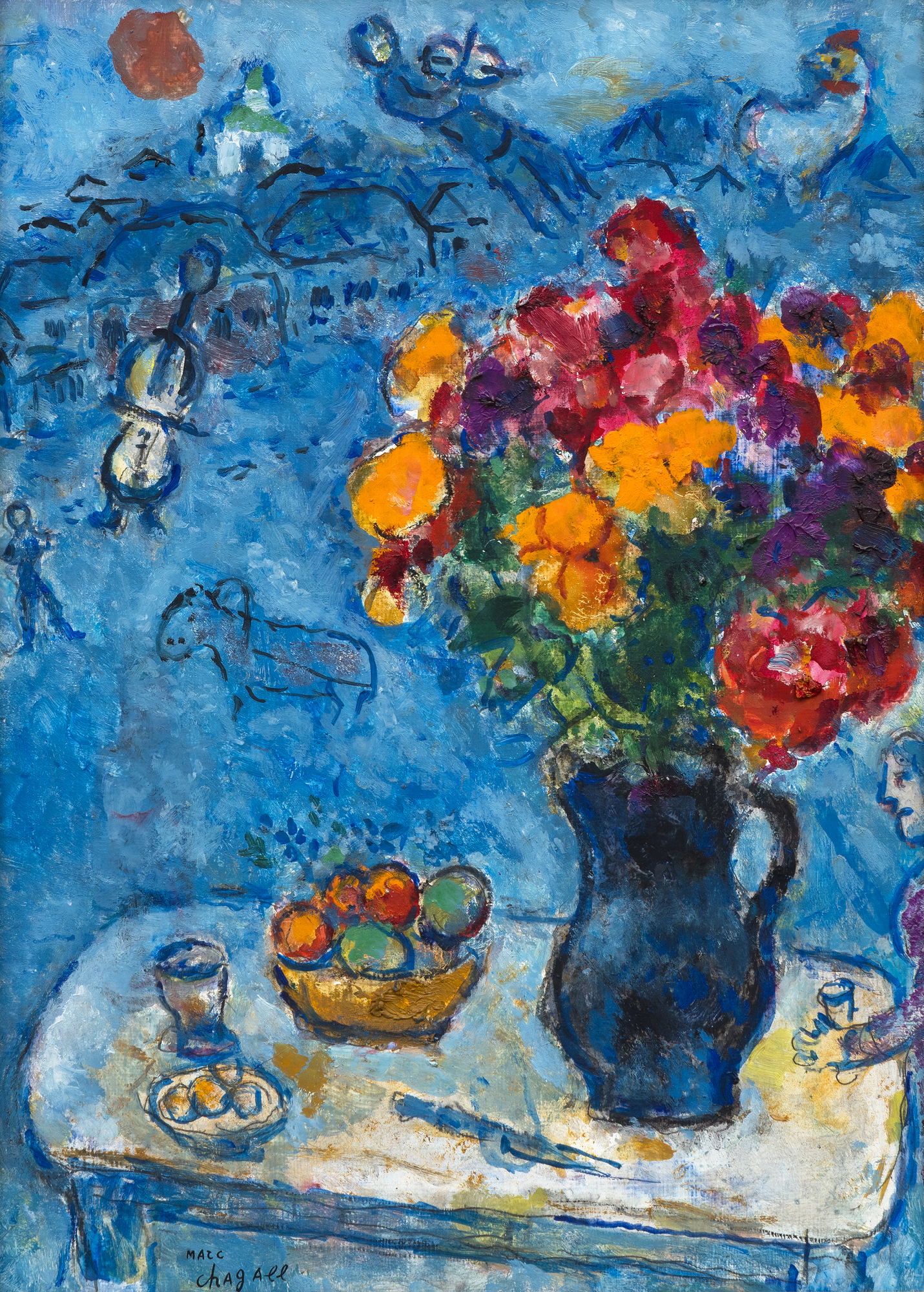
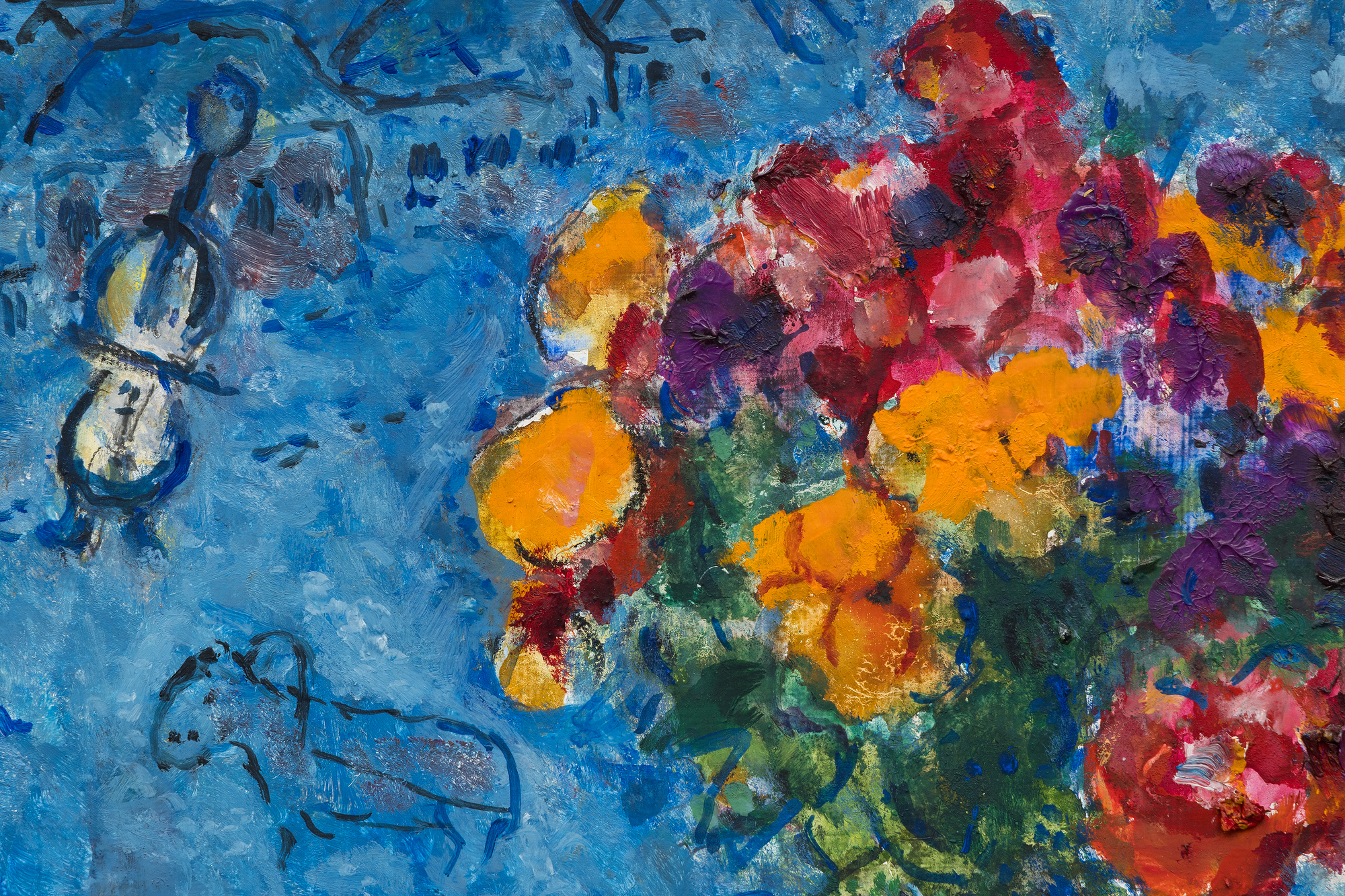
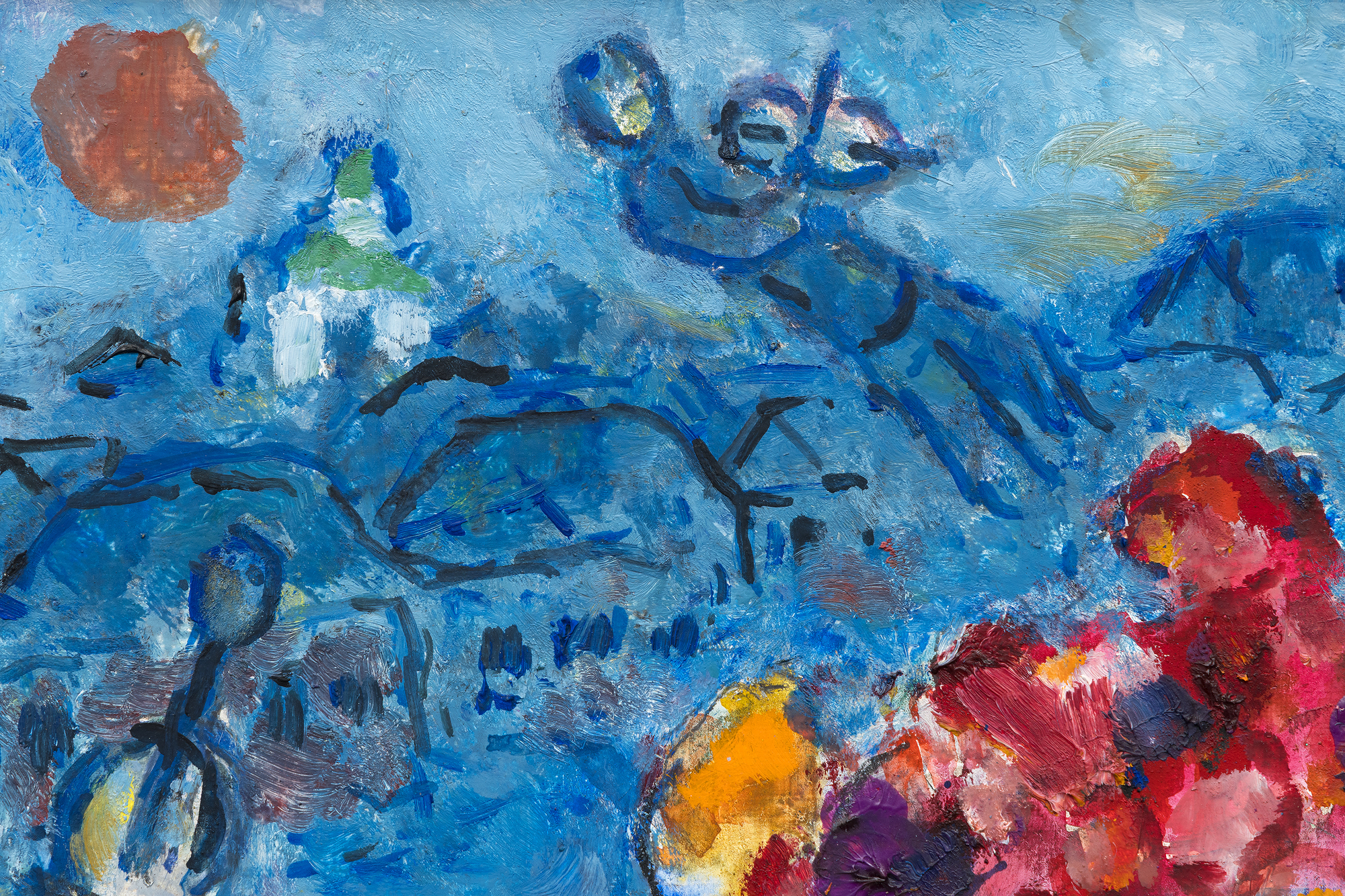
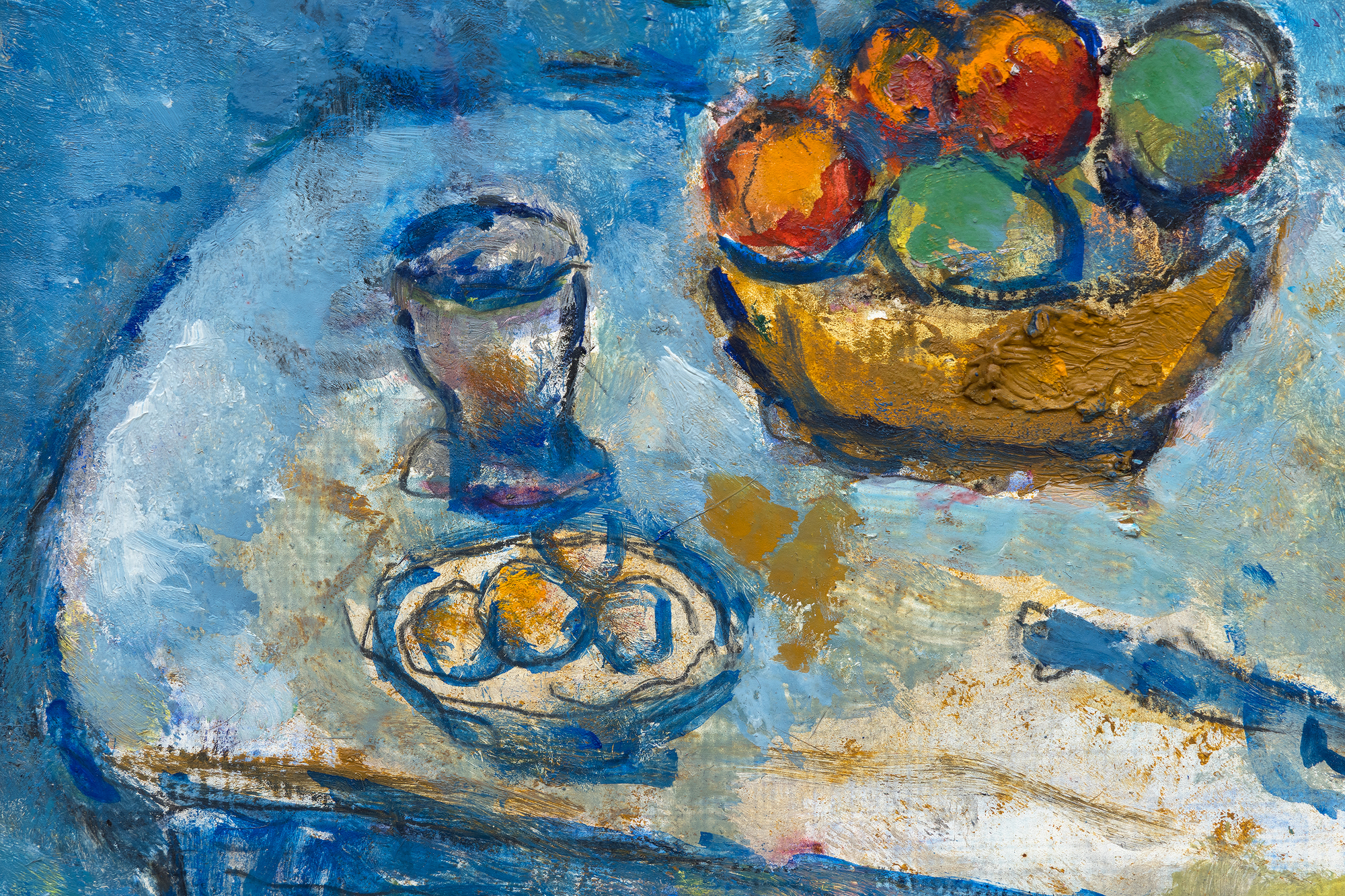
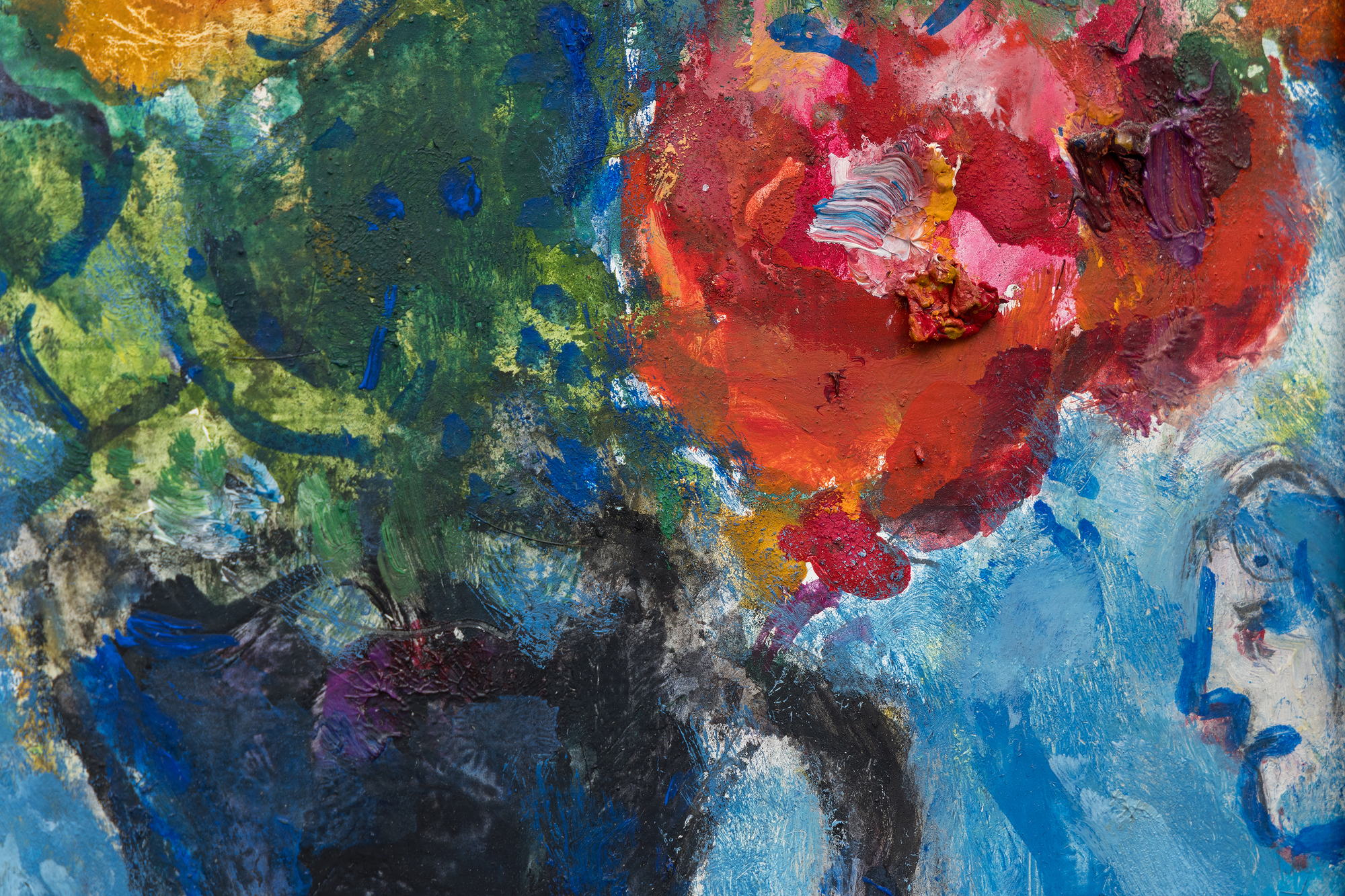
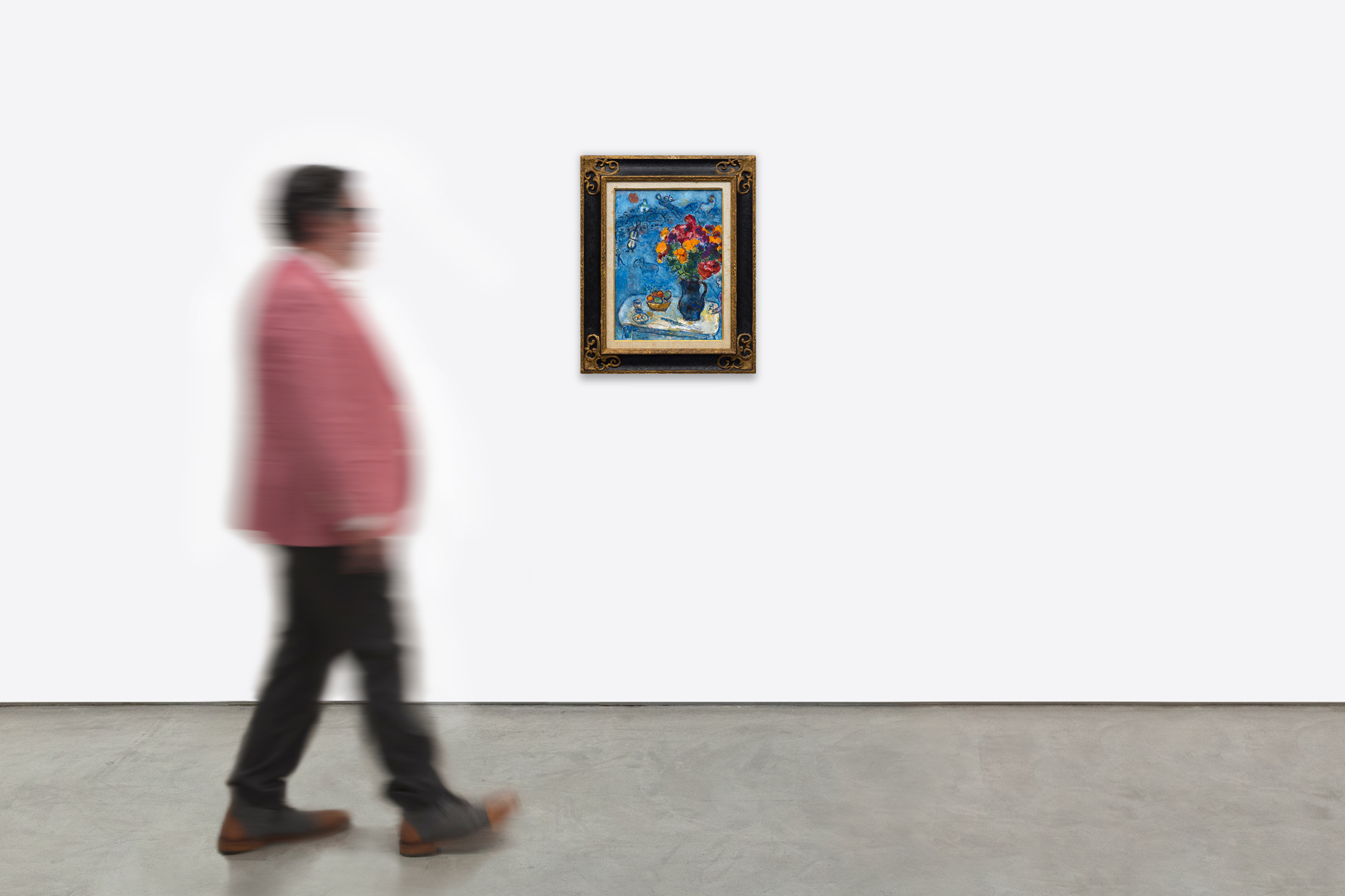
<div><font face=Lato size=3 color=black>Marc Chagall’s <em>Sur la table</em> is a radiant celebration of color, memory, and imagination. Bathed in a deep blue palette, the painting brings together several of the artist’s most beloved motifs: a rooster, violinist, goat, and exuberant bouquet. The composition is animated with Chagall’s signature sense of movement and dreamlike harmony, creating a world where everyday life, folklore, and love coexist in vibrant equilibrium.</font></div><br><br><div> </div><br><br><div><font face=Lato size=3 color=black>Painted in a richly productive period just after Chagall’s return to his homeland in the early 1970s, <em>Sur la table</em> reflects the renewed emotional and visual energy that came from reconnecting with his roots in Vitebsk, represented here by the white domed church in the distance. The expansive bouquet, one of Chagall’s enduring symbols of love for his first wife, Bella, dominates the foreground and infuses the work with emotional warmth and vitality.</font></div><br><br><div> </div><br><br><div><font face=Lato size=3 color=black>The painting remained in Chagall’s own collection and estate until after his death in 1985, underscoring its personal significance. Authenticated by the Comité Marc Chagall, <em>Sur la table</em> belongs to a lineage of floral and symbolic compositions that define his mature work.</font></div> <div><font face=Lato size=3 color=black>Marc Chagall’s <em>Sur la table</em> is a radiant celebration of color, memory, and imagination. Bathed in a deep blue palette, the painting brings together several of the artist’s most beloved motifs: a rooster, violinist, goat, and exuberant bouquet. The composition is animated with Chagall’s signature sense of movement and dreamlike harmony, creating a world where everyday life, folklore, and love coexist in vibrant equilibrium.</font></div><br><br><div> </div><br><br><div><font face=Lato size=3 color=black>Painted in a richly productive period just after Chagall’s return to his homeland in the early 1970s, <em>Sur la table</em> reflects the renewed emotional and visual energy that came from reconnecting with his roots in Vitebsk, represented here by the white domed church in the distance. The expansive bouquet, one of Chagall’s enduring symbols of love for his first wife, Bella, dominates the foreground and infuses the work with emotional warmth and vitality.</font></div><br><br><div> </div><br><br><div><font face=Lato size=3 color=black>The painting remained in Chagall’s own collection and estate until after his death in 1985, underscoring its personal significance. Authenticated by the Comité Marc Chagall, <em>Sur la table</em> belongs to a lineage of floral and symbolic compositions that define his mature work.</font></div> <div><font face=Lato size=3 color=black>Marc Chagall’s <em>Sur la table</em> is a radiant celebration of color, memory, and imagination. Bathed in a deep blue palette, the painting brings together several of the artist’s most beloved motifs: a rooster, violinist, goat, and exuberant bouquet. The composition is animated with Chagall’s signature sense of movement and dreamlike harmony, creating a world where everyday life, folklore, and love coexist in vibrant equilibrium.</font></div><br><br><div> </div><br><br><div><font face=Lato size=3 color=black>Painted in a richly productive period just after Chagall’s return to his homeland in the early 1970s, <em>Sur la table</em> reflects the renewed emotional and visual energy that came from reconnecting with his roots in Vitebsk, represented here by the white domed church in the distance. The expansive bouquet, one of Chagall’s enduring symbols of love for his first wife, Bella, dominates the foreground and infuses the work with emotional warmth and vitality.</font></div><br><br><div> </div><br><br><div><font face=Lato size=3 color=black>The painting remained in Chagall’s own collection and estate until after his death in 1985, underscoring its personal significance. Authenticated by the Comité Marc Chagall, <em>Sur la table</em> belongs to a lineage of floral and symbolic compositions that define his mature work.</font></div> <div><font face=Lato size=3 color=black>Marc Chagall’s <em>Sur la table</em> is a radiant celebration of color, memory, and imagination. Bathed in a deep blue palette, the painting brings together several of the artist’s most beloved motifs: a rooster, violinist, goat, and exuberant bouquet. The composition is animated with Chagall’s signature sense of movement and dreamlike harmony, creating a world where everyday life, folklore, and love coexist in vibrant equilibrium.</font></div><br><br><div> </div><br><br><div><font face=Lato size=3 color=black>Painted in a richly productive period just after Chagall’s return to his homeland in the early 1970s, <em>Sur la table</em> reflects the renewed emotional and visual energy that came from reconnecting with his roots in Vitebsk, represented here by the white domed church in the distance. The expansive bouquet, one of Chagall’s enduring symbols of love for his first wife, Bella, dominates the foreground and infuses the work with emotional warmth and vitality.</font></div><br><br><div> </div><br><br><div><font face=Lato size=3 color=black>The painting remained in Chagall’s own collection and estate until after his death in 1985, underscoring its personal significance. Authenticated by the Comité Marc Chagall, <em>Sur la table</em> belongs to a lineage of floral and symbolic compositions that define his mature work.</font></div> <div><font face=Lato size=3 color=black>Marc Chagall’s <em>Sur la table</em> is a radiant celebration of color, memory, and imagination. Bathed in a deep blue palette, the painting brings together several of the artist’s most beloved motifs: a rooster, violinist, goat, and exuberant bouquet. The composition is animated with Chagall’s signature sense of movement and dreamlike harmony, creating a world where everyday life, folklore, and love coexist in vibrant equilibrium.</font></div><br><br><div> </div><br><br><div><font face=Lato size=3 color=black>Painted in a richly productive period just after Chagall’s return to his homeland in the early 1970s, <em>Sur la table</em> reflects the renewed emotional and visual energy that came from reconnecting with his roots in Vitebsk, represented here by the white domed church in the distance. The expansive bouquet, one of Chagall’s enduring symbols of love for his first wife, Bella, dominates the foreground and infuses the work with emotional warmth and vitality.</font></div><br><br><div> </div><br><br><div><font face=Lato size=3 color=black>The painting remained in Chagall’s own collection and estate until after his death in 1985, underscoring its personal significance. Authenticated by the Comité Marc Chagall, <em>Sur la table</em> belongs to a lineage of floral and symbolic compositions that define his mature work.</font></div> <div><font face=Lato size=3 color=black>Marc Chagall’s <em>Sur la table</em> is a radiant celebration of color, memory, and imagination. Bathed in a deep blue palette, the painting brings together several of the artist’s most beloved motifs: a rooster, violinist, goat, and exuberant bouquet. The composition is animated with Chagall’s signature sense of movement and dreamlike harmony, creating a world where everyday life, folklore, and love coexist in vibrant equilibrium.</font></div><br><br><div> </div><br><br><div><font face=Lato size=3 color=black>Painted in a richly productive period just after Chagall’s return to his homeland in the early 1970s, <em>Sur la table</em> reflects the renewed emotional and visual energy that came from reconnecting with his roots in Vitebsk, represented here by the white domed church in the distance. The expansive bouquet, one of Chagall’s enduring symbols of love for his first wife, Bella, dominates the foreground and infuses the work with emotional warmth and vitality.</font></div><br><br><div> </div><br><br><div><font face=Lato size=3 color=black>The painting remained in Chagall’s own collection and estate until after his death in 1985, underscoring its personal significance. Authenticated by the Comité Marc Chagall, <em>Sur la table</em> belongs to a lineage of floral and symbolic compositions that define his mature work.</font></div> <div><font face=Lato size=3 color=black>Marc Chagall’s <em>Sur la table</em> is a radiant celebration of color, memory, and imagination. Bathed in a deep blue palette, the painting brings together several of the artist’s most beloved motifs: a rooster, violinist, goat, and exuberant bouquet. The composition is animated with Chagall’s signature sense of movement and dreamlike harmony, creating a world where everyday life, folklore, and love coexist in vibrant equilibrium.</font></div><br><br><div> </div><br><br><div><font face=Lato size=3 color=black>Painted in a richly productive period just after Chagall’s return to his homeland in the early 1970s, <em>Sur la table</em> reflects the renewed emotional and visual energy that came from reconnecting with his roots in Vitebsk, represented here by the white domed church in the distance. The expansive bouquet, one of Chagall’s enduring symbols of love for his first wife, Bella, dominates the foreground and infuses the work with emotional warmth and vitality.</font></div><br><br><div> </div><br><br><div><font face=Lato size=3 color=black>The painting remained in Chagall’s own collection and estate until after his death in 1985, underscoring its personal significance. Authenticated by the Comité Marc Chagall, <em>Sur la table</em> belongs to a lineage of floral and symbolic compositions that define his mature work.</font></div> <div><font face=Lato size=3 color=black>Marc Chagall’s <em>Sur la table</em> is a radiant celebration of color, memory, and imagination. Bathed in a deep blue palette, the painting brings together several of the artist’s most beloved motifs: a rooster, violinist, goat, and exuberant bouquet. The composition is animated with Chagall’s signature sense of movement and dreamlike harmony, creating a world where everyday life, folklore, and love coexist in vibrant equilibrium.</font></div><br><br><div> </div><br><br><div><font face=Lato size=3 color=black>Painted in a richly productive period just after Chagall’s return to his homeland in the early 1970s, <em>Sur la table</em> reflects the renewed emotional and visual energy that came from reconnecting with his roots in Vitebsk, represented here by the white domed church in the distance. The expansive bouquet, one of Chagall’s enduring symbols of love for his first wife, Bella, dominates the foreground and infuses the work with emotional warmth and vitality.</font></div><br><br><div> </div><br><br><div><font face=Lato size=3 color=black>The painting remained in Chagall’s own collection and estate until after his death in 1985, underscoring its personal significance. Authenticated by the Comité Marc Chagall, <em>Sur la table</em> belongs to a lineage of floral and symbolic compositions that define his mature work.</font></div> <div><font face=Lato size=3 color=black>Marc Chagall’s <em>Sur la table</em> is a radiant celebration of color, memory, and imagination. Bathed in a deep blue palette, the painting brings together several of the artist’s most beloved motifs: a rooster, violinist, goat, and exuberant bouquet. The composition is animated with Chagall’s signature sense of movement and dreamlike harmony, creating a world where everyday life, folklore, and love coexist in vibrant equilibrium.</font></div><br><br><div> </div><br><br><div><font face=Lato size=3 color=black>Painted in a richly productive period just after Chagall’s return to his homeland in the early 1970s, <em>Sur la table</em> reflects the renewed emotional and visual energy that came from reconnecting with his roots in Vitebsk, represented here by the white domed church in the distance. The expansive bouquet, one of Chagall’s enduring symbols of love for his first wife, Bella, dominates the foreground and infuses the work with emotional warmth and vitality.</font></div><br><br><div> </div><br><br><div><font face=Lato size=3 color=black>The painting remained in Chagall’s own collection and estate until after his death in 1985, underscoring its personal significance. Authenticated by the Comité Marc Chagall, <em>Sur la table</em> belongs to a lineage of floral and symbolic compositions that define his mature work.</font></div> <div><font face=Lato size=3 color=black>Marc Chagall’s <em>Sur la table</em> is a radiant celebration of color, memory, and imagination. Bathed in a deep blue palette, the painting brings together several of the artist’s most beloved motifs: a rooster, violinist, goat, and exuberant bouquet. The composition is animated with Chagall’s signature sense of movement and dreamlike harmony, creating a world where everyday life, folklore, and love coexist in vibrant equilibrium.</font></div><br><br><div> </div><br><br><div><font face=Lato size=3 color=black>Painted in a richly productive period just after Chagall’s return to his homeland in the early 1970s, <em>Sur la table</em> reflects the renewed emotional and visual energy that came from reconnecting with his roots in Vitebsk, represented here by the white domed church in the distance. The expansive bouquet, one of Chagall’s enduring symbols of love for his first wife, Bella, dominates the foreground and infuses the work with emotional warmth and vitality.</font></div><br><br><div> </div><br><br><div><font face=Lato size=3 color=black>The painting remained in Chagall’s own collection and estate until after his death in 1985, underscoring its personal significance. Authenticated by the Comité Marc Chagall, <em>Sur la table</em> belongs to a lineage of floral and symbolic compositions that define his mature work.</font></div>
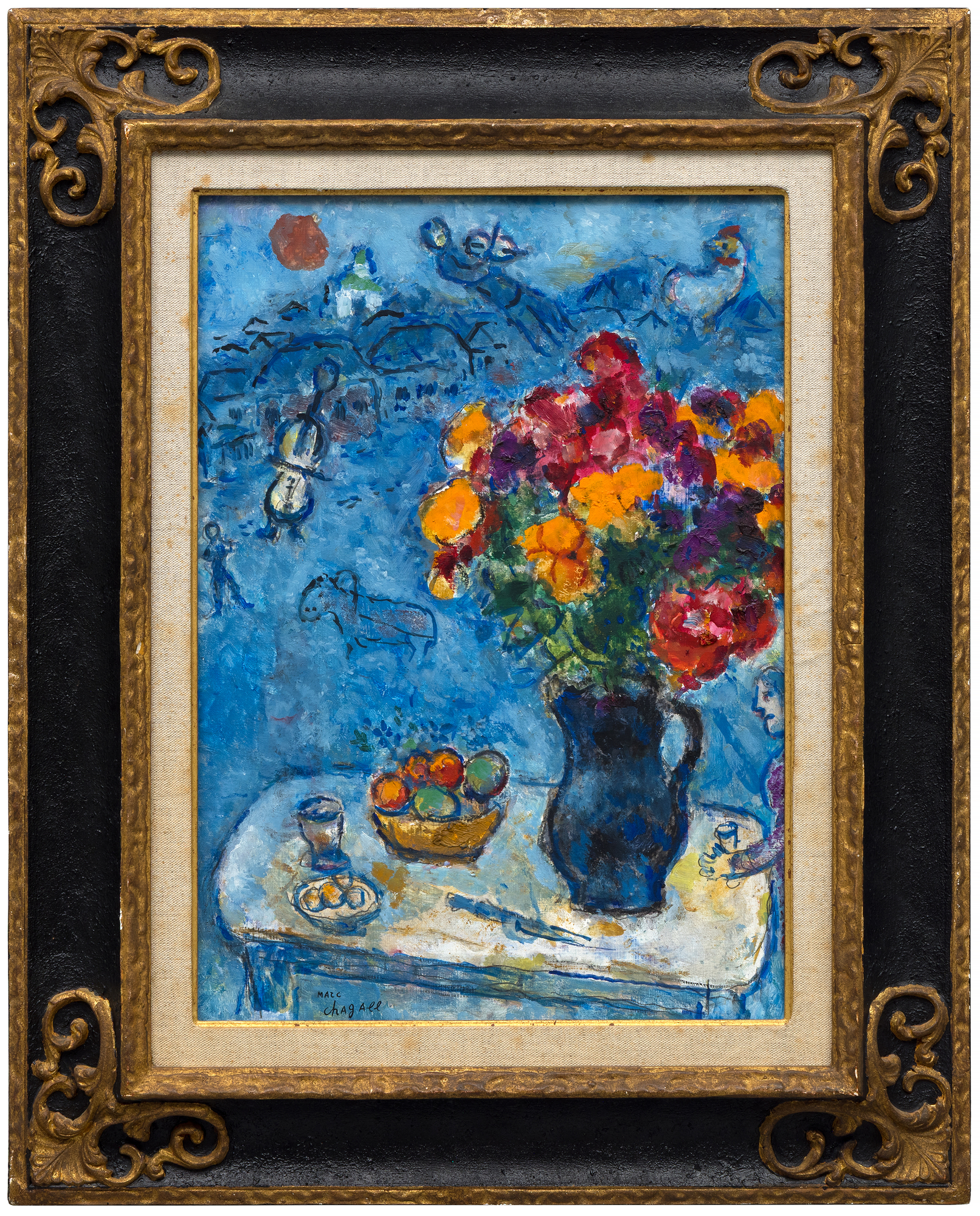
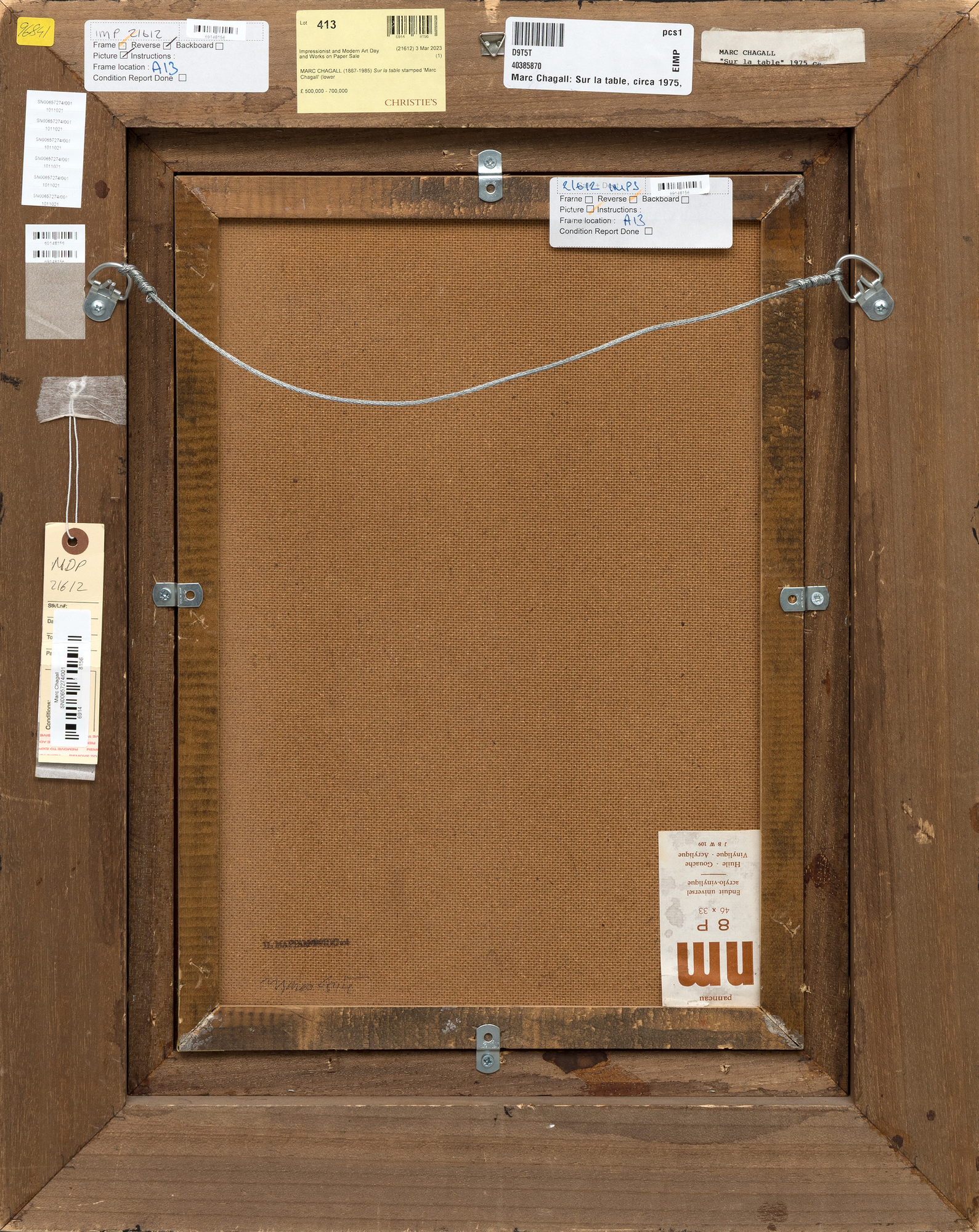
Sur la tablevers 197517 3/4 x 12 3/4 po(45,09 x 32,39 cm) huile sur panneau
Provenance
Succession de l'artiste
Galerie d'art Contini, Mestre
Collection privée, Padoue
Galleria Il Mappamondo, Milan
Collection privée, Milan
Collection privée, acquise auprès de la collection ci-dessus
Sur la table, de Marc Chagall, est une célébration rayonnante de la couleur, de la mémoire et de l'imagination. Baigné dans une palette de bleus profonds, le tableau rassemble plusieurs des motifs les plus appréciés de l'artiste : un coq, un violoniste, une chèvre et un bouquet exubérant. La composition est animée par le sens du mouvement et l'harmonie onirique caractéristiques de Chagall, créant un monde où la vie quotidienne, le folklore et l'amour coexistent dans un équilibre vibrant.


Peint pendant une période très productive juste après le retour de Chagall dans son pays natal au début des années 1970, Sur la table reflète l'énergie émotionnelle et visuelle renouvelée qui a découlé de sa reconnexion avec ses racines à Vitebsk, représentées ici par l'église au dôme blanc au loin. Le bouquet imposant, l'un des symboles durables de l'amour de Chagall pour sa première femme, Bella, domine le premier plan et imprègne l'œuvre d'une chaleur émotionnelle et d'une vitalité.


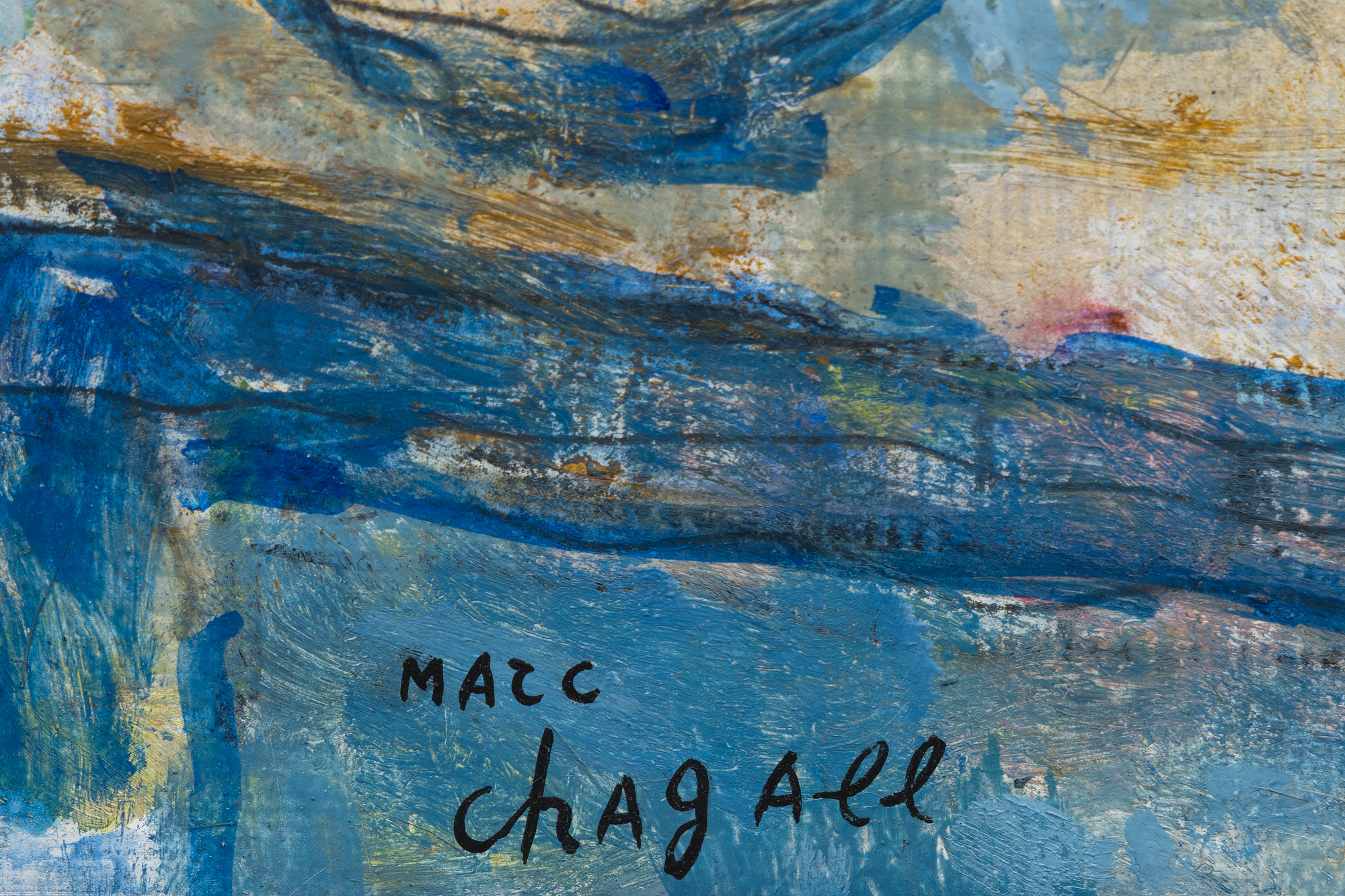
Le tableau est resté dans la collection et la succession de Chagall jusqu'après sa mort en 1985, soulignant ainsi son importance personnelle. Authentifié par le Comité Marc Chagall, Sur la table appartient à une lignée de compositions florales et symboliques qui définissent son œuvre mature.
demander