戻る

ポール・シニャック(PAUL SIGNAC) 1863-1935

$3,750,000

 
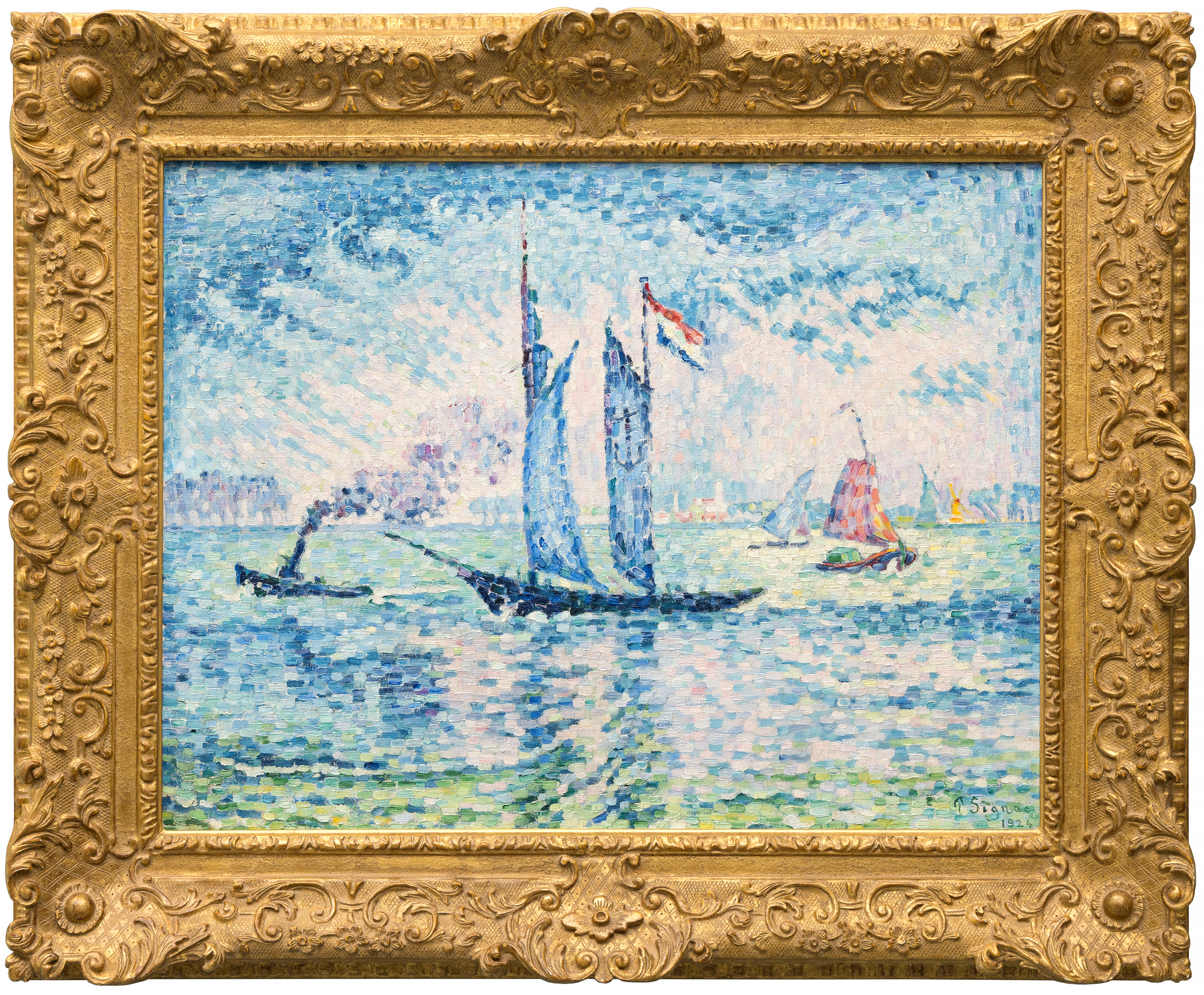
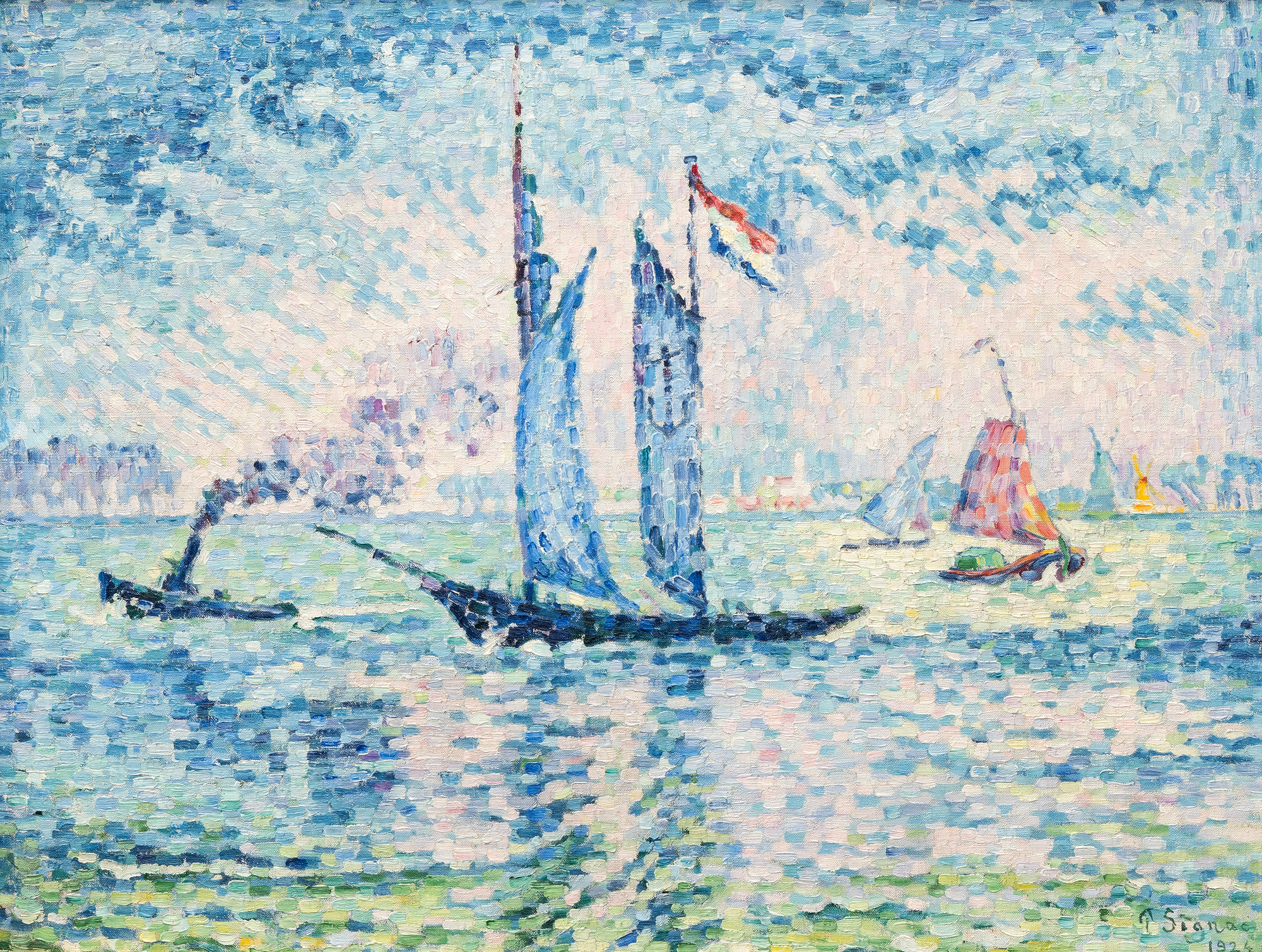
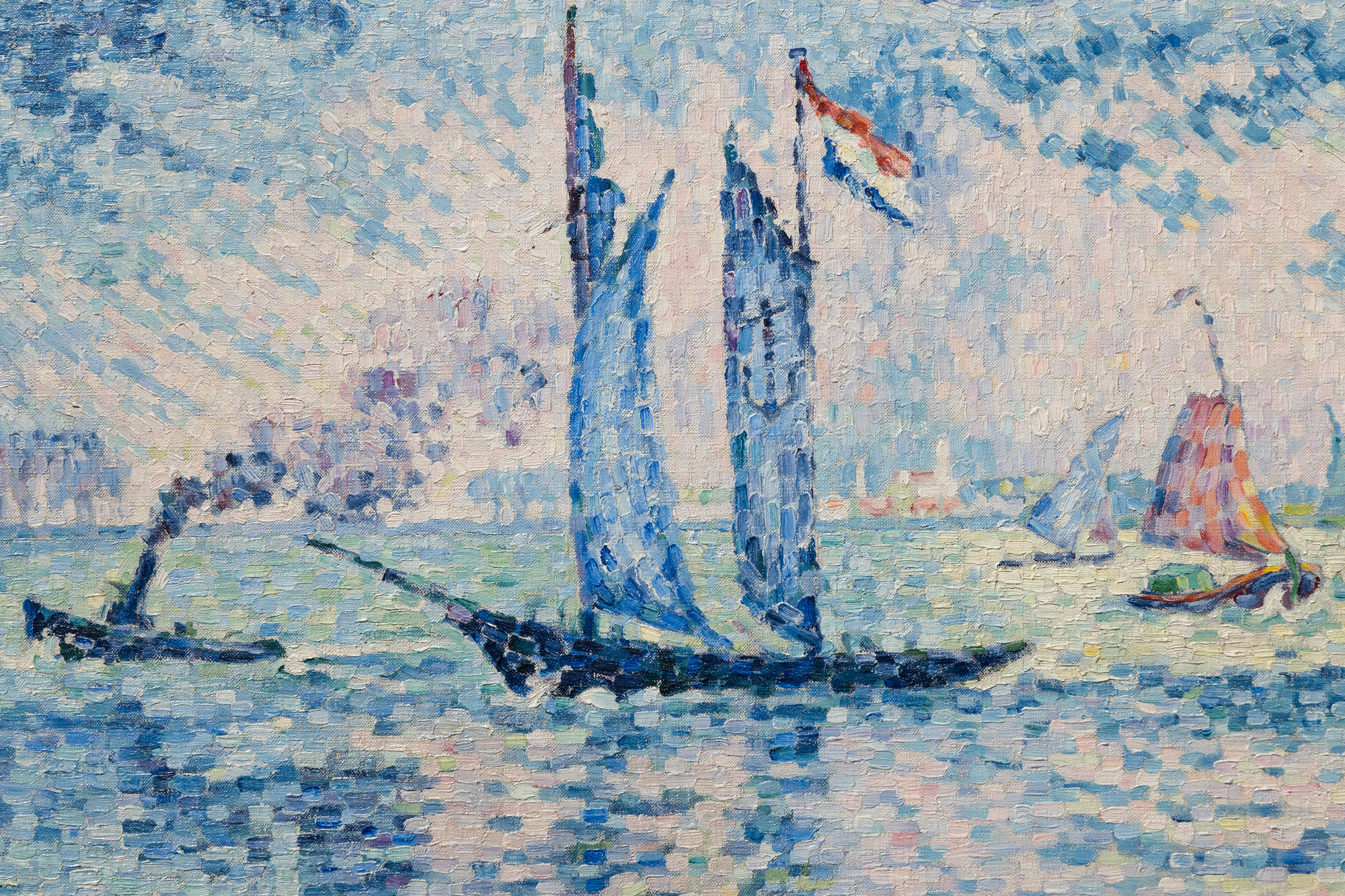
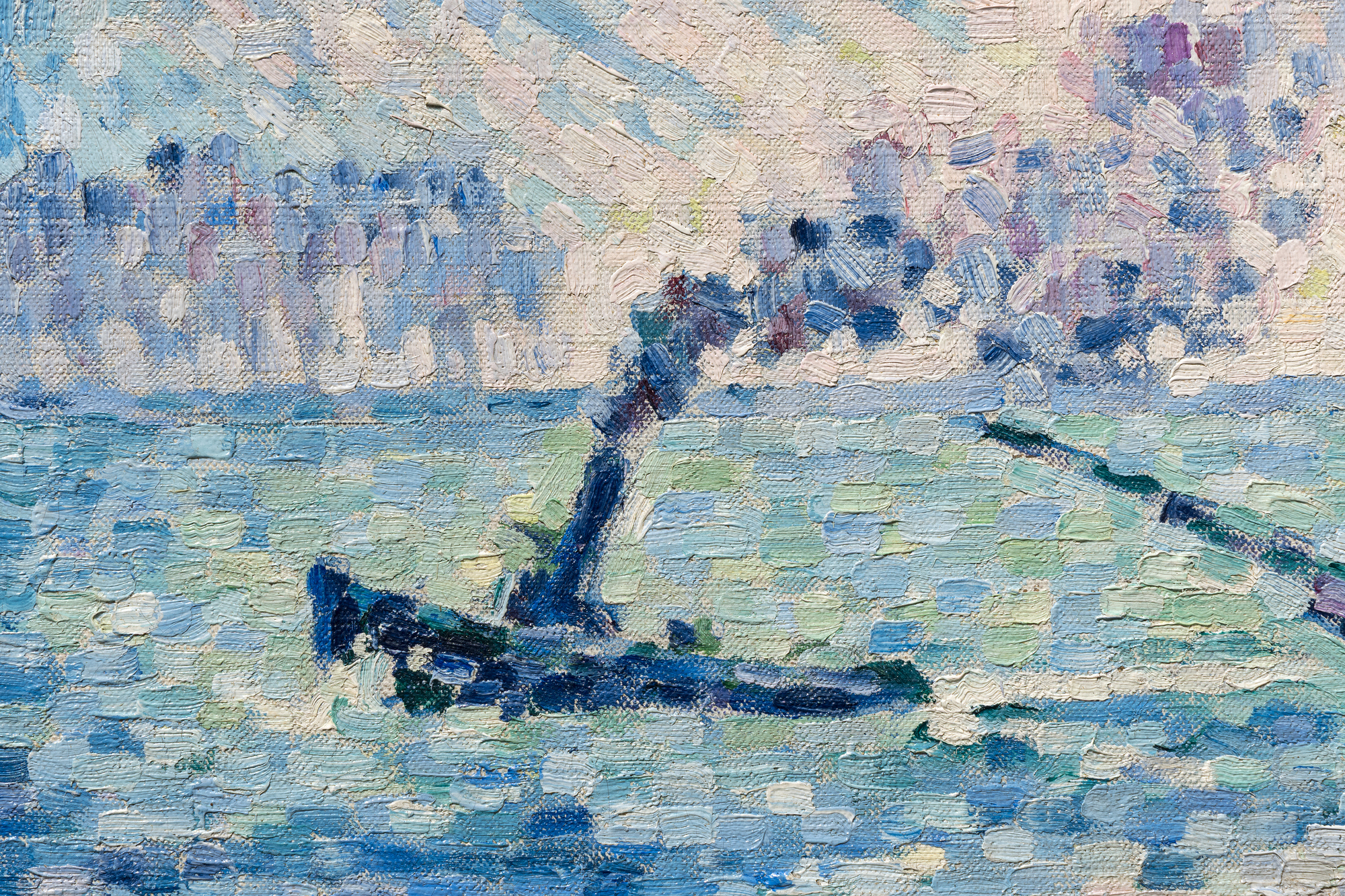
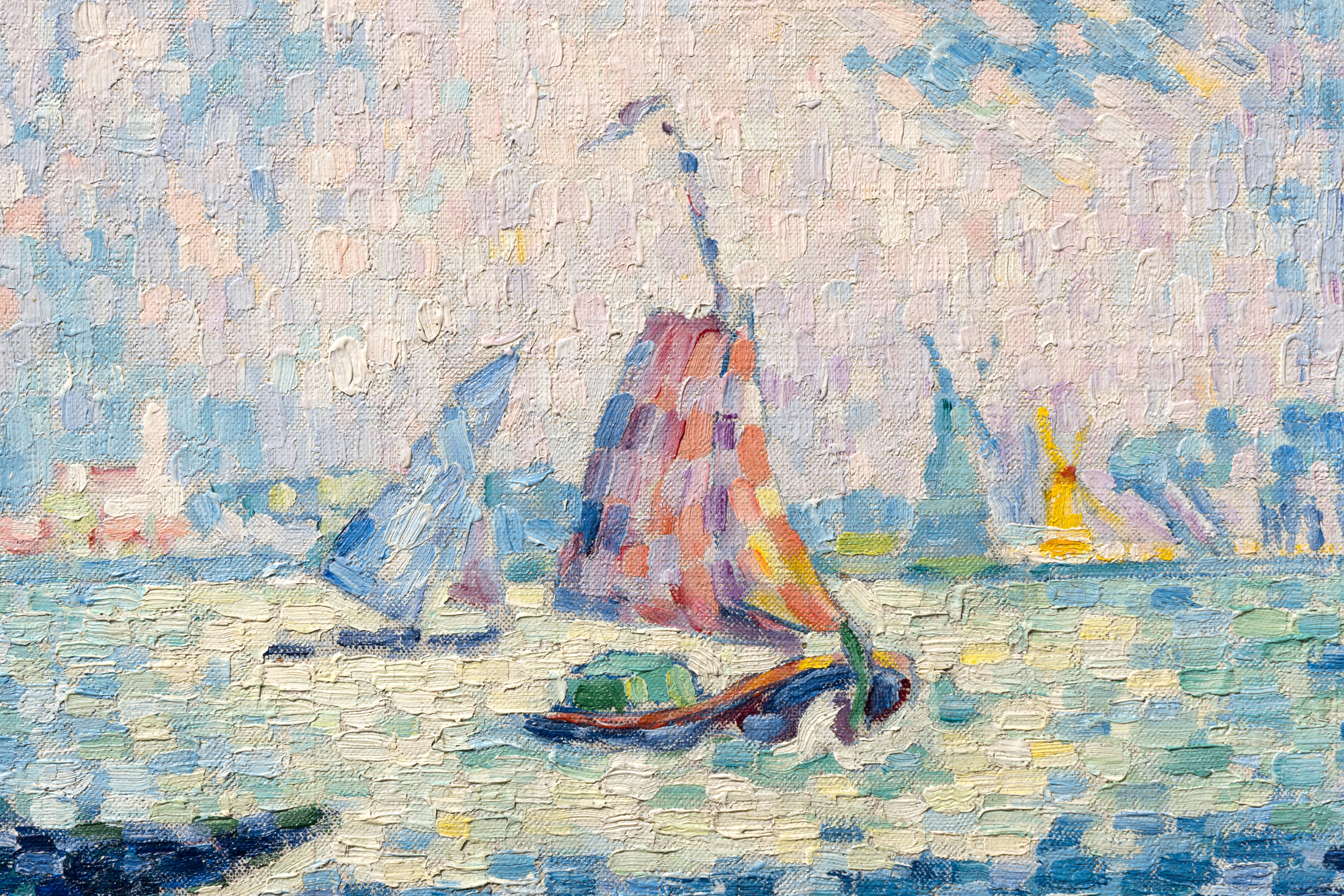
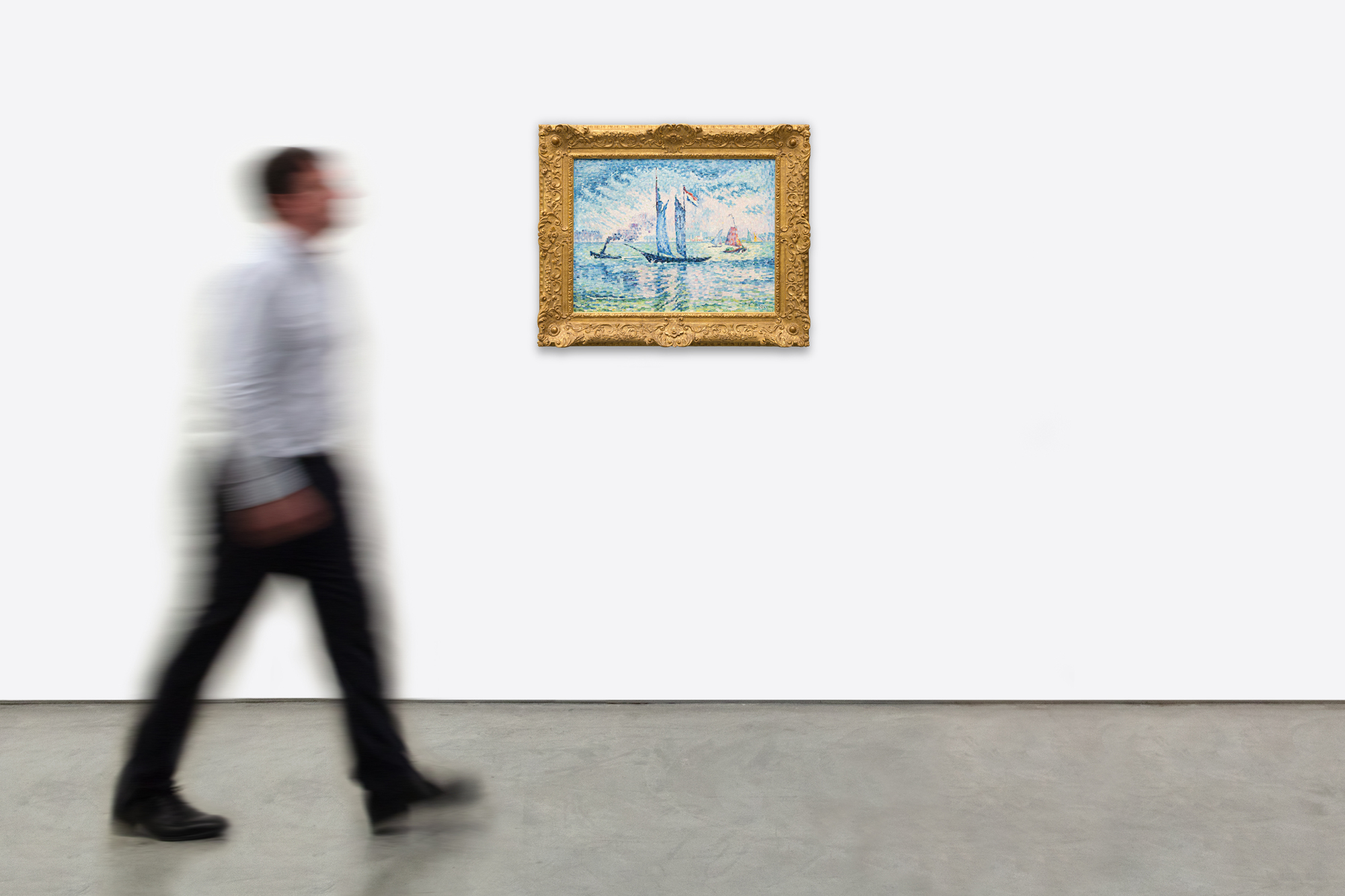
<div>Paul Signac’s "Pilote de la Meuse" (1924) is a refined late masterpiece that unites his devotion to color theory with his lifelong love of sailing. The composition is rigorously constructed around a highly structured framework of verticals and horizontals—the horizon line, the river’s surface, and the upright masts establish a sense of order and clarity. This geometry is gently softened by subtle diagonals: the angled masts, the slanted smokestack of a distant tugboat, and the wind-filled sails introduce movement and visual counterpoint without disrupting the overall balance.</div><br><br><div> </div><br><br><div>Executed in predominantly blue and green tones, the painting exemplifies Signac’s evolved Neo-Impressionist technique. While he and Georges Seurat pioneered pointillism as a scientific, color-theory-driven alternative to Impressionism, Signac’s later works from the 1910s and 1920s mark a decisive shift. Here, the earlier tight dots give way to broader, rectangular “mosaic strokes,” allowing color to carry greater physical presence and expressive freedom. The water in the foreground becomes a vibrant checkerboard of shifting hues, conveying turbulent weather, moving light, and wind-driven currents.</div><br><br><div> </div><br><br><div>A single prominent sailboat dominates the scene, accompanied by a few smaller vessels and the tugboat in the distance, whose swirling smoke animates the sky. This restrained yet dynamic marine subject reflects Signac’s deep personal connection to sailing—he owned 32 boats and traveled extensively by water.</div><br><br><div> </div><br><br><div>Similar maritime scenes from this mature period are held in major institutional collections, including the Minneapolis Institute of Art, The Metropolitan Museum of Art, and the Musée d’Orsay, underscoring the significance of this composition within Signac’s final artistic phase.</div><br><br><div> </div><br><br><div>The painting is accompanied by exceptional archival material: nine typed onion skins by Edmond Sussfeld; three autograph letters signed by Paul Signac; two autograph letters and the original invoice from the merchant Léon Marseille; and a certificate of authenticity from Mrs. Marina Ferretti-Bocquillon, providing outstanding historical context and provenance.</div> <div>Paul Signac’s "Pilote de la Meuse" (1924) is a refined late masterpiece that unites his devotion to color theory with his lifelong love of sailing. The composition is rigorously constructed around a highly structured framework of verticals and horizontals—the horizon line, the river’s surface, and the upright masts establish a sense of order and clarity. This geometry is gently softened by subtle diagonals: the angled masts, the slanted smokestack of a distant tugboat, and the wind-filled sails introduce movement and visual counterpoint without disrupting the overall balance.</div><br><br><div> </div><br><br><div>Executed in predominantly blue and green tones, the painting exemplifies Signac’s evolved Neo-Impressionist technique. While he and Georges Seurat pioneered pointillism as a scientific, color-theory-driven alternative to Impressionism, Signac’s later works from the 1910s and 1920s mark a decisive shift. Here, the earlier tight dots give way to broader, rectangular “mosaic strokes,” allowing color to carry greater physical presence and expressive freedom. The water in the foreground becomes a vibrant checkerboard of shifting hues, conveying turbulent weather, moving light, and wind-driven currents.</div><br><br><div> </div><br><br><div>A single prominent sailboat dominates the scene, accompanied by a few smaller vessels and the tugboat in the distance, whose swirling smoke animates the sky. This restrained yet dynamic marine subject reflects Signac’s deep personal connection to sailing—he owned 32 boats and traveled extensively by water.</div><br><br><div> </div><br><br><div>Similar maritime scenes from this mature period are held in major institutional collections, including the Minneapolis Institute of Art, The Metropolitan Museum of Art, and the Musée d’Orsay, underscoring the significance of this composition within Signac’s final artistic phase.</div><br><br><div> </div><br><br><div>The painting is accompanied by exceptional archival material: nine typed onion skins by Edmond Sussfeld; three autograph letters signed by Paul Signac; two autograph letters and the original invoice from the merchant Léon Marseille; and a certificate of authenticity from Mrs. Marina Ferretti-Bocquillon, providing outstanding historical context and provenance.</div> <div>Paul Signac’s "Pilote de la Meuse" (1924) is a refined late masterpiece that unites his devotion to color theory with his lifelong love of sailing. The composition is rigorously constructed around a highly structured framework of verticals and horizontals—the horizon line, the river’s surface, and the upright masts establish a sense of order and clarity. This geometry is gently softened by subtle diagonals: the angled masts, the slanted smokestack of a distant tugboat, and the wind-filled sails introduce movement and visual counterpoint without disrupting the overall balance.</div><br><br><div> </div><br><br><div>Executed in predominantly blue and green tones, the painting exemplifies Signac’s evolved Neo-Impressionist technique. While he and Georges Seurat pioneered pointillism as a scientific, color-theory-driven alternative to Impressionism, Signac’s later works from the 1910s and 1920s mark a decisive shift. Here, the earlier tight dots give way to broader, rectangular “mosaic strokes,” allowing color to carry greater physical presence and expressive freedom. The water in the foreground becomes a vibrant checkerboard of shifting hues, conveying turbulent weather, moving light, and wind-driven currents.</div><br><br><div> </div><br><br><div>A single prominent sailboat dominates the scene, accompanied by a few smaller vessels and the tugboat in the distance, whose swirling smoke animates the sky. This restrained yet dynamic marine subject reflects Signac’s deep personal connection to sailing—he owned 32 boats and traveled extensively by water.</div><br><br><div> </div><br><br><div>Similar maritime scenes from this mature period are held in major institutional collections, including the Minneapolis Institute of Art, The Metropolitan Museum of Art, and the Musée d’Orsay, underscoring the significance of this composition within Signac’s final artistic phase.</div><br><br><div> </div><br><br><div>The painting is accompanied by exceptional archival material: nine typed onion skins by Edmond Sussfeld; three autograph letters signed by Paul Signac; two autograph letters and the original invoice from the merchant Léon Marseille; and a certificate of authenticity from Mrs. Marina Ferretti-Bocquillon, providing outstanding historical context and provenance.</div> <div>Paul Signac’s "Pilote de la Meuse" (1924) is a refined late masterpiece that unites his devotion to color theory with his lifelong love of sailing. The composition is rigorously constructed around a highly structured framework of verticals and horizontals—the horizon line, the river’s surface, and the upright masts establish a sense of order and clarity. This geometry is gently softened by subtle diagonals: the angled masts, the slanted smokestack of a distant tugboat, and the wind-filled sails introduce movement and visual counterpoint without disrupting the overall balance.</div><br><br><div> </div><br><br><div>Executed in predominantly blue and green tones, the painting exemplifies Signac’s evolved Neo-Impressionist technique. While he and Georges Seurat pioneered pointillism as a scientific, color-theory-driven alternative to Impressionism, Signac’s later works from the 1910s and 1920s mark a decisive shift. Here, the earlier tight dots give way to broader, rectangular “mosaic strokes,” allowing color to carry greater physical presence and expressive freedom. The water in the foreground becomes a vibrant checkerboard of shifting hues, conveying turbulent weather, moving light, and wind-driven currents.</div><br><br><div> </div><br><br><div>A single prominent sailboat dominates the scene, accompanied by a few smaller vessels and the tugboat in the distance, whose swirling smoke animates the sky. This restrained yet dynamic marine subject reflects Signac’s deep personal connection to sailing—he owned 32 boats and traveled extensively by water.</div><br><br><div> </div><br><br><div>Similar maritime scenes from this mature period are held in major institutional collections, including the Minneapolis Institute of Art, The Metropolitan Museum of Art, and the Musée d’Orsay, underscoring the significance of this composition within Signac’s final artistic phase.</div><br><br><div> </div><br><br><div>The painting is accompanied by exceptional archival material: nine typed onion skins by Edmond Sussfeld; three autograph letters signed by Paul Signac; two autograph letters and the original invoice from the merchant Léon Marseille; and a certificate of authenticity from Mrs. Marina Ferretti-Bocquillon, providing outstanding historical context and provenance.</div> <div>Paul Signac’s "Pilote de la Meuse" (1924) is a refined late masterpiece that unites his devotion to color theory with his lifelong love of sailing. The composition is rigorously constructed around a highly structured framework of verticals and horizontals—the horizon line, the river’s surface, and the upright masts establish a sense of order and clarity. This geometry is gently softened by subtle diagonals: the angled masts, the slanted smokestack of a distant tugboat, and the wind-filled sails introduce movement and visual counterpoint without disrupting the overall balance.</div><br><br><div> </div><br><br><div>Executed in predominantly blue and green tones, the painting exemplifies Signac’s evolved Neo-Impressionist technique. While he and Georges Seurat pioneered pointillism as a scientific, color-theory-driven alternative to Impressionism, Signac’s later works from the 1910s and 1920s mark a decisive shift. Here, the earlier tight dots give way to broader, rectangular “mosaic strokes,” allowing color to carry greater physical presence and expressive freedom. The water in the foreground becomes a vibrant checkerboard of shifting hues, conveying turbulent weather, moving light, and wind-driven currents.</div><br><br><div> </div><br><br><div>A single prominent sailboat dominates the scene, accompanied by a few smaller vessels and the tugboat in the distance, whose swirling smoke animates the sky. This restrained yet dynamic marine subject reflects Signac’s deep personal connection to sailing—he owned 32 boats and traveled extensively by water.</div><br><br><div> </div><br><br><div>Similar maritime scenes from this mature period are held in major institutional collections, including the Minneapolis Institute of Art, The Metropolitan Museum of Art, and the Musée d’Orsay, underscoring the significance of this composition within Signac’s final artistic phase.</div><br><br><div> </div><br><br><div>The painting is accompanied by exceptional archival material: nine typed onion skins by Edmond Sussfeld; three autograph letters signed by Paul Signac; two autograph letters and the original invoice from the merchant Léon Marseille; and a certificate of authenticity from Mrs. Marina Ferretti-Bocquillon, providing outstanding historical context and provenance.</div> <div>Paul Signac’s "Pilote de la Meuse" (1924) is a refined late masterpiece that unites his devotion to color theory with his lifelong love of sailing. The composition is rigorously constructed around a highly structured framework of verticals and horizontals—the horizon line, the river’s surface, and the upright masts establish a sense of order and clarity. This geometry is gently softened by subtle diagonals: the angled masts, the slanted smokestack of a distant tugboat, and the wind-filled sails introduce movement and visual counterpoint without disrupting the overall balance.</div><br><br><div> </div><br><br><div>Executed in predominantly blue and green tones, the painting exemplifies Signac’s evolved Neo-Impressionist technique. While he and Georges Seurat pioneered pointillism as a scientific, color-theory-driven alternative to Impressionism, Signac’s later works from the 1910s and 1920s mark a decisive shift. Here, the earlier tight dots give way to broader, rectangular “mosaic strokes,” allowing color to carry greater physical presence and expressive freedom. The water in the foreground becomes a vibrant checkerboard of shifting hues, conveying turbulent weather, moving light, and wind-driven currents.</div><br><br><div> </div><br><br><div>A single prominent sailboat dominates the scene, accompanied by a few smaller vessels and the tugboat in the distance, whose swirling smoke animates the sky. This restrained yet dynamic marine subject reflects Signac’s deep personal connection to sailing—he owned 32 boats and traveled extensively by water.</div><br><br><div> </div><br><br><div>Similar maritime scenes from this mature period are held in major institutional collections, including the Minneapolis Institute of Art, The Metropolitan Museum of Art, and the Musée d’Orsay, underscoring the significance of this composition within Signac’s final artistic phase.</div><br><br><div> </div><br><br><div>The painting is accompanied by exceptional archival material: nine typed onion skins by Edmond Sussfeld; three autograph letters signed by Paul Signac; two autograph letters and the original invoice from the merchant Léon Marseille; and a certificate of authenticity from Mrs. Marina Ferretti-Bocquillon, providing outstanding historical context and provenance.</div> <div>Paul Signac’s "Pilote de la Meuse" (1924) is a refined late masterpiece that unites his devotion to color theory with his lifelong love of sailing. The composition is rigorously constructed around a highly structured framework of verticals and horizontals—the horizon line, the river’s surface, and the upright masts establish a sense of order and clarity. This geometry is gently softened by subtle diagonals: the angled masts, the slanted smokestack of a distant tugboat, and the wind-filled sails introduce movement and visual counterpoint without disrupting the overall balance.</div><br><br><div> </div><br><br><div>Executed in predominantly blue and green tones, the painting exemplifies Signac’s evolved Neo-Impressionist technique. While he and Georges Seurat pioneered pointillism as a scientific, color-theory-driven alternative to Impressionism, Signac’s later works from the 1910s and 1920s mark a decisive shift. Here, the earlier tight dots give way to broader, rectangular “mosaic strokes,” allowing color to carry greater physical presence and expressive freedom. The water in the foreground becomes a vibrant checkerboard of shifting hues, conveying turbulent weather, moving light, and wind-driven currents.</div><br><br><div> </div><br><br><div>A single prominent sailboat dominates the scene, accompanied by a few smaller vessels and the tugboat in the distance, whose swirling smoke animates the sky. This restrained yet dynamic marine subject reflects Signac’s deep personal connection to sailing—he owned 32 boats and traveled extensively by water.</div><br><br><div> </div><br><br><div>Similar maritime scenes from this mature period are held in major institutional collections, including the Minneapolis Institute of Art, The Metropolitan Museum of Art, and the Musée d’Orsay, underscoring the significance of this composition within Signac’s final artistic phase.</div><br><br><div> </div><br><br><div>The painting is accompanied by exceptional archival material: nine typed onion skins by Edmond Sussfeld; three autograph letters signed by Paul Signac; two autograph letters and the original invoice from the merchant Léon Marseille; and a certificate of authenticity from Mrs. Marina Ferretti-Bocquillon, providing outstanding historical context and provenance.</div> <div>Paul Signac’s "Pilote de la Meuse" (1924) is a refined late masterpiece that unites his devotion to color theory with his lifelong love of sailing. The composition is rigorously constructed around a highly structured framework of verticals and horizontals—the horizon line, the river’s surface, and the upright masts establish a sense of order and clarity. This geometry is gently softened by subtle diagonals: the angled masts, the slanted smokestack of a distant tugboat, and the wind-filled sails introduce movement and visual counterpoint without disrupting the overall balance.</div><br><br><div> </div><br><br><div>Executed in predominantly blue and green tones, the painting exemplifies Signac’s evolved Neo-Impressionist technique. While he and Georges Seurat pioneered pointillism as a scientific, color-theory-driven alternative to Impressionism, Signac’s later works from the 1910s and 1920s mark a decisive shift. Here, the earlier tight dots give way to broader, rectangular “mosaic strokes,” allowing color to carry greater physical presence and expressive freedom. The water in the foreground becomes a vibrant checkerboard of shifting hues, conveying turbulent weather, moving light, and wind-driven currents.</div><br><br><div> </div><br><br><div>A single prominent sailboat dominates the scene, accompanied by a few smaller vessels and the tugboat in the distance, whose swirling smoke animates the sky. This restrained yet dynamic marine subject reflects Signac’s deep personal connection to sailing—he owned 32 boats and traveled extensively by water.</div><br><br><div> </div><br><br><div>Similar maritime scenes from this mature period are held in major institutional collections, including the Minneapolis Institute of Art, The Metropolitan Museum of Art, and the Musée d’Orsay, underscoring the significance of this composition within Signac’s final artistic phase.</div><br><br><div> </div><br><br><div>The painting is accompanied by exceptional archival material: nine typed onion skins by Edmond Sussfeld; three autograph letters signed by Paul Signac; two autograph letters and the original invoice from the merchant Léon Marseille; and a certificate of authenticity from Mrs. Marina Ferretti-Bocquillon, providing outstanding historical context and provenance.</div> <div>Paul Signac’s "Pilote de la Meuse" (1924) is a refined late masterpiece that unites his devotion to color theory with his lifelong love of sailing. The composition is rigorously constructed around a highly structured framework of verticals and horizontals—the horizon line, the river’s surface, and the upright masts establish a sense of order and clarity. This geometry is gently softened by subtle diagonals: the angled masts, the slanted smokestack of a distant tugboat, and the wind-filled sails introduce movement and visual counterpoint without disrupting the overall balance.</div><br><br><div> </div><br><br><div>Executed in predominantly blue and green tones, the painting exemplifies Signac’s evolved Neo-Impressionist technique. While he and Georges Seurat pioneered pointillism as a scientific, color-theory-driven alternative to Impressionism, Signac’s later works from the 1910s and 1920s mark a decisive shift. Here, the earlier tight dots give way to broader, rectangular “mosaic strokes,” allowing color to carry greater physical presence and expressive freedom. The water in the foreground becomes a vibrant checkerboard of shifting hues, conveying turbulent weather, moving light, and wind-driven currents.</div><br><br><div> </div><br><br><div>A single prominent sailboat dominates the scene, accompanied by a few smaller vessels and the tugboat in the distance, whose swirling smoke animates the sky. This restrained yet dynamic marine subject reflects Signac’s deep personal connection to sailing—he owned 32 boats and traveled extensively by water.</div><br><br><div> </div><br><br><div>Similar maritime scenes from this mature period are held in major institutional collections, including the Minneapolis Institute of Art, The Metropolitan Museum of Art, and the Musée d’Orsay, underscoring the significance of this composition within Signac’s final artistic phase.</div><br><br><div> </div><br><br><div>The painting is accompanied by exceptional archival material: nine typed onion skins by Edmond Sussfeld; three autograph letters signed by Paul Signac; two autograph letters and the original invoice from the merchant Léon Marseille; and a certificate of authenticity from Mrs. Marina Ferretti-Bocquillon, providing outstanding historical context and provenance.</div> <div>Paul Signac’s "Pilote de la Meuse" (1924) is a refined late masterpiece that unites his devotion to color theory with his lifelong love of sailing. The composition is rigorously constructed around a highly structured framework of verticals and horizontals—the horizon line, the river’s surface, and the upright masts establish a sense of order and clarity. This geometry is gently softened by subtle diagonals: the angled masts, the slanted smokestack of a distant tugboat, and the wind-filled sails introduce movement and visual counterpoint without disrupting the overall balance.</div><br><br><div> </div><br><br><div>Executed in predominantly blue and green tones, the painting exemplifies Signac’s evolved Neo-Impressionist technique. While he and Georges Seurat pioneered pointillism as a scientific, color-theory-driven alternative to Impressionism, Signac’s later works from the 1910s and 1920s mark a decisive shift. Here, the earlier tight dots give way to broader, rectangular “mosaic strokes,” allowing color to carry greater physical presence and expressive freedom. The water in the foreground becomes a vibrant checkerboard of shifting hues, conveying turbulent weather, moving light, and wind-driven currents.</div><br><br><div> </div><br><br><div>A single prominent sailboat dominates the scene, accompanied by a few smaller vessels and the tugboat in the distance, whose swirling smoke animates the sky. This restrained yet dynamic marine subject reflects Signac’s deep personal connection to sailing—he owned 32 boats and traveled extensively by water.</div><br><br><div> </div><br><br><div>Similar maritime scenes from this mature period are held in major institutional collections, including the Minneapolis Institute of Art, The Metropolitan Museum of Art, and the Musée d’Orsay, underscoring the significance of this composition within Signac’s final artistic phase.</div><br><br><div> </div><br><br><div>The painting is accompanied by exceptional archival material: nine typed onion skins by Edmond Sussfeld; three autograph letters signed by Paul Signac; two autograph letters and the original invoice from the merchant Léon Marseille; and a certificate of authenticity from Mrs. Marina Ferretti-Bocquillon, providing outstanding historical context and provenance.</div>
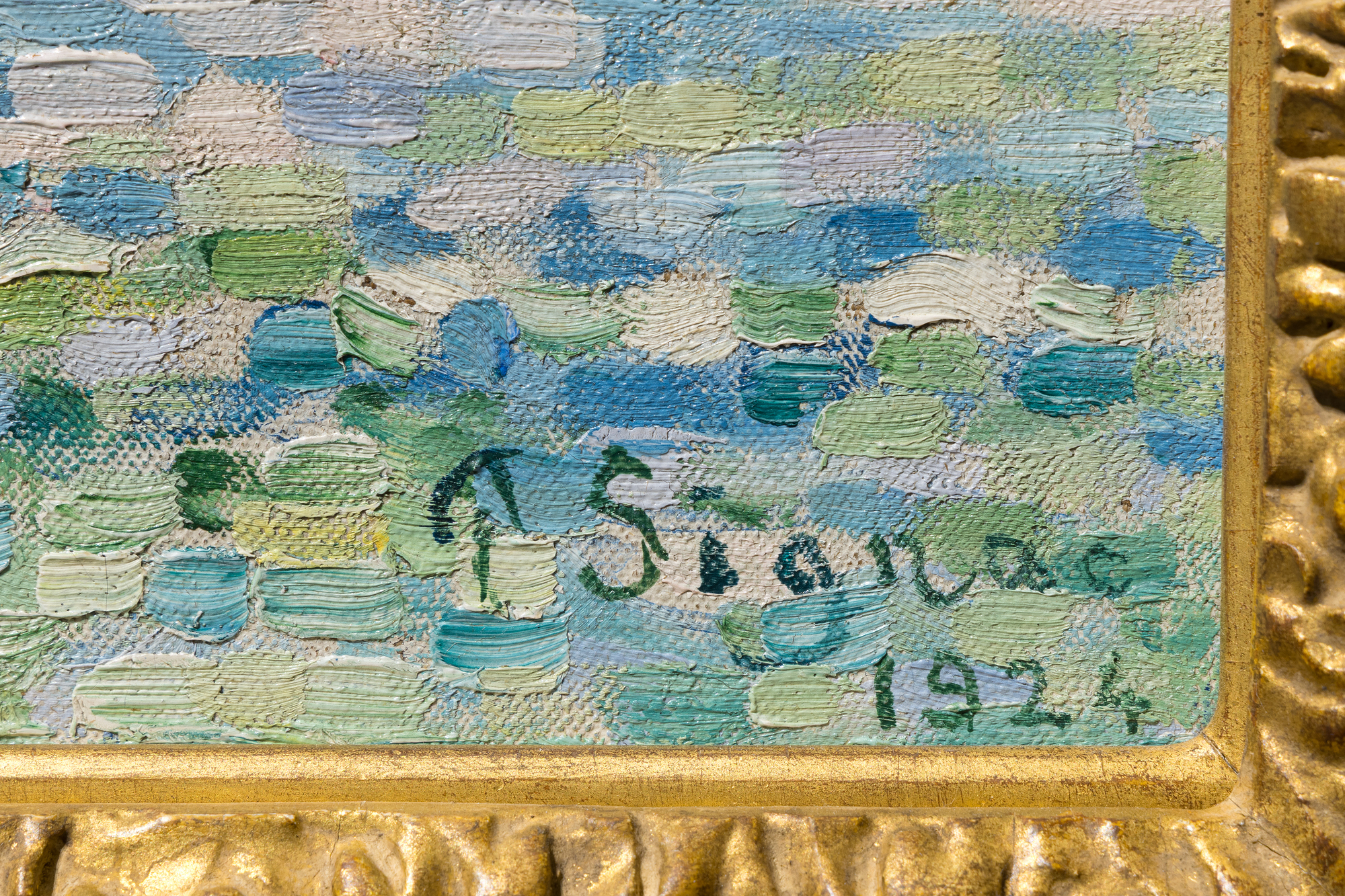
ムーズのパイロット1924年19 3/4 x 25 1/2 インチ(50.17 x 64.77 cm) 油彩・キャンバス
出所
レオン・マルセイユ・ギャラリー、パリ
エドモン・ススフェルド・コレクション
個人コレクション、上記コレクションからの継承
個人コレクション、ヨーロッパ
ドロワ・エスティメーション、パリ、2022年11月18日、ロット00003(エドモン・ススフェルド・コレクション)
個人コレクション、ロンドン、上記オークションにて取得
展示会
パリ、ベルヌ・ジュヌ、ポール・シニャック展、1930年5月19日~5月30日、作品番号40
パリ、プチ・パレ、ポール・シニャック展、1934年、作品番号35
ヴィロフレ、コロー追悼サロン、第13回展、1965年
文学
ベルヌ=ジュヌ、ポール・シニャック展 5月19日(月)より...もっとその。。。 1930年5月30日金曜日、パリ、1930年、第40号(図版付)
フランソワーズ・カシャン、『シニャック:絵画作品総覧』、パリ、2000年、第565号、323頁(図版付)
...少ない。。。
ポール・シニャックの『ムーズ川の船長』(1924年)は、色彩理論への傾倒と生涯にわたる航海への愛を融合させた、洗練された晩年の傑作である。 構図は厳密に構築されており、水平線、川面、垂直に立つマストといった高度に構造化された垂直線と水平線を軸に秩序と明快さを確立している。この幾何学的な構成は、斜めに立つマスト、遠くの曳船の傾いた煙突、風を受けた帆といった微妙な斜線によって優しく和らげられ、全体のバランスを崩すことなく動きと視覚的な対位法をもたらしている。


青と緑を基調とした本作は、シニャックが発展させた新印象派技法の典型である。彼とジョルジュ・スーラが色彩理論に基づく科学的アプローチとして点描法を印象派の代替技法として確立した一方、1910年代から20年代にかけてのシニャック後期作品には決定的な転換が見られる。 ここでは初期の緻密な点描が、より広範な長方形の「モザイク筆致」へと移行し、色彩がより強い物理的臨場感と表現の自由を獲得している。前景の水面は移り変わる色調の鮮やかなチェッカーボードとなり、荒れた天候、動く光、風による潮流を伝えている。


単一の大型帆船が画面を支配し、数隻の小型船と遠方の曳船が伴っている。曳船の渦巻く煙が空に躍動感を与えている。 この抑制されながらも躍動感ある海洋主題は、シニャックの航海への深い個人的関わりを反映している——彼は32隻の船を所有し、水上で広く旅をした。


この成熟期の類似した海洋風景画は、ミネアポリス美術館、メトロポリタン美術館、オルセー美術館などの主要な機関コレクションに所蔵されており、シニャックの最終芸術段階におけるこの構図の重要性を裏付けている。


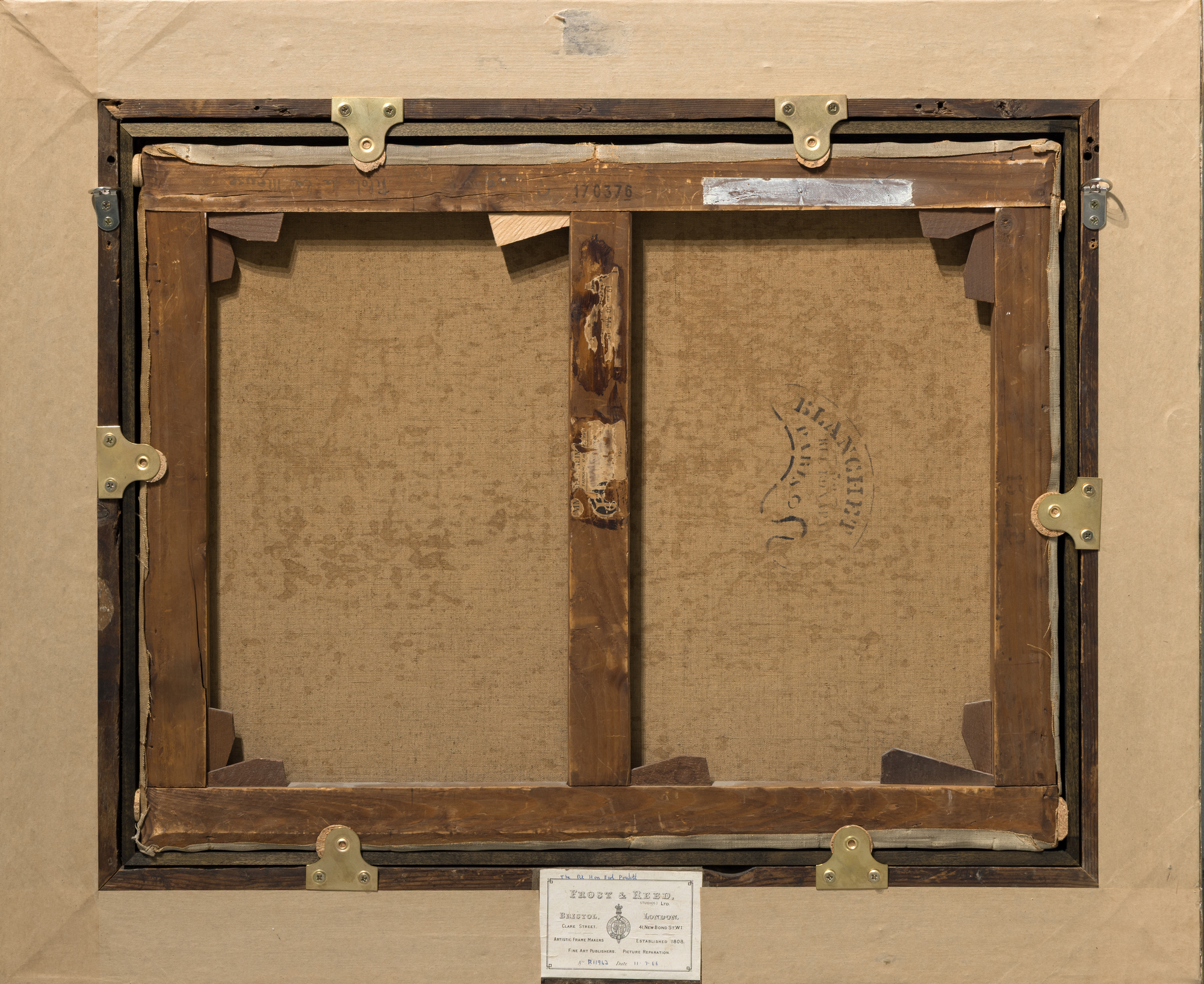
本作には類まれな関連資料が付属する:エドモン・ススフェルドによるタイプ原稿9点、ポール・シニャック直筆署名書簡3通、商人レオン・マルセイユによる直筆書簡2通と原本請求書、マリーナ・フェレッティ=ボキヨン夫人による真作証明書。これらにより卓越した歴史的背景と来歴が裏付けられている。
お 問い合わせ