戻る

クロード・モネ (1840-1926)

 
<div><font face=Lato size=3 color="#191919">As the idea of using drawings, whether in pencil or pastel to prepare a painting was at odds with Monet’s publicised creative process, he tended to downplay its importance in his work. However, after his death eight folios containing over four hundred drawings came to light as well as many pastels. This convenient and lightweight medium allowed him to experiment with composition and colour and develop ideas for his oil paintings at speed. He also used pastel to produce finished pictures, as in this example.</font></div><br><br><div><font face=Lato size=3 color="#191919"> </font></div><br><br><div><font face=Lato size=3 color="#191919">During the 1880s Monet returned to the Normandy coast. He found inspiration in the sparkling light and famous limestone cliffs, as had Delacroix and Courbet. As well as working directly in oils, he followed Boudin’s example and used black chalk and pastel to study the effects of light and colour on the sky, sea and land.</font></div><br><br><div><font face=Lato size=3 color="#191919"> </font></div><br><br><div><font face=Lato size=3 color="#191919">In this seascape at Etretat, twenty miles round the coast to the north of Le Havre, Monet has chosen an unusual composition, dividing the landscape down the centre with the vertiginous cliffs; the left half of the picture composed of earthy greens and browns, the right half a sun dappled sea that dissolves into the sky, the horizon only suggested by the lightest touch of charcoal. This picture has a marked difference in atmosphere to another pastel of the nearby Porte d’Aval, dateable to the same period, whose late afternoon sky shows the range of expression that could be achieved with pastel. By the summer of 1885 the year he made this pastel Monet had largely abandoned urban subjects, and was more drawn towards natural phenomena. He painted many views along the coast under different light conditions. As noted in the catalogue raisonné on Monet, this pastel is not a preparatory study for an oil painting, but a wholly original composition. It demonstrates how well the painter understood and enjoyed the versatility of the medium when trying to capture such variable weather.</font></div> <div><font face=Lato size=3 color="#191919">As the idea of using drawings, whether in pencil or pastel to prepare a painting was at odds with Monet’s publicised creative process, he tended to downplay its importance in his work. However, after his death eight folios containing over four hundred drawings came to light as well as many pastels. This convenient and lightweight medium allowed him to experiment with composition and colour and develop ideas for his oil paintings at speed. He also used pastel to produce finished pictures, as in this example.</font></div><br><br><div><font face=Lato size=3 color="#191919"> </font></div><br><br><div><font face=Lato size=3 color="#191919">During the 1880s Monet returned to the Normandy coast. He found inspiration in the sparkling light and famous limestone cliffs, as had Delacroix and Courbet. As well as working directly in oils, he followed Boudin’s example and used black chalk and pastel to study the effects of light and colour on the sky, sea and land.</font></div><br><br><div><font face=Lato size=3 color="#191919"> </font></div><br><br><div><font face=Lato size=3 color="#191919">In this seascape at Etretat, twenty miles round the coast to the north of Le Havre, Monet has chosen an unusual composition, dividing the landscape down the centre with the vertiginous cliffs; the left half of the picture composed of earthy greens and browns, the right half a sun dappled sea that dissolves into the sky, the horizon only suggested by the lightest touch of charcoal. This picture has a marked difference in atmosphere to another pastel of the nearby Porte d’Aval, dateable to the same period, whose late afternoon sky shows the range of expression that could be achieved with pastel. By the summer of 1885 the year he made this pastel Monet had largely abandoned urban subjects, and was more drawn towards natural phenomena. He painted many views along the coast under different light conditions. As noted in the catalogue raisonné on Monet, this pastel is not a preparatory study for an oil painting, but a wholly original composition. It demonstrates how well the painter understood and enjoyed the versatility of the medium when trying to capture such variable weather.</font></div> <div><font face=Lato size=3 color="#191919">As the idea of using drawings, whether in pencil or pastel to prepare a painting was at odds with Monet’s publicised creative process, he tended to downplay its importance in his work. However, after his death eight folios containing over four hundred drawings came to light as well as many pastels. This convenient and lightweight medium allowed him to experiment with composition and colour and develop ideas for his oil paintings at speed. He also used pastel to produce finished pictures, as in this example.</font></div><br><br><div><font face=Lato size=3 color="#191919"> </font></div><br><br><div><font face=Lato size=3 color="#191919">During the 1880s Monet returned to the Normandy coast. He found inspiration in the sparkling light and famous limestone cliffs, as had Delacroix and Courbet. As well as working directly in oils, he followed Boudin’s example and used black chalk and pastel to study the effects of light and colour on the sky, sea and land.</font></div><br><br><div><font face=Lato size=3 color="#191919"> </font></div><br><br><div><font face=Lato size=3 color="#191919">In this seascape at Etretat, twenty miles round the coast to the north of Le Havre, Monet has chosen an unusual composition, dividing the landscape down the centre with the vertiginous cliffs; the left half of the picture composed of earthy greens and browns, the right half a sun dappled sea that dissolves into the sky, the horizon only suggested by the lightest touch of charcoal. This picture has a marked difference in atmosphere to another pastel of the nearby Porte d’Aval, dateable to the same period, whose late afternoon sky shows the range of expression that could be achieved with pastel. By the summer of 1885 the year he made this pastel Monet had largely abandoned urban subjects, and was more drawn towards natural phenomena. He painted many views along the coast under different light conditions. As noted in the catalogue raisonné on Monet, this pastel is not a preparatory study for an oil painting, but a wholly original composition. It demonstrates how well the painter understood and enjoyed the versatility of the medium when trying to capture such variable weather.</font></div> <div><font face=Lato size=3 color="#191919">As the idea of using drawings, whether in pencil or pastel to prepare a painting was at odds with Monet’s publicised creative process, he tended to downplay its importance in his work. However, after his death eight folios containing over four hundred drawings came to light as well as many pastels. This convenient and lightweight medium allowed him to experiment with composition and colour and develop ideas for his oil paintings at speed. He also used pastel to produce finished pictures, as in this example.</font></div><br><br><div><font face=Lato size=3 color="#191919"> </font></div><br><br><div><font face=Lato size=3 color="#191919">During the 1880s Monet returned to the Normandy coast. He found inspiration in the sparkling light and famous limestone cliffs, as had Delacroix and Courbet. As well as working directly in oils, he followed Boudin’s example and used black chalk and pastel to study the effects of light and colour on the sky, sea and land.</font></div><br><br><div><font face=Lato size=3 color="#191919"> </font></div><br><br><div><font face=Lato size=3 color="#191919">In this seascape at Etretat, twenty miles round the coast to the north of Le Havre, Monet has chosen an unusual composition, dividing the landscape down the centre with the vertiginous cliffs; the left half of the picture composed of earthy greens and browns, the right half a sun dappled sea that dissolves into the sky, the horizon only suggested by the lightest touch of charcoal. This picture has a marked difference in atmosphere to another pastel of the nearby Porte d’Aval, dateable to the same period, whose late afternoon sky shows the range of expression that could be achieved with pastel. By the summer of 1885 the year he made this pastel Monet had largely abandoned urban subjects, and was more drawn towards natural phenomena. He painted many views along the coast under different light conditions. As noted in the catalogue raisonné on Monet, this pastel is not a preparatory study for an oil painting, but a wholly original composition. It demonstrates how well the painter understood and enjoyed the versatility of the medium when trying to capture such variable weather.</font></div> <div><font face=Lato size=3 color="#191919">As the idea of using drawings, whether in pencil or pastel to prepare a painting was at odds with Monet’s publicised creative process, he tended to downplay its importance in his work. However, after his death eight folios containing over four hundred drawings came to light as well as many pastels. This convenient and lightweight medium allowed him to experiment with composition and colour and develop ideas for his oil paintings at speed. He also used pastel to produce finished pictures, as in this example.</font></div><br><br><div><font face=Lato size=3 color="#191919"> </font></div><br><br><div><font face=Lato size=3 color="#191919">During the 1880s Monet returned to the Normandy coast. He found inspiration in the sparkling light and famous limestone cliffs, as had Delacroix and Courbet. As well as working directly in oils, he followed Boudin’s example and used black chalk and pastel to study the effects of light and colour on the sky, sea and land.</font></div><br><br><div><font face=Lato size=3 color="#191919"> </font></div><br><br><div><font face=Lato size=3 color="#191919">In this seascape at Etretat, twenty miles round the coast to the north of Le Havre, Monet has chosen an unusual composition, dividing the landscape down the centre with the vertiginous cliffs; the left half of the picture composed of earthy greens and browns, the right half a sun dappled sea that dissolves into the sky, the horizon only suggested by the lightest touch of charcoal. This picture has a marked difference in atmosphere to another pastel of the nearby Porte d’Aval, dateable to the same period, whose late afternoon sky shows the range of expression that could be achieved with pastel. By the summer of 1885 the year he made this pastel Monet had largely abandoned urban subjects, and was more drawn towards natural phenomena. He painted many views along the coast under different light conditions. As noted in the catalogue raisonné on Monet, this pastel is not a preparatory study for an oil painting, but a wholly original composition. It demonstrates how well the painter understood and enjoyed the versatility of the medium when trying to capture such variable weather.</font></div> <div><font face=Lato size=3 color="#191919">As the idea of using drawings, whether in pencil or pastel to prepare a painting was at odds with Monet’s publicised creative process, he tended to downplay its importance in his work. However, after his death eight folios containing over four hundred drawings came to light as well as many pastels. This convenient and lightweight medium allowed him to experiment with composition and colour and develop ideas for his oil paintings at speed. He also used pastel to produce finished pictures, as in this example.</font></div><br><br><div><font face=Lato size=3 color="#191919"> </font></div><br><br><div><font face=Lato size=3 color="#191919">During the 1880s Monet returned to the Normandy coast. He found inspiration in the sparkling light and famous limestone cliffs, as had Delacroix and Courbet. As well as working directly in oils, he followed Boudin’s example and used black chalk and pastel to study the effects of light and colour on the sky, sea and land.</font></div><br><br><div><font face=Lato size=3 color="#191919"> </font></div><br><br><div><font face=Lato size=3 color="#191919">In this seascape at Etretat, twenty miles round the coast to the north of Le Havre, Monet has chosen an unusual composition, dividing the landscape down the centre with the vertiginous cliffs; the left half of the picture composed of earthy greens and browns, the right half a sun dappled sea that dissolves into the sky, the horizon only suggested by the lightest touch of charcoal. This picture has a marked difference in atmosphere to another pastel of the nearby Porte d’Aval, dateable to the same period, whose late afternoon sky shows the range of expression that could be achieved with pastel. By the summer of 1885 the year he made this pastel Monet had largely abandoned urban subjects, and was more drawn towards natural phenomena. He painted many views along the coast under different light conditions. As noted in the catalogue raisonné on Monet, this pastel is not a preparatory study for an oil painting, but a wholly original composition. It demonstrates how well the painter understood and enjoyed the versatility of the medium when trying to capture such variable weather.</font></div> <div><font face=Lato size=3 color="#191919">As the idea of using drawings, whether in pencil or pastel to prepare a painting was at odds with Monet’s publicised creative process, he tended to downplay its importance in his work. However, after his death eight folios containing over four hundred drawings came to light as well as many pastels. This convenient and lightweight medium allowed him to experiment with composition and colour and develop ideas for his oil paintings at speed. He also used pastel to produce finished pictures, as in this example.</font></div><br><br><div><font face=Lato size=3 color="#191919"> </font></div><br><br><div><font face=Lato size=3 color="#191919">During the 1880s Monet returned to the Normandy coast. He found inspiration in the sparkling light and famous limestone cliffs, as had Delacroix and Courbet. As well as working directly in oils, he followed Boudin’s example and used black chalk and pastel to study the effects of light and colour on the sky, sea and land.</font></div><br><br><div><font face=Lato size=3 color="#191919"> </font></div><br><br><div><font face=Lato size=3 color="#191919">In this seascape at Etretat, twenty miles round the coast to the north of Le Havre, Monet has chosen an unusual composition, dividing the landscape down the centre with the vertiginous cliffs; the left half of the picture composed of earthy greens and browns, the right half a sun dappled sea that dissolves into the sky, the horizon only suggested by the lightest touch of charcoal. This picture has a marked difference in atmosphere to another pastel of the nearby Porte d’Aval, dateable to the same period, whose late afternoon sky shows the range of expression that could be achieved with pastel. By the summer of 1885 the year he made this pastel Monet had largely abandoned urban subjects, and was more drawn towards natural phenomena. He painted many views along the coast under different light conditions. As noted in the catalogue raisonné on Monet, this pastel is not a preparatory study for an oil painting, but a wholly original composition. It demonstrates how well the painter understood and enjoyed the versatility of the medium when trying to capture such variable weather.</font></div>
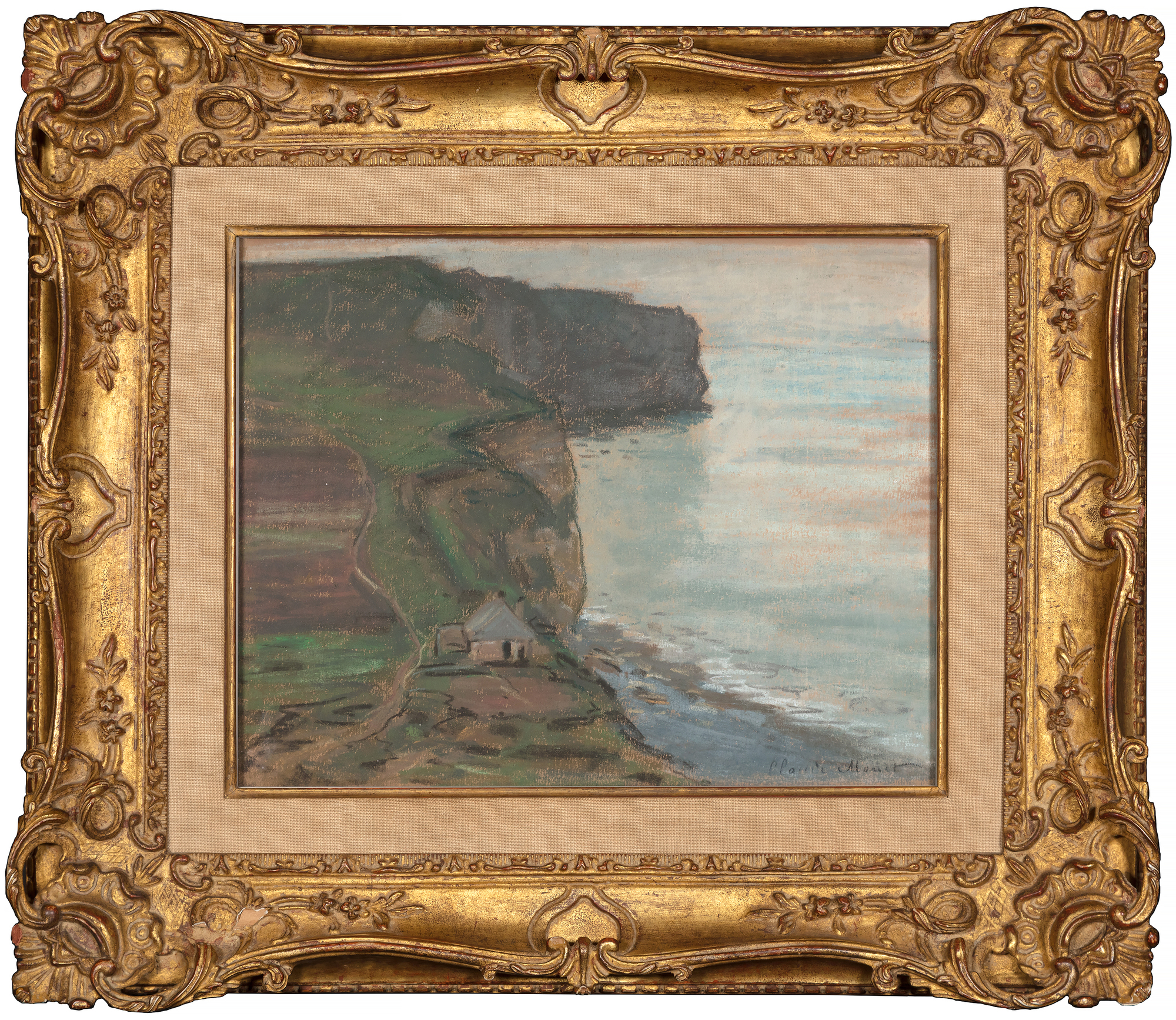
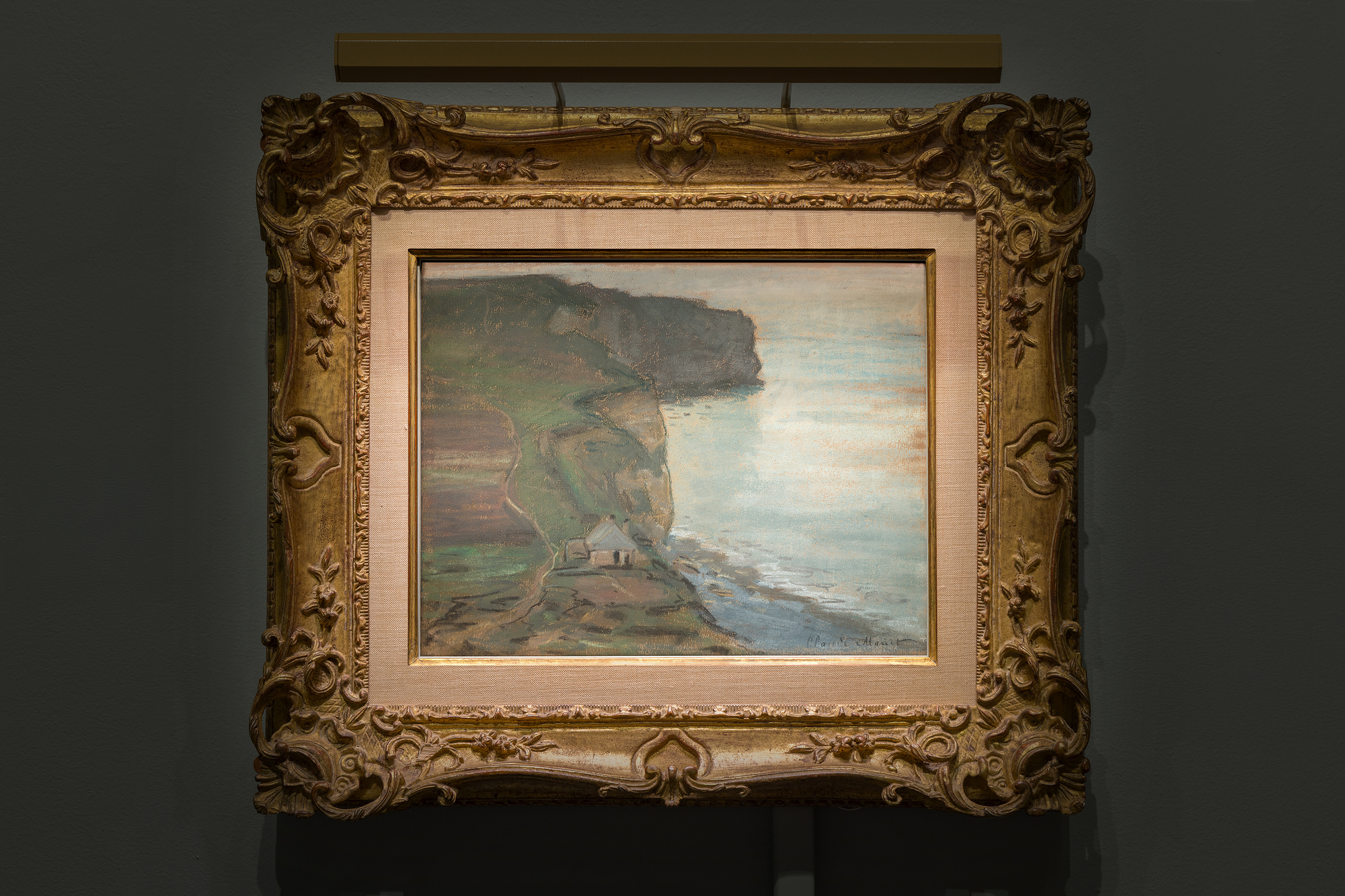
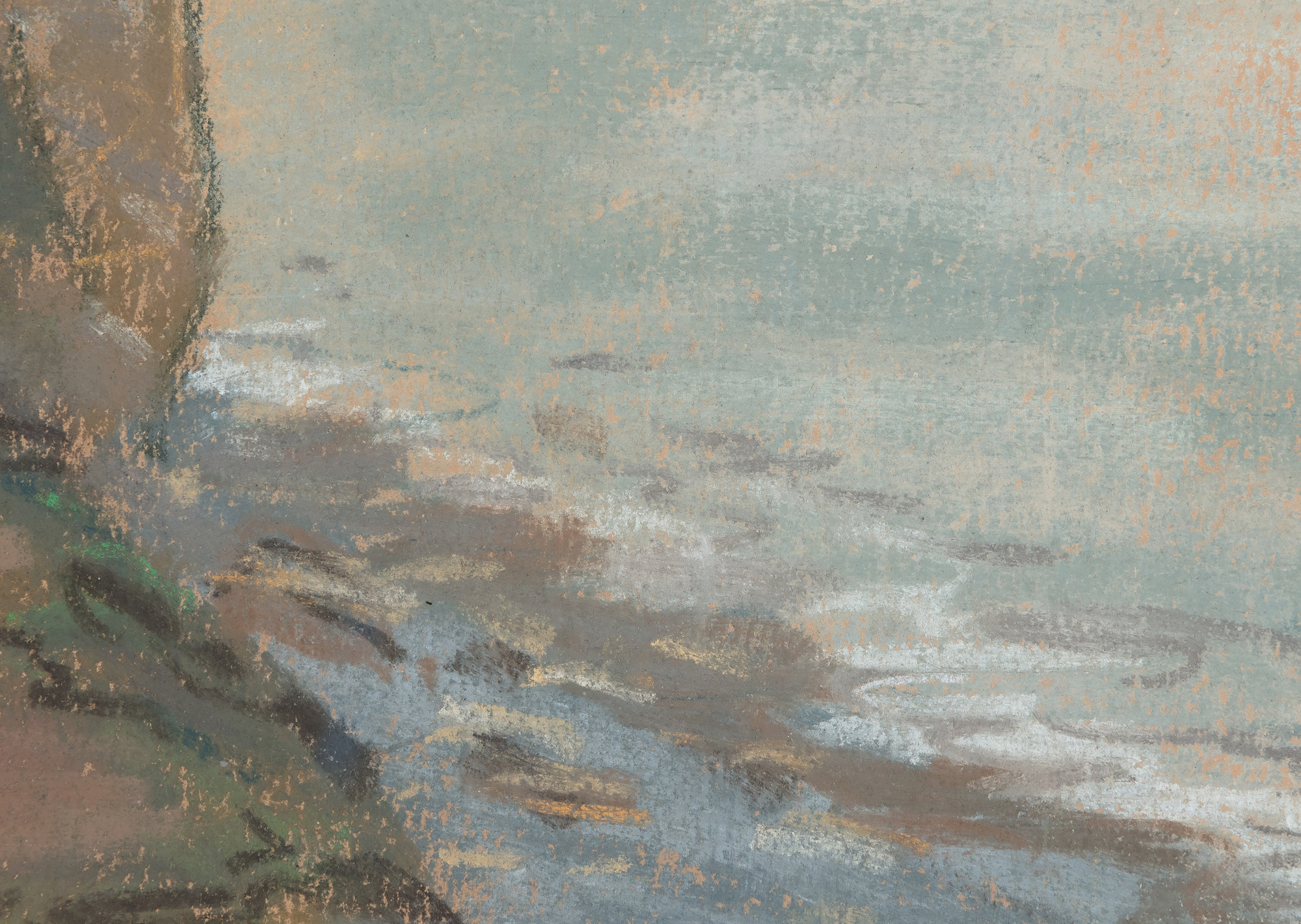
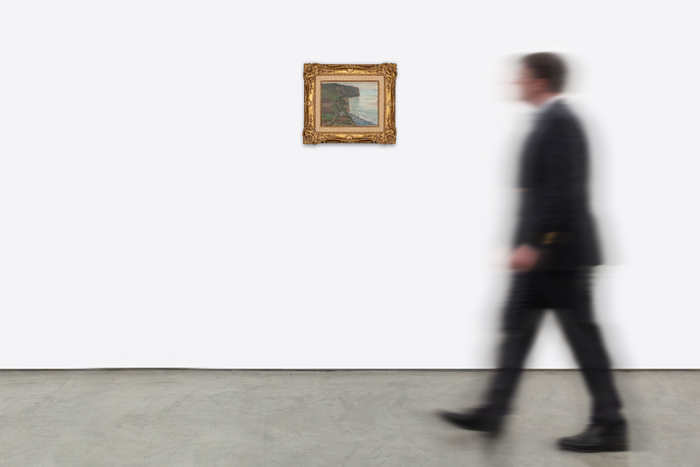
エトルタ、アンティフェ岬1885年頃10 1/2 x 13 3/8 インチ(26.67 x 33.97 cm) 紙にパステル、板に貼付
出所
(おそらく)マテルヌ夫人、1894年頃
I. シュチュキン、パリ
オテル・ドロワ、パリ、1900年3月24日、ロット36
オリヴィエ・ヴァンゼール
ロランスー画廊、パリ
ワイルデンシュタイン社、パリ
アリス・タリー、上記より取得、1973年
クリスティーズ、ニューヨーク、1994年11月10日、ロット138
ネフ=デガン・ギャラリー、ロンドン
個人コレクション、上記より取得、2002年、その後相続により継承
個人コレクション、カリフォルニア州
展示会
ニューヨーク州イーストハンプトン、ギルドホール、『海は我らに』誌、1953年8月-9月号、第45号
和紙
...もっとその。。。ワシントンD.C.、アダムズ・デイヴィッドソン・ギャラリー『フランス印象派とその継承者たち』展1971年12月~1972年1月
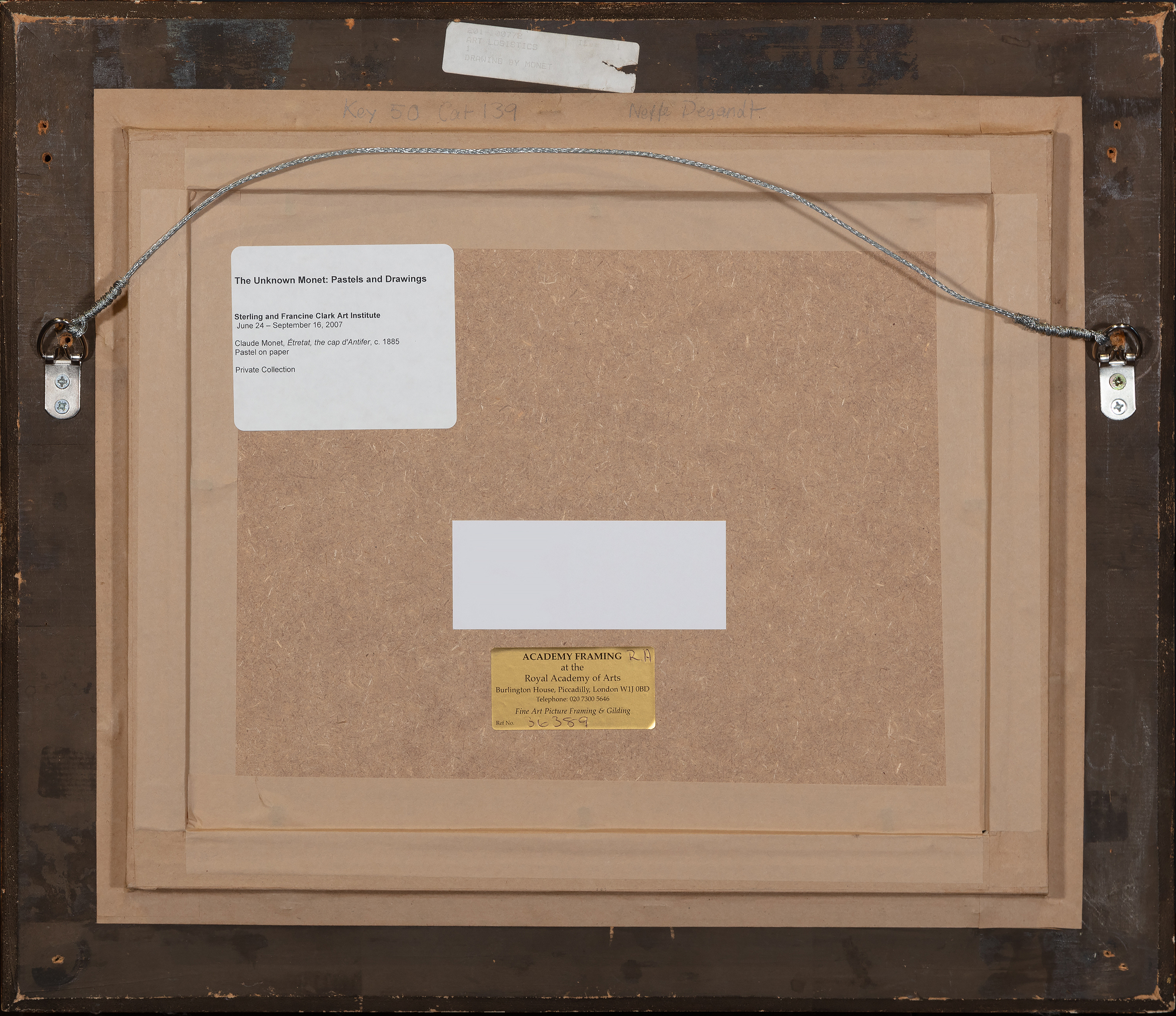
ロンドン、ロイヤル・アカデミー・オブ・アーツ;ウィリアムズタウン、スターリング・アンド・フランシーン・クラーク美術館『知られざるモネ:パステル画と素描』展、2007年3月~9月、作品番号139
文学
ダニエル・ヴィルデンシュタイン編『クロード・モネ作品総覧 補遺:絵画・素描・パステル』ローザンヌ、1991年、第5巻、P 80番、171頁(図版掲載)
ジェームズ・ガンツ、リチャード・ケンデル共著『知られざるモネ:パステル画と素描』ウィリアムズタウン、マサチューセッツ州、2007年、作品番号139、158-159ページおよび302ページ(図版掲載ページ158)
...少ない。。。
鉛筆やパステルを使って絵画の準備をするという発想は、モネが公にしていた創作プロセスとは相容れないものだったため、彼はその重要性を軽視する傾向がありました。しかし、彼の死後、400点以上のデッサンと多くのパステル画を含む8冊のフォリオが発見されました。この便利で軽量な画材により、彼は構図や色彩を実験し、油絵のアイデアを素早く発展させることができました。また、この作品のように、パステルを使って完成した絵も制作しています。


1880年代、モネはノルマンディーの海岸に戻りました。彼は、ドラクロワやクールベがそうであったように、きらめく光と有名な石灰岩の崖からインスピレーションを得ました。油絵の具を使って直接制作するだけでなく、ブーダンの例に倣って、黒チョークやパステルを使って、空、海、陸に光と色が与える影響を研究しました。


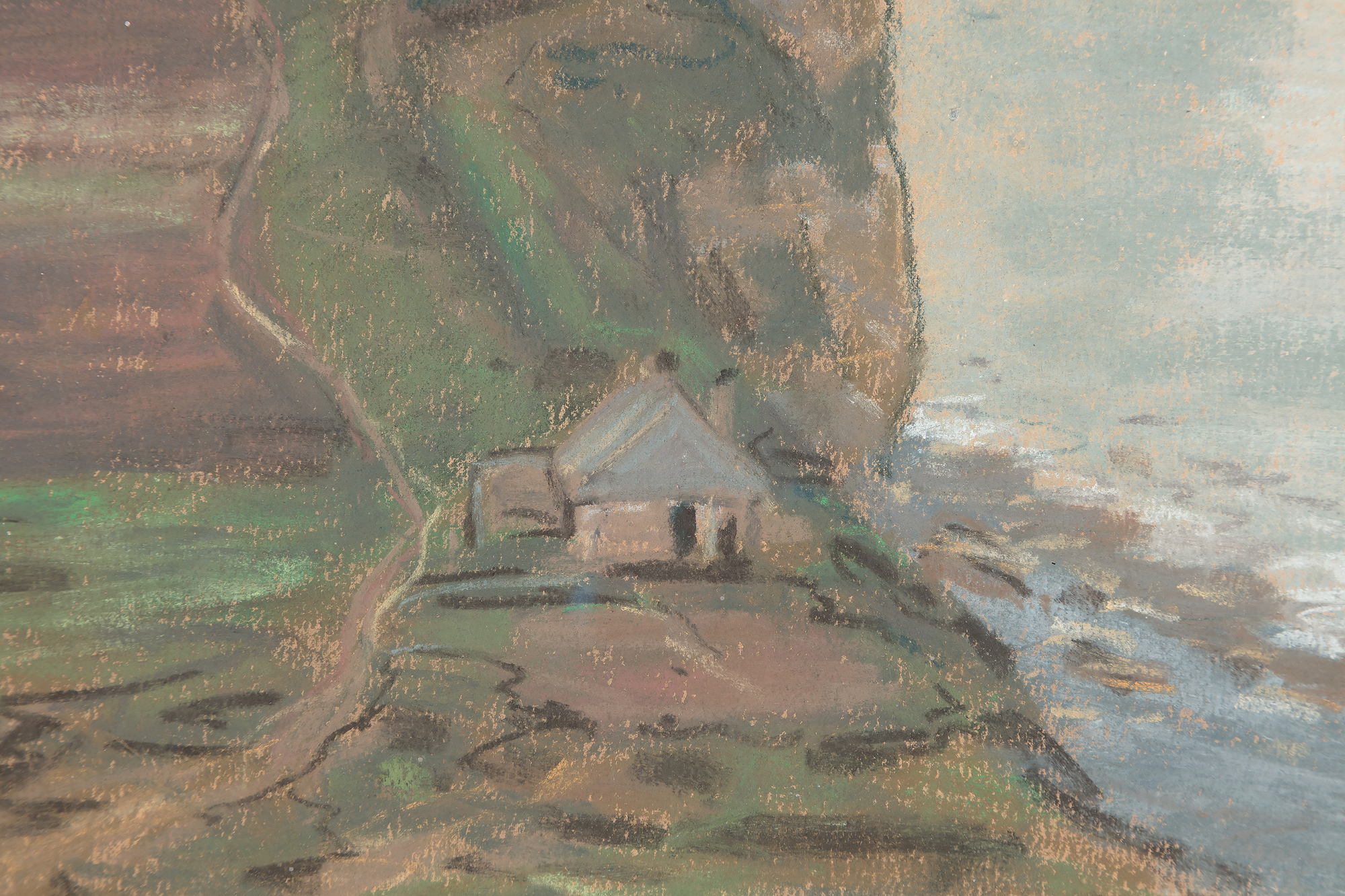
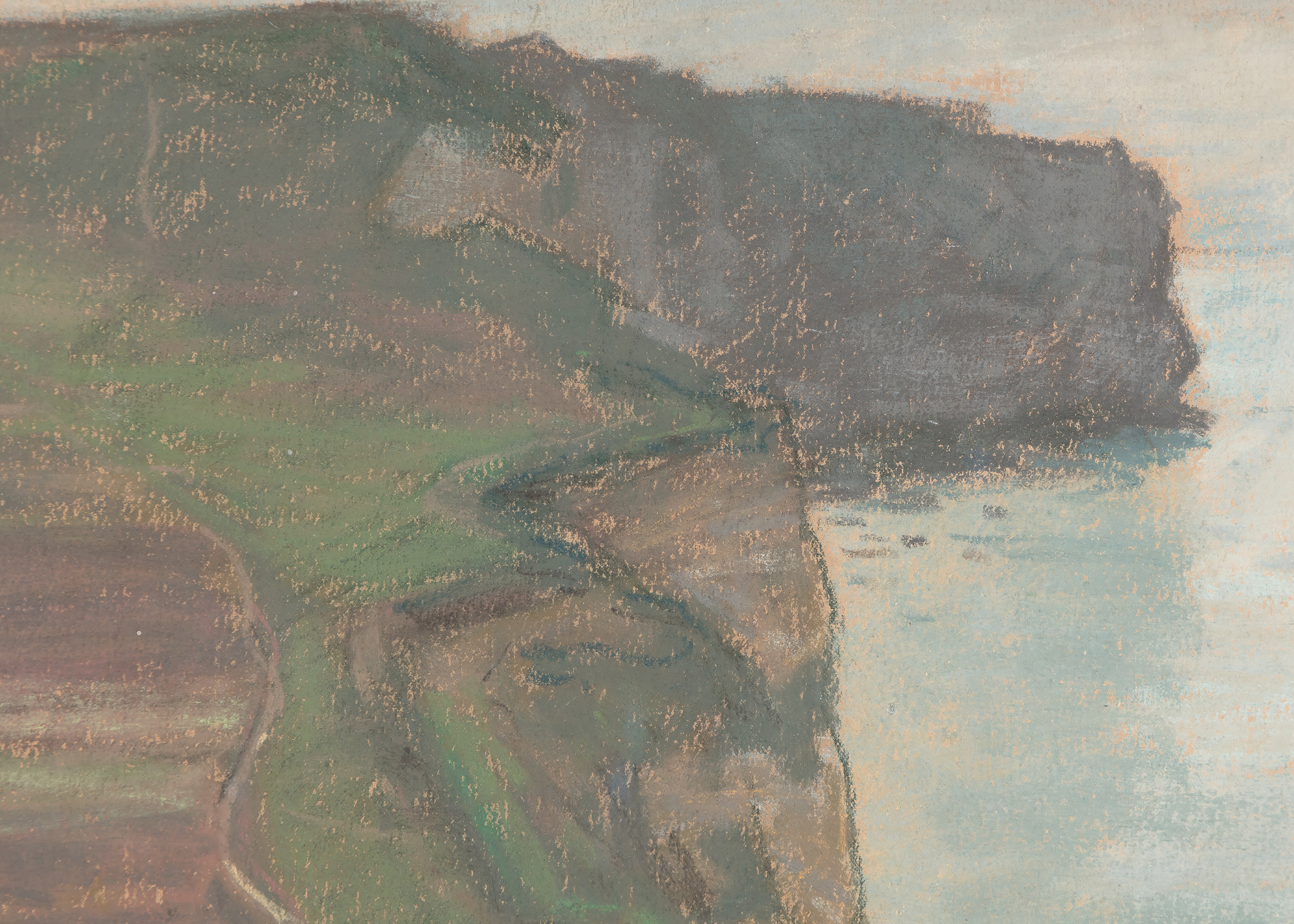
ル・アーヴルから北へ 20 マイルの海岸沿いにあるエトルタのこの海景画で、モネは、目もくらむような崖で風景を中央で分割するという、珍しい構図を選択しています。絵の左半分は土色の緑と茶色で構成され、右半分は空に溶け込む、太陽の光がきらめく海で、地平線はごくわずかな木炭のタッチで暗示されています。 この作品は、同時期に制作された近隣のポルト・ダヴァルを描いた別のパステル画とは雰囲気が大きく異なる。後者の夕暮れの空は、パステルで表現可能な表現力の幅を示している。1885年夏、このパステル画を制作した年までにモネは都市の主題をほぼ放棄し、自然現象へとより強く惹かれていた。彼は様々な光の条件下で海岸沿いの多くの風景を描いた。 モネの作品総覧が指摘するように、このパステル画は油彩画の下絵ではなく、完全に独立した作品である。変化に富む天候を捉えようとする際、画家がこの画材の多様性をいかに深く理解し、楽しんでいたかを示している。
お 問い合わせ