戻る

ウィリアム・メリット・チェイス (1849-1916)

 
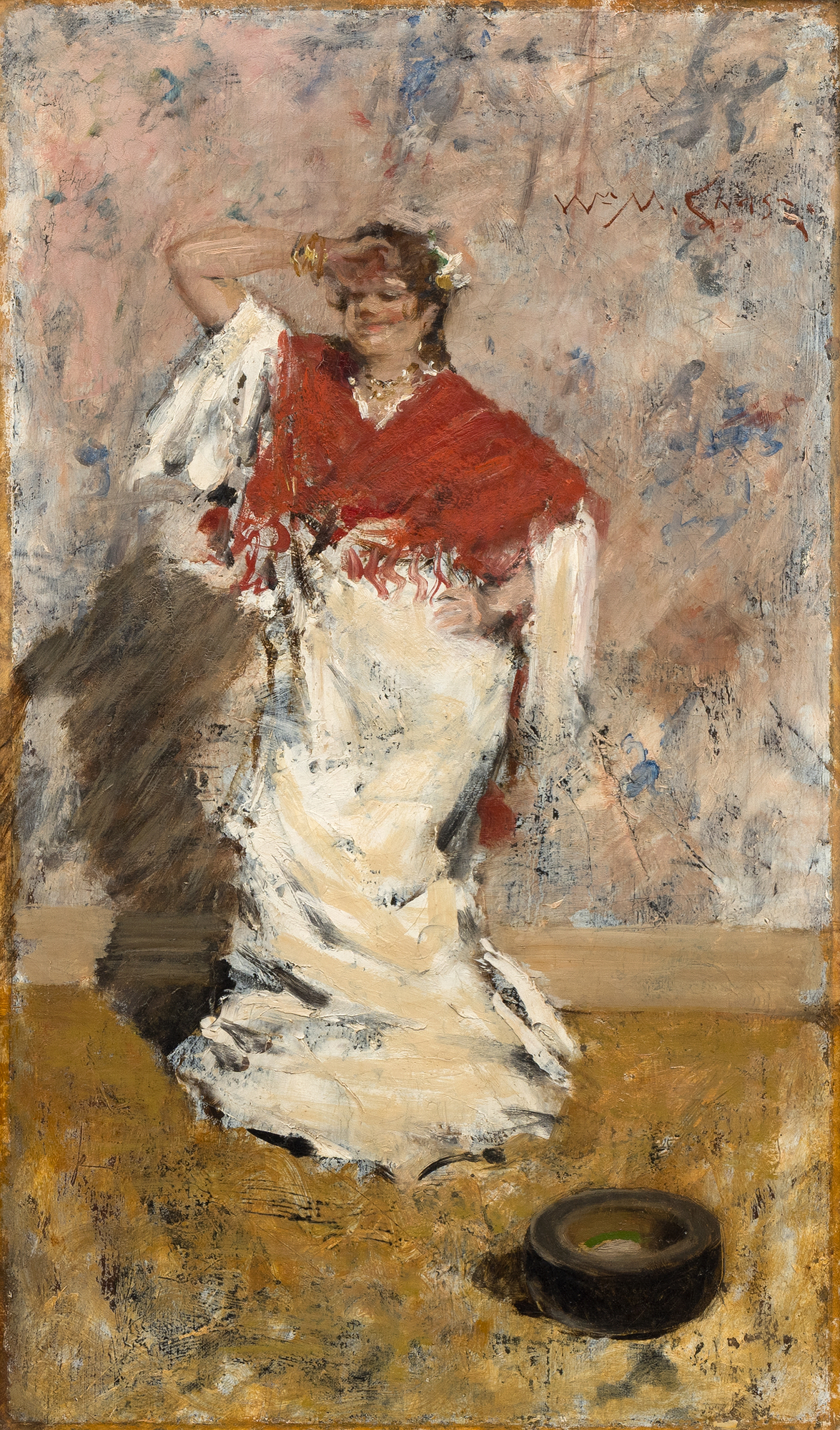
<div><font face=Lato size=3 color=black><em>Dancing Girl</em> dates from 1881 to 1882, a dynamic and exploratory moment in William Merritt Chase’s career when he was actively engaging with European subjects and broadening the expressive range of American painting. The work is included in the Chase catalogue raisonne and reflects the artists fascination with Spanish themes, which many American painters of the period encountered firsthand while studying the masters in the Prado and absorbing the culture, costume, and movement of Spain. Although the painting was later mislabeled by an early owner as an Italian street scene, Chase was in Spain during the summer when this work was created, firmly situating it within his Spanish period.</font></div><br><br><div> </div><br><br><div><font face=Lato size=3 color=black>The animated single figure captures a woman in motion, a subject that is notably rare within Chases oeuvre and distinct from the more contemplative female figures that dominate his most valuable works. His auction record painting, <em>I Think I Am Ready Now</em> from around 1883, shares the focus on a single female figure from the same period, underscoring the importance of this moment in his artistic development. The present work also relates closely to important institutional examples, including <em>Carmencita</em> from 1885 in the Metropolitan Museum of Art and <em>A Tambourine Player</em> in the Montclair Art Museum, both of which highlight Chases sustained interest in dancers and Spanish costume.</font></div><br><br><div> </div><br><br><div><font face=Lato size=3 color=black>The painting was held on long term loan to the Museum of Fine Arts Boston from 1906 to 1922, affirming its early institutional recognition. Chase’s Spanish works should be viewed in dialogue with those of John Singer Sargent, whom he met in 1881 while Sargent was developing studies for <em>El Jaleo</em>, as both artists looked to Velázquez for inspiration. <em>Dancing Girl</em> stands as a spirited and uncommon example of Chase portraying a woman at play, capturing movement, rhythm, and cultural immediacy at the height of his European engagement.</font></div><br><br><div> </div> <div><font face=Lato size=3 color=black><em>Dancing Girl</em> dates from 1881 to 1882, a dynamic and exploratory moment in William Merritt Chase’s career when he was actively engaging with European subjects and broadening the expressive range of American painting. The work is included in the Chase catalogue raisonne and reflects the artists fascination with Spanish themes, which many American painters of the period encountered firsthand while studying the masters in the Prado and absorbing the culture, costume, and movement of Spain. Although the painting was later mislabeled by an early owner as an Italian street scene, Chase was in Spain during the summer when this work was created, firmly situating it within his Spanish period.</font></div><br><br><div> </div><br><br><div><font face=Lato size=3 color=black>The animated single figure captures a woman in motion, a subject that is notably rare within Chases oeuvre and distinct from the more contemplative female figures that dominate his most valuable works. His auction record painting, <em>I Think I Am Ready Now</em> from around 1883, shares the focus on a single female figure from the same period, underscoring the importance of this moment in his artistic development. The present work also relates closely to important institutional examples, including <em>Carmencita</em> from 1885 in the Metropolitan Museum of Art and <em>A Tambourine Player</em> in the Montclair Art Museum, both of which highlight Chases sustained interest in dancers and Spanish costume.</font></div><br><br><div> </div><br><br><div><font face=Lato size=3 color=black>The painting was held on long term loan to the Museum of Fine Arts Boston from 1906 to 1922, affirming its early institutional recognition. Chase’s Spanish works should be viewed in dialogue with those of John Singer Sargent, whom he met in 1881 while Sargent was developing studies for <em>El Jaleo</em>, as both artists looked to Velázquez for inspiration. <em>Dancing Girl</em> stands as a spirited and uncommon example of Chase portraying a woman at play, capturing movement, rhythm, and cultural immediacy at the height of his European engagement.</font></div><br><br><div> </div> <div><font face=Lato size=3 color=black><em>Dancing Girl</em> dates from 1881 to 1882, a dynamic and exploratory moment in William Merritt Chase’s career when he was actively engaging with European subjects and broadening the expressive range of American painting. The work is included in the Chase catalogue raisonne and reflects the artists fascination with Spanish themes, which many American painters of the period encountered firsthand while studying the masters in the Prado and absorbing the culture, costume, and movement of Spain. Although the painting was later mislabeled by an early owner as an Italian street scene, Chase was in Spain during the summer when this work was created, firmly situating it within his Spanish period.</font></div><br><br><div> </div><br><br><div><font face=Lato size=3 color=black>The animated single figure captures a woman in motion, a subject that is notably rare within Chases oeuvre and distinct from the more contemplative female figures that dominate his most valuable works. His auction record painting, <em>I Think I Am Ready Now</em> from around 1883, shares the focus on a single female figure from the same period, underscoring the importance of this moment in his artistic development. The present work also relates closely to important institutional examples, including <em>Carmencita</em> from 1885 in the Metropolitan Museum of Art and <em>A Tambourine Player</em> in the Montclair Art Museum, both of which highlight Chases sustained interest in dancers and Spanish costume.</font></div><br><br><div> </div><br><br><div><font face=Lato size=3 color=black>The painting was held on long term loan to the Museum of Fine Arts Boston from 1906 to 1922, affirming its early institutional recognition. Chase’s Spanish works should be viewed in dialogue with those of John Singer Sargent, whom he met in 1881 while Sargent was developing studies for <em>El Jaleo</em>, as both artists looked to Velázquez for inspiration. <em>Dancing Girl</em> stands as a spirited and uncommon example of Chase portraying a woman at play, capturing movement, rhythm, and cultural immediacy at the height of his European engagement.</font></div><br><br><div> </div> <div><font face=Lato size=3 color=black><em>Dancing Girl</em> dates from 1881 to 1882, a dynamic and exploratory moment in William Merritt Chase’s career when he was actively engaging with European subjects and broadening the expressive range of American painting. The work is included in the Chase catalogue raisonne and reflects the artists fascination with Spanish themes, which many American painters of the period encountered firsthand while studying the masters in the Prado and absorbing the culture, costume, and movement of Spain. Although the painting was later mislabeled by an early owner as an Italian street scene, Chase was in Spain during the summer when this work was created, firmly situating it within his Spanish period.</font></div><br><br><div> </div><br><br><div><font face=Lato size=3 color=black>The animated single figure captures a woman in motion, a subject that is notably rare within Chases oeuvre and distinct from the more contemplative female figures that dominate his most valuable works. His auction record painting, <em>I Think I Am Ready Now</em> from around 1883, shares the focus on a single female figure from the same period, underscoring the importance of this moment in his artistic development. The present work also relates closely to important institutional examples, including <em>Carmencita</em> from 1885 in the Metropolitan Museum of Art and <em>A Tambourine Player</em> in the Montclair Art Museum, both of which highlight Chases sustained interest in dancers and Spanish costume.</font></div><br><br><div> </div><br><br><div><font face=Lato size=3 color=black>The painting was held on long term loan to the Museum of Fine Arts Boston from 1906 to 1922, affirming its early institutional recognition. Chase’s Spanish works should be viewed in dialogue with those of John Singer Sargent, whom he met in 1881 while Sargent was developing studies for <em>El Jaleo</em>, as both artists looked to Velázquez for inspiration. <em>Dancing Girl</em> stands as a spirited and uncommon example of Chase portraying a woman at play, capturing movement, rhythm, and cultural immediacy at the height of his European engagement.</font></div><br><br><div> </div> <div><font face=Lato size=3 color=black><em>Dancing Girl</em> dates from 1881 to 1882, a dynamic and exploratory moment in William Merritt Chase’s career when he was actively engaging with European subjects and broadening the expressive range of American painting. The work is included in the Chase catalogue raisonne and reflects the artists fascination with Spanish themes, which many American painters of the period encountered firsthand while studying the masters in the Prado and absorbing the culture, costume, and movement of Spain. Although the painting was later mislabeled by an early owner as an Italian street scene, Chase was in Spain during the summer when this work was created, firmly situating it within his Spanish period.</font></div><br><br><div> </div><br><br><div><font face=Lato size=3 color=black>The animated single figure captures a woman in motion, a subject that is notably rare within Chases oeuvre and distinct from the more contemplative female figures that dominate his most valuable works. His auction record painting, <em>I Think I Am Ready Now</em> from around 1883, shares the focus on a single female figure from the same period, underscoring the importance of this moment in his artistic development. The present work also relates closely to important institutional examples, including <em>Carmencita</em> from 1885 in the Metropolitan Museum of Art and <em>A Tambourine Player</em> in the Montclair Art Museum, both of which highlight Chases sustained interest in dancers and Spanish costume.</font></div><br><br><div> </div><br><br><div><font face=Lato size=3 color=black>The painting was held on long term loan to the Museum of Fine Arts Boston from 1906 to 1922, affirming its early institutional recognition. Chase’s Spanish works should be viewed in dialogue with those of John Singer Sargent, whom he met in 1881 while Sargent was developing studies for <em>El Jaleo</em>, as both artists looked to Velázquez for inspiration. <em>Dancing Girl</em> stands as a spirited and uncommon example of Chase portraying a woman at play, capturing movement, rhythm, and cultural immediacy at the height of his European engagement.</font></div><br><br><div> </div> <div><font face=Lato size=3 color=black><em>Dancing Girl</em> dates from 1881 to 1882, a dynamic and exploratory moment in William Merritt Chase’s career when he was actively engaging with European subjects and broadening the expressive range of American painting. The work is included in the Chase catalogue raisonne and reflects the artists fascination with Spanish themes, which many American painters of the period encountered firsthand while studying the masters in the Prado and absorbing the culture, costume, and movement of Spain. Although the painting was later mislabeled by an early owner as an Italian street scene, Chase was in Spain during the summer when this work was created, firmly situating it within his Spanish period.</font></div><br><br><div> </div><br><br><div><font face=Lato size=3 color=black>The animated single figure captures a woman in motion, a subject that is notably rare within Chases oeuvre and distinct from the more contemplative female figures that dominate his most valuable works. His auction record painting, <em>I Think I Am Ready Now</em> from around 1883, shares the focus on a single female figure from the same period, underscoring the importance of this moment in his artistic development. The present work also relates closely to important institutional examples, including <em>Carmencita</em> from 1885 in the Metropolitan Museum of Art and <em>A Tambourine Player</em> in the Montclair Art Museum, both of which highlight Chases sustained interest in dancers and Spanish costume.</font></div><br><br><div> </div><br><br><div><font face=Lato size=3 color=black>The painting was held on long term loan to the Museum of Fine Arts Boston from 1906 to 1922, affirming its early institutional recognition. Chase’s Spanish works should be viewed in dialogue with those of John Singer Sargent, whom he met in 1881 while Sargent was developing studies for <em>El Jaleo</em>, as both artists looked to Velázquez for inspiration. <em>Dancing Girl</em> stands as a spirited and uncommon example of Chase portraying a woman at play, capturing movement, rhythm, and cultural immediacy at the height of his European engagement.</font></div><br><br><div> </div> <div><font face=Lato size=3 color=black><em>Dancing Girl</em> dates from 1881 to 1882, a dynamic and exploratory moment in William Merritt Chase’s career when he was actively engaging with European subjects and broadening the expressive range of American painting. The work is included in the Chase catalogue raisonne and reflects the artists fascination with Spanish themes, which many American painters of the period encountered firsthand while studying the masters in the Prado and absorbing the culture, costume, and movement of Spain. Although the painting was later mislabeled by an early owner as an Italian street scene, Chase was in Spain during the summer when this work was created, firmly situating it within his Spanish period.</font></div><br><br><div> </div><br><br><div><font face=Lato size=3 color=black>The animated single figure captures a woman in motion, a subject that is notably rare within Chases oeuvre and distinct from the more contemplative female figures that dominate his most valuable works. His auction record painting, <em>I Think I Am Ready Now</em> from around 1883, shares the focus on a single female figure from the same period, underscoring the importance of this moment in his artistic development. The present work also relates closely to important institutional examples, including <em>Carmencita</em> from 1885 in the Metropolitan Museum of Art and <em>A Tambourine Player</em> in the Montclair Art Museum, both of which highlight Chases sustained interest in dancers and Spanish costume.</font></div><br><br><div> </div><br><br><div><font face=Lato size=3 color=black>The painting was held on long term loan to the Museum of Fine Arts Boston from 1906 to 1922, affirming its early institutional recognition. Chase’s Spanish works should be viewed in dialogue with those of John Singer Sargent, whom he met in 1881 while Sargent was developing studies for <em>El Jaleo</em>, as both artists looked to Velázquez for inspiration. <em>Dancing Girl</em> stands as a spirited and uncommon example of Chase portraying a woman at play, capturing movement, rhythm, and cultural immediacy at the height of his European engagement.</font></div><br><br><div> </div>
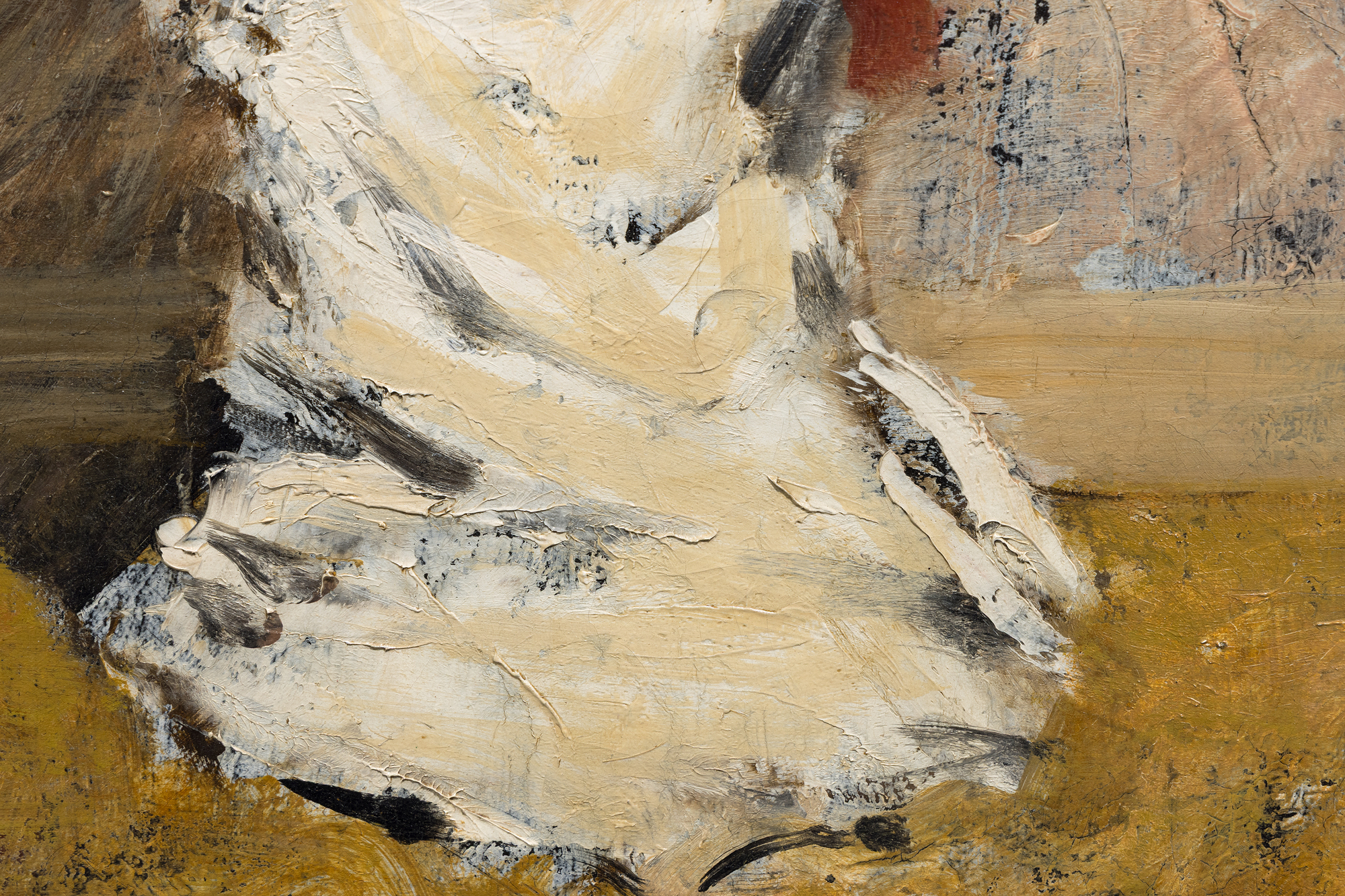
踊る女1881-82年26 x 15 1/2 インチ(66.04 x 39.37 cm) 油彩・キャンバス
出所
チェイス・スタジオ(ニューヨーク)、1881年頃
(おそらく)ボストン・アート・クラブにて、1886年
W.B. シーウォール夫人(ボストン)、1906年
ボストン美術館(W.B. シーウォール夫人より貸与、1906年11月2日~1913年10月30日)
ルーファス・L・シーウォール
ハロルド・I・シーウォールとウィリアム・G・シーウォール
ボストン美術館(貸与、1913年10月30日~1922年7月5日)
個人所蔵、ボストン
個人所蔵、ニューヨーク
個人所蔵、ボストン(上記より取得)
展示会
マサチューセッツ州ボストン、ボストン美術クラブ、絵画展覧会 ...もっとその。。。ニューヨーク市ウィリアム・M・チェイス氏による習作とスケッチ、1886年11月18日~12月4日、第57番『スペインの踊り子』
文学
ロナルド・ピサーノ著『ウィリアム・メリット・チェイス:油彩肖像画集』ニューヨーク、2006年、作品番号OP.99「ストリート・ダンサー、イタリア(女性の習作;踊る少女)」として
...少ない。。。
『踊る少女』は1881年から1882年にかけて制作された。ウィリアム・メリット・チェイスのキャリアにおいて、ヨーロッパの題材に積極的に取り組み、アメリカ絵画の表現の幅を広げていた、躍動的で探求的な時期の作品である。 本作はチェイスの作品総覧(カタログ・レゾネ)に収録されており、当時の多くのアメリカ人画家たちがプラド美術館で巨匠たちの作品を学び、スペインの文化・衣装・動きを吸収する中で直接触れたスペイン的テーマへの画家の傾倒を反映している。後に初期所有者によってイタリアの街角風景と誤ってラベル付けされたが、本作制作時の夏にチェイスはスペインに滞在しており、彼のスペイン期に確固として位置づけられる。


躍動する単一の人物像は、動きのある女性を捉えており、チェイスの作品群において顕著に稀な主題である。これは彼の最も価値ある作品を支配する、より瞑想的な女性像とは一線を画す。彼のオークション最高記録作品である『今こそ準備は整った』(1883年頃)も、同時期の単一女性像に焦点を当てており、この瞬間が彼の芸術的発展において重要であったことを強調している。 本作品は重要な収蔵例とも密接に関連している。メトロポリタン美術館所蔵の1885年作『カルメンシータ』やモントクレア美術館所蔵の『タンブリン奏者』はいずれも、チェイスがダンサーとスペイン衣装に持続的に関心を寄せたことを示している。


本作は1906年から1922年までボストン美術館に長期貸与されており、初期の収蔵機関による評価を裏付けている。 チェイスのスペイン関連作品は、ジョン・シンガー・サージェントの作品と対話的に鑑賞すべきである。両者は1881年、サージェントが『闘牛』の下絵制作中に知り合い、ともにベラスケスから着想を得ていた。『踊る女』は、チェイスが女性の遊びを表現した活気に満ちた特異な作品であり、ヨーロッパ滞在の絶頂期に動き、リズム、文化的臨場感を捉えている。


お 問い合わせ