Jackson Hole Galerie Rundgang 2022

VERÖFFENTLICHT IN: Galerie Rundgänge

In der wilden Schönheit von Jackson Hole, Wyoming, mit den Nationalparks als atemberaubende Kulisse gelegen, bringt Heather James Jackson seit über einem Jahrzehnt Kunstwerke und Dienstleistungen von höchstem Niveau in das Intermountain West.

Heather James ist bestrebt, eine unvergleichliche Auswahl an Kunstwerken und Dienstleistungen für Einheimische und Besucher anzubieten, die Jackson Hole zu einem unvergleichlichen Ziel für die amerikanische Kultur und die freie Natur machen.

Under the Tang China experienced a period of great cultural flowering, remarkable for its achievements across all areas of the arts and sciences. The tolerance of the Tang Imperial Court to outside influence and the free movement along the East- West trade route known as the Silk Road saw major urban centres become thriving cosmopolitan cities, with the Chinese capital, Chang’an (modern Xian) expanding to reach a population of over one million.<br><br>In keeping with centuries of tradition, funerary rites remained very important. A separate government department existed with responsibility for overseeing the manufacture of funerary wares. Officially there were limits on the number of grave goods and restrictions on the size of the objects which could accompany the deceased, according to rank – the highest ranked officials were meant to have a maximum of 90 figurines, no more than 30cm tall while members of the Imperial family were allowed several hundred up to about one meter tall. However, these rules were frequently broken. The deceased’s relatives believed they could improve their ancestor’s status in the afterlife by providing mingqi in excess of necessity, thereby ensuring their own good fortune. Tang Dynasty figurative ceramics share particular characteristics. The forms are animated and life-like, the subject matter covers all aspects of social and ritual life and the scale of the figures was reasonably small with the exception of some magnificent larger works commissioned for the tombs of the elite. Figures of courtiers and entertainers, polo players and the exotic travelers who now regularly arrived in the Chinese cities with their great pack camels became common place, illustrating the cosmopolitan nature of the times. The variety of forms tells us that craftsmen had scope for individual innovation and were not controlled by rules regarding particular styles. Now the funerary wares spoke not only of power and military strength, but also of the sophistication and intellectual achievements of the deceased.

CHINESISCH

RICHARD SERRA - Cape Breton Horizontal Reversal No. 16 - Litho-Kreide auf zwei Blättern handgeschöpften Papiers - 19 3/4 x 55 7/8 in.

RICHARD SERRA

<div><font face=Lato size=3>Andy Warhol’s "Marilyn #30" (1967) is part of the artist’s landmark Marilyn portfolio, one of his most celebrated and sought-after series. From an edition of 250 (this work numbered 138/250, with 26 artist’s proofs), the portfolio is represented in major institutions including the Museum of Modern Art, New York. </font></div><br><br><div><font face=Lato size=3> </font></div><br><br><div><font face=Lato size=3>Based on a publicity still from the 1953 film Niagara, Warhol’s Marilyns epitomize his fascination with celebrity, mass media, and the power of the reproduced image. Each print in the series was created with five screens—one carrying the photographic likeness and four for areas of color—deliberately layered with bold hues that are at times slightly off-register. This misalignment heightens the tension between glamour and artifice, echoing the fragile brilliance of Marilyn Monroe’s own persona. </font></div><br><br><div><font face=Lato size=3> </font></div><br><br><div><font face=Lato size=3>As one of Warhol’s defining bodies of work, the "Marilyn" prints remain icons of Pop Art, merging Hollywood stardom with silkscreen’s mechanical repetition to create a timeless meditation on fame, desire, and image. </font></div>

ANDY WARHOL

GEORGE RICKEY - Space Churn with Squares - kinetische Skulptur aus rostfreiem Stahl - 35 1/2 x 20 x 13 Zoll.

GEORGE RICKEY

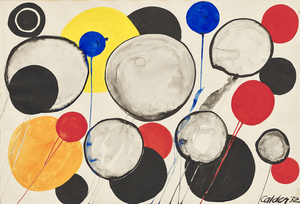
Alexander Calders Rouge Mouille (Wet Red) zeigt einen Hintergrund aus roten Kreisen, von denen sich einige wie Explosionen auflösen und ein Gefühl von energetischer Ausdehnung vermitteln, während andere nach unten laufen, als ob sie die Spuren eines Feuerwerks ziehen. Dieser animierte Hintergrund ist mit zahlreichen undurchsichtigen runden Kugeln geschmückt, die überwiegend schwarz sind, aber von auffälligen blauen, roten und dezent gelben Kugeln durchsetzt sind. Die strategische Platzierung der bunten Kugeln im Kontrast zu den explosiven Rottönen fängt die Ehrfurcht und das Spektakel eines Feuerwerks ein und verwandelt das Gemälde in eine visuelle Metapher für dieses schillernde und feierliche Ereignis. Das Kunstwerk strahlt Spannung und Lebendigkeit aus und fasst die vergängliche Schönheit in einem statischen Medium zusammen.

ALEXANDER KALANDER

© 2023 Calder Foundation, New York / Artists Rights Society (ARS), New York

ALEXANDER KALANDER

Zigzag, Sun, and Crags, painted in 1972, recalls the early morning hour of June 9, 1922 when the young seafaring adventurer Sandy (Alexander) Calder was awakened on the deck of the H. F. Alexander by the intense beams of tropical sunlight that burst across the bow. He stood, squinting against the glare, then turned his head to the west and felt a sudden rush of sensations that brought to him a cosmic resonance he had never felt before. <br><br>“It was early one morning on a calm sea, off Guatemala, when over my couch — a coil of rope — I saw the beginning of a fiery red sunrise on one side and the moon looking like a silver coin on the other. Of the whole trip this impressed me most of all; it left me with a lasting sensation of the solar system.” <br><br>Zignag, Sun, and Crags is not a simple memento of that experience. It is an exhilarating work that celebrates Calder’s inimitable way of imparting the wonder of the natural world by amplifying our experience of it. If, as he might wish, it brings a sense of interconnectedness and belonging as it did to him along the coast of Guatemala as a young Merchant Marine, so much the better.

ALEXANDER KALANDER

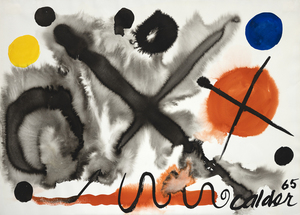
"Wigwam rouge et jaune", ein fesselndes Gouache-Gemälde von Alexander Calder, ist eine lebendige Erkundung von Design und Farbe. Die Komposition wird von einem Gitter aus diagonalen Linien dominiert, die sich in der Nähe ihres Scheitelpunkts kreuzen, und strahlt ein dynamisches Gleichgewicht aus. Calder bringt mit roten und gelben Rautenformen ein Element der Laune ins Spiel, das dem Werk Verspieltheit verleiht und eine festliche Atmosphäre schafft. Rote Kugeln am Scheitelpunkt der rechten Linien erwecken einen skurrilen Eindruck, während kleinere graue Kugeln auf den linken Linien für Kontrast und Gleichgewicht sorgen. Calders meisterhafte Verschmelzung von Einfachheit und lebendigen Designelementen macht Wigwam rouge et jaune zu einem visuellen Vergnügen.

ALEXANDER KALANDER

© 2023 Calder Foundation, New York / Artists Rights Society (ARS), New York

ALEXANDER KALANDER

© 2023 Calder Foundation, New York / Artists Rights Society (ARS), New York

ALEXANDER KALANDER

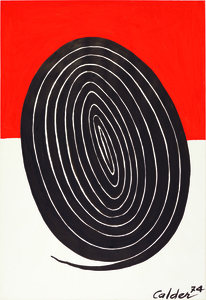
ALEXANDER CALDER - Die ovale Spirale - Gouache und Tinte auf Papier - 43 1/4 x 29 1/2 in.

ALEXANDER KALANDER

HARRY BERTOIA - Weidenskulptur - Edelstahl - 61 1/2 x 39 x 39 Zoll.

HARRY BERTOIA

© 2023 Calder Foundation, New York / Artists Rights Society (ARS), New York

ALEXANDER KALANDER

HARRY BERTOIA - Untitled (Sounding Sculpture) - Berylliumkupfer und Bronze mit Holzsockel - 36 1/2 x 8 x 8 in.

HARRY BERTOIA

© 2023 Calder Foundation, New York / Artists Rights Society (ARS), New York

ALEXANDER KALANDER

<div><font face=Calibri size=3 color=black>Harry Bertoia was an authentic visionary in art, and they are rare. Of those whose métier is sculpture, Alexander Calder and Harry Bertoia are the twentieth-century American standouts. They are engineers of beauty; their creative currency is feats of invention and pure artistry that honor our experience of them (if we are willing to quiet our mind) as if a sacred event. It was Duchamp who suggested Calder call his kinetic works “mobiles”, but it was up to Bertoia himself to coin a word to describe something for which there was little precedent. Visually precise, kinetic, and offering resonant, vibratory sound, a “Sonambient” sculpture is at once a metaphor for our sentient experience in the world yet capable of inducing an aura of transcendent experience. Given that insight, it is easy to understand Bertoia’s view that “I don’t hold onto terms like music and sculpture anymore. Those old distinctions have lost all their meaning.”</font></div><br><br><div> </div><br><br><div><font face=Calibri size=3 color=black>The present “Sonambient” sculpture is a forty-eight-inch-tall curtain of thin-gauged tines. Once activated, it becomes a 15 3/4 inch long, 8 inches deep wall of sound. Five rows of narrow tines are staggered in number, alternating between 30 and 29 tines that, when activated, present as an undulating wall of sound. When touched or moved by air currents, the rods produce a sound that, while metallic, does not betray its source of inspiration: the serene connection Bertoia felt in observing the gentle undulating movement of desert grasses. As always, this is a Bertoia sculpture that invites participation in the experience of changing shapes and sounds, a participatory work that asks us to be present in the moment, to connect across time with the object and its creator.</font></div>

HARRY BERTOIA

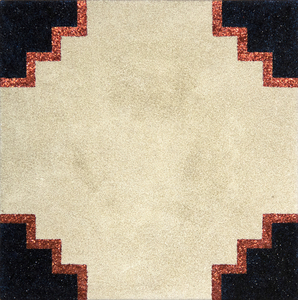
The essential and dramatic declaration “Let there be light” of Genesis is not so far removed from Mary Corse’s recollection of the moment in 1968 when the late afternoon sun electrified the reflective road markings of Malibu as she drove east. In an instant, the glowing asphalt markings provided the oracle she needed to realize she could ‘put light in the painting and not just make a picture of light’.  Using the same glass microbeads utilized by road maintenance services, she layers and embeds the prismatic material in bands and geometric configurations creating nuanced glimmering abstract fields which shift as the viewer moves in relationship to the work. Move to one side and dimness brightens to light. Walk back and forth and you might feel a rippling effect from its shimmering, prismatic effects.<br><br>A photographic image of a Mary Corse microsphere painting is not only a dull representation, but it also misses the point – it is experience dependent art that requires participation to ‘be’.  Of course, “Untitled” (1975) defies that one-point static perspective and instead, depends upon a real time, interactive art experience which heightens awareness of the body in space as the viewer experiences shifts of retinal stimulation, sensation and feeling. It is a rare bird.  Unusually petite at two-foot square, its design, geometry and color belie her earlier revelation that led to a devotion to her usual reductive palette. Instead, it is a bold statement in sequined color, its center field bounded at the corners by a sparkling red stepped motif that separates it from its starry night sky corner spandrels. It may not include a star motif, but it has the glamour and presence that belongs along Hollywood’s Walk of Fame.

MARY CORSE

<div><font face=Lato size=3>Andy Warhol’s <em>Mao</em> (1972) is one of the artist’s most iconic and provocative screenprints, reflecting his fascination with the intersection of political power and celebrity culture. This impression, numbered 244/250, comes from the regular edition of 250, in addition to 50 artist’s proofs. Warhol based the image on the widely circulated official portrait of Chairman Mao Zedong, a figure whose likeness was omnipresent in China during the Cultural Revolution. By reimagining the image through his vivid Pop palette, Warhol transformed a symbol of political authority into a mass-produced cultural icon. </font></div><br><br><div><font face=Lato size=3> </font></div><br><br><div><font face=Lato size=3>In this version, Mao’s face is rendered in a striking deep blue, offset by a green shirt and set against a turquoise background. The bold chromatic choices infuse the portrait with both drama and irony, destabilizing the original propagandistic authority of the image. Warhol further heightens this tension by juxtaposing flat, mechanical silkscreen layers with painterly flourishes, blurring the line between mass production and individual expression. </font></div><br><br><div><font face=Lato size=3> </font></div><br><br><div><font face=Lato size=3>The <em>Mao </em>series marked a new chapter in Warhol’s career in the 1970s, shifting from Hollywood stars to figures of global influence. Today, these works are regarded as essential statements on the nature of power, fame, and the pervasive reach of the image in contemporary culture. </font></div>

ANDY WARHOL

<div><font face=Lato size=3 color=black>Wayne Thiebaud’s <em>Boston Cremes</em> (1970–71) forms part of the artist’s portfolio <em>Seven Still Lifes and a Silver Landscape</em>. Signed and dated by the artist in 1970, the print has not previously appeared at auction. Thiebaud, a central figure in Post-War American art, is celebrated for his luminous depictions of everyday objects, most notably desserts and consumer goods, that situate him at the intersection of Pop Art’s engagement with mass culture and a painterly sensibility indebted to Impressionism.</font></div><br><br><div> </div><br><br><div><font face=Lato size=3 color=black>Decadent rows of chocolate-topped pastries are presented in neat sequence, echoing the logic of bakery displays while transforming a familiar confection into a cultural icon. Within the apparent uniformity, subtle variations in contour, texture, and shading emerge, inviting close attention to the individuality of each form.</font></div><br><br><div> </div><br><br><div><font face=Lato size=3 color=black>Rendered in bright, pastel grounds offset by rich browns, yellows, and creams, the image exemplifies Thiebaud’s distinctive use of color, particularly his shadows infused with unexpected blues and purples. These chromatic choices lend vibrancy and a sense of light to ordinary subjects, elevating them into objects of contemplation.</font></div><br><br><div><font face=Lato size=3> </font></div><br><br><div><font face=Lato size=3 color=black>At once nostalgic and critical, <em>Boston Cremes</em> reflects the artist’s engagement with American consumer culture and his distinctive balance between realism and stylization. Transforming familiar confections into enduring symbols of American life, the work evokes memory while challenging the boundaries between fine art and popular imagery.</font></div>

WAYNE THIEBAUD

KHMER - Männlicher Torso - Sandstein - 24 x 9 x 5 Zoll.

KHMER

Ray Parkers frühe Beiträge zur Farbfeldmalerei aus den späten 1950er bis Mitte der 1960er Jahre zeichnen sich durch ihre lebendige, frische Qualität aus. Parker arrangierte zwei oder mehr robuste, grobkantige Farbblöcke mit einer kräftigen, pinselartigen Technik auf großen, mit Gesso vorbereiteten Leinwänden. Diese Blöcke, die in gesättigten und doch subtil leuchtenden Farben wiedergegeben werden, weisen eine ausgeprägte Energie auf. Parkers Kompositionen erinnern zwar an Rothkos, doch die Art und Weise, wie die Farben eingesetzt werden - solide und kraftvoll - unterscheidet sie von diesen. Unter Beibehaltung des großen Maßstabs und der Dynamik der New York School weicht Parkers Arbeit von der emotionalen Intensität ab, die oft mit dem Abstrakten Expressionismus assoziiert wird, und umfasst eine Vision der Bewegung, die frei von ihrem typischen Pathos ist.

RAY PARKER

This well preserved bell is one of the largest known bronzes from the Southeast Asian Bronze Age, generally named after the Dongson site in North Vietnam.  The swirling band design is finely and crisply cast. Dongson bronze drums were also reported in South China, Thailand, Laos, West Malaysia, and Indonesia and as Far East as Western Iranian Java. <br><br>The Dong Son culture is a Bronze age culture including all of southeast Asia and into the Indo-Malaya Archipelago from about 1000 to 1 BC. Centered on the Red River Valley of Vietnam, the Dong Son were sophisticated agriculturalists, raising rice and buffalo. Dong Son probably arose from local Neolithic cultures, such as Phung Nguyen and Dong Dau phases. Dong Son is identified with the Van Lang ruling dynasty, the first ruling dynasty of Vietnam. By the second century BC, impacts from the Han Dynasty in China were being felt and according to historic records, the Dong Son were absorbed into the Han Dynasty territory.

SÜDOSTASIATISCH

KHMER - Kopf von Avalokiteshvara - grauer Sandstein - 13 x 7 x 7 in.

KHMER

<div><font face=Lato size=3 color=black>Wayne Thiebaud’s <em>Breakfast</em>, from an edition of 50, demonstrates the artist’s signature blend of Pop-inflected realism and painterly intimacy. Executed in colored drypoint, the work captures the simple subject of a morning meal with a remarkable freshness: hatching lines soften and blur the composition, creating a pastel-like effect that distinguishes it from the crispness of commercial print design. Though slightly faded, the impression retains the playful chromatic sensibility and softly modeled shadowing that became hallmarks of Thiebaud’s style.</font></div><br><br><div><font face=Lato size=3> </font></div><br><br><div><font face=Lato size=3 color=black>Since the early 1960s, Thiebaud has been celebrated for his depictions of food—cakes, pies, gumball machines, and diner counters—rendered not as literal meals but as cultural icons, at once nostalgic and idealized. In <em>Breakfast</em>, the modest meal is transformed into a subject of contemplation and delight, celebrating the pleasures of everyday American life while evoking memory and desire. The combination of precision and informality speaks to Thiebaud’s ability to merge the immediacy of drawing with the enduring resonance of painting.</font></div><br><br><div><font face=Lato size=3> </font></div><br><br><div><font face=Lato size=3 color=black>Institutional recognition of the work’s importance is reflected in its inclusion within the National Gallery of Art, Washington, affirming its role within Thiebaud’s larger project of elevating common objects into images of enduring cultural significance.</font></div>

WAYNE THIEBAUD

ELLSWORTH KELLY - Ohne Titel, (aus der Mappe Eight by Eight to celebrate the Temporary Contemporary) - Lithografie auf Bogenpapier - 28 3/4 x 40 3/4 Zoll.

ELLSWORTH KELLY

<div><font face=Lato size=3 color=black>Ed Ruscha’s <em>Metro, Petro, Neuro, Psycho</em>, from an edition of 25 with 10 artist proofs, exemplifies the artist’s ongoing investigation into the visual and conceptual potential of language. In this work, stacked words unfold like an architectural structure, their rhyming syllables generating a verbal beat that underscores Ruscha’s fascination with the rhythm and absurdity of text. Letters become forms, spacing becomes structure, and typography itself takes on the weight of image.</font></div><br><br><div><font face=Lato size=3> </font></div><br><br><div><font face=Lato size=3 color=black>Bridging Ruscha’s iconic word paintings of the 1960s with his more layered experiments of the 1980s and beyond, the print embodies his approach to isolating fragments of language—billboard slogans, overheard words, or invented phrases—so they can be reconsidered as both visual and semantic phenomena. Ruscha himself has described such arrangements as “visual noise,” simultaneously playful and disorienting. Institutional recognition of the work’s importance is affirmed by examples in the Museum of Modern Art, New York, and the National Gallery of Art, Washington.</font></div>

ED RUSCHA

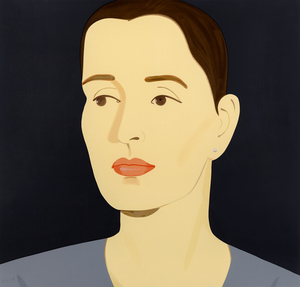
ALEX KATZ - Vivien - Siebdruck auf Museumskarton - 39 x 41 Zoll.

ALEX KATZ

ELLSWORTH KELLY - Rote Kurve - Farblithographie - 10 x 7 1/2 Zoll.

ELLSWORTH KELLY

Das hier abgebildete Zeichen ist das Zeichen für langes Leben, das auf Chinesisch shou und auf Japanisch kotobuki heißt. Die Eleganz der Schriftzeichen, vor allem in ihrer kursiven Form, hat sie zu beliebten dekorativen Motiven auf Textilien, Keramik, Lack und vielen anderen Medien gemacht. Hier ist das mit Goldfäden aufgebaute Zeichen von Chrysanthemen umgeben, die aufgrund ihrer gesundheitsfördernden Eigenschaften auch als Symbol für ein langes Leben gelten. Eine solche Fukusa wurde wahrscheinlich als Umschlag für ein Geburtstagsgeschenk hergestellt.

JAPANISCHE

ELLSWORTH KELLY - Rot, Gelb, Blau - Farblithographie - 7 1/2 x 7 1/2 Zoll.

ELLSWORTH KELLY

ELLSWORTH KELLY - Rote Kurve (Schwarzer Staat) - Farblithographie - 10 x 7 1/2 Zoll.

ELLSWORTH KELLY

JOSEF ALBERS - Rezeptur: Artikulation - Siebdruck - links: 10 x 17 1/2 Zoll, rechts: 6 x 10 1/2 Zoll.

JOSEF ALBERS

JOSEF ALBERS - Rezeptur: Artikulation - Siebdruck - 12 x 11 3/4 in. ea.

JOSEF ALBERS

LAWRENCE SCHILLER - End of the Day, Marilyn Monroe, "Something's Got to Give" - Silbergelatineabzug - 20 x 24 Zoll.

LAWRENCE SCHILLER