Précédent

MAX PECHSTEIN (1881-1955)

 
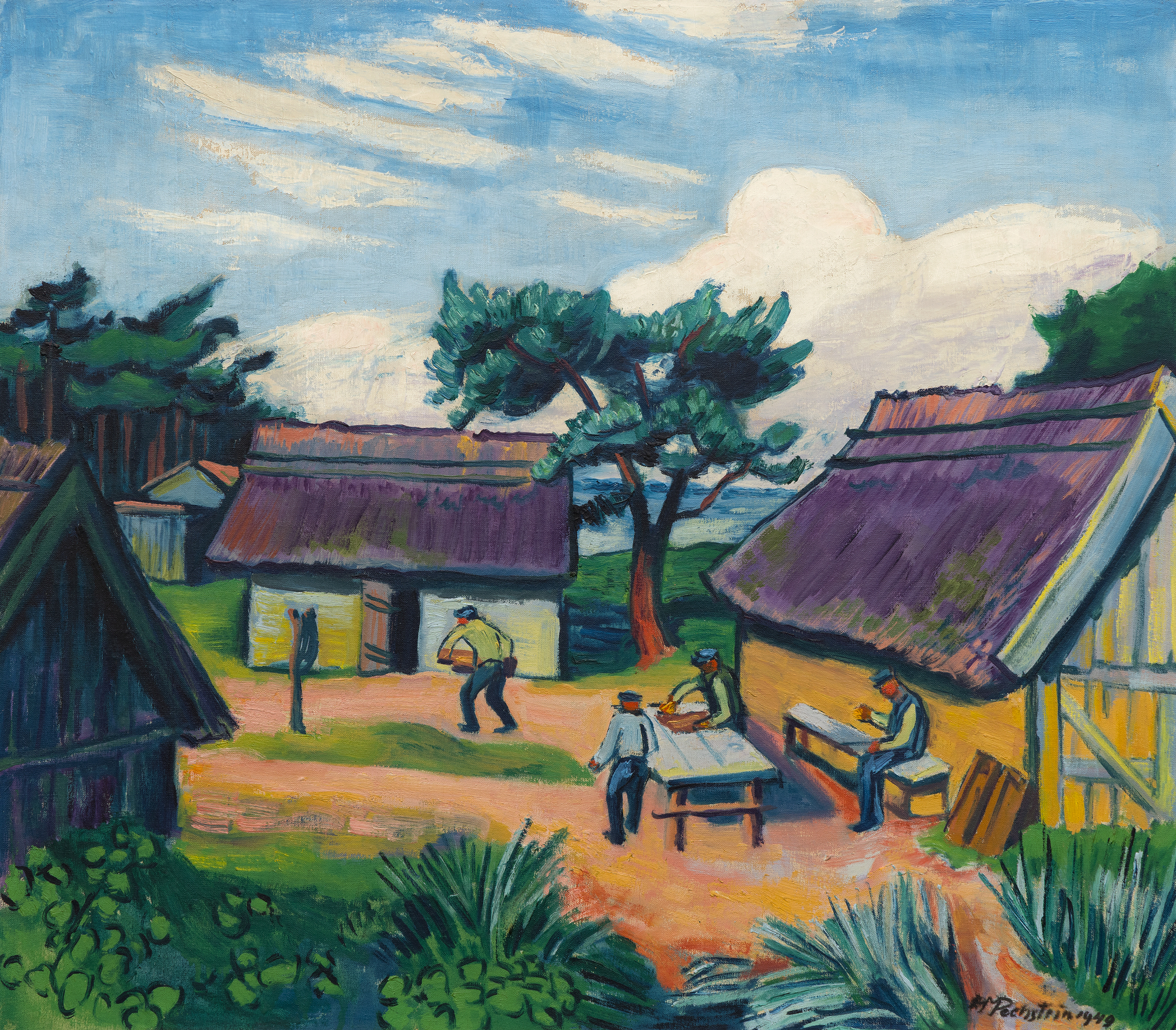
<div><font face=Lato size=3 color=black><em>Alte Fischerhütten</em> (1949) by Max Pechstein is an oil on canvas in which the artist transforms a humble cluster of weathered fishing huts into a study of light, form, and atmosphere. Broad, rhythmic brushstrokes delineate the worn timbers and thatched roofs, while a sky streaked with lavender and rose imbues the scene with a quiet, almost meditative luminosity. Pechstein’s bold outlines and flattened perspective are tempered by a late-career restraint, allowing the simple geometry of dunes, huts, and sea to resonate with an almost timeless calm.<br><br></font></div><br><br><div><font face=Lato size=3 color=black>Though painted in 1949, this work reaches back to a motif Pechstein first explored between 1927 and 1930 during summers on the Baltic coast and in the village of Rowe with <em>Herbstabend </em>(1927) and <em>Getreideernte</em> (1930). In a letter from that earlier period he wrote of his inspiration:<br><br></font></div><br><br><div><font face=Lato size=3 color=black>“A small, empty fishing hut on the lagoon, which Martin Sakuth had set aside for me… it was there that I first felt the heady, eternal rhythm of the sea.” (translated)<br><br></font></div><br><br><div><font face=Lato size=3 color=black>By revisiting these modest structures in his final decade, Pechstein fuses the elemental power of wind, sand, and sea with a masterful control of color and form. <em>Alte Fischerhütten</em> thus stands as a poignant culmination of his lifelong dialogue with vernacular architecture and elemental landscapes, an enduring testament to his vision of nature’s quiet grandeur.</font></div> <div><font face=Lato size=3 color=black><em>Alte Fischerhütten</em> (1949) by Max Pechstein is an oil on canvas in which the artist transforms a humble cluster of weathered fishing huts into a study of light, form, and atmosphere. Broad, rhythmic brushstrokes delineate the worn timbers and thatched roofs, while a sky streaked with lavender and rose imbues the scene with a quiet, almost meditative luminosity. Pechstein’s bold outlines and flattened perspective are tempered by a late-career restraint, allowing the simple geometry of dunes, huts, and sea to resonate with an almost timeless calm.<br><br></font></div><br><br><div><font face=Lato size=3 color=black>Though painted in 1949, this work reaches back to a motif Pechstein first explored between 1927 and 1930 during summers on the Baltic coast and in the village of Rowe with <em>Herbstabend </em>(1927) and <em>Getreideernte</em> (1930). In a letter from that earlier period he wrote of his inspiration:<br><br></font></div><br><br><div><font face=Lato size=3 color=black>“A small, empty fishing hut on the lagoon, which Martin Sakuth had set aside for me… it was there that I first felt the heady, eternal rhythm of the sea.” (translated)<br><br></font></div><br><br><div><font face=Lato size=3 color=black>By revisiting these modest structures in his final decade, Pechstein fuses the elemental power of wind, sand, and sea with a masterful control of color and form. <em>Alte Fischerhütten</em> thus stands as a poignant culmination of his lifelong dialogue with vernacular architecture and elemental landscapes, an enduring testament to his vision of nature’s quiet grandeur.</font></div> <div><font face=Lato size=3 color=black><em>Alte Fischerhütten</em> (1949) by Max Pechstein is an oil on canvas in which the artist transforms a humble cluster of weathered fishing huts into a study of light, form, and atmosphere. Broad, rhythmic brushstrokes delineate the worn timbers and thatched roofs, while a sky streaked with lavender and rose imbues the scene with a quiet, almost meditative luminosity. Pechstein’s bold outlines and flattened perspective are tempered by a late-career restraint, allowing the simple geometry of dunes, huts, and sea to resonate with an almost timeless calm.<br><br></font></div><br><br><div><font face=Lato size=3 color=black>Though painted in 1949, this work reaches back to a motif Pechstein first explored between 1927 and 1930 during summers on the Baltic coast and in the village of Rowe with <em>Herbstabend </em>(1927) and <em>Getreideernte</em> (1930). In a letter from that earlier period he wrote of his inspiration:<br><br></font></div><br><br><div><font face=Lato size=3 color=black>“A small, empty fishing hut on the lagoon, which Martin Sakuth had set aside for me… it was there that I first felt the heady, eternal rhythm of the sea.” (translated)<br><br></font></div><br><br><div><font face=Lato size=3 color=black>By revisiting these modest structures in his final decade, Pechstein fuses the elemental power of wind, sand, and sea with a masterful control of color and form. <em>Alte Fischerhütten</em> thus stands as a poignant culmination of his lifelong dialogue with vernacular architecture and elemental landscapes, an enduring testament to his vision of nature’s quiet grandeur.</font></div> <div><font face=Lato size=3 color=black><em>Alte Fischerhütten</em> (1949) by Max Pechstein is an oil on canvas in which the artist transforms a humble cluster of weathered fishing huts into a study of light, form, and atmosphere. Broad, rhythmic brushstrokes delineate the worn timbers and thatched roofs, while a sky streaked with lavender and rose imbues the scene with a quiet, almost meditative luminosity. Pechstein’s bold outlines and flattened perspective are tempered by a late-career restraint, allowing the simple geometry of dunes, huts, and sea to resonate with an almost timeless calm.<br><br></font></div><br><br><div><font face=Lato size=3 color=black>Though painted in 1949, this work reaches back to a motif Pechstein first explored between 1927 and 1930 during summers on the Baltic coast and in the village of Rowe with <em>Herbstabend </em>(1927) and <em>Getreideernte</em> (1930). In a letter from that earlier period he wrote of his inspiration:<br><br></font></div><br><br><div><font face=Lato size=3 color=black>“A small, empty fishing hut on the lagoon, which Martin Sakuth had set aside for me… it was there that I first felt the heady, eternal rhythm of the sea.” (translated)<br><br></font></div><br><br><div><font face=Lato size=3 color=black>By revisiting these modest structures in his final decade, Pechstein fuses the elemental power of wind, sand, and sea with a masterful control of color and form. <em>Alte Fischerhütten</em> thus stands as a poignant culmination of his lifelong dialogue with vernacular architecture and elemental landscapes, an enduring testament to his vision of nature’s quiet grandeur.</font></div> <div><font face=Lato size=3 color=black><em>Alte Fischerhütten</em> (1949) by Max Pechstein is an oil on canvas in which the artist transforms a humble cluster of weathered fishing huts into a study of light, form, and atmosphere. Broad, rhythmic brushstrokes delineate the worn timbers and thatched roofs, while a sky streaked with lavender and rose imbues the scene with a quiet, almost meditative luminosity. Pechstein’s bold outlines and flattened perspective are tempered by a late-career restraint, allowing the simple geometry of dunes, huts, and sea to resonate with an almost timeless calm.<br><br></font></div><br><br><div><font face=Lato size=3 color=black>Though painted in 1949, this work reaches back to a motif Pechstein first explored between 1927 and 1930 during summers on the Baltic coast and in the village of Rowe with <em>Herbstabend </em>(1927) and <em>Getreideernte</em> (1930). In a letter from that earlier period he wrote of his inspiration:<br><br></font></div><br><br><div><font face=Lato size=3 color=black>“A small, empty fishing hut on the lagoon, which Martin Sakuth had set aside for me… it was there that I first felt the heady, eternal rhythm of the sea.” (translated)<br><br></font></div><br><br><div><font face=Lato size=3 color=black>By revisiting these modest structures in his final decade, Pechstein fuses the elemental power of wind, sand, and sea with a masterful control of color and form. <em>Alte Fischerhütten</em> thus stands as a poignant culmination of his lifelong dialogue with vernacular architecture and elemental landscapes, an enduring testament to his vision of nature’s quiet grandeur.</font></div> <div><font face=Lato size=3 color=black><em>Alte Fischerhütten</em> (1949) by Max Pechstein is an oil on canvas in which the artist transforms a humble cluster of weathered fishing huts into a study of light, form, and atmosphere. Broad, rhythmic brushstrokes delineate the worn timbers and thatched roofs, while a sky streaked with lavender and rose imbues the scene with a quiet, almost meditative luminosity. Pechstein’s bold outlines and flattened perspective are tempered by a late-career restraint, allowing the simple geometry of dunes, huts, and sea to resonate with an almost timeless calm.<br><br></font></div><br><br><div><font face=Lato size=3 color=black>Though painted in 1949, this work reaches back to a motif Pechstein first explored between 1927 and 1930 during summers on the Baltic coast and in the village of Rowe with <em>Herbstabend </em>(1927) and <em>Getreideernte</em> (1930). In a letter from that earlier period he wrote of his inspiration:<br><br></font></div><br><br><div><font face=Lato size=3 color=black>“A small, empty fishing hut on the lagoon, which Martin Sakuth had set aside for me… it was there that I first felt the heady, eternal rhythm of the sea.” (translated)<br><br></font></div><br><br><div><font face=Lato size=3 color=black>By revisiting these modest structures in his final decade, Pechstein fuses the elemental power of wind, sand, and sea with a masterful control of color and form. <em>Alte Fischerhütten</em> thus stands as a poignant culmination of his lifelong dialogue with vernacular architecture and elemental landscapes, an enduring testament to his vision of nature’s quiet grandeur.</font></div> <div><font face=Lato size=3 color=black><em>Alte Fischerhütten</em> (1949) by Max Pechstein is an oil on canvas in which the artist transforms a humble cluster of weathered fishing huts into a study of light, form, and atmosphere. Broad, rhythmic brushstrokes delineate the worn timbers and thatched roofs, while a sky streaked with lavender and rose imbues the scene with a quiet, almost meditative luminosity. Pechstein’s bold outlines and flattened perspective are tempered by a late-career restraint, allowing the simple geometry of dunes, huts, and sea to resonate with an almost timeless calm.<br><br></font></div><br><br><div><font face=Lato size=3 color=black>Though painted in 1949, this work reaches back to a motif Pechstein first explored between 1927 and 1930 during summers on the Baltic coast and in the village of Rowe with <em>Herbstabend </em>(1927) and <em>Getreideernte</em> (1930). In a letter from that earlier period he wrote of his inspiration:<br><br></font></div><br><br><div><font face=Lato size=3 color=black>“A small, empty fishing hut on the lagoon, which Martin Sakuth had set aside for me… it was there that I first felt the heady, eternal rhythm of the sea.” (translated)<br><br></font></div><br><br><div><font face=Lato size=3 color=black>By revisiting these modest structures in his final decade, Pechstein fuses the elemental power of wind, sand, and sea with a masterful control of color and form. <em>Alte Fischerhütten</em> thus stands as a poignant culmination of his lifelong dialogue with vernacular architecture and elemental landscapes, an enduring testament to his vision of nature’s quiet grandeur.</font></div> <div><font face=Lato size=3 color=black><em>Alte Fischerhütten</em> (1949) by Max Pechstein is an oil on canvas in which the artist transforms a humble cluster of weathered fishing huts into a study of light, form, and atmosphere. Broad, rhythmic brushstrokes delineate the worn timbers and thatched roofs, while a sky streaked with lavender and rose imbues the scene with a quiet, almost meditative luminosity. Pechstein’s bold outlines and flattened perspective are tempered by a late-career restraint, allowing the simple geometry of dunes, huts, and sea to resonate with an almost timeless calm.<br><br></font></div><br><br><div><font face=Lato size=3 color=black>Though painted in 1949, this work reaches back to a motif Pechstein first explored between 1927 and 1930 during summers on the Baltic coast and in the village of Rowe with <em>Herbstabend </em>(1927) and <em>Getreideernte</em> (1930). In a letter from that earlier period he wrote of his inspiration:<br><br></font></div><br><br><div><font face=Lato size=3 color=black>“A small, empty fishing hut on the lagoon, which Martin Sakuth had set aside for me… it was there that I first felt the heady, eternal rhythm of the sea.” (translated)<br><br></font></div><br><br><div><font face=Lato size=3 color=black>By revisiting these modest structures in his final decade, Pechstein fuses the elemental power of wind, sand, and sea with a masterful control of color and form. <em>Alte Fischerhütten</em> thus stands as a poignant culmination of his lifelong dialogue with vernacular architecture and elemental landscapes, an enduring testament to his vision of nature’s quiet grandeur.</font></div> <div><font face=Lato size=3 color=black><em>Alte Fischerhütten</em> (1949) by Max Pechstein is an oil on canvas in which the artist transforms a humble cluster of weathered fishing huts into a study of light, form, and atmosphere. Broad, rhythmic brushstrokes delineate the worn timbers and thatched roofs, while a sky streaked with lavender and rose imbues the scene with a quiet, almost meditative luminosity. Pechstein’s bold outlines and flattened perspective are tempered by a late-career restraint, allowing the simple geometry of dunes, huts, and sea to resonate with an almost timeless calm.<br><br></font></div><br><br><div><font face=Lato size=3 color=black>Though painted in 1949, this work reaches back to a motif Pechstein first explored between 1927 and 1930 during summers on the Baltic coast and in the village of Rowe with <em>Herbstabend </em>(1927) and <em>Getreideernte</em> (1930). In a letter from that earlier period he wrote of his inspiration:<br><br></font></div><br><br><div><font face=Lato size=3 color=black>“A small, empty fishing hut on the lagoon, which Martin Sakuth had set aside for me… it was there that I first felt the heady, eternal rhythm of the sea.” (translated)<br><br></font></div><br><br><div><font face=Lato size=3 color=black>By revisiting these modest structures in his final decade, Pechstein fuses the elemental power of wind, sand, and sea with a masterful control of color and form. <em>Alte Fischerhütten</em> thus stands as a poignant culmination of his lifelong dialogue with vernacular architecture and elemental landscapes, an enduring testament to his vision of nature’s quiet grandeur.</font></div> <div><font face=Lato size=3 color=black><em>Alte Fischerhütten</em> (1949) by Max Pechstein is an oil on canvas in which the artist transforms a humble cluster of weathered fishing huts into a study of light, form, and atmosphere. Broad, rhythmic brushstrokes delineate the worn timbers and thatched roofs, while a sky streaked with lavender and rose imbues the scene with a quiet, almost meditative luminosity. Pechstein’s bold outlines and flattened perspective are tempered by a late-career restraint, allowing the simple geometry of dunes, huts, and sea to resonate with an almost timeless calm.<br><br></font></div><br><br><div><font face=Lato size=3 color=black>Though painted in 1949, this work reaches back to a motif Pechstein first explored between 1927 and 1930 during summers on the Baltic coast and in the village of Rowe with <em>Herbstabend </em>(1927) and <em>Getreideernte</em> (1930). In a letter from that earlier period he wrote of his inspiration:<br><br></font></div><br><br><div><font face=Lato size=3 color=black>“A small, empty fishing hut on the lagoon, which Martin Sakuth had set aside for me… it was there that I first felt the heady, eternal rhythm of the sea.” (translated)<br><br></font></div><br><br><div><font face=Lato size=3 color=black>By revisiting these modest structures in his final decade, Pechstein fuses the elemental power of wind, sand, and sea with a masterful control of color and form. <em>Alte Fischerhütten</em> thus stands as a poignant culmination of his lifelong dialogue with vernacular architecture and elemental landscapes, an enduring testament to his vision of nature’s quiet grandeur.</font></div>
Les anciennes toilettes194928 x 31 5/8 in.(71.12 x 80.33 cm) huile sur toile
Provenance
Collection privée, Europe
Lempertz, Cologne, 15 juin 1966, lot 531
Selected Artists Galleries, New York, acquise en 1970
Collection privée, New York, acquise auprès de la collection précédente
Collection privée, par descendance de ce qui précède
Phillips, New York, mercredi 15 novembre 2023, lot 123
Collection privée, acquise auprès de la personne susmentionnée
Littérature
Aya Soika, Max Pechstein The Catalgoue raisonne of oil paintings, Volume II 1919-1954, Munich, 2011, no. 1949/12, p. 490, illustré
Alte Fischerhütten (1949) de Max Pechstein est une huile sur toile dans laquelle l'artiste transforme un humble groupe de cabanes de pêche usées par le temps en une étude de la lumière, de la forme et de l'atmosphère. De larges coups de pinceau rythmés délimitent les poutres usées et les toits de chaume, tandis qu'un ciel strié de lavande et de rose imprègne la scène d'une luminosité calme, presque méditative. Les contours audacieux et la perspective aplatie de Pechstein sont tempérés par une retenue de fin de carrière, permettant à la géométrie simple des dunes, des huttes et de la mer de résonner avec un calme presque intemporel.


Bien qu'elle ait été peinte en 1949, cette œuvre renvoie à un motif que Pechstein a exploré pour la première fois entre 1927 et 1930 pendant les étés sur la côte baltique et dans le village de Rowe avec Herbstabend (1927) et Getreideernte (1930). Dans une lettre datant de cette période, il décrit son inspiration :


"Une petite cabane de pêcheur vide sur la lagune, que Martin Sakuth m'avait réservée... c'est là que j'ai ressenti pour la première fois le rythme enivrant et éternel de la mer". (traduit)


En revisitant ces modestes structures au cours de sa dernière décennie, Pechstein fusionne le pouvoir élémentaire du vent, du sable et de la mer avec un contrôle magistral de la couleur et de la forme. Alte Fischerhütten est donc l'aboutissement poignant du dialogue qu'il a entretenu toute sa vie avec l'architecture vernaculaire et les paysages élémentaires, un témoignage durable de sa vision de la grandeur tranquille de la nature.
demander