



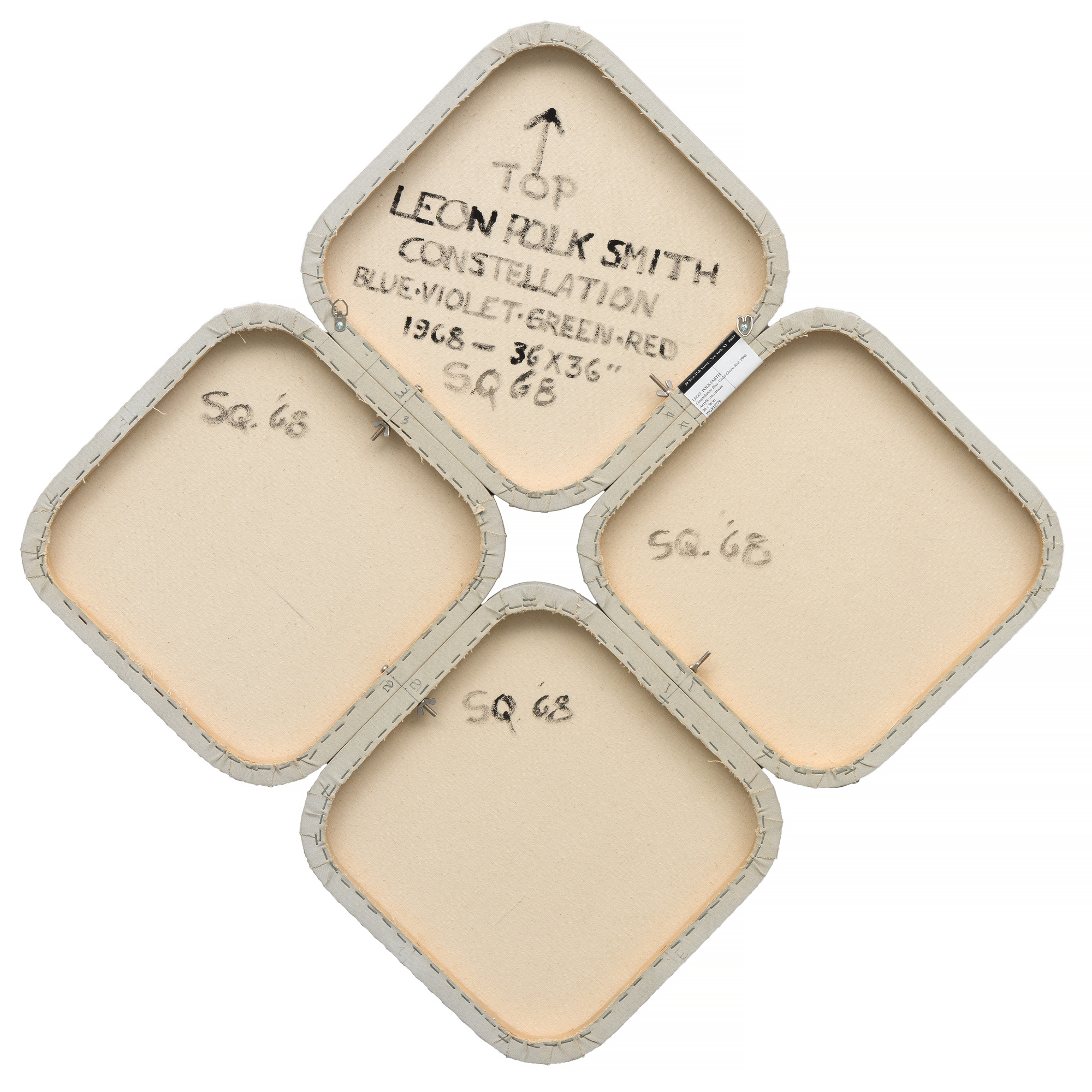
גב

ליאון פולק סמית (1906-1996)

 
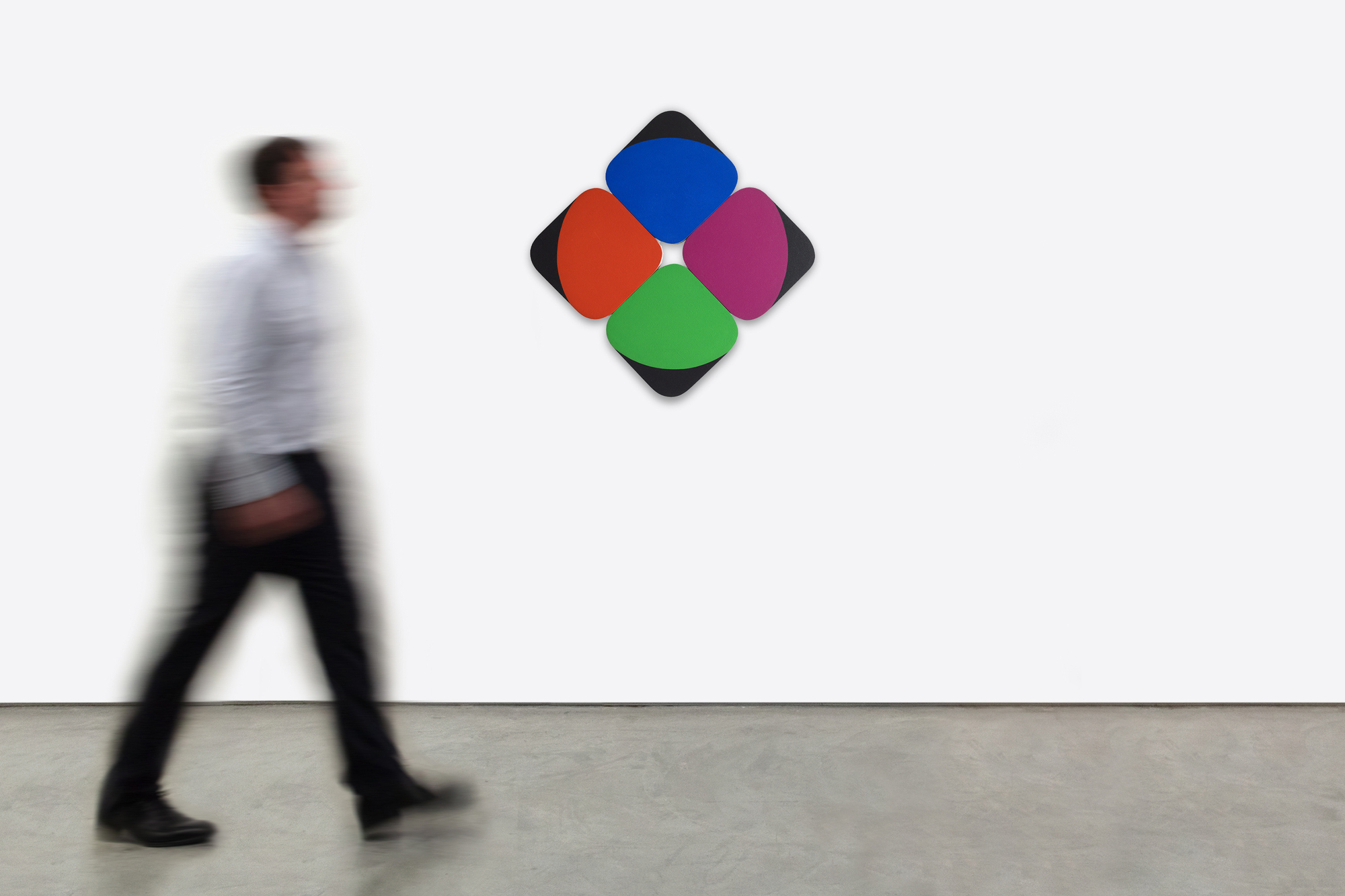
<div><font face=Lato size=3>Leon Polk Smith’s "Constellation Blue Violet Green Red" (1968) is a striking example of the artist’s radical exploration of form and color in postwar abstraction. Executed in acrylic on canvas, the work consists of four rounded-square panels arranged in a diamond formation. Each panel bears a crisp division of color: black at the outer edge, paired with one of four luminous hues—blue, violet, green, and red—creating a rhythmic interplay of symmetry and variation. </font></div><br><br><div><font face=Lato size=3> </font></div><br><br><div><font face=Lato size=3>Smith was a central figure in the development of hard-edge painting and geometric abstraction, aligned with contemporaries such as Ellsworth Kelly and Carmen Herrera. His "Constellation" series, begun in the 1960s, was groundbreaking for its use of multiple shaped canvases installed directly on the wall, eschewing traditional frames in favor of compositions that expand dynamically into surrounding space. </font></div><br><br><div><font face=Lato size=3> </font></div><br><br><div><font face=Lato size=3>While Smith was highly prolific in both works on paper and monumental single-panel paintings, multi-panel "Constellation" works remain less common within his oeuvre. Today, his paintings are represented in major institutions including The Museum of Modern Art, the Whitney Museum of American Art, and the Brooklyn Museum. In "Constellation Blue Violet Green Red", the clarity of Smith’s vision is on full display—color and geometry united in a constellation that feels both precise and expansive, disciplined yet alive with visual energy. </font></div> <div><font face=Lato size=3>Leon Polk Smith’s "Constellation Blue Violet Green Red" (1968) is a striking example of the artist’s radical exploration of form and color in postwar abstraction. Executed in acrylic on canvas, the work consists of four rounded-square panels arranged in a diamond formation. Each panel bears a crisp division of color: black at the outer edge, paired with one of four luminous hues—blue, violet, green, and red—creating a rhythmic interplay of symmetry and variation. </font></div><br><br><div><font face=Lato size=3> </font></div><br><br><div><font face=Lato size=3>Smith was a central figure in the development of hard-edge painting and geometric abstraction, aligned with contemporaries such as Ellsworth Kelly and Carmen Herrera. His "Constellation" series, begun in the 1960s, was groundbreaking for its use of multiple shaped canvases installed directly on the wall, eschewing traditional frames in favor of compositions that expand dynamically into surrounding space. </font></div><br><br><div><font face=Lato size=3> </font></div><br><br><div><font face=Lato size=3>While Smith was highly prolific in both works on paper and monumental single-panel paintings, multi-panel "Constellation" works remain less common within his oeuvre. Today, his paintings are represented in major institutions including The Museum of Modern Art, the Whitney Museum of American Art, and the Brooklyn Museum. In "Constellation Blue Violet Green Red", the clarity of Smith’s vision is on full display—color and geometry united in a constellation that feels both precise and expansive, disciplined yet alive with visual energy. </font></div> <div><font face=Lato size=3>Leon Polk Smith’s "Constellation Blue Violet Green Red" (1968) is a striking example of the artist’s radical exploration of form and color in postwar abstraction. Executed in acrylic on canvas, the work consists of four rounded-square panels arranged in a diamond formation. Each panel bears a crisp division of color: black at the outer edge, paired with one of four luminous hues—blue, violet, green, and red—creating a rhythmic interplay of symmetry and variation. </font></div><br><br><div><font face=Lato size=3> </font></div><br><br><div><font face=Lato size=3>Smith was a central figure in the development of hard-edge painting and geometric abstraction, aligned with contemporaries such as Ellsworth Kelly and Carmen Herrera. His "Constellation" series, begun in the 1960s, was groundbreaking for its use of multiple shaped canvases installed directly on the wall, eschewing traditional frames in favor of compositions that expand dynamically into surrounding space. </font></div><br><br><div><font face=Lato size=3> </font></div><br><br><div><font face=Lato size=3>While Smith was highly prolific in both works on paper and monumental single-panel paintings, multi-panel "Constellation" works remain less common within his oeuvre. Today, his paintings are represented in major institutions including The Museum of Modern Art, the Whitney Museum of American Art, and the Brooklyn Museum. In "Constellation Blue Violet Green Red", the clarity of Smith’s vision is on full display—color and geometry united in a constellation that feels both precise and expansive, disciplined yet alive with visual energy. </font></div> <div><font face=Lato size=3>Leon Polk Smith’s "Constellation Blue Violet Green Red" (1968) is a striking example of the artist’s radical exploration of form and color in postwar abstraction. Executed in acrylic on canvas, the work consists of four rounded-square panels arranged in a diamond formation. Each panel bears a crisp division of color: black at the outer edge, paired with one of four luminous hues—blue, violet, green, and red—creating a rhythmic interplay of symmetry and variation. </font></div><br><br><div><font face=Lato size=3> </font></div><br><br><div><font face=Lato size=3>Smith was a central figure in the development of hard-edge painting and geometric abstraction, aligned with contemporaries such as Ellsworth Kelly and Carmen Herrera. His "Constellation" series, begun in the 1960s, was groundbreaking for its use of multiple shaped canvases installed directly on the wall, eschewing traditional frames in favor of compositions that expand dynamically into surrounding space. </font></div><br><br><div><font face=Lato size=3> </font></div><br><br><div><font face=Lato size=3>While Smith was highly prolific in both works on paper and monumental single-panel paintings, multi-panel "Constellation" works remain less common within his oeuvre. Today, his paintings are represented in major institutions including The Museum of Modern Art, the Whitney Museum of American Art, and the Brooklyn Museum. In "Constellation Blue Violet Green Red", the clarity of Smith’s vision is on full display—color and geometry united in a constellation that feels both precise and expansive, disciplined yet alive with visual energy. </font></div> <div><font face=Lato size=3>Leon Polk Smith’s "Constellation Blue Violet Green Red" (1968) is a striking example of the artist’s radical exploration of form and color in postwar abstraction. Executed in acrylic on canvas, the work consists of four rounded-square panels arranged in a diamond formation. Each panel bears a crisp division of color: black at the outer edge, paired with one of four luminous hues—blue, violet, green, and red—creating a rhythmic interplay of symmetry and variation. </font></div><br><br><div><font face=Lato size=3> </font></div><br><br><div><font face=Lato size=3>Smith was a central figure in the development of hard-edge painting and geometric abstraction, aligned with contemporaries such as Ellsworth Kelly and Carmen Herrera. His "Constellation" series, begun in the 1960s, was groundbreaking for its use of multiple shaped canvases installed directly on the wall, eschewing traditional frames in favor of compositions that expand dynamically into surrounding space. </font></div><br><br><div><font face=Lato size=3> </font></div><br><br><div><font face=Lato size=3>While Smith was highly prolific in both works on paper and monumental single-panel paintings, multi-panel "Constellation" works remain less common within his oeuvre. Today, his paintings are represented in major institutions including The Museum of Modern Art, the Whitney Museum of American Art, and the Brooklyn Museum. In "Constellation Blue Violet Green Red", the clarity of Smith’s vision is on full display—color and geometry united in a constellation that feels both precise and expansive, disciplined yet alive with visual energy. </font></div> <div><font face=Lato size=3>Leon Polk Smith’s "Constellation Blue Violet Green Red" (1968) is a striking example of the artist’s radical exploration of form and color in postwar abstraction. Executed in acrylic on canvas, the work consists of four rounded-square panels arranged in a diamond formation. Each panel bears a crisp division of color: black at the outer edge, paired with one of four luminous hues—blue, violet, green, and red—creating a rhythmic interplay of symmetry and variation. </font></div><br><br><div><font face=Lato size=3> </font></div><br><br><div><font face=Lato size=3>Smith was a central figure in the development of hard-edge painting and geometric abstraction, aligned with contemporaries such as Ellsworth Kelly and Carmen Herrera. His "Constellation" series, begun in the 1960s, was groundbreaking for its use of multiple shaped canvases installed directly on the wall, eschewing traditional frames in favor of compositions that expand dynamically into surrounding space. </font></div><br><br><div><font face=Lato size=3> </font></div><br><br><div><font face=Lato size=3>While Smith was highly prolific in both works on paper and monumental single-panel paintings, multi-panel "Constellation" works remain less common within his oeuvre. Today, his paintings are represented in major institutions including The Museum of Modern Art, the Whitney Museum of American Art, and the Brooklyn Museum. In "Constellation Blue Violet Green Red", the clarity of Smith’s vision is on full display—color and geometry united in a constellation that feels both precise and expansive, disciplined yet alive with visual energy. </font></div> <div><font face=Lato size=3>Leon Polk Smith’s "Constellation Blue Violet Green Red" (1968) is a striking example of the artist’s radical exploration of form and color in postwar abstraction. Executed in acrylic on canvas, the work consists of four rounded-square panels arranged in a diamond formation. Each panel bears a crisp division of color: black at the outer edge, paired with one of four luminous hues—blue, violet, green, and red—creating a rhythmic interplay of symmetry and variation. </font></div><br><br><div><font face=Lato size=3> </font></div><br><br><div><font face=Lato size=3>Smith was a central figure in the development of hard-edge painting and geometric abstraction, aligned with contemporaries such as Ellsworth Kelly and Carmen Herrera. His "Constellation" series, begun in the 1960s, was groundbreaking for its use of multiple shaped canvases installed directly on the wall, eschewing traditional frames in favor of compositions that expand dynamically into surrounding space. </font></div><br><br><div><font face=Lato size=3> </font></div><br><br><div><font face=Lato size=3>While Smith was highly prolific in both works on paper and monumental single-panel paintings, multi-panel "Constellation" works remain less common within his oeuvre. Today, his paintings are represented in major institutions including The Museum of Modern Art, the Whitney Museum of American Art, and the Brooklyn Museum. In "Constellation Blue Violet Green Red", the clarity of Smith’s vision is on full display—color and geometry united in a constellation that feels both precise and expansive, disciplined yet alive with visual energy. </font></div> <div><font face=Lato size=3>Leon Polk Smith’s "Constellation Blue Violet Green Red" (1968) is a striking example of the artist’s radical exploration of form and color in postwar abstraction. Executed in acrylic on canvas, the work consists of four rounded-square panels arranged in a diamond formation. Each panel bears a crisp division of color: black at the outer edge, paired with one of four luminous hues—blue, violet, green, and red—creating a rhythmic interplay of symmetry and variation. </font></div><br><br><div><font face=Lato size=3> </font></div><br><br><div><font face=Lato size=3>Smith was a central figure in the development of hard-edge painting and geometric abstraction, aligned with contemporaries such as Ellsworth Kelly and Carmen Herrera. His "Constellation" series, begun in the 1960s, was groundbreaking for its use of multiple shaped canvases installed directly on the wall, eschewing traditional frames in favor of compositions that expand dynamically into surrounding space. </font></div><br><br><div><font face=Lato size=3> </font></div><br><br><div><font face=Lato size=3>While Smith was highly prolific in both works on paper and monumental single-panel paintings, multi-panel "Constellation" works remain less common within his oeuvre. Today, his paintings are represented in major institutions including The Museum of Modern Art, the Whitney Museum of American Art, and the Brooklyn Museum. In "Constellation Blue Violet Green Red", the clarity of Smith’s vision is on full display—color and geometry united in a constellation that feels both precise and expansive, disciplined yet alive with visual energy. </font></div> <div><font face=Lato size=3>Leon Polk Smith’s "Constellation Blue Violet Green Red" (1968) is a striking example of the artist’s radical exploration of form and color in postwar abstraction. Executed in acrylic on canvas, the work consists of four rounded-square panels arranged in a diamond formation. Each panel bears a crisp division of color: black at the outer edge, paired with one of four luminous hues—blue, violet, green, and red—creating a rhythmic interplay of symmetry and variation. </font></div><br><br><div><font face=Lato size=3> </font></div><br><br><div><font face=Lato size=3>Smith was a central figure in the development of hard-edge painting and geometric abstraction, aligned with contemporaries such as Ellsworth Kelly and Carmen Herrera. His "Constellation" series, begun in the 1960s, was groundbreaking for its use of multiple shaped canvases installed directly on the wall, eschewing traditional frames in favor of compositions that expand dynamically into surrounding space. </font></div><br><br><div><font face=Lato size=3> </font></div><br><br><div><font face=Lato size=3>While Smith was highly prolific in both works on paper and monumental single-panel paintings, multi-panel "Constellation" works remain less common within his oeuvre. Today, his paintings are represented in major institutions including The Museum of Modern Art, the Whitney Museum of American Art, and the Brooklyn Museum. In "Constellation Blue Violet Green Red", the clarity of Smith’s vision is on full display—color and geometry united in a constellation that feels both precise and expansive, disciplined yet alive with visual energy. </font></div> <div><font face=Lato size=3>Leon Polk Smith’s "Constellation Blue Violet Green Red" (1968) is a striking example of the artist’s radical exploration of form and color in postwar abstraction. Executed in acrylic on canvas, the work consists of four rounded-square panels arranged in a diamond formation. Each panel bears a crisp division of color: black at the outer edge, paired with one of four luminous hues—blue, violet, green, and red—creating a rhythmic interplay of symmetry and variation. </font></div><br><br><div><font face=Lato size=3> </font></div><br><br><div><font face=Lato size=3>Smith was a central figure in the development of hard-edge painting and geometric abstraction, aligned with contemporaries such as Ellsworth Kelly and Carmen Herrera. His "Constellation" series, begun in the 1960s, was groundbreaking for its use of multiple shaped canvases installed directly on the wall, eschewing traditional frames in favor of compositions that expand dynamically into surrounding space. </font></div><br><br><div><font face=Lato size=3> </font></div><br><br><div><font face=Lato size=3>While Smith was highly prolific in both works on paper and monumental single-panel paintings, multi-panel "Constellation" works remain less common within his oeuvre. Today, his paintings are represented in major institutions including The Museum of Modern Art, the Whitney Museum of American Art, and the Brooklyn Museum. In "Constellation Blue Violet Green Red", the clarity of Smith’s vision is on full display—color and geometry united in a constellation that feels both precise and expansive, disciplined yet alive with visual energy. </font></div>
קבוצת כוכבים כחול סגול ירוק אדום 1968 36 x 36 1/4 אינץ' (91.44 x 92.08 ס"מ) אקריליק על בד
מקור ומקור
גלריית ליסון, ניו יורק
אוסף פרטי, נרכש מהנ"ל
"קבוצת הכוכבים כחול סגול ירוק אדום" (1968) של ליאון פולק סמית' הוא דוגמה בולטת לחקר הרדיקלי של האמן את הצורה והצבע באבסטרקציה שלאחר המלחמה. היצירה, שבוצעה באקריליק על בד, מורכבת מארבעה פאנלים מעוגלים-מרובעים המסודרים בצורת יהלום. כל פאנל נושא חלוקה חדה של צבע: שחור בקצה החיצוני, בשילוב עם אחד מארבעה גוונים זוהרים - כחול, סגול, ירוק ואדום - היוצרים משחק גומלין קצבי של סימטריה ושונות.


סמית' היה דמות מרכזית בפיתוח ציור קצוות קשיחים והפשטה גיאומטרית, בדומה לאנשי דורו כמו אלסוורת' קלי וקרמן הררה. סדרת "קונסטליישן" שלו, שהחלה בשנות ה-60, הייתה פורצת דרך בזכות השימוש שלה בבדים מרובי צורות המותקנים ישירות על הקיר, תוך הימנעות ממסגרות מסורתיות לטובת קומפוזיציות המתרחבות באופן דינמי אל תוך המרחב הסובב.


בעוד שסמית' היה פורה מאוד הן בעבודות על נייר והן בציורים מונומנטליים בעלי פאנל אחד, עבודות "קבוצת כוכבים" מרובות פאנלים נותרות פחות נפוצות ביצירתו. כיום, ציוריו מיוצגים במוסדות מרכזיים, כולל המוזיאון לאמנות מודרנית, מוזיאון ויטני לאמנות אמריקאית ומוזיאון ברוקלין. ב"קבוצת כוכבים כחולה סגולה ירוקה אדומה", בהירות חזונו של סמית' באה לידי ביטוי במלואה - צבע וגיאומטריה מאוחדים בקבוצת כוכבים שמרגישה מדויקת ורחבה כאחד, ממושמעת אך חיה עם אנרגיה חזותית.
לברר