

גב

ז'ול שרה (1836-1932)

$75,000

 
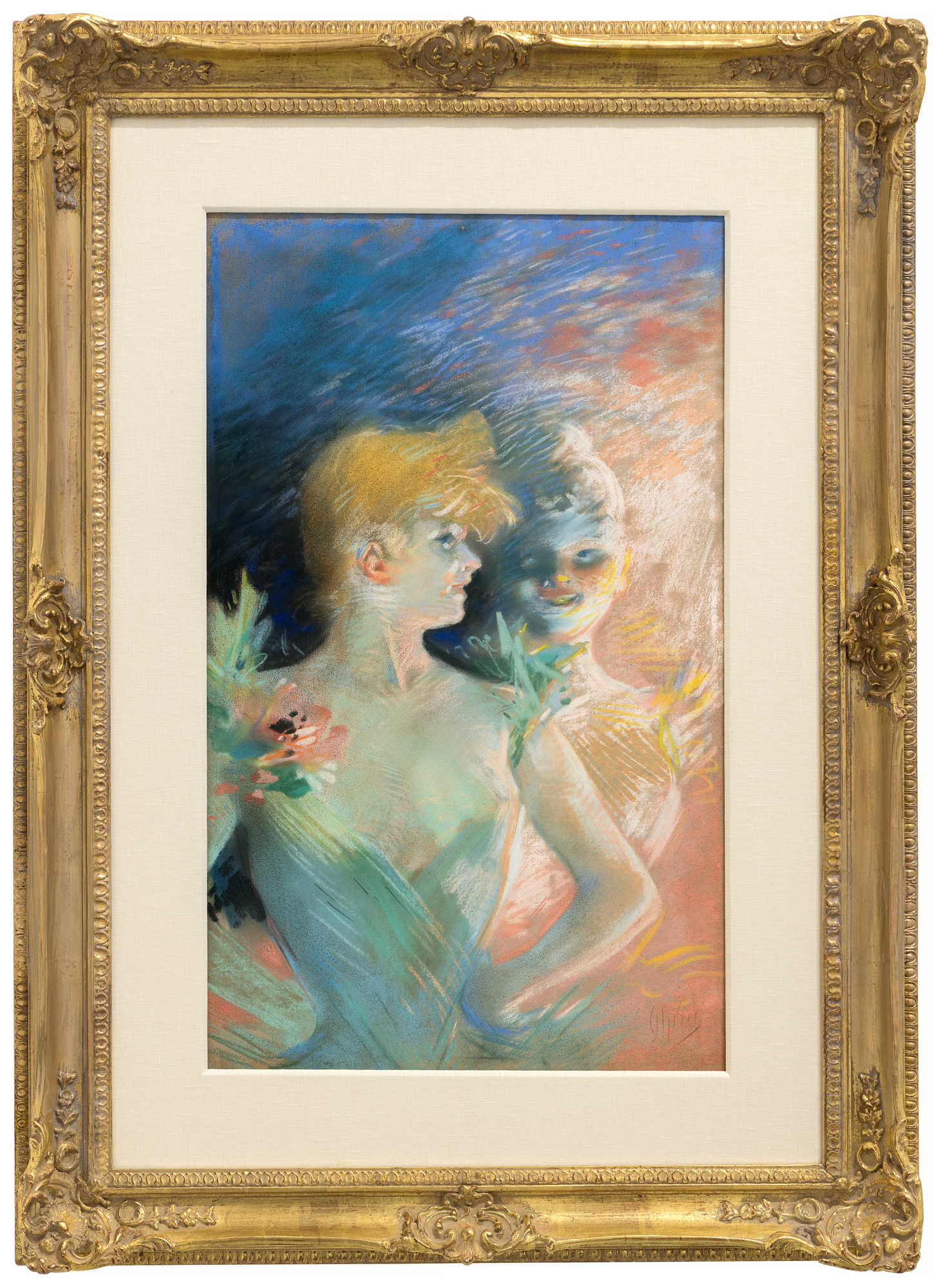
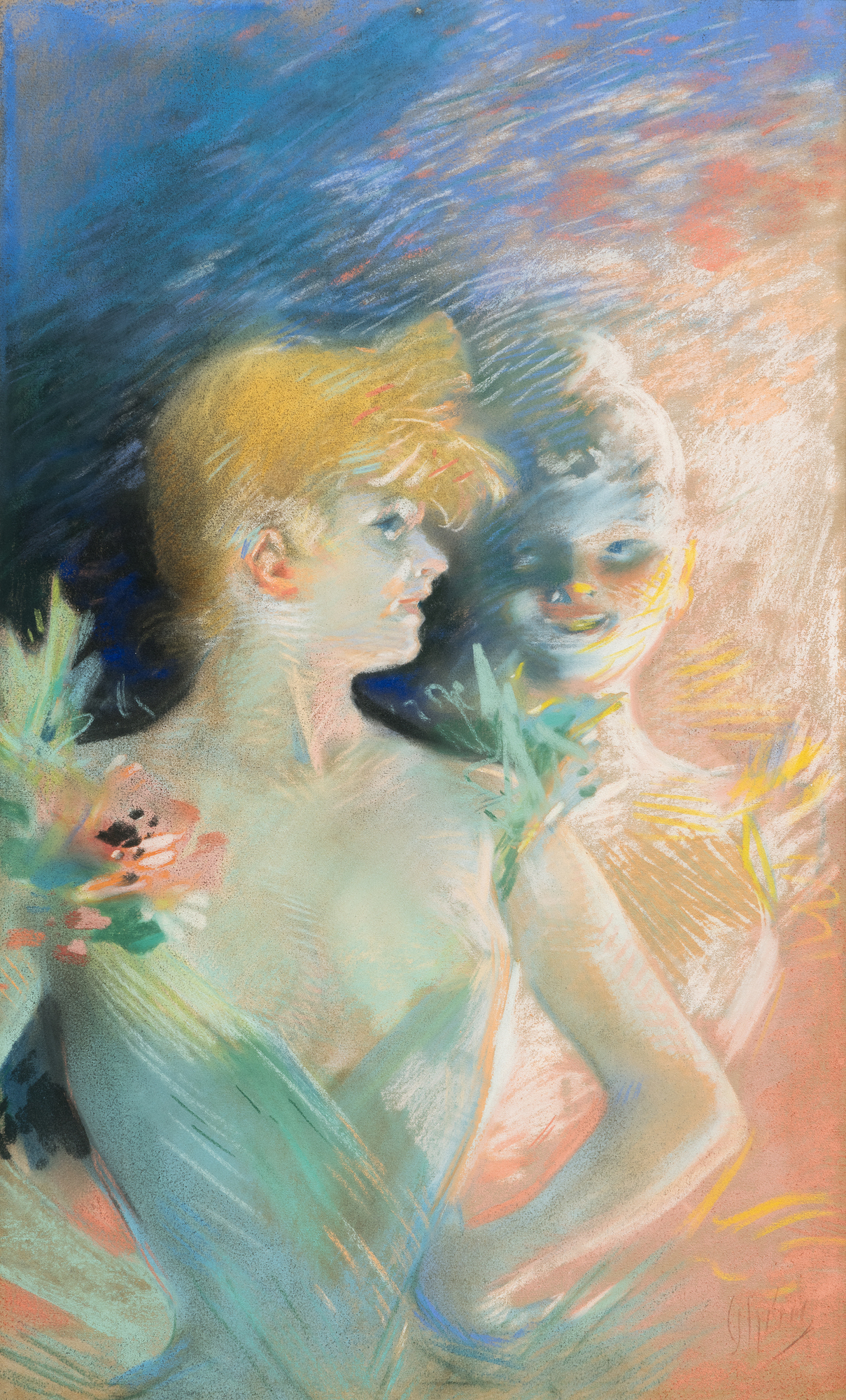
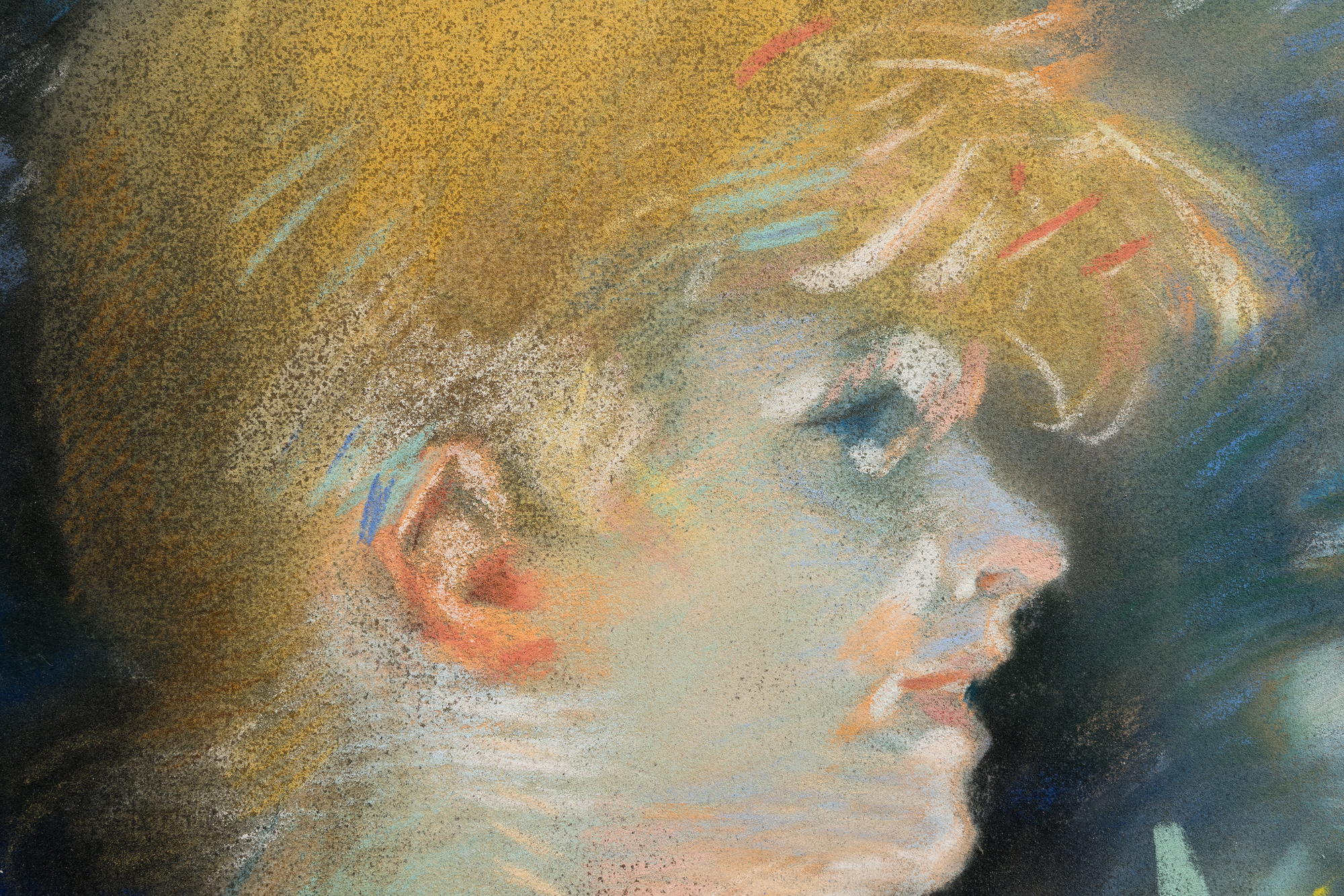
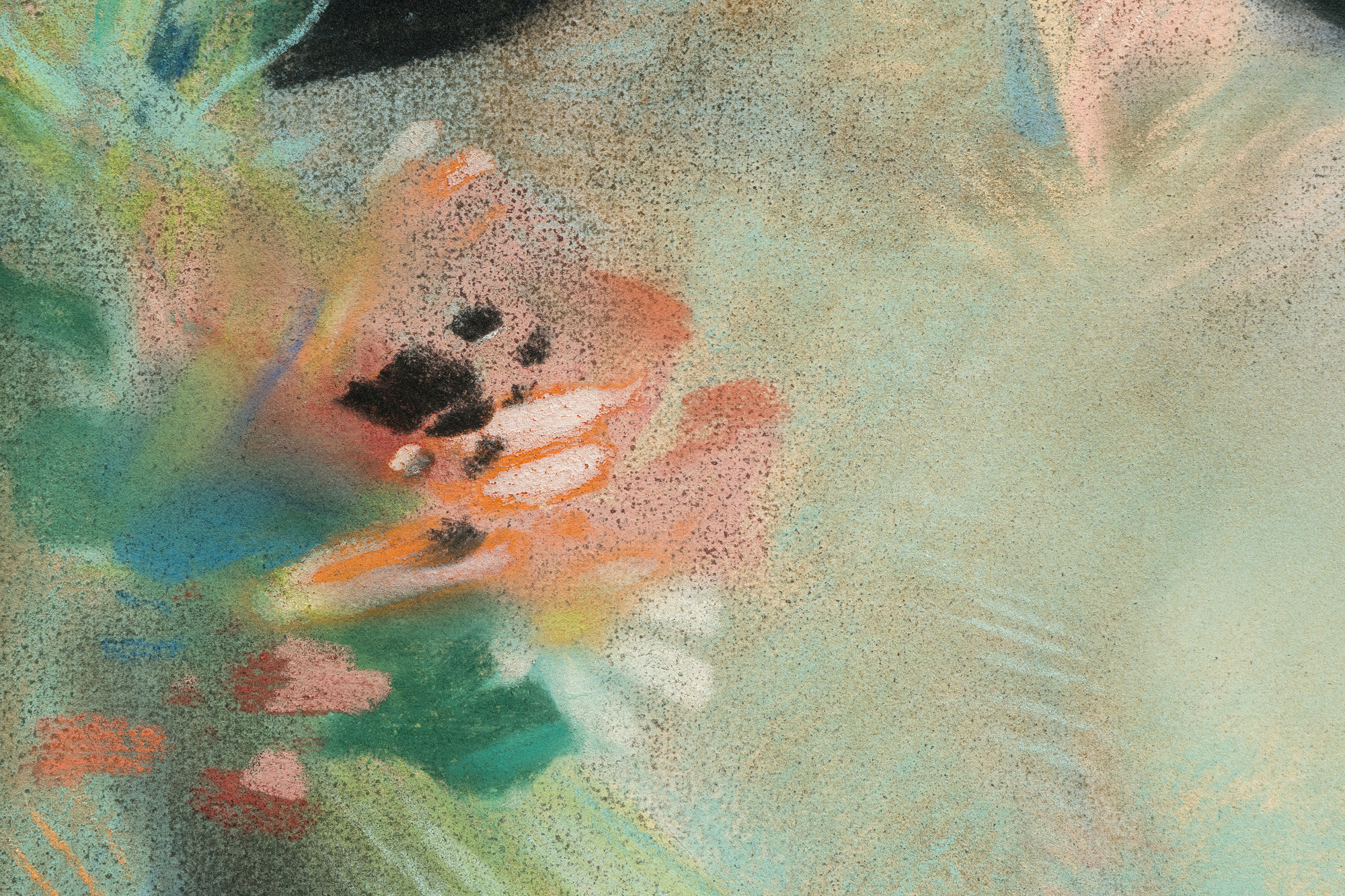
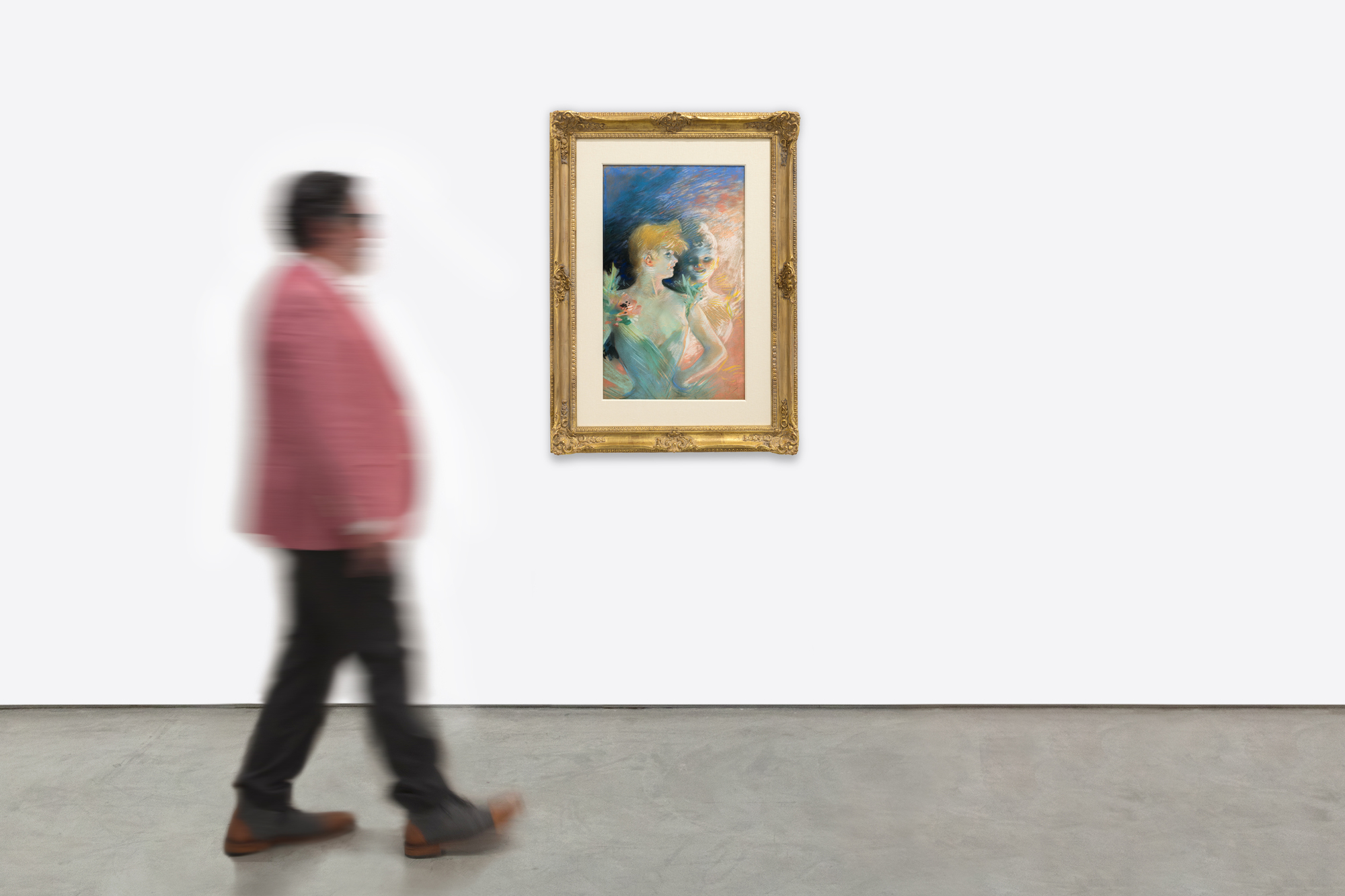
<div>Jules Chéret’s <em>Portrait</em> is a lively pastel chalk on canvas that reveals the painterly sensibility behind the artist best known as the master of Belle Époque poster art. In this composition, two female figures emerge from a whirlwind of color and light, their forms dissolving into strokes of turquoise, rose, and gold. The surface vibrates with movement, recalling the theatrical energy and fleeting glamour that defined fin-de-siècle Paris. Softly modeled yet animated by sweeping gestures, the figures seem caught mid-performance—at once intimate and exuberant. </div><br><br><div> </div><br><br><div>Though widely celebrated for his advertising posters, Chéret was deeply influenced by the Rococo masters, particularly Jean-Honoré Fragonard and Antoine Watteau. Their spirit of elegance, sensuality, and decorative flourish permeates this work, where lightness of touch and chromatic brilliance take precedence over strict realism. These same qualities made his vivid lithographic posters for the Eldorado, the Olympia, the Folies Bergère, the Théâtre de l’Opéra, the Alcazar d’Été, and the Moulin Rouge iconic emblems of Parisian modern life. </div><br><br><div> </div><br><br><div>Chéret’s success in poster design helped launch a new generation of artists, including Charles Gesmar and Henri de Toulouse-Lautrec, solidifying the poster as a legitimate artistic medium. While he achieved recognition as a painter, it was his advertising imagery—initially undertaken to earn a living but later pursued with conviction—that secured his legacy. Honored with a posthumous exhibition at the Salon d’Automne in 1933, Chéret’s works are now held in major institutions including The Museum of Modern Art, the Musée d’Orsay, the Hermitage Museum, and the Art Institute of Chicago, affirming his enduring place in the history of modern art. </div> <div>Jules Chéret’s <em>Portrait</em> is a lively pastel chalk on canvas that reveals the painterly sensibility behind the artist best known as the master of Belle Époque poster art. In this composition, two female figures emerge from a whirlwind of color and light, their forms dissolving into strokes of turquoise, rose, and gold. The surface vibrates with movement, recalling the theatrical energy and fleeting glamour that defined fin-de-siècle Paris. Softly modeled yet animated by sweeping gestures, the figures seem caught mid-performance—at once intimate and exuberant. </div><br><br><div> </div><br><br><div>Though widely celebrated for his advertising posters, Chéret was deeply influenced by the Rococo masters, particularly Jean-Honoré Fragonard and Antoine Watteau. Their spirit of elegance, sensuality, and decorative flourish permeates this work, where lightness of touch and chromatic brilliance take precedence over strict realism. These same qualities made his vivid lithographic posters for the Eldorado, the Olympia, the Folies Bergère, the Théâtre de l’Opéra, the Alcazar d’Été, and the Moulin Rouge iconic emblems of Parisian modern life. </div><br><br><div> </div><br><br><div>Chéret’s success in poster design helped launch a new generation of artists, including Charles Gesmar and Henri de Toulouse-Lautrec, solidifying the poster as a legitimate artistic medium. While he achieved recognition as a painter, it was his advertising imagery—initially undertaken to earn a living but later pursued with conviction—that secured his legacy. Honored with a posthumous exhibition at the Salon d’Automne in 1933, Chéret’s works are now held in major institutions including The Museum of Modern Art, the Musée d’Orsay, the Hermitage Museum, and the Art Institute of Chicago, affirming his enduring place in the history of modern art. </div> <div>Jules Chéret’s <em>Portrait</em> is a lively pastel chalk on canvas that reveals the painterly sensibility behind the artist best known as the master of Belle Époque poster art. In this composition, two female figures emerge from a whirlwind of color and light, their forms dissolving into strokes of turquoise, rose, and gold. The surface vibrates with movement, recalling the theatrical energy and fleeting glamour that defined fin-de-siècle Paris. Softly modeled yet animated by sweeping gestures, the figures seem caught mid-performance—at once intimate and exuberant. </div><br><br><div> </div><br><br><div>Though widely celebrated for his advertising posters, Chéret was deeply influenced by the Rococo masters, particularly Jean-Honoré Fragonard and Antoine Watteau. Their spirit of elegance, sensuality, and decorative flourish permeates this work, where lightness of touch and chromatic brilliance take precedence over strict realism. These same qualities made his vivid lithographic posters for the Eldorado, the Olympia, the Folies Bergère, the Théâtre de l’Opéra, the Alcazar d’Été, and the Moulin Rouge iconic emblems of Parisian modern life. </div><br><br><div> </div><br><br><div>Chéret’s success in poster design helped launch a new generation of artists, including Charles Gesmar and Henri de Toulouse-Lautrec, solidifying the poster as a legitimate artistic medium. While he achieved recognition as a painter, it was his advertising imagery—initially undertaken to earn a living but later pursued with conviction—that secured his legacy. Honored with a posthumous exhibition at the Salon d’Automne in 1933, Chéret’s works are now held in major institutions including The Museum of Modern Art, the Musée d’Orsay, the Hermitage Museum, and the Art Institute of Chicago, affirming his enduring place in the history of modern art. </div> <div>Jules Chéret’s <em>Portrait</em> is a lively pastel chalk on canvas that reveals the painterly sensibility behind the artist best known as the master of Belle Époque poster art. In this composition, two female figures emerge from a whirlwind of color and light, their forms dissolving into strokes of turquoise, rose, and gold. The surface vibrates with movement, recalling the theatrical energy and fleeting glamour that defined fin-de-siècle Paris. Softly modeled yet animated by sweeping gestures, the figures seem caught mid-performance—at once intimate and exuberant. </div><br><br><div> </div><br><br><div>Though widely celebrated for his advertising posters, Chéret was deeply influenced by the Rococo masters, particularly Jean-Honoré Fragonard and Antoine Watteau. Their spirit of elegance, sensuality, and decorative flourish permeates this work, where lightness of touch and chromatic brilliance take precedence over strict realism. These same qualities made his vivid lithographic posters for the Eldorado, the Olympia, the Folies Bergère, the Théâtre de l’Opéra, the Alcazar d’Été, and the Moulin Rouge iconic emblems of Parisian modern life. </div><br><br><div> </div><br><br><div>Chéret’s success in poster design helped launch a new generation of artists, including Charles Gesmar and Henri de Toulouse-Lautrec, solidifying the poster as a legitimate artistic medium. While he achieved recognition as a painter, it was his advertising imagery—initially undertaken to earn a living but later pursued with conviction—that secured his legacy. Honored with a posthumous exhibition at the Salon d’Automne in 1933, Chéret’s works are now held in major institutions including The Museum of Modern Art, the Musée d’Orsay, the Hermitage Museum, and the Art Institute of Chicago, affirming his enduring place in the history of modern art. </div> <div>Jules Chéret’s <em>Portrait</em> is a lively pastel chalk on canvas that reveals the painterly sensibility behind the artist best known as the master of Belle Époque poster art. In this composition, two female figures emerge from a whirlwind of color and light, their forms dissolving into strokes of turquoise, rose, and gold. The surface vibrates with movement, recalling the theatrical energy and fleeting glamour that defined fin-de-siècle Paris. Softly modeled yet animated by sweeping gestures, the figures seem caught mid-performance—at once intimate and exuberant. </div><br><br><div> </div><br><br><div>Though widely celebrated for his advertising posters, Chéret was deeply influenced by the Rococo masters, particularly Jean-Honoré Fragonard and Antoine Watteau. Their spirit of elegance, sensuality, and decorative flourish permeates this work, where lightness of touch and chromatic brilliance take precedence over strict realism. These same qualities made his vivid lithographic posters for the Eldorado, the Olympia, the Folies Bergère, the Théâtre de l’Opéra, the Alcazar d’Été, and the Moulin Rouge iconic emblems of Parisian modern life. </div><br><br><div> </div><br><br><div>Chéret’s success in poster design helped launch a new generation of artists, including Charles Gesmar and Henri de Toulouse-Lautrec, solidifying the poster as a legitimate artistic medium. While he achieved recognition as a painter, it was his advertising imagery—initially undertaken to earn a living but later pursued with conviction—that secured his legacy. Honored with a posthumous exhibition at the Salon d’Automne in 1933, Chéret’s works are now held in major institutions including The Museum of Modern Art, the Musée d’Orsay, the Hermitage Museum, and the Art Institute of Chicago, affirming his enduring place in the history of modern art. </div> <div>Jules Chéret’s <em>Portrait</em> is a lively pastel chalk on canvas that reveals the painterly sensibility behind the artist best known as the master of Belle Époque poster art. In this composition, two female figures emerge from a whirlwind of color and light, their forms dissolving into strokes of turquoise, rose, and gold. The surface vibrates with movement, recalling the theatrical energy and fleeting glamour that defined fin-de-siècle Paris. Softly modeled yet animated by sweeping gestures, the figures seem caught mid-performance—at once intimate and exuberant. </div><br><br><div> </div><br><br><div>Though widely celebrated for his advertising posters, Chéret was deeply influenced by the Rococo masters, particularly Jean-Honoré Fragonard and Antoine Watteau. Their spirit of elegance, sensuality, and decorative flourish permeates this work, where lightness of touch and chromatic brilliance take precedence over strict realism. These same qualities made his vivid lithographic posters for the Eldorado, the Olympia, the Folies Bergère, the Théâtre de l’Opéra, the Alcazar d’Été, and the Moulin Rouge iconic emblems of Parisian modern life. </div><br><br><div> </div><br><br><div>Chéret’s success in poster design helped launch a new generation of artists, including Charles Gesmar and Henri de Toulouse-Lautrec, solidifying the poster as a legitimate artistic medium. While he achieved recognition as a painter, it was his advertising imagery—initially undertaken to earn a living but later pursued with conviction—that secured his legacy. Honored with a posthumous exhibition at the Salon d’Automne in 1933, Chéret’s works are now held in major institutions including The Museum of Modern Art, the Musée d’Orsay, the Hermitage Museum, and the Art Institute of Chicago, affirming his enduring place in the history of modern art. </div> <div>Jules Chéret’s <em>Portrait</em> is a lively pastel chalk on canvas that reveals the painterly sensibility behind the artist best known as the master of Belle Époque poster art. In this composition, two female figures emerge from a whirlwind of color and light, their forms dissolving into strokes of turquoise, rose, and gold. The surface vibrates with movement, recalling the theatrical energy and fleeting glamour that defined fin-de-siècle Paris. Softly modeled yet animated by sweeping gestures, the figures seem caught mid-performance—at once intimate and exuberant. </div><br><br><div> </div><br><br><div>Though widely celebrated for his advertising posters, Chéret was deeply influenced by the Rococo masters, particularly Jean-Honoré Fragonard and Antoine Watteau. Their spirit of elegance, sensuality, and decorative flourish permeates this work, where lightness of touch and chromatic brilliance take precedence over strict realism. These same qualities made his vivid lithographic posters for the Eldorado, the Olympia, the Folies Bergère, the Théâtre de l’Opéra, the Alcazar d’Été, and the Moulin Rouge iconic emblems of Parisian modern life. </div><br><br><div> </div><br><br><div>Chéret’s success in poster design helped launch a new generation of artists, including Charles Gesmar and Henri de Toulouse-Lautrec, solidifying the poster as a legitimate artistic medium. While he achieved recognition as a painter, it was his advertising imagery—initially undertaken to earn a living but later pursued with conviction—that secured his legacy. Honored with a posthumous exhibition at the Salon d’Automne in 1933, Chéret’s works are now held in major institutions including The Museum of Modern Art, the Musée d’Orsay, the Hermitage Museum, and the Art Institute of Chicago, affirming his enduring place in the history of modern art. </div> <div>Jules Chéret’s <em>Portrait</em> is a lively pastel chalk on canvas that reveals the painterly sensibility behind the artist best known as the master of Belle Époque poster art. In this composition, two female figures emerge from a whirlwind of color and light, their forms dissolving into strokes of turquoise, rose, and gold. The surface vibrates with movement, recalling the theatrical energy and fleeting glamour that defined fin-de-siècle Paris. Softly modeled yet animated by sweeping gestures, the figures seem caught mid-performance—at once intimate and exuberant. </div><br><br><div> </div><br><br><div>Though widely celebrated for his advertising posters, Chéret was deeply influenced by the Rococo masters, particularly Jean-Honoré Fragonard and Antoine Watteau. Their spirit of elegance, sensuality, and decorative flourish permeates this work, where lightness of touch and chromatic brilliance take precedence over strict realism. These same qualities made his vivid lithographic posters for the Eldorado, the Olympia, the Folies Bergère, the Théâtre de l’Opéra, the Alcazar d’Été, and the Moulin Rouge iconic emblems of Parisian modern life. </div><br><br><div> </div><br><br><div>Chéret’s success in poster design helped launch a new generation of artists, including Charles Gesmar and Henri de Toulouse-Lautrec, solidifying the poster as a legitimate artistic medium. While he achieved recognition as a painter, it was his advertising imagery—initially undertaken to earn a living but later pursued with conviction—that secured his legacy. Honored with a posthumous exhibition at the Salon d’Automne in 1933, Chéret’s works are now held in major institutions including The Museum of Modern Art, the Musée d’Orsay, the Hermitage Museum, and the Art Institute of Chicago, affirming his enduring place in the history of modern art. </div> <div>Jules Chéret’s <em>Portrait</em> is a lively pastel chalk on canvas that reveals the painterly sensibility behind the artist best known as the master of Belle Époque poster art. In this composition, two female figures emerge from a whirlwind of color and light, their forms dissolving into strokes of turquoise, rose, and gold. The surface vibrates with movement, recalling the theatrical energy and fleeting glamour that defined fin-de-siècle Paris. Softly modeled yet animated by sweeping gestures, the figures seem caught mid-performance—at once intimate and exuberant. </div><br><br><div> </div><br><br><div>Though widely celebrated for his advertising posters, Chéret was deeply influenced by the Rococo masters, particularly Jean-Honoré Fragonard and Antoine Watteau. Their spirit of elegance, sensuality, and decorative flourish permeates this work, where lightness of touch and chromatic brilliance take precedence over strict realism. These same qualities made his vivid lithographic posters for the Eldorado, the Olympia, the Folies Bergère, the Théâtre de l’Opéra, the Alcazar d’Été, and the Moulin Rouge iconic emblems of Parisian modern life. </div><br><br><div> </div><br><br><div>Chéret’s success in poster design helped launch a new generation of artists, including Charles Gesmar and Henri de Toulouse-Lautrec, solidifying the poster as a legitimate artistic medium. While he achieved recognition as a painter, it was his advertising imagery—initially undertaken to earn a living but later pursued with conviction—that secured his legacy. Honored with a posthumous exhibition at the Salon d’Automne in 1933, Chéret’s works are now held in major institutions including The Museum of Modern Art, the Musée d’Orsay, the Hermitage Museum, and the Art Institute of Chicago, affirming his enduring place in the history of modern art. </div> <div>Jules Chéret’s <em>Portrait</em> is a lively pastel chalk on canvas that reveals the painterly sensibility behind the artist best known as the master of Belle Époque poster art. In this composition, two female figures emerge from a whirlwind of color and light, their forms dissolving into strokes of turquoise, rose, and gold. The surface vibrates with movement, recalling the theatrical energy and fleeting glamour that defined fin-de-siècle Paris. Softly modeled yet animated by sweeping gestures, the figures seem caught mid-performance—at once intimate and exuberant. </div><br><br><div> </div><br><br><div>Though widely celebrated for his advertising posters, Chéret was deeply influenced by the Rococo masters, particularly Jean-Honoré Fragonard and Antoine Watteau. Their spirit of elegance, sensuality, and decorative flourish permeates this work, where lightness of touch and chromatic brilliance take precedence over strict realism. These same qualities made his vivid lithographic posters for the Eldorado, the Olympia, the Folies Bergère, the Théâtre de l’Opéra, the Alcazar d’Été, and the Moulin Rouge iconic emblems of Parisian modern life. </div><br><br><div> </div><br><br><div>Chéret’s success in poster design helped launch a new generation of artists, including Charles Gesmar and Henri de Toulouse-Lautrec, solidifying the poster as a legitimate artistic medium. While he achieved recognition as a painter, it was his advertising imagery—initially undertaken to earn a living but later pursued with conviction—that secured his legacy. Honored with a posthumous exhibition at the Salon d’Automne in 1933, Chéret’s works are now held in major institutions including The Museum of Modern Art, the Musée d’Orsay, the Hermitage Museum, and the Art Institute of Chicago, affirming his enduring place in the history of modern art. </div>
דיוקן סוף 1800 30 1/2 x 18 1/2 אינץ' (77.47 x 46.99 ס"מ) גיר פסטל על בד
מקור ומקור
נכסים שוויצריים
Germann Auktionshaus AG, ציריך, 23 ביוני 2025, מגרש 00027
אוסף פרטי, נרכש במכירה הנ"ל
תערוכה
ז'נבה, שוויץ, Petit Palais de Genève, Trésors du Petit Palais de Genève, 18 במאי - 23 באוגוסט 1983, נסע לאוסקה אומדה, טוקיו, פוקושימה, סאפורו, האקאטה
רוטרדם, הולנד, Kunsthal Rotterdam, Schilders van Parijs Van Renoir tot Picasso - Verzameling Oscar Ghez, 2 באוקטובר 2004 - 3 באפריל 2005
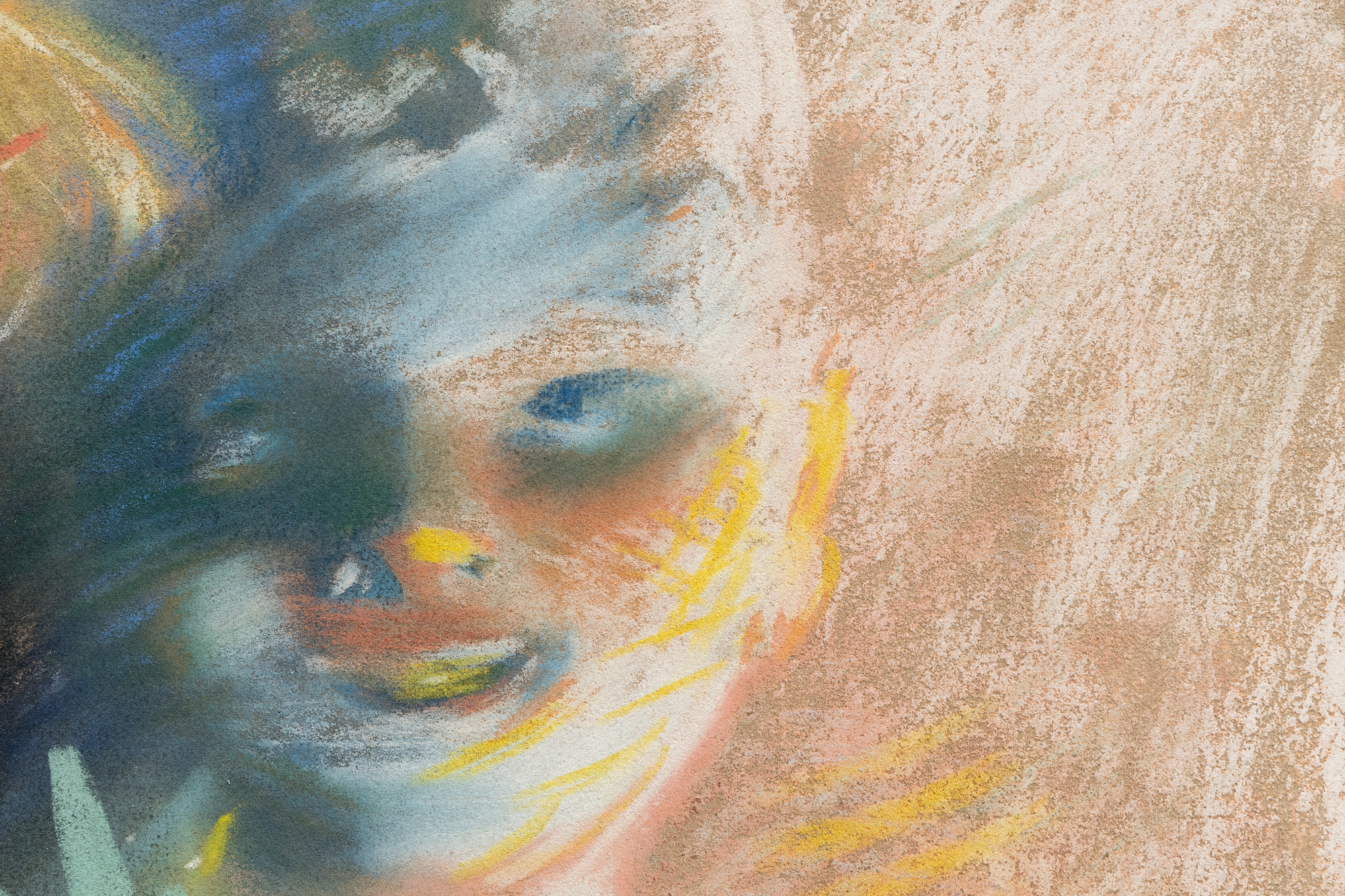
"דיוקן" של ז'ול שרטה הוא ציור פסטל גיר על בד מלא חיים, החושף את הרגישות הציורית שמאחורי האמן הידוע בעיקר כאמן אמנות הפוסטרים בבל אפוק. בקומפוזיציה זו, שתי דמויות נשיות מגיחות מתוך מערבולת של צבע ואור, צורותיהן מתמוססות למשיכות של טורקיז, ורוד וזהב. פני השטח רוטטים מתנועה, ומזכירים את האנרגיה התיאטרלית והזוהר החולף שהגדירו את פריז של סוף המאה. הדמויות, מעוצבות בעדינות אך מונפשות על ידי מחוות גורפות, נראות לכודות באמצע הופעה - בו זמנית אינטימיות ושופעות חיים.


למרות ששרה זכה לתהילה רבה בזכות כרזות הפרסום שלו, הוא הושפע עמוקות מאמני הרוקוקו, ובמיוחד מז'אן-אונורה פרגונאר ואנטואן וואטו. רוח האלגנטיות, החושניות והעיצוב שלהם מחלחלת לעבודה זו, שבה קלילות המגע והברק הכרומטי גוברים על ריאליזם קפדני. אותן תכונות הפכו את כרזותיו הליטוגרפיות התוססות עבור אלדורדו, אולימפיה, פולי ברז'ר, תיאטרון האופרה, אלקזר ד'אטה והמולן רוז' לסמלים האיקוניים של החיים המודרניים בפריז.


הצלחתו של שרֶה בעיצוב פוסטרים סייעה להשיק דור חדש של אמנים, ביניהם שארל ג'סמר ואנרי דה טולוז-לוטרק, וביססה את הפוסטר כמדיום אמנותי לגיטימי. בעוד שהוא זכה להכרה כצייר, היו אלה דימויי הפרסום שלו - בתחילה נוצלו כדי להתפרנס אך מאוחר יותר נמשכו באמונה - שהבטיחו את מורשתו. יצירותיו של שרֶה, שזכו לכבוד בתערוכה לאחר מותו בסלון הסתיו בשנת 1933, מוצגות כיום במוסדות מרכזיים, ביניהם המוזיאון לאמנות מודרנית, מוזיאון ד'אורסיי, מוזיאון ההרמיטאז' ומכון האמנות של שיקגו, מה שמאשר את מקומו המתמשך בהיסטוריה של האמנות המודרנית.
לברר