
Alfred Sisley
(1839–1899)
Artworks by Alfred Sisley

About Alfred Sisley
Alfred Sisley (1839–1899) was an Impressionist landscape painter, born in Paris to affluent expatriate English parents (with French family ties through his grandmother). Though he spent almost his entire life in France, he retained British nationality. Sent to London in 1857 for several years to prepare for a commercial career, he returned to Paris and committed himself to art. In 1862 he entered the atelier of Charles Gleyre, where he met Pierre-Auguste Renoir, Claude Monet, and Frédéric Bazille; within months, the friends left to paint outdoors directly from nature around Paris and the Forest of Fontainebleau.
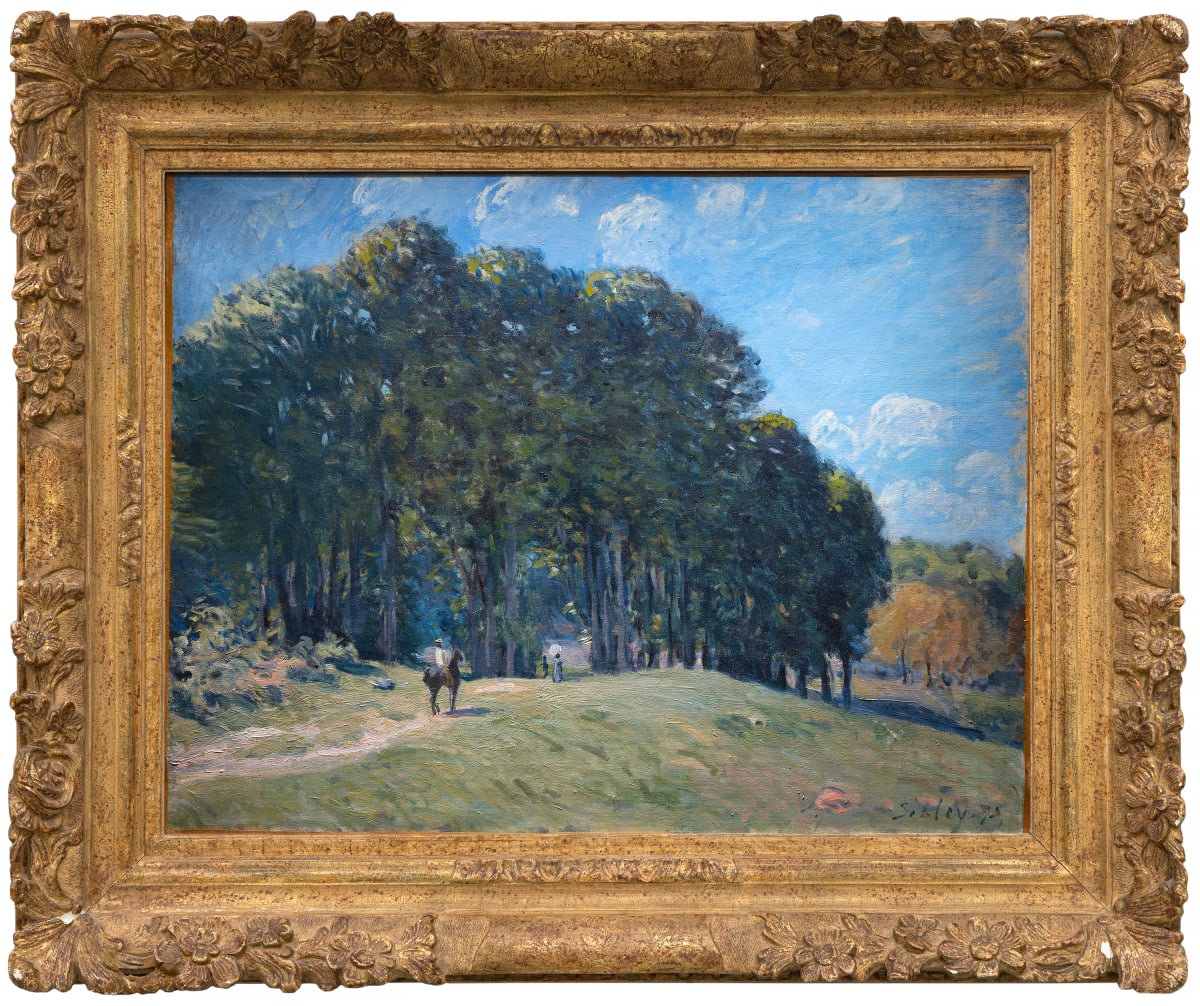
Sisley’s most prolific—and often described as his “golden”—period was the 1870s, when he produced a sustained body of luminous river and village landscapes around Louveciennes, Marly-le-Roi, and other Seine-side suburbs. During these years he refined the calm, structured compositions and subtle tonal harmonies that distinguish his work within Impressionism, balancing fresh, immediate brushwork with a strong underlying sense of order.
He exhibited with the Impressionists in 1874, 1876, 1877, and 1882, yet received little recognition and, after 1871—when his father could no longer support him—lived much of his life in poverty. Even so, he continued working steadily, including periods in Britain (notably around Hampton Court in 1874 and the coast near Cardiff in 1897).
After working in several towns on the outskirts of Paris, Sisley settled near Moret-sur-Loing in the early 1880s, painting many of his late masterpieces there—bridges, towpaths, and riverbanks observed through changing seasons and weather. A solo exhibition at La Vie Moderne in Paris in 1883 was a rare spotlight in his lifetime. He died at Moret-sur-Loing in 1899, long underappreciated, but is now recognized as one of Impressionism’s most consistently poetic landscape painters.