GEORGE INNESS (1825-1894)
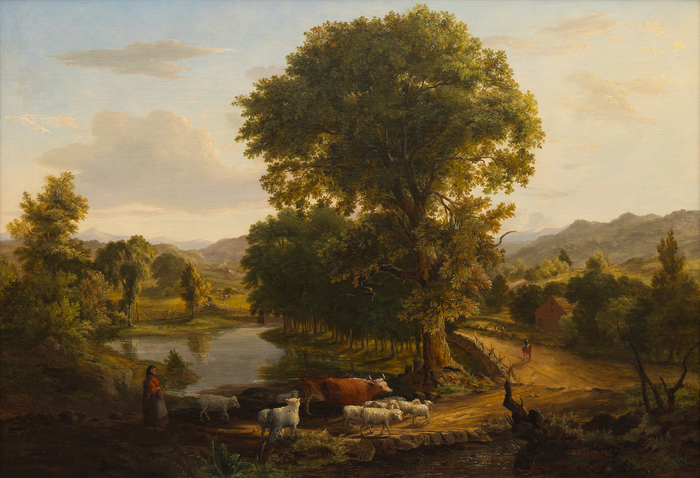 "The poetic quality is not obtained by eschewing any truths of fact or of Nature...Poetry is the vision of reality." – George Inness
George Inness was born in 1825 in Newburgh, New York. He grew up in Newark, New Jersey and knew from an early age that he wanted to be an artist. While working at engraving companies including Currier & Ives, Inness learned composition by studying reproduction of works by Old Master painters Claude Lorrain and Salvator Rosa. He was also introduced to the works of Thomas Cole and Asher Durand and studied under Régis François Gignoux.
In 1851 Inness traveled to Rome and Florence where he came under the influence of philosopher and theologian Emanuel Swedenborg who heavily influenced Inness’s approach to landscape and painting. In this vein, Inness stated that “painters should not glorify nature but, rather, express its hidden spirit and underlying character”. Before returning to New York, Inness passed through Paris where he attended the famed Salon where he encountered painters of the Barbizon School which would prove another important influence on his work. In Inness works under the influence of Swedenborg and the Barbizon School, the viewer thus can see him striving to find a deeper significance in the details of nature rather than a realism or extolment of nature.
Inness was an ardent abolitionist and these themes of freedom and optimism at the close the U.S. Civil War can be found in his paintings of that time. During this time, Inness also turned to teaching and one of his students included Louis Comfort Tiffany. After a longer stint in Europe from 1870-1874, Inness returned to New England and to New Jersey, where he continued to paint and explore the possibilities of landscapes. In 1889, he received a gold medal at the Paris Exposition. In 1894, Inness travelled one last time to Europe where he died in Scotland, supposedly watching the sunset, and was buried in New York. His oeuvre covers some 1,150 paintings, watercolors, and sketches.
“The true use of art is, first, to cultivate the artist's own spiritual nature” – George Inness
ARTWORK