MENU
Heather James
SEARCH


  • Home
  • About
    • Palm Desert
    • Jackson Hole
    • New York
    • London
    • Los Angeles
    • Montecito
    • Consultants
    • Services
  • Viewing Room
  • Artists
    • Artists
    • Categories
  • Artwork
  • Exhibitions
  • Publications
    • Gallery Tours
    • Exhibition Tours
    • Videos
    • Catalogs
  • Learn
    • Art as an Investment
    • Press
    • News
    • Education
  • Sell
  • New Arrivals
  • Contact
  • Advisory
  • Home
  • About
    • Palm Desert
    • Jackson Hole
    • New York
    • London
    • Los Angeles
    • Montecito
    • Consultants
    • Services
  • Viewing Room
  • Artists
    • Artists
    • Categories
  • Artwork
  • Exhibitions
  • Publications
    • Gallery Tours
    • Exhibition Tours
    • Videos
    • Catalogs
  • Learn
    • Art as an Investment
    • Press
    • News
    • Education
  • Sell
  • New Arrivals
  • Contact
  • Advisory


FLORALS FOR SPRING, GROUNDBREAKING

May 8 – November 30, 2023  |  Palm Desert, CA

ARTWORK     ABOUT     INQUIRE     ADDITIONAL RESOURCES     ARTISTS

“I think that nothing is more difficult for a true painter than to paint a rose, since before he can do so, he has first to forget all the roses that were ever painted.” – Henri Matisse

ARTWORK

Florals for Spring, Groundbreaking

May 8, 2023 - August 31, 2024
Palm Desert, CA

“Love Bomb considers the real and the virtual worlds we live in… We live in a world where real news and fake news can often be indistinguishable. To me Love Bomb looks at one of the great questions of the twenty-first century: what is truly real in our lives?” – Marc Quinn

ABOUT

Are flowers in art boring and predictable? Aren’t flower paintings just imitations of nature? In the film The Devil Wears Prada, the iconic Miranda Priestley sarcastically quipped, “Florals? For spring? Groundbreaking.” And after all, until recently in art history, still lifes occupied the lowest tier of art. Yet, flowers have always been a fascinating means for artists to explore deeper questions of humanity. This exhibition reevaluates the role of flowers in art and takes a broader view of their role while also situating them for individual artists.

Portrait of Marc Chagall
Portrait of Marc Chagall, Library of Congress, Prints & Photographs Division, Carl Van Vechten Collection, LC-USZ62-116611
31510
Photograph of Paul Wonner
Mimosa Jan
Donald Sultan, “Mimosa Jan 16 2019”, 2019, oil, tar, enamel, and vinyl on Masonite, Modern Art Museum of Fort Worth

A GERMINATING SEED

Flowers in a Glass Vase with a Tulip
Rachel Ruysch, “Flowers in a Glass Vase with a Tulip”, 1716, oil on canvas, The National Gallery, London
A Bouquet of Flowers
Clara Peeters, “A Bouquet of Flowers”, c. 1612, oil on wood, The Metropolitan Museum of Art, New York
Mask amid bunches of grapes and vines
“Mask amid bunches of grapes and vines” (1st century CE). House of V. Popidius or House of Mosaic Doves, Pompeii

From Ancient Rome and their garden murals to the still lifes of the Dutch Golden Age to Contemporary art, flowers have been symbols layered with meanings and questions. When used as works of art, there is something a bit unnatural about painted flowers, given that these botanic wonders spring from nature. A painted flower “lives” much longer than the organic material. This idea has fascinated artists who mined this gap, whether by grouping flowers and plants that would not normally be in season or bloom at the same time or including nods to the transience of life amongst an immortal painted arrangement.

The flowers themselves can be evocative of the person’s, and by extension their respective nation’s, prosperity and wealth. Each object could trace the trade routes and paths to wealth for the owner. Think forcing flowers in a greenhouse or bringing in exotic orchids. Moreover, there was the Dutch tulip mania of the 1630s. The owner’s wealth could even be expressed in the pigments used (some colors were more expensive than others) or their ability to trick the eye (trompe l’oeil) as in the Roman murals.

Still life paintings were also one of the few ways women could become artists as many were forbidden to study the nude life models. Nevertheless, their still lifes commanded high prices and acclaim. Rachel Ruysch’s works sold for more in her lifetime than Rembrandt’s works did in his and her fame continues to this day.

THE ROOT OF PAINTING

Flowers can be instructive to artists to think about figural structure, composition, color. They provide insight into the basic building blocks of a painting. From there, artists can investigate the essence of painting – the material qualities of the medium, the interplay of color and shape. We can see this in the works of the Impressionist as they painted outdoors (“en plein air”) or with the Bay Area Figurative artists that made representational art the new avant-garde in the face of Abstract Expressionism.

Flowers can even be the inspiration into deeper questions into humanity, into the very essence of being. What do our short lives mean in the grand scheme? Where does humanity fit into the natural world? Floral still lifes are not just pretty pictures but an expression of the artist’s capabilities, to make more real the real objects before them.

Like their spiritual forebears, Nell Walker Warner and Gertrude Jekyll gained acclaim through flowers and plants. Jekyll has been a touchstone for gardeners since the 19th century and Warner has been called “America’s foremost painter of flowers” and “possibly one of the ablest painters of flowers studies America has ever produced.” Perhaps they have not yet achieved their deserved importance because of the “feminine” and “decorative” associations of flowers but this exhibition hopes to move the dial on the conversation of floral still lifes. For more about women and California Impressionists like Walker, visit our exhibition California Here We Come: The California Impressionists.

The Orange Trees
Gustave Caillebotte, “The Orange Trees”, 1878, oil on canvas, The Museum of Fine Arts Houston, Houston
Paul Wonner Studio
Paul Wonner painting a still life in his studio
Cinnerarias and Daffodils
Nell Walker Warner, “Cinnerarias and Daffodils”, c. 1966, oil on canvas, Springville Museum of Art, Springville, Utah
Garden at Munstead Wood
Garden at Munstead Wood designed by Gertrude Jekyll

BLOOMING SUCCESS

Flowers
Andy Warhol, “Flowers” (hand colored), 1974, screenprint with watercolor, Whitney Museum of American Art, New York; a similar work is in our exhibition Florals for Spring, Groundbreaking
Donald Sultan
Portrait of Donald Sultan, Library of Congress, Prints & Photographs Division, © Nancy Lee Katz, LC-DIG-ppss-01497
Lovebomb
Marc Quinn, “Lovebomb”, 2006, stainless steel & laser-printed vinyl, Jupiter Artland, Edinburgh, UK

The exhibition includes artists from the 19th, 20th, and 21st centuries, showing the range of approaches that they have had to flowers. From Impressionism to Abstract Expressionism to Pop Art to Contemporary Art, artists have gone beyond simple but beautiful representations of flowers to investigate the purpose and limits of painting, consumerism, and even the temporality of life.

Some of the most famed floral works are by Pop Art provocateur, Andy Warhol. Warhol’s appropriation of a photograph of flowers radically transformed what could be considered art and for what purpose. Flowers have played a long role in Warhol’s career and the exhibition examines his series of Flowers (hand colored). Warhol drew from a wallpaper catalogue, Interpretive Flower Designs, fascinated by line and composition of the images. The use of a wallpaper catalogue plays on the tension of the natural world and a manmade world. For more about Pop Art, visit our exhibition Pop Art: Can’t Buy My Love.

Donald Sultan was part of the “New Image” movement and is known for his use of unconventional materials to create sculptural paintings. Flowers have also played a role in his body of work. By using unusual materials like tar, Sultan interrogates how these natural wonders have been depicted through history and how to destabilize our understanding of their meaning. Here, the yellow tulip glows against a tar black background, a luminous light of geometric shapes that seems to recall and question the idea of tulips including the Dutch tulip mania.

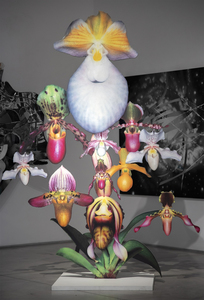
Marc Quinn has been an influential member of the Young British Artists or YBAs. The provocative works by the YBAs look to new radical approaches in art making and Quinn lead the charge in combining art, science, and technology to explore corporeality, decay, and preservation. Still lifes and flowers naturally lend themselves to these explorations. The work in the exhibition seems to turn the idea of Golden Age Dutch still lifes on its ear, creating a riotous collection of exoticism. Approaching the work, we know the impossibility of seeing these flowers together and at this size but their magical transformation seduces us, bluring the lines of reality and fantasy. Quinn proves that flowers are not antiquated subjects of art history but avatars for contemporary concerns:

These are not idle questions but something we have grappled with since ancient times, often with real consequences. After all, Roman Emperor Domitian once served all black food which left his guests fearing that they would be executed. And, Emperor Elagablus was said to have smothered his dinner guests under a blizzard rose petals. Today, we just have other ways to be fooled and other ways to discover the truth.

Flowers for spring? We should be so lucky and with artwork, we can have flowers any time of the year, providing us with beauty and thoughtful examinations of the nature of painting and humanity.

“I always notice flowers.” – Andy Warhol
INQUIRE

Contact Us

ADDITIONAL RESOURCES

Curator of Exhibitions at Appleton Museum of Art, Patricia Tomlinson, discusses Andy Warhol’s “Flowers “
The monumental version of Marc Quinn’s “Lovebomb” that is in our exhibition
The Getty Museum presents how to analyze a still life with works by Jan van Huysum and Man Ray
“The Fruits of Prosperity and Global Trade: Dutch Decorative Arts of the 17th Century” by Thomas Michie, curator at the Museum of Fine Arts, Boston
“A Visit to Emil Nolde’s Garden” from the Royal Academy of Arts
MARC QUINN - Lovebomb - photo laminate on aluminum - 108 1/4 x 71 3/4 x 37 3/4 in.
marc quinn
Inquire
Join List Short Form

CONNECT

Back to Top
© Copyright 2026 Heather James. All Rights Reserved.
  • Privacy Policy
  • Terms and Conditions

Thank you for contacting us!

Would you like to customize your art preferences?

Go to Communication Preferences

Education

Education is of the utmost importance at Heather James Art Advisory. Whether you are a seasoned collector or just beginning, we aim to grow with our clients and believe fully in providing information and insight to help our clients learn and cultivate their art interests.

Curation

Heather James Art Advisory brings decades of curatorial experience with guidance from our Senior Curatorial staff who have organized exhibitions globally at museums, galleries and in private residences. Bringing together aesthetic and art historical elements, we will help your collection and home reflect your artistic interests.

Logistics

HJ Art Advisory provides complete logistics when handling, transporting, and supervising our clients’ artworks. Our oversight involves every aspect of care with the artwork.  We oversee every step of the process with transporting, installing, and storing artworks. We advise on and facilitate framing design, lighting, security requirements, conservation and condition assessment.

Documentation
  • When purchasing artworks, HJ Art Advisory researches the provenance of the artwork and will seek representations and warranties from the seller, that the seller has valid title and that the object is free from any liens, claims and encumbrances.
  • HJ Art Advisory will seek indemnification for a full refund for the artwork in the event of breach of warranty (possibly include this line???).
  • Private Sales and Auction Process: Critical information to capture include:  Artist, Artwork Title, Date, Medium, Dimensions, Price, Image, Offering entity, Provenance, Certificates, Invoice (when possible), Condition report, Liens, Litigation, Ownership Title.
Museum Loans

Heather James has been honored to facilitate loans to top museums across the world including MoMA, the Centre Pompidou, and more. HJ Art Advisory takes care of all the necessary paperwork and logistics for our collectors who decide to lend an artwork to a museum exhibition.

Sales and Acquisitions

HJ Art Advisory is focused on sourcing artworks for potential acquisitions from private sales, auction houses, and artist commissions. HJ Art Advisory continually monitors the private and public market for significant artworks pertaining to our clients’ interests that will enhance their collections. We negotiate the sale or selling price on behalf of a collector in order to achieve the best possible deal for our clients.

Finance
  • HJ Art Advisory assists clients with asset-backed lending, purchasing art for trusts, estate planning. We offer our expertise on art market insights to best position our clients when making decisions for their collection. We work with estates, legal teams, and financial advisors to best support our clients and their goals.
  • Heather James Fine Art is not a registered investment, legal, or tax advisor. All investment and financial opinions expressed by Heather James Fine Art are opinion based on personal research. Past performance is not a guarantee of future return, nor is it necessarily indicative of future performance.
Value & Insurance

HJ Art Advisory group evaluates and appraises art collections for insurance valuation, acquisition, and deaccession. This involves in-depth research of both private and public art market analysis to determine value.

Authentication

HJ Art Advisory maintains the highest standards of due diligence through inquiry, research, and provenance of objects prior to acquisition to determine that clear title can be obtained.  Such research includes, but is not limited to, determining:

  • Ownership history of the object
  • Countries in which the object has been located and when.
  • Exhibition history of the object
  • Publication history of the object
  • Any claims object ownership if they’ve been made
  • Databases of stolen objects relevant to the object
  • The circumstances under which the object is being offered
  • Relevant research sources, including: The ArtLoss Register or other databases.
  • Warranty and indemnification representations from the seller, ensuring the seller has valid title, and the object is free from any liens, claims and encumbrances
  • Nazi/World War II Era research and documentation following guidelines relating to the acquisition of objects likely to have been in German-occupied Europe between 1933 and 1945
Connoisseurship

HJ Art Advisory works with, and on behalf, of clients developing new collections or with well-established collections, providing advice and an in-depth offering of services. Our extensive knowledge and experience along with many years in the art business positions our highly skilled and experienced staff to provide guidance and direction on multiple levels.

Want to know more about this / these works?  Send us a message to let us know your interest.

Inquire - Art Single
  • 日本語
  • 中文 (简体)
  • Deutsch
  • Français
  • Español
  • עברית
  • العربية‏